

The Timurid Empire: Rise, Splendor, and Legacy of Central Asia's Last Great Dynastic Power
Discover the complete history of the Timurid Empire, from Timur's conquests and Samarkand's golden age to its cultural legacy in art, architecture, and Islamic civilization. A comprehensive, expert guide.
EMPIRES/HISTORYHISTORY
Jagdish Nishad
4/16/202617 min read
What Was the Timurid Empire?
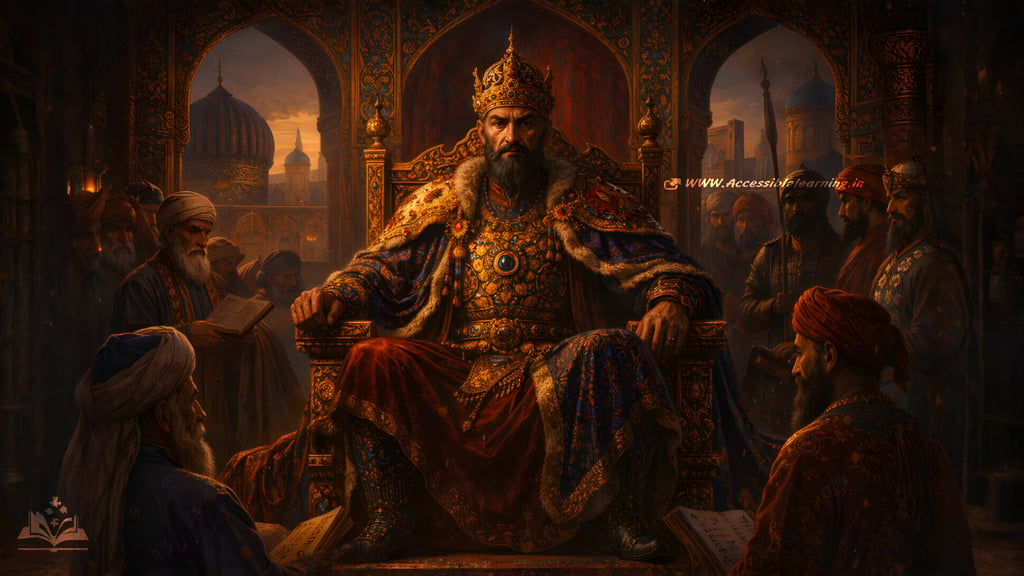
The Timurid Empire was a late medieval Turco-Mongol empire that dominated Central Asia, Persia, and much of the broader Islamic world from approximately 1370 to 1507 CE. Founded by the fearsome warlord Timur, known in the West as Tamerlane, the empire stretched at its height from modern-day Turkey and Syria in the west to northern India and the borders of China in the east.
What makes the Timurid Empire extraordinary is its profound paradox: built through some of history's most brutal military campaigns, it simultaneously gave rise to one of the most magnificent flowerings of Islamic art, architecture, literature, astronomy, and philosophy ever recorded. Scholars today often call this period the Timurid Renaissance, comparing it in cultural ambition and output to the European Renaissance unfolding in parallel on the other side of the known world.
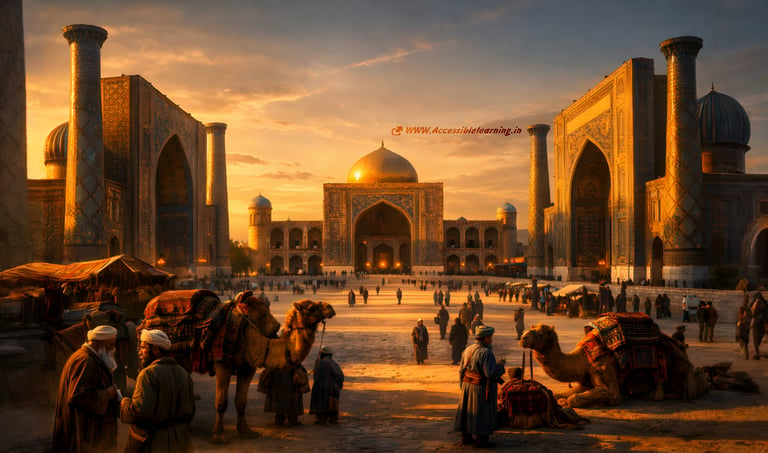
The empire's capital, Samarkand, situated along the legendary Silk Road in present-day Uzbekistan, became one of the wealthiest, most cosmopolitan, and architecturally stunning cities on Earth. Its dazzling mosques, madrasas, and mausoleums still awe visitors centuries later.
The Timurids left a legacy that shaped the entire trajectory of Islamic civilization. Their descendants went on to found the Mughal Empire of the Indian subcontinent, carrying Timurid culture, aesthetics, and governance into a new era and new geography. The Taj Mahal, arguably the most recognized building in the world, is, in a direct cultural lineage, a Timurid architectural heir.
Timur (Tamerlane): The Conqueror Who Remade the World
Who Was Timur?
Timur ibn Taraghay Barlas, born in 1336 CE near the city of Kesh (modern Shahrisabz, Uzbekistan), was the founder of the Timurid dynasty. Of Turco-Mongol origin from the Barlas tribal confederation, Timur fashioned himself as a legitimate successor to the legacy of Genghis Khan, though he was not a direct descendant. To claim Mongol imperial legitimacy, he married into the line of Genghis Khan's descendants and adopted the title Gurkan (son-in-law of the Khan), ruling as a nominal regent rather than Khan outright.
His epithet in the West, Tamerlane, derives from the Persian Timur-e-Lang ("Timur the Lame"), a reference to injuries he sustained in his youth, likely from an arrow wound, that left him with a permanent limp. Far from diminishing him, the name became synonymous with unstoppable power.
Timur's Early Rise to Power
Timur's ascent was neither linear nor inevitable. He rose through the fractured politics of the Chagatai Khanate, the successor state to the Mongol Empire in Central Asia using military genius, cunning alliances, and ruthless betrayal of rivals. By 1370, he had consolidated control over Transoxiana (the land between the Amu Darya and Syr Darya rivers) and declared himself ruler from Samarkand.
The Military Mind of Tamerlane
Timur is widely considered one of the most gifted military commanders in history. His tactical innovations included:
Feigned retreats to lure enemies into disordered pursuit before a devastating counterattack
Psychological warfare towers of skulls built from slaughtered enemies served both as grisly victory monuments and as deliberate terror instruments
Highly mobile cavalry combined with disciplined infantry and sophisticated siege engineering
Intelligence networks that gathered information on enemies' troop dispositions and supply lines in advance
His campaigns were marked by extraordinary speed of movement of, with armies covering distances that conventional military wisdom deemed impossible, combined with adaptive tactical thinking on the battlefield.
Timur and the Paradox of Destruction and Patronage
Timur was a man of staggering contradictions. He ordered massacres of entire cities; Delhi, Baghdad, Isfahan, and Damascus all suffered catastrophic destruction under his campaigns. The death toll from his conquests is estimated in the tens of millions, making him one of the most lethal conquerors in human history by absolute numbers.
And yet, Timur was simultaneously a passionate patron of architecture, scholarship, and the arts. He forcibly relocated the most skilled craftsmen, architects, astronomers, theologians, and poets from conquered cities to Samarkand, transforming his capital into a living treasury of the world's finest talent. His court was intellectually vibrant. He played chess obsessively and was said to engage scholars and clerics in sophisticated theological debate. This paradox of the destroyer who built defines Timur and, by extension, the empire he created.

Founding the Empire: Military Campaigns and Territorial Expansion
Timur's Conquests: A World Reshaped
Over roughly 35 years of continuous campaigning between 1370 and his death in 1405, Timur conquered an empire of staggering size. His major campaigns included
Khorasan and Persia (1380–1387): Timur subdued the fractured successor states of Persia, absorbing the Kartid dynasty, defeating the Muzaffarids, and incorporating the culturally rich cities of Herat, Shiraz, Isfahan, and Tabriz into his domain.
The Golden Horde (1391–1395): Timur delivered a catastrophic defeat to Tokhtamysh, Khan of the Golden Horde, at the Battle of the Kondurcha River (1391) and again at the Battle of the Terek River (1395). These victories permanently broke the power of the Golden Horde and opened the Russian steppe to new political configurations.
Persia and Mesopotamia (1393–1394 and 1400–1401): Timur sacked Baghdad twice and executed tens of thousands of its inhabitants. The Abbasid-era intellectual infrastructure of Iraq was devastated, a blow from which the region took centuries to recover.
India Campaign (1398–1399): Timur invaded the weakened Delhi Sultanate, inflicting a catastrophic defeat on Sultan Mahmud Tughlaq at the Battle of Delhi. He sacked Delhi and departed with enormous plunder, leaving behind devastation so severe that the Delhi Sultanate never fully recovered its former power.
The Levant (1400–1401): Timur captured Aleppo, Damascus, and other Mamluk-controlled cities in Syria and Palestine, removing and destroying priceless relics and craftsmen.
The Ottoman Campaign (1402): In one of history's most dramatic reversals, Timur utterly defeated Bayezid I, the powerful Ottoman Sultan, at the Battle of Ankara (1402). Bayezid was captured and died in captivity. This stunning victory delayed Ottoman expansion in Europe by nearly half a century and allowed the Byzantine Empire, including Constantinople, to survive for another fifty years.
The China Campaign (1404–1405): Timur began his most ambitious campaign yet, a march against the Ming Dynasty of China, but died of fever at Otrar in January 1405 before the campaign could begin.
The Scale of the Empire
At its maximum extent under Timur, the empire covered approximately 4 to 5 million square kilometers, encompassing:
Modern Uzbekistan, Tajikistan, Turkmenistan, and Kazakhstan
Modern Iran, Afghanistan, and much of Pakistan
Iraq, Azerbaijan, Georgia, and Armenia
Parts of Turkey, Syria, and northern India
Samarkand: The Jewel of the Timurid World
A Capital Reborn
Samarkand was already an ancient city of deep historical significance; it had been a major Silk Road hub for over two millennia, but Timur transformed it into something the world had not seen since the height of classical antiquity. He described his ambition with characteristic grandiosity, reportedly saying he wished to build a city so magnificent that people would doubt human hands had made it.
He was not exaggerating his intentions. Samarkand under Timur and his successors became a city of:
Wide, tree-lined boulevards
Lush gardens and artificial water channels
Markets overflowing with goods from China, India, Persia, and Europe
Schools, hospitals, and caravanserais for travelers
Mosques and mausoleums of breathtaking architectural ambition
The Venetian ambassador Ruy González de Clavijo, who visited Samarkand in 1404, wrote one of the most detailed eyewitness accounts of the city at the height of its glory, marveling at its size, wealth, and architectural splendor.
The Great Monuments of Timurid Samarkand
The Registan, arguably the greatest civic architectural ensemble in the Islamic world, anchors the heart of Samarkand. It consists of three monumental madrasas (Islamic schools) arrayed around a central plaza:
Ulugh Beg Madrasa (completed 1420): built by Timur's grandson, the astronomer-king Ulugh Beg
Tilya-Kori Madrasa (1660): though built slightly after the Timurid period, it completes the ensemble in the Timurid spirit
Sher-Dor Madrasa (1636): similarly post-Timurid but completing the square
Bibi-Khanym Mosque: Timur's great congregational mosque, begun in 1399 and completed in 1404. At the time of its completion, it was among the largest mosques in the Islamic world, its dome visible from miles away. Built by craftsmen brought from conquered lands across the empire, it represents the full synthesis of Timurid architectural ambition.
Gur-e-Amir Mausoleum: the tomb of Timur himself, completed in 1404. Its ribbed azure dome made from glazed turquoise tiles became the prototype for a new style of Islamic funerary architecture that would echo across Central Asia and India for centuries. Timur's jade tombstone, said to be the largest piece of carved jade in the world, rests above his burial chamber.
Shah-i-Zinda Necropolis: a stunning avenue of mausoleums built over several centuries for Timurid royalty and nobles, featuring some of the finest tilework and geometric decoration in all of Islamic art.
The Timurid Renaissance: Art, Architecture, and Intellectual Life
What Was the Timurid Renaissance?
The term "Timurid Renaissance" refers to the extraordinary cultural and intellectual flourishing that occurred under the Timurid dynasty, particularly during the reigns of Shah Rukh (r. 1409–1447) at Herat and Ulugh Beg (r. 1411–1449) at Samarkand. This period produced innovations and masterworks across nearly every domain of human knowledge and aesthetic achievement.
Scholars argue that the Timurid Renaissance was not merely derivative of earlier Islamic Golden Age traditions but was a genuine creative renaissance a period of active synthesis, innovation, and expansion across the arts and sciences.
Architecture: The Timurid Style
Timurid architecture represents one of the great achievements in world architecture. Its defining characteristics include:
The double-shell dome: a structural innovation that created an exterior dome of dramatic visual height while maintaining interior proportions suited to human scale. This structural technique, perfected by Timurid builders, would later influence Safavid Persian, Mughal Indian, and even Ottoman Turkish architectural traditions.
Elaborate tile mosaic (kashi tilework): surfaces covered in complex geometric and floral patterns executed in brilliant turquoise, cobalt, white, gold, and green glazed tiles. The technical sophistication of Timurid tilework remains among the finest achievements in the ceramic arts.
Monumental iwan portals: enormous arched gateways framed by minarets, creating compositions of dramatic vertical power.
Integration of calligraphy into architectural ornament: Quranic verses and poetic inscriptions woven seamlessly into tile decoration, merging text and visual art.
Miniature Painting: A New Art Form Reaches Maturity
The Timurid school of miniature painting represents one of the most significant developments in the history of visual art. Centered primarily at the royal workshops of Herat, Timurid painters achieved a synthesis of Chinese, Persian, and indigenous Central Asian artistic traditions that resulted in paintings of extraordinary refinement and visual complexity.
Key features of the Timurid miniature style include:
Rich, saturated colors with extensive use of lapis lazuli blues and gold leaf
Elaborate architectural and landscape backgrounds rendered with meticulous detail
Multiple vanishing points creating a distinctive spatial depth
Exquisitely rendered human figures and animals with individualized expressions
The Herat School, centered around the master painter Kamal ud-Din Behzad (c. 1450–1535), often called the "Raphael of the East," produced works that defined the entire subsequent tradition of Persian and Mughal miniature painting for over two centuries.
Literature and Poetry: The Persian Literary Renaissance
The Timurid court was deeply invested in Persian literary culture. The poet Jami (1414–1492), often called the last great classical Persian poet, produced his masterworks under Timurid patronage at Herat. His works include Haft Awrang (Seven Thrones), Tuhfat al-Ahrar, and the monumental Nafahat al-Uns, a biographical dictionary of Sufi mystics.
Equally significant was the emergence of Chagatai Turkic as a fully literary language under Timurid patronage. Alisher Navoi (1441–1501) poet, statesman, linguist, and close friend of Sultan Husayn Bayqara, created a body of literary work in Chagatai that established it as a vehicle for sophisticated poetic expression. Navoi is considered the father of Uzbek literature and remains one of the greatest literary figures of the Turkic world.
Astronomy and Science: Ulugh Beg's Observatory
Ulugh Beg (1394–1449), Timur's grandson and ruler of Samarkand, was one of the greatest astronomers of the pre-telescopic age. He built the Ulugh Beg Observatory in Samarkand, whose enormous sextant arc, carved into bedrock, measured stellar positions with an accuracy that would not be surpassed for over 150 years in any part of the world.
His star catalogue, Zij-i-Sultani (completed c. 1437), recorded the positions of 1,018 stars with a precision that astonished European astronomers when the work became available to them in the 17th century. Ulugh Beg's measurement of the length of the sidereal year 365 days, 6 hours, 10 minutes, and 8 seconds, was accurate to within approximately 58 seconds of the modern value.
Ulugh Beg's Samarkand was also home to some of the greatest Islamic mathematicians of the era, including Al-Kashi, who contributed to the development of decimal fractions and made significant advances in trigonometry.
Timurid Rulers After Timur: The Dynasty's Golden Successors
The Succession Crisis
Timur died in February 1405 without successfully securing a stable succession, triggering an immediate civil war among his sons and grandsons. The empire fractured, though the Timurid dynasty remarkably survived the chaos and eventually reunified much of its territory under capable rulers.
Shah Rukh (r. 1409–1447)
Shah Rukh, Timur's fourth and youngest son, emerged as the dominant ruler after years of conflict, moving the empire's administrative capital to Herat (in modern Afghanistan) while allowing Samarkand to remain a subsidiary royal seat under his son Ulugh Beg.
Shah Rukh's long reign represented the mature phase of Timurid civilization, a period of relative peace, prosperity, and extraordinary cultural achievement. He fostered a magnificent court at Herat, patronizing painters, poets, calligraphers, and architects. Under his queen, Gawhar Shad, herself a remarkable figure who commissioned some of the most beautiful buildings of the era, including the Gawhar Shad Mosque in Mashhad and the Musalla Complex in Herat, the Timurid court became one of the most cultured in the Islamic world.
Ulugh Beg (r. 1411–1449 in Samarkand; 1447–1449 as overall ruler)
Already discussed for his astronomical achievements, Ulugh Beg was also a complex political figure. As sole ruler of the empire following Shah Rukh's death, he faced rebellion from his own son Abd al-Latif, who had him assassinated in 1449. The act shocked the Islamic world and destabilized the dynasty for decades.
Abu Sa'id (r. 1451–1469)
Abu Sa'id Mirza re-consolidated Timurid rule over much of the empire, but his reign was marked by ongoing dynastic struggles and the growing pressure of external enemies, particularly the Aq Qoyunlu (White Sheep Turkomans) of western Iran.
Sultan Husayn Bayqara (r. 1469–1506)
The last great Timurid ruler, Sultan Husayn Bayqara, presided over the final golden age of the dynasty at Herat. His court, enriched by the literary genius of Alisher Navoi and the painterly brilliance of Behzad produced some of the finest manuscripts, paintings, and architectural works of the entire Timurid era. His reign, however, was beset by dynastic infighting among his numerous sons, fatally weakening the empire's ability to resist external pressure.
Religion, Society, and Governance in the Timurid Era
Religious Identity
The Timurid dynasty was Sunni Muslim, and the faith was central to both the legitimacy of their rule and the patronage culture of their courts. However, the Timurid approach to Islam was notably sophisticated, syncretic, and intellectually engaged rather than rigidly orthodox.
Sufism, the mystical dimension of Islam, was particularly influential at Timurid courts. Major Sufi orders, particularly the Naqshbandiyya, wielded significant spiritual and political influence. Timur himself maintained close relationships with Sufi sheikhs and depicted his conquests as part of a divinely ordained mission, even as the religious justification for his massacres was often deeply problematic.
Timurid rulers were also patrons of madrasa education and formal Islamic scholarship and the great madrasas of Samarkand and Herat produced theologians, jurists, and philosophers of the first rank.
Society and Economy
Timurid society was organized around the interaction of several distinct groups:
The Turco-Mongol military aristocracy: the tribal and clan-based elite that provided military leadership
The Persian administrative class: bureaucrats, secretaries, and scholars who ran the imperial machinery
Urban artisans and merchants: the craft guilds and trading houses of cities like Samarkand, Herat, and Tabriz
The nomadic pastoral populations of the steppe and mountain regions
The Silk Road remained critically important to Timurid prosperity. Samarkand sat at the intersection of the major east-west and north-south trade routes, and Timurid rulers actively encouraged commerce by building caravanserais, maintaining road security, and imposing predictable customs arrangements.
Governance and Administration
The Timurid state combined elements of Mongol customary law (yasa) with Islamic law (sharia) and Persian administrative traditions. The result was a pragmatic synthesis in which Islamic legitimacy was emphasized in public life while Mongol-Turk tribal customs governed military organization and the royal household.
The diwan (administrative department) system inherited from earlier Persian imperial traditions managed taxation, justice, and provincial administration. Governors of major provinces were almost invariably drawn from the Timurid royal family, a practice that maintained dynastic control but also created the perpetual risk of provincial insubordination.
The Decline and Fall of the Timurid Empire
Seeds of Decline
The Timurid Empire's decline was rooted in structural weaknesses that had been present since Timur's death. These included:
Dynastic fragmentation: the Timurid practice of dividing the empire's provinces among male members of the royal family created a permanent tendency toward centrifugal disintegration. Each prince with a territorial base had both the means and often the motivation to challenge the central authority.
Military overextension: the vast empire was difficult to defend against simultaneous threats from multiple directions.
The rise of powerful neighbors: the Aq Qoyunlu in the west, the Uzbek Khanate (Shaybanids) in the north, and the newly rising Safavid dynasty in Persia all posed existential threats to Timurid power in the late 15th century.
The Uzbek Invasion
The decisive blow came from the Shaybanid Uzbeks under Muhammad Shaybani Khan. Descending from the steppes of the Qipchaq plain, the Shaybanids represented a revitalized nomadic military power against which the urbanized, culturally refined Timurid princes could not mount an effective defense.
Between 1500 and 1507, Shaybani Khan systematically conquered the Timurid heartland:
Samarkand fell in 1500
Herat fell in 1507, with the death of the last effective Timurid ruler
The Timurid dynasty in Central Asia was effectively ended. The great libraries were looted or scattered. The brilliant court of Sultan Husayn Bayqara was dissolved.
Babur's Escape and the Seeds of the Mughal Empire
The last gasp of Central Asian Timurid power came from Babur (1483–1530), a Timurid prince who lost Samarkand, a city he loved with almost painful intensity and captured briefly three times, and eventually retreated to Kabul. From there, after decades of struggle, Babur invaded India and founded the Mughal Empire in 1526, decisively defeating Ibrahim Lodi at the Battle of Panipat.
Babur's Baburnama, his autobiography, written in Chagatai Turkic, is one of the greatest personal memoirs in world literature, capturing both his Timurid cultural inheritance and the grief of exile from his ancestral homeland.

The Timurid Legacy: From the Mughal Empire to Modern Memory
The Mughal Empire as Timurid Continuation
The most direct and transformative legacy of the Timurid dynasty was the Mughal Empire (1526–1857) of the Indian subcontinent. Founded by Babur and developed by his successors particularly Humayun, Akbar, Jahangir, Shah Jahan, and Aurangzeb, the Mughal Empire consciously styled itself as the continuation of the Timurid tradition.
Mughal emperors:
Called themselves Gurkani (the Timurid dynastic title)
Maintained the Timurid tradition of sophisticated Persian-language literary culture
Developed a school of miniature painting that directly descended from the Herat School
Built some of the greatest works of world architecture, the Taj Mahal, Humayun's Tomb, Fatehpur Sikri, and the Red Fort in a style that owed its essential vocabulary to Timurid architectural tradition
The ribbed dome of Gur-e-Amir in Samarkand has a direct compositional descendant in the famous white marble dome of the Taj Mahal in Agra.
Impact on Persian Literature and Language
The Timurid period was decisive in establishing Persianate culture as the dominant high-cultural model across the entire Islamic world from Turkey to Bengal. Persian, as the language of literature, administration, philosophy, and courtly life, was a pattern the Timurids both inherited and powerfully reinforced, shaping the cultural identity of dozens of successor states and empires for centuries.
Legacy in Science and Astronomy
Ulugh Beg's observational astronomy was eventually transmitted to European scholars and contributed to the broader project of pre-telescopic celestial cartography. The Zij-i-Sultani was translated into Latin and consulted by European astronomers well into the 17th century.
Modern National Identities
The Timurid legacy is actively claimed by several modern nations:
Uzbekistan has made Timur, referred to as Amir Timur a central figure of national identity since independence in 1991. A large equestrian statue of Timur stands in the central square of Tashkent (replacing a Soviet-era Lenin statue), and the official airline is named Uzbekistan Airways with Timur's image on its livery. The ruins of Samarkand and other Timurid monuments are UNESCO World Heritage Sites.
Tajikistan and Afghanistan both claim elements of the Timurid cultural heritage, particularly the literary and artistic legacy associated with Herat and the Persian-language poetic tradition.
Iran regards the Timurid period as part of its own broader Persian cultural legacy, particularly given that many of the greatest Timurid artistic and literary figures were ethnically Persian or wrote primarily in Persian.
Key Timurid Sites You Can Still Visit
Samarkand, Uzbekistan
Samarkand is a UNESCO World Heritage Site (inscribed in 2001 as "Samarkand Crossroads of Cultures") and home to the greatest concentration of surviving Timurid architecture in the world.
Must-visit monuments:
The Registan: the iconic triple-madrasa plaza, one of the most photographed architectural ensembles in Asia
Gur-e-Amir: Timur's mausoleum, with its famous ribbed azure dome
Bibi-Khanym Mosque: the great congregational mosque, extensively restored
Shah-i-Zinda: the necropolis avenue of exquisite mausoleums
Ulugh Beg Observatory: the excavated remains of the great sextant and a museum on site
Shahrisabz, Uzbekistan
Timur's birthplace is also a UNESCO World Heritage Site. The ruins of the Ak-Saray Palace ("White Palace"), once the most magnificent palace in the Timurid world, with a gate reportedly 70 meters high, are among the most evocative Timurid ruins in Central Asia.
Herat, Afghanistan
Herat, the cultural capital of the Timurid Renaissance under Shah Rukh and Sultan Husayn Bayqara, retains important Timurid monuments despite centuries of conflict. The Musalla Complex (partially surviving), the Friday Mosque (substantially Timurid in fabric), and the Ikhtiyaruddin Citadel are among the key sites. Access conditions vary with the security situation.
Mashhad, Iran
The Gawhar Shad Mosque, commissioned by Shah Rukh's queen in 1418 — is one of the finest surviving works of Timurid architecture outside Central Asia. Located within the vast Imam Reza Shrine complex, it features exceptional tile mosaic decoration.
Why the Timurid Empire Still Matters
The Timurid Empire endures not merely as a chapter in medieval history but as one of humanity's most compelling demonstrations that civilization is not a product of comfort or peace alone; it can emerge, sometimes explosively, even from the crucible of conquest and destruction.
Timur built his world through fire. His successors transformed it through beauty. The mosques, the manuscripts, the star catalogues, the poetry, and the paintings all of it was achieved within living memory of catastrophic violence, and yet all of it pointed not backward toward destruction but forward toward a tradition of refinement and intellectual ambition that shaped cultures from Istanbul to Delhi for centuries to come.
When we stand before the azure dome of Gur-e-Amir in Samarkand, or read the luminous poems of Jami, or trace the visual elegance of a Behzad miniature, we are in the presence of a civilization that chose, repeatedly and deliberately, to make beauty its highest aspiration. That choice made under conditions we can barely imagine is the Timurid Empire's most enduring gift to the world.
Frequently Asked Questions
Q: What was the Timurid Empire?
The Timurid Empire was a Turco-Mongol empire that ruled Central Asia, Persia, and surrounding regions from approximately 1370 to 1507 CE. Founded by Timur (Tamerlane), it was both one of history's most powerful military states and one of its most brilliant centers of Islamic art and culture.
Q: Who founded the Timurid Empire?
The empire was founded by Timur (also known as Tamerlane or Timur the Lame), born in 1336 near Kesh in present-day Uzbekistan. He consolidated control over Central Asia by 1370 and spent the following three and a half decades building an empire through military conquest.
Q: Where was the capital of the Timurid Empire?
The primary capital was Samarkand, in present-day Uzbekistan, where Timur invested enormous resources in monumental architecture and urban development. Under Shah Rukh, administrative functions largely shifted to Herat (in modern Afghanistan), though Samarkand remained the spiritual heart of the dynasty.
Q: What was the Timurid Renaissance?
The Timurid Renaissance refers to the extraordinary flourishing of art, architecture, literature, astronomy, and scholarship under the Timurid dynasty, especially during the 15th century. It is particularly associated with the courts of Shah Rukh at Herat and Ulugh Beg at Samarkand and produced masterworks of Persian poetry, miniature painting, Islamic architecture, and pre-telescopic astronomy.
Q: How did the Timurid Empire fall?
The empire fell primarily due to persistent dynastic fragmentation, with Timurid princes fighting each other for regional power, which fatally weakened collective military capacity. The decisive blow came from the Shaybanid Uzbeks under Muhammad Shaybani Khan, who conquered Samarkand in 1500 and Herat in 1507, ending Timurid rule in Central Asia. The surviving Timurid prince Babur subsequently founded the Mughal Empire in India.
Q: What is the connection between the Timurid Empire and the Mughal Empire?
The connection is direct and genealogical. Babur, the founder of the Mughal Empire, was a Timurid prince, a descendant of Timur on his father's side and of Genghis Khan on his mother's side. After being driven from Central Asia by the Uzbeks, Babur conquered northern India and established the Mughal dynasty in 1526. The Mughals consciously maintained Timurid cultural and artistic traditions, which is why Mughal architecture, painting, and court culture so closely resemble their Timurid predecessors.
Q: Who was Ulugh Beg, and why is he important?
Ulugh Beg (1394–1449) was Timur's grandson and ruler of Samarkand, most famous as a pioneering astronomer. He built the Ulugh Beg Observatory, one of the finest pre-telescopic astronomical instruments in the world, and compiled the Zij-i-Sultani, a star catalogue of 1,018 stars accurate to within roughly one minute of arc. His measurement of the length of the sidereal year was accurate to within 58 seconds of the modern value, a remarkable achievement for the 15th century.
Q: What language did the Timurid court use?
The Timurid court was primarily Persian-speaking in its literary and administrative culture. Persian was the language of high culture, poetry, historiography, and formal correspondence throughout the Islamic world. However, Chagatai Turkic (an ancestor of modern Uzbek) was also used, and the great poet Alisher Navoi elevated it to a major literary language. Administrative documents were also produced in Arabic.
Q: Did women play any role in the Timurid court?
Yes, Timurid royal women held significant cultural and, at times, political influence. Gawhar Shad, the wife of Shah Rukh, was one of the most important architectural patrons of the era, commissioning the Gawhar Shad Mosque in Mashhad and the Musalla Complex in Herat. She effectively served as a co-ruler alongside her husband and exercised considerable political influence until her execution in 1457.
Q: Is Samarkand a UNESCO World Heritage Site?
Yes. Samarkand was inscribed as a UNESCO World Heritage Site in 2001 under the title "Samarkand Crossroads of Cultures." The site encompasses the major Timurid and later monuments of the city, including the Registan, Gur-e-Amir, Bibi-Khanym Mosque, and the Shah-i-Zinda necropolis.
Q: How large was the Timurid Empire at its height?
At its maximum extent under Timur (roughly 1400–1405), the empire covered approximately 4 to 5 million square kilometers, encompassing modern Uzbekistan, Tajikistan, Turkmenistan, Kazakhstan, Iran, Afghanistan, Pakistan, Iraq, Azerbaijan, Georgia, Armenia, and parts of Turkey, Syria, and northern India.
Q: What is Timur's legacy in modern Uzbekistan?
In post-Soviet Uzbekistan, Timur (Amir Timur) has been rehabilitated as the supreme national hero and symbol of Uzbek civilizational achievement. A large equestrian statue of him stands in the center of Tashkent. His image appears on currency, public buildings, and official imagery. The government has actively promoted Timurid heritage through the restoration of monuments and international cultural diplomacy.
Subscribe To Our Newsletter
All © Copyright reserved by Accessible-Learning Hub
| Terms & Conditions
Knowledge is power. Learn with Us. 📚

