

The Mughal Empire: A Comprehensive Guide to India's Most Magnificent Dynasty (1526-1857)
Discover the Mughal Empire's 331-year reign over India (1526-1857): from Babur's conquest to architectural marvels like the Taj Mahal. Explore how Mughal emperors shaped South Asian culture, administration, art, and cuisine—leaving a legacy that influences 1.8 billion people today. Learn about Akbar's religious tolerance, Shah Jahan's building genius, and the empire's dramatic decline.
HISTORY & CIVILIZATIONS
---
2/14/20269 min read
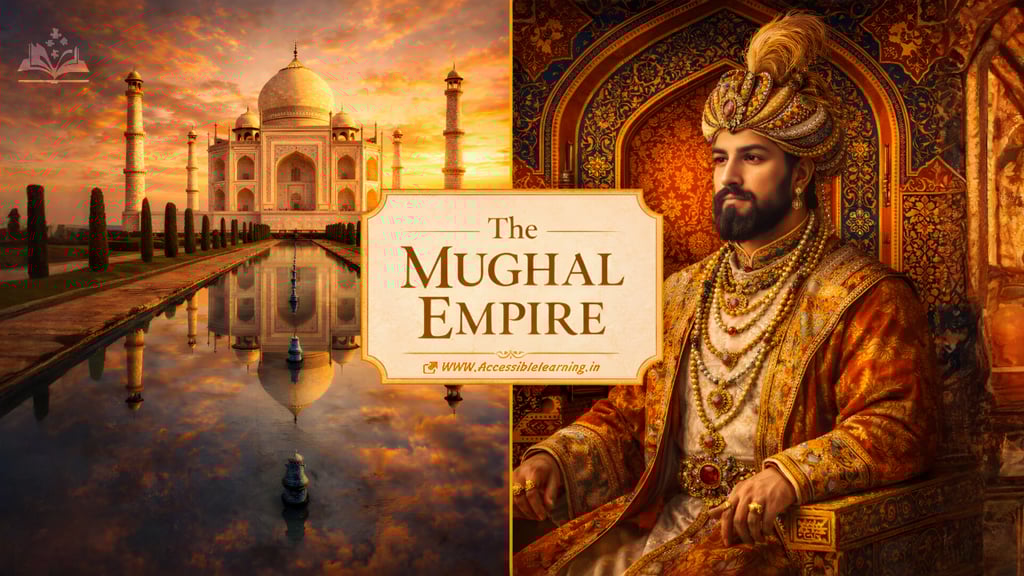
The Mughal Empire stands as one of history's most culturally rich and administratively sophisticated civilizations. For over three centuries, Mughal emperors ruled vast territories across the Indian subcontinent, creating an enduring legacy of art, architecture, administration, and cultural synthesis that continues to shape South Asia today.
What Was the Mughal Empire?
The Mughal Empire was a powerful Islamic dynasty that ruled large parts of the Indian subcontinent from 1526 to 1857. Founded by Babur, a descendant of both Timur and Genghis Khan, the empire reached its zenith under emperors like Akbar, Jahangir, Shah Jahan, and Aurangzeb, controlling approximately 4 million square kilometers at its peak and governing nearly 150 million people—about a quarter of the world's population at that time.
The term "Mughal" derives from "Mongol," reflecting Babur's Mongol ancestry through his mother's lineage, though the empire's culture was predominantly Persian-influenced with strong Central Asian, Indian, and Islamic elements.
The Foundation: How Did Babur Establish the Mughal Empire?
Babur's Conquest and the First Battle of Panipat (1526)
Zahir-ud-din Muhammad Babur, born in 1483 in Fergana (present-day Uzbekistan), was a military genius and cultured ruler who combined Timurid administrative traditions with innovative battlefield tactics. After losing his ancestral kingdom in Central Asia to the Uzbeks, Babur turned his attention to India.
The First Battle of Panipat on April 21, 1526, marked the empire's dramatic beginning. Babur's force of approximately 12,000 troops faced Ibrahim Lodi's massive army of 100,000 soldiers and 1,000 elephants. Despite overwhelming numerical disadvantage, Babur employed revolutionary tactics:
Tulughma: A Central Asian tactic involving flanking movements
Artillery warfare: One of the first major uses of gunpowder weapons in Indian warfare
Wagon fortifications: Creating mobile defensive positions
Babur's victory established Mughal rule in North India, though he ruled for only four years before his death in 1530.
Who Were the Great Mughal Emperors?
Humayun (1530-1540, 1555-1556): The Interrupted Reign
Babur's son Humayun faced immediate challenges from Afghan ruler Sher Shah Suri, who defeated him in 1540, forcing Humayun into 15 years of exile in Persia. During this period, Sher Shah implemented administrative reforms that later Mughal emperors would adopt, including the Grand Trunk Road and standardized currency.
Humayun regained his throne in 1555 with Persian support but died in 1556 from injuries sustained falling down the stairs of his library—a death his chroniclers described as poetically fitting for a scholarly emperor.
Akbar the Great (1556-1605): The Architect of Mughal Greatness
Jalaluddin Muhammad Akbar, ascending the throne at age 13, transformed the Mughal Empire into a sophisticated, administratively advanced state. His reign is considered the golden age of Mughal rule for several reasons:
Administrative Innovations
Akbar created the Mansabdari system, a military and civil administrative structure where officials (mansabdars) were assigned ranks (mansabs) determining their salary and military obligations. This system:
Prevented hereditary aristocracy from gaining excessive power
Ensured loyalty to the emperor rather than regional powers
Created a merit-based promotion structure
Integrated diverse ethnic and religious communities into governance
Religious Policy and Cultural Synthesis
Akbar's Sulh-i-Kul (universal peace) policy promoted religious tolerance unprecedented in contemporary empires. His initiatives included:
Abolishing the jizya tax on non-Muslims in 1564
Promoting interfaith dialogue through the Ibadat Khana (House of Worship)
Marrying Rajput princesses to create political alliances while respecting Hindu customs
Attempting to create Din-i-Ilahi, a syncretic faith combining elements of various religions
Territorial Expansion
Under Akbar, the empire expanded dramatically, incorporating:
Gujarat (1573)
Bengal (1576)
Kashmir (1586)
Kandahar (1595)
Parts of the Deccan plateau
Jahangir (1605-1627): The Aesthetic Emperor
Nur-ud-din Muhammad Salim, who took the title Jahangir ("World Seizer"), was known for his refined aesthetic sensibilities and patronage of arts, particularly Mughal miniature painting. His reign saw:
The flourishing of Mughal painting to unprecedented artistic heights
Increased European trade and diplomatic relations
Significant influence of his wife, Nur Jahan, in state affairs
Continued territorial consolidation
Shah Jahan (1628-1658): The Master Builder
Shah Jahan's reign represents the architectural zenith of the Mughal Empire. His building projects showcase the empire's wealth and artistic sophistication:
The Taj Mahal: Monument to Eternal Love
Built between 1632 and 1653 in Agra, the Taj Mahal remains the most recognizable symbol of Mughal architecture. Commissioned as a mausoleum for Shah Jahan's beloved wife, Mumtaz Mahal, who died during childbirth, this UNESCO World Heritage Site exemplifies:
Perfect symmetry in Indo-Islamic architecture
Intricate marble inlay work (pietra dura) featuring semi-precious stones
Advanced engineering for earthquake resistance
Integration of Persian, Turkish, and Indian architectural elements
Other Architectural Masterpieces
Red Fort, Delhi: The empire's primary residence and administrative center
Jama Masjid, Delhi: One of India's largest mosques
Shalimar Gardens, Lahore: Persian-style terraced gardens
Peacock Throne: A legendary throne encrusted with precious stones (later looted by Nadir Shah of Persia in 1739)
Aurangzeb (1658-1707): The Controversial Expansionist
Alamgir Aurangzeb's 49-year reign was the longest in Mughal history and remains historically contested. He expanded the empire to its greatest territorial extent, controlling most of the Indian subcontinent, but his policies also sowed seeds of future decline:
Territorial Peak
By 1700, the Mughal Empire encompassed approximately 4 million square kilometers, stretching from Kabul to Chittagong and from Kashmir to Kaveri.
Religious Policy Shift
Unlike his predecessors, Aurangzeb adopted stricter Islamic policies:
Reimposed the jizya tax on non-Muslims in 1679
Destroyed some Hindu temples while also patronizing others
Reduced Hindu representation in high administrative positions
Banned certain Hindu festivals and practices
Military Campaigns
His prolonged Deccan campaigns (1681-1707) drained imperial resources while facing fierce resistance from Maratha forces under Shivaji and later his successors.

What Made Mughal Administration So Effective?
The Mansabdari System Explained
The Mansabdari system operated on two numerical designations:
Zat: Personal rank determining salary and status
Sawar: Number of cavalry the mansabdar maintained
This dual system allowed flexibility in assigning military versus civil responsibilities. Mansabdars received jagirs (land revenue assignments) rather than ownership, preventing feudalization while ensuring the empire could reassign territories based on loyalty and competence.
Revenue Administration
Akbar's finance minister Todar Mal implemented the Zabt system of land revenue assessment:
Land surveyed and classified by fertility
Revenue fixed as one-third of agricultural produce
Peasants could pay in cash or kind
Ten-year settlement provided stability for farmers
This system generated enormous revenue, making the Mughal Empire one of the world's wealthiest states, controlling approximately 25% of global GDP at its peak.
Provincial Governance
The empire was divided into subahs (provinces), each administered by a subahdar (governor). The subahdar controlled:
Military forces in the province
Revenue collection
Law and order
Justice administration
A system of checks and balances prevented excessive provincial autonomy, with separate officials reporting directly to the emperor on revenue and military matters.
How Did Mughal Culture Shape South Asian Civilization?
Language and Literature
The Mughal court promoted Persian as the official language while also patronizing
Urdu: Emerged from the interaction between Persian, Arabic, and local languages
Regional languages: Court patronage for Hindi, Bengali, and other vernaculars
Translation projects: Sanskrit texts translated into Persian
Notable literary figures included:
Abul Fazl: Author of Akbarnama and Ain-i-Akbari
Abdul Qadir Bedil: Renowned Persian poet
Tulsidas: Received Mughal patronage for Ramcharitmanas
Mughal Miniature Painting
Mughal painting synthesized Persian miniature traditions with Indian artistic sensibilities, creating a distinctive style characterized by:
Realistic portraiture and naturalistic depiction
Rich color palettes using natural pigments
Detailed illustrations of court life, battles, and nature
Individual artistic styles within court workshops
Master artists like Basawan, Daswanth, and Mansur created works that influenced South Asian visual arts for centuries.
Culinary Legacy
Mughal cuisine introduced sophisticated cooking techniques and dishes that define Indian gastronomy:
Biryani: Layered rice and meat preparation
Korma: Rich, creamy curries
Kebabs: Various grilled meat preparations
Mughlai cuisine: Characterized by rich sauces, dried fruits, nuts, and aromatic spices
The Mughal emphasis on elaborate presentation and refined flavors established haute cuisine traditions in South Asia.
Architectural Innovation
Mughal architecture represents the synthesis of Persian, Central Asian, and Indian building traditions:
Key Characteristics:
Large bulbous domes
Tall minarets
Intricate jali (lattice) work
Charbagh (four-garden) layouts
Red sandstone and white marble construction
Pietra dura (stone inlay) decoration
Major Monuments:
Humayun's Tomb, Delhi (1570)
Fatehpur Sikri complex (1571-1585)
Agra Fort (reconstructed under Akbar)
Lahore Fort
Badshahi Mosque, Lahore
Why Did the Mughal Empire Decline?
Internal Factors
Aurangzeb's Policy Reversal: His departure from Akbar's religious tolerance alienated significant portions of the population, particularly Hindu Rajput allies and newly prosperous merchant classes.
War of Succession: The Mughal tradition of dividing the empire among princes led to devastating civil wars after each emperor's death, weakening central authority.
Administrative Inefficiency: The mansabdari system became increasingly corrupt, with positions sold to the highest bidder rather than awarded based on merit.
Jagirdari Crisis: Shortage of available land revenue assignments created discontent among mansabdars, reducing their loyalty and effectiveness.
External Pressures
Maratha Resistance: Shivaji Maharaj established an independent Maratha kingdom in 1674, and his successors expanded Maratha power throughout the 18th century, extracting tribute from Mughal territories.
Nadir Shah's Invasion (1739): The Persian emperor's sack of Delhi demonstrated Mughal military weakness, with the looting of the Peacock Throne and Koh-i-Noor diamond symbolizing the empire's decline.
Afghan Invasions: Ahmad Shah Durrani's repeated invasions further weakened Mughal authority in northwestern India.
European Colonial Powers: The British East India Company gradually assumed control over Indian territories, initially as tax collectors and later as de facto rulers.
How Did British Colonialism End Mughal Rule?
The Battle of Plassey (1757)
Robert Clive's victory over the Nawab of Bengal marked the beginning of British territorial control in India, though the Mughal emperor remained the nominal sovereign.
Dual Government in Bengal
The Company received the diwani (revenue collection rights) of Bengal, Bihar, and Orissa in 1765, gaining enormous wealth while leaving administration to the Mughal-appointed nawab—creating a system where the Company collected revenue without administrative responsibility.
The Indian Rebellion of 1857
Also called the First War of Independence or Sepoy Mutiny, this uprising against British rule saw rebels proclaim Bahadur Shah II as emperor of India. The rebellion's suppression led to:
British Crown assuming direct control from the East India Company
Formal abolition of the Mughal Empire
Exile of Bahadur Shah II to Rangoon, where he died in 1862
The last Mughal emperor died as a pensioner of the British government, marking the definitive end of a dynasty that had shaped South Asian civilization for over three centuries.


What Is the Mughal Empire's Lasting Legacy?
Cultural Synthesis
The Mughal Empire created a unique Indo-Islamic culture that continues to define South Asian identity:
Architectural traditions influencing modern buildings
Culinary heritage forming the basis of regional cuisines
Urdu language spoken by hundreds of millions
Administrative concepts influencing modern governance
Artistic traditions in miniature painting, calligraphy, and textile design
Economic Impact
At its peak around 1700, the Mughal Empire produced approximately 25% of world GDP, primarily through:
Textile manufacturing (muslin, silk, cotton)
Agricultural production
Trade in spices, indigo, and luxury goods
Sophisticated banking and financial systems
Political Legacy
Mughal administrative innovations influenced:
British colonial administration in India
Modern bureaucratic structures in South Asian nations
Land revenue systems continuing into the 20th century
Concepts of secular, multi-religious governance
Monuments and Tourism
Mughal architectural heritage generates billions in tourism revenue annually, with the Taj Mahal alone attracting 7-8 million visitors yearly, making it one of the world's most visited monuments.
The Mughal Empire's Historical Significance
The Mughal Empire represents one of history's most remarkable examples of cultural synthesis, administrative innovation, and artistic achievement. From Babur's audacious conquest to the empire's gradual dissolution under British colonialism, the Mughals shaped South Asian civilization in ways that remain visible today.
Their legacy transcends mere political history, encompassing:
Architectural marvels recognized worldwide
Administrative systems that influenced modern governance
Cultural traditions defining regional identity
Economic structures that made India one of the world's wealthiest regions
Artistic innovations across painting, literature, music, and crafts
Understanding the Mughal Empire provides essential context for comprehending contemporary South Asia, the region's religious and cultural diversity, its architectural heritage, and the historical foundations of modern India, Pakistan, and Bangladesh. The empire's successes and failures offer valuable lessons about governance, cultural integration, religious tolerance, and the complex dynamics between indigenous and foreign ruling dynasties.
As we examine this remarkable dynasty over four centuries after its zenith, the Mughal Empire continues to fascinate historians, inspire artists, and attract millions of visitors to its enduring monuments—testament to an empire that, while politically extinct, remains culturally immortal.


Frequently Asked Questions
Q: Who founded the Mughal Empire, and when?
Babur founded the Mughal Empire in 1526 after defeating Ibrahim Lodi at the First Battle of Panipat. A descendant of Timur and Genghis Khan, Babur established the dynasty that would rule most of the Indian subcontinent for over 300 years.
Q: Which Mughal emperor built the Taj Mahal?
Shah Jahan commissioned the Taj Mahal between 1632 and 1653 as a mausoleum for his wife, Mumtaz Mahal, who died giving birth to their 14th child. This architectural masterpiece took approximately 20,000 artisans to complete and remains one of the world's most recognizable monuments.
Q: How large was the Mughal Empire at its peak?
At its territorial zenith under Aurangzeb around 1700, the Mughal Empire controlled approximately 4 million square kilometers, encompassing most of the Indian subcontinent and governing nearly 150 million people—roughly one-quarter of the world's population at that time.
Q: What language did the Mughals speak?
The Mughal court primarily used Persian as the official administrative and literary language. However, the emperors were multilingual, often speaking Chagatai Turkish (their ancestral language), Arabic, and various Indian languages. The interaction between Persian and local languages eventually created Urdu.
Q: Who was the greatest Mughal emperor?
Most historians consider Akbar the Great (1556-1605) the most accomplished Mughal emperor due to his administrative innovations, military conquests, religious tolerance policies, and cultural patronage that established the empire's foundations for long-term success.
Q: Why did the Mughal Empire fall?
The Mughal Empire declined due to multiple factors: Aurangzeb's expensive military campaigns and religious policies that alienated allies, succession wars that weakened central authority, Maratha and Afghan military challenges, administrative corruption, and ultimately British colonial expansion that replaced Mughal authority with Company rule.
Q: What was Akbar's religious policy?
Akbar practiced Sulh-i-Kul (universal peace), promoting religious tolerance through abolishing discriminatory taxes on non-Muslims, encouraging interfaith dialogue, marrying across religious lines for political alliances, and respecting diverse religious practices. This policy helped integrate the empire's religiously diverse population.
Q: When did the Mughal Empire officially end?
The Mughal Empire officially ended in 1857 when the British exiled the last emperor, Bahadur Shah II, following the Indian Rebellion. Though the empire had lost real power decades earlier, this marked the formal abolition of the dynasty.
Q: What is the Mansabdari system?
The Mansabdari system was a military-civil administrative structure created by Akbar where officials received numerical ranks (mansabs) determining their salary, military obligations, and status. This prevented hereditary aristocracy while ensuring loyalty to the emperor through merit-based advancement.
Q: How did Mughal architecture influence India?
Mughal architecture created a distinctive Indo-Islamic style combining Persian, Central Asian, and Indian elements. This legacy includes iconic monuments like the Taj Mahal, Red Fort, and Jama Masjid, while architectural principles like symmetry, garden layouts, and decorative techniques continue influencing South Asian building design.
Subscribe to Frontier Intelligence
All © Copyright reserved by Accessible-Learning Hub
| Terms & Conditions
Accessible Learning Hub — Actionable clarity for high-agency minds.
Weekly breakdowns on AI breakthroughs, capital flow, and human performance systems. Zero fluff.