

The Delhi Sultanate: Complete History of India's Five Islamic Dynasties (1206-1526)
Explore the Delhi Sultanate (1206-1526): five dynasties that shaped medieval India through military prowess, architectural innovation, and Indo-Islamic cultural fusion.
INDIAN HISTORYEMPIRES/HISTORYHISTORY
Jagdish Nishad
2/27/20268 min read
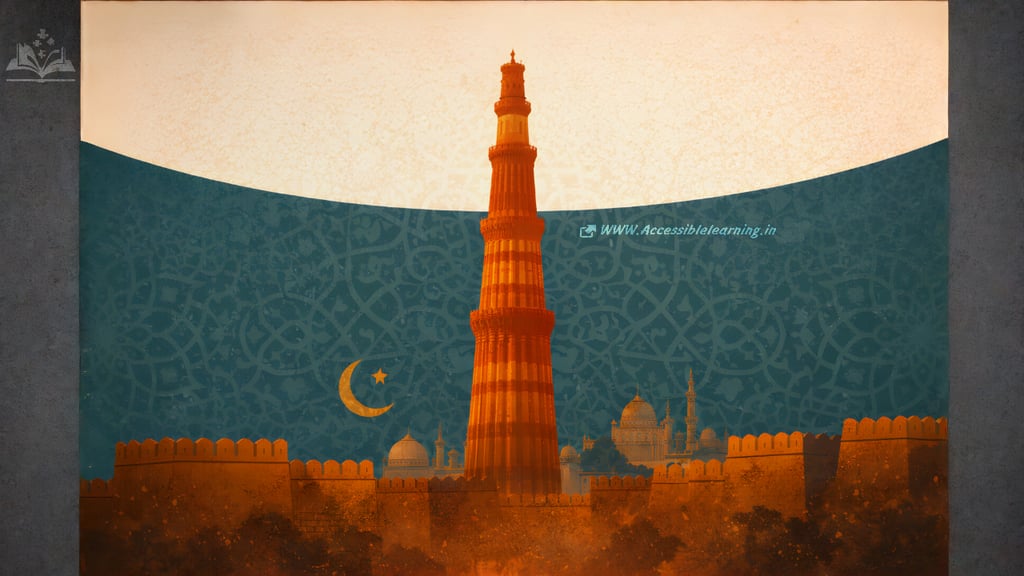
The Delhi Sultanate represents one of the most transformative periods in Indian history—a 320-year span when five successive dynasties ruled from Delhi, fundamentally reshaping the subcontinent's political, cultural, and architectural landscape. This article explores how Turkish and Afghan rulers established the first major Islamic empire in India, creating a legacy that continues to influence South Asian culture today.
What Was the Delhi Sultanate?
The Delhi Sultanate was a series of five Muslim dynasties that ruled large parts of the Indian subcontinent from 1206 to 1526 CE. Established by Qutb al-Din Aibak, a former slave-general of Muhammad Ghori, this empire marked the beginning of sustained Islamic political power in India. The Sultanate served as a bridge between the Central Asian Turkic-Persian Islamic world and the Indian subcontinent, creating a unique Indo-Islamic cultural synthesis.
Geographic Extent and Territory
At its zenith under Muhammad bin Tughluq (1325-1351), the Delhi Sultanate controlled territories extending from Bengal in the east to Gujarat in the west, and from the Himalayas in the north to the Deccan plateau in the south. However, territorial control fluctuated significantly across different dynasties, with periods of expansion followed by fragmentation and loss of peripheral regions.
The Five Dynasties of the Delhi Sultanate
The Mamluk (Slave) Dynasty (1206-1290)
The foundation of the Sultanate began with the Mamluk Dynasty, also called the Slave Dynasty because its founders were originally military slaves (mamluks) who rose through military prowess.
Key Rulers:
Qutb al-Din Aibak (1206-1210): Founded the dynasty and began construction of the Qutb Minar, now a UNESCO World Heritage Site
Iltutmish (1211-1236): Consolidated the Sultanate, introduced the silver tanka and copper jital coins, and organized the famous "Forty" (Chalisa) - a group of Turkish nobles
Razia Sultana (1236-1240): The first and only female Muslim ruler of Delhi, who faced opposition from nobles due to gender prejudices despite her capable administration
Ghiyas ud-din Balban (1266-1287): Strengthened royal authority through strict administration and the doctrine of kingship based on Persian ideals
The Khalji Dynasty (1290-1320)
The Khaljis, of Turko-Afghan origin, brought military expansion and administrative reforms.
Key Rulers:
Jalal ud-din Khalji (1290-1296): Founded the dynasty with relatively mild policies
Alauddin Khalji (1296-1316): Perhaps the most powerful Sultan, he implemented revolutionary market control regulations, conquered Gujarat, Ranthambore, and Chittor, and successfully repelled multiple Mongol invasions. His ambitious Deccan campaigns extended Sultanate influence southward
The Tughluq Dynasty (1320-1414)
The Tughluqs represented a period of ambitious experiments and eventual decline.
Key Rulers:
Ghiyas ud din Tughluq (1320-1325): Founded the dynasty and focused on agricultural development
Muhammad bin Tughluq (1325-1351): Known for innovative but often impractical administrative experiments, including shifting the capital from Delhi to Daulatabad, introducing token currency, and ambitious expansion attempts
Firoz Shah Tughluq (1351-1388): Focused on public welfare, building canals, gardens, hospitals, and establishing the practice of imposing jizya (tax on non-Muslims) more systematically
The Sayyid Dynasty (1414-1451)
This dynasty ruled over a much-diminished Sultanate, controlling little beyond Delhi and surrounding regions as provincial governors declared independence.
The Lodi Dynasty (1451-1526)
The last dynasty of the Delhi Sultanate consisted of Afghan Lodi Pashtuns.
Key Rulers:
Bahlul Lodi (1451-1489): Consolidated power in northern India
Sikandar Lodi (1489-1517): Extended control and founded Agra
Ibrahim Lodi (1517-1526): The last Sultan, defeated by Babur at the First Battle of Panipat in 1526, marking the end of the Sultanate and the beginning of the Mughal Empire
Administrative System and Governance
Central Administration
The Sultan stood at the apex of the administrative hierarchy, wielding both temporal and religious authority. Key administrative positions included:
Wazir (Prime Minister): Head of civil administration and revenue
Ariz-i-Mumalik: Head of military department
Dabir-i-Khas: Head of royal correspondence
Barid-i-Mumalik: Head of intelligence and postal system
Provincial Administration
The empire was divided into iqtas (provinces) governed by muqtis or iqtadars who collected revenue and maintained military forces. This iqta system served as both an administrative and military mechanism, where officials received revenue assignments rather than fixed salaries.
Military Organization
The Sultanate maintained a standing army composed primarily of cavalry, with Turkish and Afghan soldiers forming the core. Alauddin Khalji introduced the dagh (branding of horses) and chehra (descriptive roll of soldiers) systems to prevent fraud in military administration—innovations later adopted by the Mughals.
Economic Policies and Trade
Revenue and Taxation
Land revenue formed the primary source of income, typically ranging from one-third to one-half of agricultural produce. The Sultanate also collected:
Jizya: Tax on non-Muslims
Kharaj: Land tax
Zakat: Islamic religious tax on Muslims
Customs duties: On trade and commerce
Market Regulations
Alauddin Khalji's market control system stands out as particularly innovative. He fixed prices of essential commodities, established shahna-i-mandi (market superintendents), and created an elaborate spy network to prevent hoarding and black marketing. These regulations ensured stable prices to support his large army at affordable costs.
Trade and Commerce
The Delhi Sultanate maintained active trade connections with Central Asia, Persia, Arabia, and Southeast Asia. Major exports included textiles, spices, and precious stones, while imports consisted of horses (crucial for military strength), luxury goods, and raw materials. The introduction of standardized coinage facilitated commercial transactions across the empire.
Cultural and Architectural Contributions
Indo-Islamic Architecture
The Delhi Sultanate period witnessed the birth of Indo-Islamic architecture—a fusion of Islamic architectural principles with Indian decorative traditions and building techniques.
Architectural Innovations:
Introduction of arches, domes, and minarets to Indian architecture
Use of mortar and cement in construction
Development of the true arch and dome (as opposed to corbelled arches used earlier)
Major Architectural Monuments:
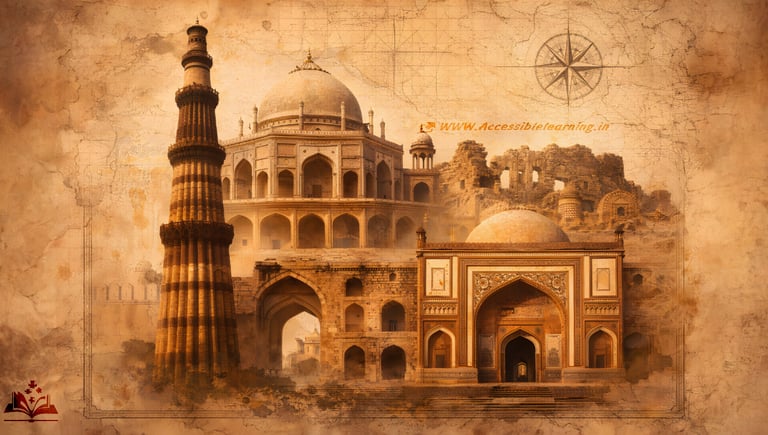
Qutb Minar Complex: Including the Qutb Minar (world's tallest brick minaret at 72.5 meters), Quwwat-ul-Islam Mosque, and Iron Pillar
Alai Darwaza: Gateway known for its architectural sophistication
Tomb of Ghiyas ud-din Tughluq: Pioneering example of Tughluq architecture
Tughlaqabad Fort: Massive fortification built by Ghiyas ud-din Tughluq
Firoz Shah Kotla: Including Jama Masjid and Ashokan pillars transported to Delhi
Language and Literature
The Sultanate period facilitated Persian's emergence as the court language, while regional languages flourished with new literary forms. The interaction between Persian, Arabic, Sanskrit, and local languages laid the groundwork for Urdu's eventual development.
Notable developments included:
Growth of Persian poetry and historical chronicles
Amir Khusrau's contributions to music, poetry, and literary innovation
Compilation of Sanskrit texts into Persian
Development of devotional literature in regional languages
Religious and Social Developments
The period witnessed significant religious movements, including the spread of Sufism in India. Sufi saints like Nizamuddin Auliya, Moinuddin Chishti, and Baba Farid played crucial roles in spreading Islamic mysticism while incorporating local cultural elements, making Islam more accessible to the Indian population.
The Bhakti movement also gained momentum during this period, emphasizing personal devotion to God and challenging caste hierarchies, partly as a response to the changing religious landscape.
Military Challenges and the Mongol Threat
The Mongol invasions posed the greatest external threat to the Delhi Sultanate. Beginning in the early 13th century, repeated Mongol incursions tested the Sultanate's military capabilities.
Alauddin Khalji successfully repelled major Mongol invasions through:
Maintaining a large standing army
Strengthening frontier fortifications
Brutal suppression of captured Mongol forces as deterrence
Strategic military campaigns that kept Mongols at bay
The Mongol threat shaped military policy, taxation systems, and administrative priorities throughout the Sultanate period.
Decline and Fall
Multiple factors contributed to the Delhi Sultanate's gradual decline:
Internal Weaknesses
Weak succession systems leading to palace intrigues and civil wars
Over-centralization followed by provincial rebellions
Administrative experiments (particularly under Muhammad bin Tughluq) that destabilized the empire
Growing power of provincial governors who declared independence
External Pressures
Timur's devastating invasion in 1398, which sacked Delhi and weakened the Sultanate irreparably
Rise of regional kingdoms like Vijayanagara in the south, Gujarat, Malwa, and Bengal
Continuous warfare draining resources
The Final Chapter
Ibrahim Lodi's defeat at the First Battle of Panipat (1526) by Babur, who employed superior military tactics including gunpowder artillery, marked the definitive end. This battle opened the way for the Mughal Empire, which would dominate Indian history for the next three centuries.
Legacy and Historical Significance
The Delhi Sultanate's impact on Indian civilization extends far beyond its political timeline:
Political Legacy
Established administrative systems and governance models that Mughals later refined
Demonstrated viability of centralized rule over diverse Indian territories
Created precedents for revenue collection and military organization
Cultural Synthesis
Facilitated Indo-Islamic cultural fusion visible in architecture, language, music, and cuisine
Promoted interaction between Islamic and Hindu philosophical traditions
Laid foundations for composite culture that characterizes modern South Asia
Architectural Heritage
Introduced architectural styles and techniques that defined Indian Islamic architecture
Created monuments that remain UNESCO World Heritage Sites
Influenced temple architecture and regional building traditions
Economic Development
Expanded trade networks connecting India with broader Islamic world
Urbanization and growth of market towns
Introduction of new crops and agricultural techniques


Understanding the Delhi Sultanate's Place in History
The Delhi Sultanate represents a pivotal transitional period in Indian history, bridging ancient and medieval eras while establishing Islamic political power that would shape the subcontinent for centuries. Its legacy transcends simple political chronology—the Sultanate fundamentally transformed Indian society, economy, culture, and architectural traditions.
Understanding the Delhi Sultanate requires appreciating both its achievements and limitations: the administrative innovations and cultural synthesis alongside political instability and social tensions. The period demonstrates how diverse civilizations interact, adapt, and create new cultural forms when brought together by political circumstances.
For contemporary students of history, the Delhi Sultanate offers insights into governance challenges, religious coexistence, cultural exchange, and the long-term impacts of political institutions. Its monuments still stand as testament to this era's architectural genius, while its cultural legacy continues influencing language, music, cuisine, and social practices across South Asia.
The Sultanate's five dynasties, spanning over three centuries, left an indelible mark on Indian civilization—one that subsequent empires, particularly the Mughals, would build upon and refine. In studying the Delhi Sultanate, we understand not just a past empire but the foundations of modern South Asian cultural complexity and historical consciousness.
Frequently Asked Questions
Q: What were the main reasons for the establishment of the Delhi Sultanate?
The Delhi Sultanate emerged following Muhammad Ghori's conquests in northern India. After Ghori's death in 1206, his trusted general Qutb al-Din Aibak established independent rule from Delhi, creating the foundation for a stable Islamic dynasty. The power vacuum in northern India after the decline of Rajput confederacies and the strategic location of Delhi facilitated this establishment.
Q: How did the Delhi Sultans treat Hindu subjects?
Treatment varied significantly across rulers and periods. While some Sultans imposed restrictive policies, including jizya tax and temple destruction during military campaigns, others pursued relatively tolerant policies promoting economic prosperity and cultural exchange. Many Hindus served in administrative and military positions. Sufi-Bhakti interactions suggest considerable religious coexistence at the popular level, though tensions certainly existed.
Q: What was Alauddin Khalji's market control system?
Alauddin Khalji implemented comprehensive price controls on essential commodities to support his large army economically. The system included fixed prices, appointment of market superintendents (shahna-i-mandi), prohibition of hoarding, intelligence networks to monitor merchants, and severe punishments for violations. This early example of a state-controlled economy successfully maintained price stability during his reign.
Q: Why did Muhammad bin Tughluq's experiments fail?
Muhammad bin Tughluq's administrative experiments—including capital relocation to Daulatabad, introduction of token currency, and taxation reforms—failed primarily due to inadequate planning, insufficient infrastructure, poor execution, and failure to build consensus among nobility and subjects. The forced population transfer to Daulatabad caused enormous hardship, while the token currency experiment collapsed due to widespread counterfeiting and lack of public confidence.
Q: How did the Delhi Sultanate contribute to Indian architecture?
The Sultanate introduced Islamic architectural elements, including true arches, domes, minarets, and geometric decorative patterns, while incorporating Indian craftsmanship, building materials, and decorative traditions. This synthesis created Indo-Islamic architecture exemplified by monuments like Qutb Minar, Alai Darwaza, and numerous mosques and tombs. These innovations influenced all subsequent Indian architecture, including Mughal monuments.
Q: What role did Sufism play during the Delhi Sultanate?
Sufism served as a crucial bridge between Islamic rulers and Hindu subjects. Sufi saints established khanqahs (hospices), emphasized spiritual equality, incorporated local cultural practices, and attracted followers across religious boundaries. The Chishti, Suhrawardi, Qadiri, and Naqshbandi orders spread throughout India during this period, fostering religious tolerance and cultural synthesis while operating largely independent of official religious establishments.
Q: How did the Delhi Sultanate finally end?
The Delhi Sultanate ended when Babur, a Central Asian ruler claiming descent from Timur and Genghis Khan, defeated Ibrahim Lodi at the First Battle of Panipat on April 21, 1526. Babur's forces employed superior tactics, cavalry maneuverability, and gunpowder technology, including matchlocks and artillery. This victory established the Mughal dynasty, though the transition represented continuity in many administrative and cultural aspects.
Q: What was the iqta system?
The iqta system was a form of land revenue assignment where provincial governors (muqtis or iqtadars) received rights to collect revenue from specific territories in lieu of salary. In exchange, they maintained military forces for the Sultan. This decentralized revenue collection while maintaining military preparedness, though it sometimes led to provincial autonomy and challenges to central authority when inadequately monitored.
Subscribe To Our Newsletter
All © Copyright reserved by Accessible-Learning Hub
| Terms & Conditions
Knowledge is power. Learn with Us. 📚

