

Byzantine Empire: The Eastern Roman Legacy That Shaped Medieval Civilization
Discover the Byzantine Empire's 1,000-year legacy: from Constantinople's glory to Orthodox Christianity, Greek fire, and the fall in 1453. Complete historical guide.
Kim Shin
1/11/202614 min read

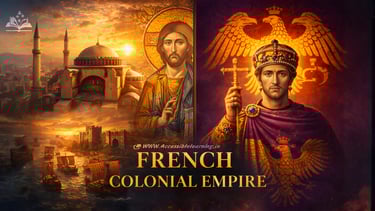
Understanding the Byzantine Empire
The Byzantine Empire stands as one of history's most remarkable civilizations, bridging the ancient and medieval worlds for over a millennium. From 330 CE to 1453 CE, this continuation of the Roman Empire preserved classical knowledge, developed distinctive art and architecture, and profoundly influenced Eastern Europe, the Mediterranean, and the Middle East.
While Western Europe fragmented into feudal kingdoms after Rome's fall, the Byzantine Empire maintained Roman law, Greek culture, and Christian orthodoxy. Its capital, Constantinople, became the most magnificent city in medieval Christendom, serving as a bulwark against invasions and a crossroads of trade connecting Europe and Asia.
This comprehensive guide explores the Byzantine Empire's political evolution, cultural achievements, religious developments, economic systems, and lasting legacy that continues shaping our world today.
What Was the Byzantine Empire? Definition and Origins
From Eastern Roman Empire to Byzantine Civilization
The term "Byzantine Empire" is actually a modern convention. Its citizens called themselves Romans (Rhomaioi in Greek) and considered their state the legitimate continuation of the Roman Empire. The name "Byzantine" derives from Byzantium, the original Greek settlement where Emperor Constantine I established his new capital in 330 CE.
The empire's transformation began when Emperor Diocletian divided the Roman Empire into eastern and western administrative regions in 285 CE. Constantine's decision to relocate the imperial capital from Rome to the strategically positioned city he renamed Constantinople marked a pivotal shift in Roman civilization's center of gravity.
When the Western Roman Empire collapsed in 476 CE under barbarian invasions, the Eastern Roman Empire endured, gradually evolving its distinct Byzantine character. This transformation involved:
Linguistic shift: Greek replaced Latin as the primary administrative and cultural language by the 7th century
Religious identity: Orthodox Christianity became central to Byzantine imperial ideology
Administrative innovation: Development of the theme system for provincial governance and military organization
Cultural synthesis: Blending of Roman political traditions, Greek intellectual heritage, and Christian theology
Geographic Scope and Territorial Evolution
At its greatest extent under Emperor Justinian I (527-565 CE), the Byzantine Empire controlled territories spanning three continents:
Europe: Greece, the Balkans, parts of Italy, and southern Spain
Asia: Asia Minor (modern Turkey), Syria, and Palestine
Africa: Egypt, Libya, and coastal North Africa
However, Byzantine territory fluctuated dramatically throughout its history. Arab conquests in the 7th century stripped away Syria, Palestine, Egypt, and North Africa. The empire's core eventually contracted to Asia Minor, Greece, and surrounding regions, with periodic expansions and contractions based on military fortunes.
Byzantine Empire Timeline: Key Periods and Dynasties
Early Byzantine Period (330-610 CE)
Foundation and Constantinopolitan Establishment
Constantine I established Constantinople in 330 CE on the site of ancient Byzantium, creating a "New Rome" strategically positioned on the Bosphorus Strait. This location offered natural defenses and controlled maritime trade routes between the Mediterranean and Black Seas.
The Theodosian dynasty (379-457 CE) solidified Christianity's dominance, with Emperor Theodosius I making Christianity the official state religion in 380 CE. The construction of massive land walls under Theodosius II in the 5th century provided Constantinople with nearly impregnable defenses that would protect the city for a thousand years.
Justinian's Reconquest and Legal Legacy
Emperor Justinian I (527-565 CE) represents the early Byzantine period's apex. His reign featured:
Military campaigns: General Belisarius reconquered North Africa from the Vandals, Italy from the Ostrogoths, and parts of Spain from the Visigoths
Legal codification: The Corpus Juris Civilis (Body of Civil Law) systematized Roman law, becoming the foundation for legal systems across Europe
Architectural magnificence: Construction of Hagia Sophia, one of antiquity's greatest architectural achievements
Administrative reforms: Reorganization of provincial governance and military structure
However, Justinian's ambitious reconquests proved unsustainable. Military campaigns drained the treasury, and the Justinianic Plague (541-549 CE) devastated the empire's population and economy, killing an estimated 25-50 million people across the Mediterranean world.
Middle Byzantine Period (610-1025 CE)
Heraclian Reforms and Survival
Emperor Heraclius (610-641 CE) confronted existential threats from the Sasanian Persian Empire and emerging Arab forces. His military reforms transformed Byzantine governance through the theme system, dividing provinces into military districts (themes) where soldier-farmers received land grants in exchange for military service.
Heraclius successfully defeated Persia but could not stem the Arab conquests that followed Muhammad's death. By 750 CE, the Byzantine Empire had lost Syria, Palestine, Egypt, and North Africa to the expanding Rashidun and Umayyad Caliphates.
Iconoclasm and Religious Controversy
The Iconoclastic Controversy (726-843 CE) divided Byzantine society over religious imagery. Iconoclast emperors banned icons (religious images), arguing they constituted idolatry, while iconodules defended them as channels to divine grace. This conflict intertwined theological debates with imperial politics and monastic power.
The restoration of icon veneration in 843 CE, known as the Triumph of Orthodoxy, became an annual celebration in Eastern Orthodox Christianity and solidified the distinctive Byzantine approach to religious art.
Macedonian Renaissance
The Macedonian dynasty (867-1056 CE) presided over Byzantine power and cultural achievement's golden age. Military successes pushed empire boundaries outward, while intellectual life flourished in Constantinople.
Key developments included:
Territorial expansion: Reconquest of Crete, Cyprus, and parts of Syria; expansion into the Balkans
Cultural flowering: Preservation and copying of classical Greek texts, patronage of scholars and artists
Missionary activity: Saints Cyril and Methodius developed the Cyrillic alphabet and spread Orthodox Christianity to Slavic peoples
Economic prosperity: Trade networks connecting Europe, Asia, and Africa generated substantial wealth

Late Byzantine Period (1025-1453 CE)
Komnenian Restoration and Crusader Interactions
Following military defeats and civil wars in the late 11th century, the Komnenos dynasty (1081-1185 CE) stabilized the empire. Emperor Alexios I Komnenos requested Western military assistance against Turkish invasions, inadvertently triggering the First Crusade in 1096.
Byzantine-Crusader relations proved complex and often hostile. While initially beneficial, Crusader states in the Levant competed with Byzantine interests. The Fourth Crusade (1204) proved catastrophic when Crusaders sacked Constantinople itself, establishing the Latin Empire and fragmenting Byzantine territories.
Palaiologan Revival and Ottoman Pressure
The Palaiologos dynasty (1261-1453 CE) recaptured Constantinople in 1261, but the restored empire represented a shadow of its former glory. Territorial losses to the rising Ottoman Turkish Empire steadily reduced Byzantine holdings to Constantinople and its immediate surroundings.
Despite political decline, the Palaiologan period witnessed a final cultural renaissance. Byzantine scholars, artists, and theologians produced sophisticated works in philosophy, theology, history, and art. Many of these intellectuals would flee to Italy as Ottoman pressure intensified, contributing to the Italian Renaissance.
The Fall of Constantinople
On May 29, 1453, Ottoman Sultan Mehmed II captured Constantinople after a 53-day siege, ending the Byzantine Empire. The Ottomans employed massive cannons that breached the Theodosian Walls, previously considered impregnable. Emperor Constantine XI Palaiologos died fighting, becoming a legendary figure in Greek folklore.
The fall of Constantinople marked the end of the medieval period for many historians and accelerated the dissemination of Greek classical knowledge to Western Europe as Byzantine scholars sought refuge in Italian city-states.
Byzantine Government and Administration
Imperial Autocracy and Divine Kingship
Byzantine emperors ruled as absolute monarchs, claiming authority directly from God. This concept of imperial theocracy positioned the emperor as God's representative on earth, responsible for both secular governance and religious orthodoxy.
The elaborate court ceremonial emphasized the emperor's sacred status. Complex rituals, magnificent regalia, and hierarchical protocols reinforced imperial majesty and distinguished the emperor from ordinary mortals.
Administrative Structure and the Theme System
Early Byzantine administration inherited Roman provincial structures, but the 7th-century crisis necessitated radical reforms. The theme system emerged as a response to Arab invasions and fiscal strain.
Each theme (military district) was governed by a strategos (general) who commanded local forces recruited from soldier-farmers. This decentralized system proved more resilient and economically sustainable than maintaining a professional standing army.
By the 10th century, approximately 30 themes organized Byzantine territories. The system gradually declined as military aristocratic families (dynatoi) accumulated land and power, undermining the free peasant-soldier class.
Bureaucracy and Civil Service
Byzantine administration developed a sophisticated bureaucracy with specialized departments:
Logothete departments: Finance, military affairs, postal service, and foreign relations
Imperial chancery: Document production, archives, and official correspondence
Legal system: Courts, judges, and legal scholars interpreting Roman law codes
Eunuchs often held high administrative positions, trusted because their inability to found dynasties theoretically made them loyal servants of the current emperor. However, powerful eunuchs sometimes wielded considerable political influence.
Byzantine Military: Strategy, Organization, and Warfare
Military Innovation and Defensive Strategy
Byzantine military thinking emphasized strategic defense, intelligence gathering, and diplomatic maneuvering over purely offensive campaigns. Military treatises like the "Strategikon" (attributed to Emperor Maurice) codified tactical principles and battlefield tactics.
Key military innovations included
Greek fire: An incendiary weapon composed of petroleum-based substances that burned on water, devastatingly effective in naval warfare
Heavy cavalry (cataphracts): Armored horsemen combining shock impact with archery capabilities
Fortress networks: Strategic fortifications controlling mountain passes and coastal approaches
Combined arms tactics: Coordination of infantry, cavalry, and missile troops
The Varangian Guard
The Varangian Guard, established in the late 10th century, served as the emperor's elite bodyguard unit. Initially composed of Scandinavian warriors (especially from Rus' territories), it later included Anglo-Saxons who fled England after the Norman Conquest of 1066.
These foreign mercenaries offered fanatical loyalty because they had no local political connections or dynastic ambitions. Their battle-axes and fierce combat reputation made them formidable warriors.
Naval Power and Maritime Dominance
Byzantine naval superiority proved crucial for an empire bordered by seas. The Byzantine navy protected trade routes, transported armies, and defended Constantinople from maritime sieges.
Dromons, the primary Byzantine warship, featured both sails and oars, allowing maneuverability in varied conditions. Equipped with Greek fire projectors, these vessels dominated Mediterranean waters for centuries.


Byzantine Economy and Trade
Constantinople as Commercial Hub
Constantinople's strategic location made it the medieval world's greatest trading center. Goods from Scandinavia, Western Europe, the Middle East, India, and China flowed through its markets.
The city's commercial infrastructure included:
Harbor facilities: Deep-water ports accommodating large merchant vessels
Regulated markets: Guilds controlling production and trade in specific commodities
Money-changing operations: Managing transactions in multiple currencies
Customs collection: Generating substantial revenue for the imperial treasury
The Gold Solidus: Medieval Reserve Currency
The Byzantine gold solidus (or nomisma) maintained stable weight and purity for seven centuries, functioning as the medieval Mediterranean's reserve currency. This monetary stability facilitated international trade and demonstrated Byzantine economic sophistication.
The solidus's reliability contrasted sharply with Western European coinage, which often suffered from debasement and irregular minting. Merchants throughout the known world trusted Byzantine gold.
Agriculture and Provincial Economy
Despite Constantinople's commercial prominence, agriculture formed the Byzantine economy's foundation. The peasant-soldier farmers of the theme system produced grain, olives, wine, and other staples.
Large estates (pronoiai) increasingly dominated agricultural production in later centuries, with military aristocrats receiving land grants in exchange for military service. This trend paralleled Western European feudalism but maintained distinctively Byzantine characteristics.
Byzantine Religion and the Orthodox Church
The Great Schism of 1054
Theological, political, and cultural differences gradually separated Eastern (Byzantine) and Western (Roman) Christianity. The formal schism of 1054 CE resulted from disputes over:
Papal authority: Rome claimed universal jurisdiction; Constantinople recognized patriarchal equality
Filioque controversy: Western addition of "and the Son" to the Nicene Creed without Eastern consent
Liturgical practices: Different approaches to the Eucharist, clerical celibacy, and ritual
Language: Greek versus Latin theological terminology and interpretations
Cardinal Humbert and Patriarch Michael Cerularius mutually excommunicated each other in 1054, symbolizing the final break. Though attempts at reunion occasionally occurred, the division persisted, creating distinct Catholic and Orthodox Christian traditions.
Monasticism and Spiritual Life
Monasticism profoundly influenced Byzantine spirituality and culture. Monasteries served as centers of learning, manuscript preservation, social welfare, and spiritual guidance.
Mount Athos in northern Greece became Orthodox monasticism's spiritual center, established in the 10th century. Its autonomous monastic republic continues operating today with twenty monasteries following ancient traditions.
Byzantine monks developed distinctive spiritual practices like hesychasm, emphasizing inner prayer, silence, and contemplation to achieve mystical union with God. The Jesus Prayer ("Lord Jesus Christ, Son of God, have mercy on me, a sinner") became central to Orthodox spiritual practice.
Religious Councils and Doctrinal Development
Seven Ecumenical Councils (325-787 CE) defined Christian orthodoxy, addressing theological controversies:
Nicaea I (325): Affirmed Christ's divinity against Arianism
Constantinople I (381): Confirmed the Holy Spirit's divinity
Ephesus (431): Declared Mary as Theotokos (God-bearer)
Chalcedon (451): Defined Christ's dual nature (human and divine)
Constantinople II (553): Addressed Christological disputes
Constantinople III (680-681): Affirmed Christ's dual wills
Nicaea II (787): Legitimized icon veneration
These councils established theological foundations still recognized by Eastern Orthodox, Oriental Orthodox, and Catholic churches.
Byzantine Art and Architecture
Hagia Sophia: Architectural Marvel
The Hagia Sophia (Holy Wisdom), completed in 537 CE under Justinian I, represents Byzantine architectural genius. Its massive dome seemingly floats above the nave, supported by pendentives that revolutionary engineering made possible.
The interior glowed with golden mosaics, colored marble, and light streaming through windows around the dome's base. Contemporary observers described entering as experiencing heaven on earth.
After Constantinople's fall in 1453, the Ottomans converted Hagia Sophia into a mosque, adding minarets and covering Christian imagery. Today it functions as a museum and mosque, recognized as a UNESCO World Heritage Site.
Mosaic Art and Iconography
Byzantine mosaics adorned churches with shimmering images created from tiny colored glass and stone tesserae set in plaster. Gold backgrounds symbolized divine light and the heavenly realm.
Iconographic conventions developed strict rules for depicting Christ, the Virgin Mary, saints, and biblical scenes. These stylized representations emphasized spiritual reality over naturalistic appearance.
Notable examples include
Ravenna mosaics: San Vitale's portraits of Justinian and Theodora with their courts
Hagia Sophia mosaics: Deësis (Christ flanked by Mary and John the Baptist)
Daphni monastery: Christological cycle demonstrating 11th-century artistic sophistication
Manuscript Illumination and Portable Art
Byzantine scribes produced magnificently illuminated manuscripts preserving classical texts and Christian writings. Gold leaf, brilliant pigments, and intricate miniatures adorned these precious books.
Portable icons painted on wooden panels allowed personal devotion and traveled with armies, merchants, and pilgrims. Ivory carvings, enameled metalwork, and silk textiles demonstrated Byzantine luxury craft excellence.

Byzantine Influence and Legacy
Impact on Eastern Europe and Russia
Byzantine missionaries spread Orthodox Christianity and Byzantine culture throughout Eastern Europe. The Christianization of Rus' in 988 CE under Vladimir I of Kiev established religious and cultural connections lasting centuries.
The Cyrillic alphabet, developed by Saints Cyril and Methodius for Slavic evangelization, enabled literacy in Russian, Bulgarian, Serbian, and other languages. Byzantine artistic, architectural, and liturgical traditions shaped Eastern European Christian cultures.
After Constantinople's fall, Moscow claimed to be the "Third Rome," continuing Byzantine imperial and religious traditions. This self-conception influenced Russian imperial ideology until the 1917 Revolution.
Contribution to Islamic Civilization
The Byzantine Empire's interactions with the Islamic world involved both conflict and cultural exchange. Arab and Turkish conquests absorbed formerly Byzantine territories, but Byzantine administrative practices, architectural styles, and intellectual traditions influenced Islamic civilization.
Greek scientific and philosophical texts reached the Islamic world partly through Byzantine intermediaries. Byzantine diplomatic protocols influenced Abbasid court ceremonial, while Byzantine artistic motifs appeared in Islamic decorative arts.
Western European Renaissance Connections
Byzantine scholars fleeing Ottoman expansion brought Greek manuscripts and classical knowledge to Italy, contributing significantly to the Renaissance. Figures like Cardinal Bessarion established libraries and promoted Greek studies.
Byzantine artistic influences appeared in Italian painting, particularly in the work of Duccio, Cimabue, and early Renaissance artists who studied Byzantine icon painting techniques before developing more naturalistic styles.
Roman law, preserved and systematized in Justinian's Corpus Juris Civilis, provided the foundation for continental European legal systems. Byzantine legal concepts influenced canon law, civil law traditions, and political theory.
Modern Cultural Heritage
The Byzantine legacy persists in multiple ways:
Orthodox Christianity: Over 200 million Orthodox Christians worldwide follow liturgical and theological traditions rooted in Byzantine Christianity
Architecture: Byzantine domes, pendentives, and basilica plans influenced later Islamic and European architecture
Art: Icon painting traditions continue in Orthodox communities
Language: Greek linguistic heritage and specialized Byzantine terminology
Political concepts: Ideas about church-state relations and imperial authority
The Byzantine Empire's thousand-year survival demonstrates remarkable adaptability, cultural sophistication, and resilience. Its synthesis of Roman political traditions, Greek intellectual heritage, and Christian spirituality created a distinctive civilization that shaped the medieval and modern worlds.
The Byzantine Empire's Enduring Significance
The Byzantine Empire's millennium-long existence represents one of history's most remarkable civilizations. As the continuation of the Roman Empire and guardian of Greek cultural heritage, Byzantium preserved classical knowledge through centuries when Western Europe fragmented into localized kingdoms.
The empire's contributions extend far beyond political history. Byzantine scholars saved countless ancient texts from destruction, Byzantine artists developed sophisticated aesthetic traditions, Byzantine theologians shaped Christian doctrine, and Byzantine diplomats pioneered international relations protocols still recognizable today.
Constantinople's strategic position made it a meeting point for cultures, religions, and trade routes connecting three continents. This cosmopolitan character fostered cultural synthesis, intellectual exchange, and economic prosperity that elevated medieval civilization.
The empire's fall in 1453 marked the medieval period's end, but the Byzantine legacy persisted through Orthodox Christianity's continuing traditions, preserved classical texts that sparked the Renaissance, legal principles embedded in European law codes, and architectural influences visible in religious buildings worldwide.
Understanding the Byzantine Empire illuminates medieval history, explains modern Eastern European and Middle Eastern cultural patterns, and demonstrates how civilizations adapt, preserve knowledge, and influence successor societies across centuries. The empire's sophisticated administration, cultural achievements, and resilient spirit offer lessons about maintaining civilization through turbulent times—insights that remain relevant today.
For anyone seeking to comprehend how the ancient world transitioned into modernity, the Byzantine Empire provides an essential connection, bridging Roman antiquity, medieval Christendom, and the Renaissance while developing its own distinctive civilization worthy of study and admiration.

Frequently Asked Questions
Q: How long did the Byzantine Empire last?
The Byzantine Empire lasted approximately 1,123 years, from 330 CE when Constantine I established Constantinople as the new imperial capital, until 1453 CE when Ottoman forces captured Constantinople. Some historians date the empire's beginning to the formal division of the Roman Empire in 395 CE or the fall of the Western Roman Empire in 476 CE, which would make its duration about 1,058 or 977 years, respectively.
Q: Why did the Byzantine Empire fall?
The Byzantine Empire fell due to multiple interconnected factors: centuries of territorial losses to Arab and Turkish invasions reduced the empire's resource base; the Fourth Crusade's sacking of Constantinople in 1204 severely weakened the state; internal civil wars and succession disputes drained military and financial resources; the rising Ottoman Turkish Empire steadily conquered Byzantine territories throughout the 14th and 15th centuries; and technological advantages, particularly Ottoman artillery that breached Constantinople's legendary walls, ultimately enabled the final conquest in 1453.
Q: What language did the Byzantine Empire speak?
While Latin served as the official administrative language in the empire's early centuries, Greek gradually became dominant by the 7th century. Byzantine citizens spoke various forms of Greek, from classical literary Greek used by educated elites to contemporary spoken dialects. Latin remained important for legal documents and ceremonial purposes. Many Byzantines were multilingual, speaking local languages like Armenian, Syriac, or Slavic tongues alongside Greek.
Q: What was the capital of the Byzantine Empire?
Constantinople served as the Byzantine Empire's capital throughout its history. Originally the ancient Greek city of Byzantium, it was refounded and renamed by Emperor Constantine I in 330 CE. The city occupied a strategically crucial location on the Bosphorus Strait, controlling maritime passage between the Mediterranean and Black Seas. Today, this city is known as Istanbul, Turkey.
Q: What religion was the Byzantine Empire?
The Byzantine Empire was Orthodox Christian. Christianity became the official state religion under Constantine I and Theodosius I in the 4th century. Byzantine emperors saw themselves as God's representatives on earth, responsible for protecting Christian orthodoxy. The empire developed distinctive Eastern Orthodox theological traditions, liturgical practices, and religious art that eventually separated from Western Roman Catholicism in the Great Schism of 1054.
Q: Was the Byzantine Empire Greek or Roman?
The Byzantine Empire represented a fusion of both Greek and Roman elements. Politically and legally, Byzantines considered themselves Romans (Rhomaioi), maintaining Roman imperial traditions, administrative structures, and law codes. Culturally and linguistically, the empire was predominantly Greek, with Greek serving as the primary language and Hellenistic cultural traditions shaping art, literature, and education. This synthesis of Roman political identity with Greek cultural heritage created a distinctive civilization.
Q: What were the major achievements of the Byzantine Empire?
Major Byzantine achievements include preserving and transmitting classical Greek and Roman knowledge to later civilizations; developing distinctive architectural innovations like the pendentive dome exemplified in Hagia Sophia; codifying Roman law in Justinian's Corpus Juris Civilis, which influenced European legal systems; creating magnificent mosaic art and icon painting traditions; maintaining economic stability with the gold solidus currency for seven centuries; spreading Orthodox Christianity and the Cyrillic alphabet to Slavic peoples; and serving as a cultural bridge between ancient and medieval worlds, ultimately contributing to the European Renaissance.
Q: How was the Byzantine Empire different from the Roman Empire?
While the Byzantine Empire was the continuation of the Eastern Roman Empire, several key differences emerged: Greek replaced Latin as the dominant language; Orthodox Christianity became more central to imperial ideology and culture; the administrative theme system replaced earlier provincial structures; Byzantine art developed distinctive stylized iconographic traditions rather than Roman naturalism; the empire faced different enemies (Persians, Arabs, and Turks) compared to Rome's Germanic and Hunnic threats; and Byzantine culture synthesized Roman political traditions with Greek intellectual heritage and Christian theology in unique ways.
Q: Who were the most important Byzantine emperors?
The most influential Byzantine emperors include Constantine I (306-337), who founded Constantinople and made Christianity the empire's religion; Justinian I (527-565), who reconquered lost territories, codified Roman law, and built Hagia Sophia; Heraclius (610-641), who reformed the military and administration; Leo III (717-741), who repelled Arab sieges and initiated iconoclasm; Basil II (976-1025), whose military campaigns expanded the empire to its medieval apex; and Constantine XI (1449-1453), the last emperor who died defending Constantinople against Ottoman conquest.
Q: What caused the split between the Catholic and Orthodox churches?
The Great Schism of 1054 resulted from centuries of growing theological, political, and cultural differences between Eastern and Western Christianity. Key issues included disputes over papal authority versus patriarchal equality; the Western addition of "filioque" (and the Son) to the Nicene Creed without Eastern consultation; different liturgical practices regarding the Eucharist and clerical celibacy; linguistic barriers between the Greek-speaking East and the Latin-speaking West; and political tensions between Byzantine emperors and the papacy. These cumulative differences led to mutual excommunication and formal separation.
Subscribe to Frontier Intelligence
All © Copyright reserved by Accessible-Learning Hub
| Terms & Conditions
Accessible Learning Hub — Actionable clarity for high-agency minds.
Weekly breakdowns on AI breakthroughs, capital flow, and human performance systems. Zero fluff.