

The Mellon Banking and Industrial Empire: How Andrew Mellon Shaped American Finance and Industry
Discover how Andrew Mellon built America's most diversified industrial empire, shaped tax policy for decades, and left a controversial legacy worth billions.
FINANCE, MARKETS & ECONOMYHISTORY & CIVILIZATIONS
Shiv Singh Rajput
1/20/202613 min read
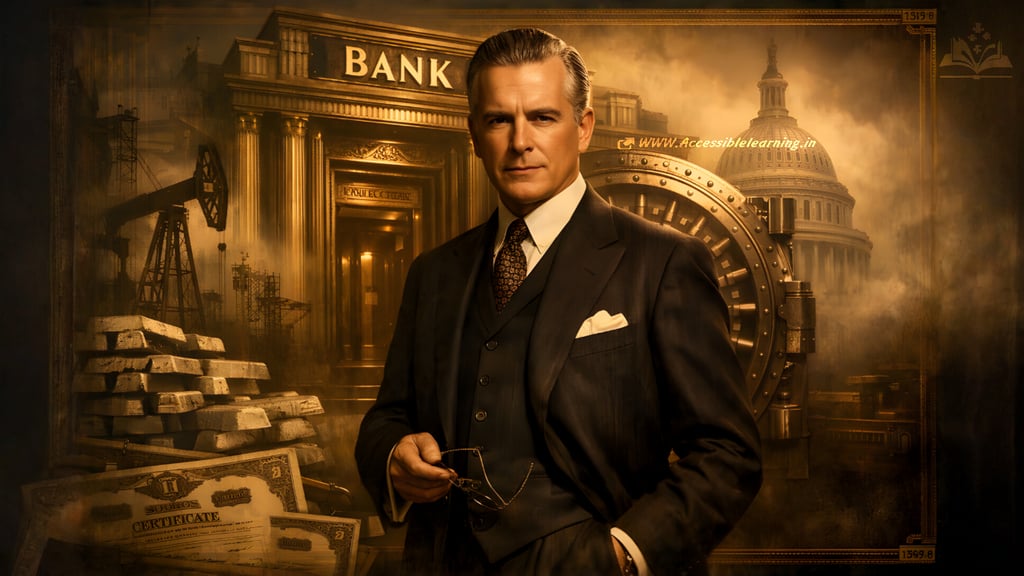

When you think about the architects of modern American capitalism, names like Rockefeller, Carnegie, and Morgan typically dominate the conversation. But there's another titan whose influence arguably exceeded them all in both scope and longevity: Andrew Mellon. The Mellon banking and industrial empire wasn't just another Gilded Age success story—it represented a fundamentally different approach to wealth-building that combined financial acumen, industrial diversification, and political influence in ways that reshaped the American economy.
Understanding the Mellon Empire: More Than Just Banking
The Mellon empire stands apart from its contemporaries because it operated on multiple levels simultaneously. While Carnegie focused on steel and Rockefeller on oil, the Mellons built an integrated financial-industrial complex that touched nearly every major sector of the American economy by the early 20th century.
The Foundation: T. Mellon & Sons Bank
The story begins not with Andrew, but with his father, Thomas Mellon, who established T. Mellon & Sons in Pittsburgh in 1869. Thomas, an Irish immigrant who became a successful judge and real estate investor, understood something crucial: banking wasn't just about lending money—it was about identifying and nurturing promising ventures that could generate compound returns across generations.
Andrew Mellon joined his father's firm in 1880 at age 25, and by 1882, he had assumed control of the bank's operations. What made Andrew exceptional wasn't just his financial instincts—it was his ability to see banking as venture capital before that term existed. The Mellon bank didn't simply provide loans; it took equity positions in companies, placed family members on boards, and actively shaped industrial development.
The Diversification Strategy: Building an Industrial Octopus
Between 1889 and 1921, Andrew Mellon and his younger brother Richard orchestrated one of history's most successful diversification campaigns. Their strategy was deceptively simple: identify industries with high growth potential, provide capital in exchange for equity and control, then leverage their financial network to ensure these companies dominated their markets.
Key holdings in the Mellon industrial empire included:
Aluminum Company of America (Alcoa) - In 1889, Andrew Mellon provided crucial funding to the Pittsburgh Reduction Company, which would become Alcoa. The Mellons recognized that Charles Martin Hall's electrolytic process for aluminum production could revolutionize multiple industries. By the 1920s, Alcoa controlled approximately 90% of American aluminum production, making it one of the most dominant monopolies of the era. The company's value grew from an initial investment of several hundred thousand dollars to a valuation exceeding $300 million by 1930.
Gulf Oil Corporation - Perhaps the Mellons' most profitable venture, Gulf Oil emerged from their backing of the Spindletop oil field discovery in Texas in 1901. The Mellon family invested heavily in the Guffey Petroleum Company, later restructured as Gulf Oil. By the 1920s, Gulf had become one of America's largest oil companies, with the Mellon family controlling approximately 60% of the stock. At its peak before the 1984 merger with Chevron, Gulf Oil represented a substantial portion of the Mellon fortune.
Mellon National Bank - The renamed and expanded family bank became one of America's largest financial institutions. By 1921, when Andrew Mellon left to serve as Treasury Secretary, Mellon National Bank held assets exceeding $200 million (equivalent to roughly $3 billion today), making it one of the ten largest banks in the United States.
Koppers Company - This coal chemical and engineering firm demonstrated the Mellons' ability to identify niche industrial opportunities. Founded with Mellon backing in 1912, Koppers pioneered coal tar processing and coke oven technology, capturing a dominant position in industrial chemicals.
Carborundum Company - The Mellons recognized the industrial potential of silicon carbide abrasives, backing this company that became the world's leading producer of industrial abrasives and ceramics.
Other significant holdings included Pittsburgh Coal Company (one of America's largest coal producers), Union Steel Company, McClintic-Marshall Construction Company (which fabricated steel for major projects including the George Washington Bridge), and numerous smaller firms across banking, real estate, construction, and manufacturing.
Andrew Mellon: The Architect of Modern Tax Policy
In 1921, President Warren G. Harding appointed Andrew Mellon as Secretary of the Treasury, a position he would hold for eleven years under three presidents—longer than anyone except Albert Gallatin in the early 1800s. This appointment gave Mellon unprecedented influence over American economic policy during the Roaring Twenties.
The Mellon Tax Cuts: Philosophy and Impact
Mellon entered office facing top marginal tax rates of 73%, implemented during World War I to fund the war effort. He believed these rates were economically destructive and drafted what would become known as the Revenue Acts of 1921, 1924, 1926, and 1928.
Mellon's philosophy centered on what he called "scientific taxation." He argued that excessively high tax rates on the wealthy actually reduced government revenue because they discouraged economic activity and encouraged tax avoidance. By reducing top marginal rates to 25% by 1925, Mellon believed he could stimulate investment and economic growth and paradoxically increase tax revenue from the wealthy through increased economic activity.
The empirical results proved complex. Federal revenues from those earning over $100,000 annually did increase from $77 million in 1921 to $230 million by 1929, suggesting that lower rates encouraged either more income generation or more honest reporting. However, critics pointed out that these revenue increases coincided with massive economic growth that would have generated higher revenues regardless of tax policy. The broader economic boom of the 1920s made it difficult to isolate the specific impact of Mellon's tax policies.
The National Debt and Economic Management
Mellon successfully reduced the federal debt from $24 billion in 1920 to under $17 billion by 1930, using budget surpluses generated during the economic boom. He also advocated for reduced government spending and balanced budgets, principles that dominated Republican economic thinking for generations.
However, Mellon's rigid adherence to these principles during the early Great Depression proved disastrous. When President Hoover consulted Mellon about the 1929 crash and subsequent economic contraction, Mellon allegedly advised, "Liquidate labor, liquidate stocks, liquidate the farmers, liquidate real estate." Whether he used exactly these words remains disputed, but Mellon certainly opposed aggressive government intervention to stabilize the economy, believing market forces should determine economic outcomes.

The Dark Side: Tax Evasion, Monopoly, and Political Influence
No examination of the Mellon empire would be complete without addressing the serious controversies that dogged Andrew Mellon throughout his career and beyond.
The Tax Evasion Trial of 1935
In 1935, the Roosevelt administration indicted Andrew Mellon for tax fraud, alleging he had evaded over $3 million in taxes during his years as Treasury Secretary. The irony was stark: the man who had shaped American tax policy for a decade stood accused of violating those very laws.
The case centered on questionable transactions where Mellon had allegedly donated art to himself through foundations he controlled, claiming charitable deductions while maintaining effective ownership. Mellon also transferred assets to family members in ways prosecutors argued were designed to avoid tax liability rather than for legitimate business purposes.
The trial lasted until 1937 and ended with the Board of Tax Appeals ruling in Mellon's favor on most charges, though it did find some technical violations. Many historians believe Mellon likely engaged in aggressive tax avoidance that, while perhaps legal, contradicted the spirit of the tax laws he had helped create. The case highlighted how America's wealthiest individuals could use complex corporate structures and foundation arrangements to minimize tax liability in ways unavailable to ordinary citizens.
Antitrust Concerns and Monopoly Power
The Mellon empire's dominance in aluminum through Alcoa became the subject of major antitrust litigation. The federal government filed suit in 1937, arguing that Alcoa had illegally monopolized the aluminum industry. The case dragged through courts until 1945, when Judge Learned Hand ruled that Alcoa had indeed violated antitrust laws through its market dominance, even though the company hadn't engaged in traditionally "predatory" practices.
This ruling established an important legal precedent: companies could violate antitrust laws simply by dominating a market too completely, even without specific anticompetitive actions. The Mellons' strategy of achieving market control through superior capital access and vertical integration—perfectly legal when executed—had created exactly the kind of concentrated economic power that Progressive-era reformers had warned against.
Conflicts of Interest as Treasury Secretary
Mellon's tenure as Treasury Secretary while simultaneously controlling vast business interests created obvious conflicts of interest. He made tax policy decisions that directly affected his own companies and personal finances. The aluminum tariffs that protected Alcoa, the tax treatments of capital gains that benefited wealthy investors, and banking regulations that advantaged large institutions all served Mellon family interests.
While such conflicts were more tolerated in the 1920s than today, they undermined public confidence in government fairness. Critics argued that Mellon's policies essentially represented wealthy interests writing rules to benefit themselves—a critique that resonated strongly during the Great Depression when millions suffered while Mellon remained extraordinarily wealthy.
The Mellon Fortune: Estimating Historical Wealth
Quantifying Andrew Mellon's peak wealth presents challenges because much of his fortune was held through private companies and family trusts. However, historians estimate that by 1929, Andrew Mellon's personal wealth ranged between $300 million and $600 million—equivalent to approximately $5 billion to $10 billion in today's dollars when adjusted for inflation.
This comparison understates his relative wealth. In 1929, America's GDP was roughly $104 billion. Mellon's fortune of $300-600 million represented approximately 0.3% to 0.6% of the entire American economy. To match that proportion today with a U.S. GDP of approximately $27 trillion would require wealth of $80 billion to $160 billion, placing him among history's wealthiest individuals alongside Rockefeller, Carnegie, and modern billionaires like Jeff Bezos and Elon Musk.
The broader Mellon family fortune, when including Richard Mellon's holdings and the collective value of Mellon-controlled enterprises, likely exceeded $1 billion in 1929—an almost incomprehensible sum representing roughly 1% of the American economy.
Legacy and Lasting Influence
The National Gallery of Art
Perhaps Andrew Mellon's most enduring legacy is the National Gallery of Art in Washington, D.C. In the 1930s, Mellon assembled one of America's greatest art collections, acquiring masterpieces from European aristocrats and Soviet Russia (which was selling off Hermitage Museum holdings). Upon his death in 1937, Mellon's will donated his entire art collection plus $10 million to create a national art museum.
The National Gallery opened in 1941 and remains one of the world's premier art museums, housing works by Leonardo da Vinci, Vermeer, Rembrandt, and countless other masters. This philanthropic gesture partially rehabilitated Mellon's reputation after the tax evasion trial and Great Depression criticism.
The Mellon Family's Continued Influence
The Mellon fortune continued to exert enormous influence long after Andrew's death. His son Paul Mellon and daughter Ailsa Mellon Bruce became major philanthropists, funding educational institutions, medical research, and environmental conservation. The various Mellon family foundations have donated billions to charitable causes over the decades.
Richard King Mellon, Andrew's nephew, led the family's business interests from the 1930s through 1970, maintaining and growing Mellon Bank and other holdings. The family played a crucial role in Pittsburgh's post-industrial transformation, funding urban renewal projects that helped the city transition from steel manufacturing to education, healthcare, and technology.
BNY Mellon, formed through the 2007 merger of Mellon Financial Corporation with Bank of New York, manages over $48 trillion in assets under custody and administration today, making it one of the world's largest financial services companies. While the Mellon family no longer controls the bank, the name remains synonymous with American finance.
Political and Economic Philosophy
Mellon's economic philosophy—emphasizing low taxes on the wealthy, limited government intervention, balanced budgets, and faith in market mechanisms—became foundational to American conservative economic thinking. His ideas directly influenced supply-side economics and the "trickle-down" theory that dominated Republican politics from the 1980s onward.
However, his failures during the Great Depression also provided cautionary lessons about the limits of laissez-faire policies during economic crises. The contrast between Mellon's liquidationist approach and Franklin Roosevelt's activist interventionism became a defining debate in American political economy that continues today.

The Mellon Legacy in American History
The Mellon banking and industrial empire represents one of American capitalism's most significant yet underappreciated chapters. While less famous than Rockefeller's oil monopoly or Carnegie's steel dominance, the Mellons' diversified approach to wealth-building arguably proved more influential and longer-lasting.
Andrew Mellon's legacy remains deeply contested. His admirers point to his role in funding crucial industries like aluminum production that proved essential to American industrial power, his reduction of the national debt during the 1920s, his tax policies that coincided with economic growth, and his ultimate philanthropic gesture creating the National Gallery of Art. His critics emphasize his monopolistic business practices, conflicts of interest as Treasury Secretary, aggressive tax avoidance despite shaping tax policy, and disastrous economic advice during the Depression's onset that intensified human suffering.
Perhaps the most balanced assessment recognizes that Mellon embodied both the productive and problematic elements of Gilded Age capitalism. His ability to identify promising industries and provide capital undoubtedly contributed to American economic development. Yet his concentration of economic power, self-interested policy advocacy, and rigid ideological opposition to government intervention during crisis illustrate capitalism's potential pathologies when wealth becomes too concentrated and regulatory frameworks too weak.
The Mellon empire ultimately demonstrates that in evaluating historical figures, we need not choose between pure celebration and pure condemnation. Andrew Mellon was simultaneously a brilliant financier, an innovative industrialist, an influential policymaker, a tax avoider, a monopolist, and a flawed economic advisor whose mistakes contributed to economic catastrophe. Understanding this complexity helps us think more clearly about wealth, power, and public policy in our own time—when debates about tax policy, monopoly power, and the proper role of government intervention in markets echo those of Mellon's era a century ago.
Frequently Asked Questions
Q: What was Andrew Mellon's net worth at his peak?
Andrew Mellon's personal wealth peaked around 1929 at an estimated $300 million to $600 million, equivalent to approximately $5 billion to $10 billion in inflation-adjusted 2024 dollars. However, his relative wealth compared to the economy was even greater—his fortune represented approximately 0.3% to 0.6% of America's total GDP, which would equate to roughly $80 billion to $160 billion today. This made him one of the wealthiest Americans in history, comparable to John D. Rockefeller and Andrew Carnegie.
Q: How did the Mellon family make their money?
The Mellon family fortune originated with Thomas Mellon's banking and real estate investments in Pittsburgh during the mid-1800s. Andrew Mellon expanded the family wealth dramatically by using the bank to take equity positions in promising industrial companies. The family's strategy combined banking, venture capital, and industrial ownership, with major investments in aluminum production through Alcoa, oil through Gulf Corporation, coal mining, steel manufacturing, and numerous other industries. Rather than focusing on a single industry, the Mellons diversified across multiple sectors while maintaining financial control through their banking operations.
Q: What companies did Andrew Mellon own or control?
Andrew Mellon and his family controlled or held significant stakes in numerous major American corporations, including Aluminum Company of America (Alcoa), which dominated 90% of U.S. aluminum production; Gulf Oil Corporation, one of America's largest oil companies; Mellon National Bank, among the nation's largest financial institutions; Koppers Company for coal chemicals; Carborundum Company for industrial abrasives; Pittsburgh Coal Company; Union Steel Company; and McClintic-Marshall Construction. The Mellons typically took controlling equity positions and board seats rather than simply providing loans, giving them direct influence over corporate strategy.
Q: Why was Andrew Mellon put on trial for tax evasion?
In 1935, the Roosevelt administration indicted Andrew Mellon for evading over $3 million in taxes during the 1920s. The charges focused on questionable charitable donations where Mellon allegedly donated art to foundations he controlled while maintaining effective ownership, claiming tax deductions without truly surrendering the assets. Prosecutors also challenged asset transfers to family members as tax avoidance schemes. The trial ended in 1937 with the Board of Tax Appeals ruling mostly in Mellon's favor, though some technical violations were found. Many historians believe the trial was partially politically motivated, as Roosevelt's administration targeted prominent Republicans, but that Mellon had indeed engaged in aggressive tax avoidance that contradicted the spirit of laws he helped create as Treasury Secretary.
Q: What was Andrew Mellon's role in the Great Depression?
As Treasury Secretary until 1932, Andrew Mellon advocated for a "liquidationist" approach to the 1929 crash and early Depression. He opposed government intervention to stabilize the economy, believing markets should correct themselves naturally even if that meant widespread business failures and unemployment. Mellon allegedly advised President Hoover to "liquidate labor, liquidate stocks, liquidate the farmers, and liquidate real estate" to purge economic excesses, though the exact quotation is disputed. This hands-off approach proved disastrous as the economy collapsed, unemployment reached 25%, and suffering intensified. Mellon's failures during this crisis discredited laissez-faire economic policies and contributed to Franklin Roosevelt's landslide election victory in 1932 on a platform of active government intervention.
Q: How did the Mellon fortune compare to other Gilded Age fortunes?
Andrew Mellon's wealth ranked among the greatest American fortunes alongside John D. Rockefeller (estimated at $400 billion in today's dollars at peak), Andrew Carnegie (approximately $310 billion adjusted), and Cornelius Vanderbilt (approximately $205 billion adjusted). While Mellon's inflation-adjusted fortune of $5-10 billion seems smaller, his wealth as a percentage of GDP was comparable because it represented 0.3-0.6% of the entire American economy. The Mellon fortune was also distinguished by its diversification—while Rockefeller focused on oil and Carnegie on steel, the Mellons controlled holdings across banking, oil, aluminum, coal, steel, and numerous other industries, creating perhaps the most diversified industrial empire of the era.
Q: What is the National Gallery of Art, and how did Andrew Mellon create it?
The National Gallery of Art in Washington, D.C., was Andrew Mellon's final major legacy. During the 1930s, Mellon assembled one of America's greatest art collections, purchasing masterpieces from European aristocrats and even from Soviet Russia, which was selling Hermitage Museum holdings. Upon his death in 1937, Mellon's will donated his entire collection—including works by Leonardo da Vinci, Raphael, Rembrandt, and Vermeer—plus $10 million to establish a national art museum. Congress accepted the gift, and the National Gallery opened on the National Mall in 1941. The museum remains free to the public and houses one of the world's finest art collections, representing Mellon's attempt to establish a lasting cultural legacy beyond his controversial business and political career.
Q: What happened to Mellon Bank and the Mellon family businesses?
Mellon National Bank continued as a major financial institution throughout the 20th century under family control, becoming Mellon Bank Corporation. The bank expanded significantly and, in 1999, merged with Dreyfus Corporation to form Mellon Financial Corporation. In 2007, Mellon Financial merged with Bank of New York to create BNY Mellon, which today manages over $48 trillion in assets under custody and administration, making it one of the world's largest financial services companies. However, the Mellon family no longer maintains controlling ownership. Other Mellon family businesses followed similar paths—Alcoa remained independent until restructuring in 2016, Gulf Oil was acquired by Chevron in 1984, and most other holdings were sold or merged over the decades. The Mellon family wealth today exists primarily through foundations, trusts, and diversified investments rather than operating businesses.
Q: How did Andrew Mellon's tax policies shape American economic policy?
Andrew Mellon's tenure as Treasury Secretary from 1921 to 1932 fundamentally shaped American tax policy and economic philosophy. He reduced top marginal tax rates from 73% to 25%, arguing that lower taxes on the wealthy would stimulate investment and economic growth, increasing total tax revenue even at lower rates. This "scientific taxation" approach became foundational to supply-side economics and "trickle-down" economic theory that influenced Republican policy for generations. The Revenue Acts Mellon championed in 1921, 1924, 1926, and 1928 established the principle that economic growth should drive tax policy rather than revenue maximization. However, his rigid opposition to government intervention during the Great Depression's onset discredited pure laissez-faire policies. The tension between Mellon's tax-cutting, limited-government philosophy and Roosevelt's New Deal interventionism defined the central economic policy debate in American politics throughout the 20th century and continues to shape policy discussions today.
Q: What lessons does the Mellon empire offer for understanding American capitalism?
The Mellon banking and industrial empire illustrates several crucial aspects of American capitalism's development. First, it demonstrates how financial capital can be leveraged to build diversified industrial empires rather than focusing on single industries. Second, it reveals the advantages that established wealth provides through access to capital, information networks, and political influence unavailable to ordinary entrepreneurs. Third, it highlights the thin line between legitimate business success and monopolistic practice—the Mellons built dominant positions through superior execution and capital, yet those positions raised legitimate antitrust concerns. Fourth, it shows how concentrated wealth translates to political power that can shape policy in self-interested ways, as seen in Mellon's conflicted role as Treasury Secretary. Finally, it illustrates both capitalism's capacity for generating enormous wealth and innovation and the need for regulatory frameworks to prevent excessive concentration of economic power. The Mellon story captures both the dynamism and the dangers of largely unregulated capitalism during America's industrial emergence.
Subscribe to Frontier Intelligence
All © Copyright reserved by Accessible-Learning Hub
Accessible Learning Hub — Actionable clarity for high-agency minds.
Weekly breakdowns on AI breakthroughs, capital flow, and human performance systems. Zero fluff.