

Carnegie Steel: The Industrial Empire That Forged Modern America
Discover how Carnegie Steel revolutionized American industry through vertical integration, the Bessemer process, and aggressive expansion—before becoming U.S. Steel in 1901.
COMPANY/INDUSTRYHISTORYENTREPRENEUR/BUSINESSMANUSA
Sachin K Chaurasiya
1/15/20269 min read
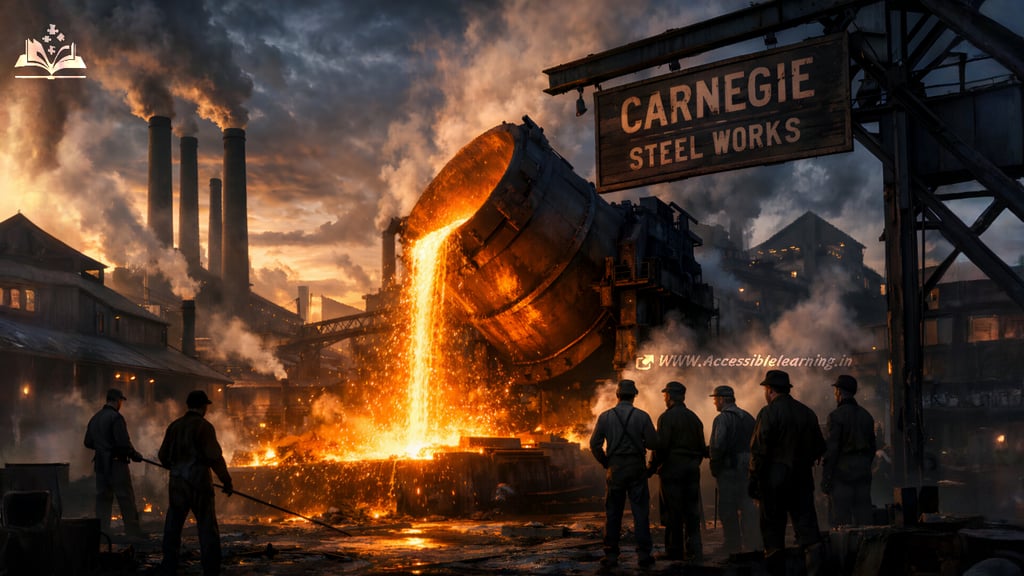
The Steel Giant That Shaped an Era
Carnegie Steel Company stands as one of the most transformative industrial enterprises in American history. Founded by Scottish immigrant Andrew Carnegie in 1892, this steel manufacturing powerhouse revolutionized production methods, dominated the American steel industry, and became the foundation for what would eventually become U.S. Steel—the world's first billion-dollar corporation.
The story of Carnegie Steel is more than a tale of industrial success; it represents the ambition, innovation, and controversy of America's Gilded Age. From pioneering vertical integration strategies to the bloody Homestead Strike, Carnegie Steel's legacy continues to influence modern business practices and labor relations.
The Origins of Carnegie Steel Company
Andrew Carnegie's Rise from Poverty to Power
Andrew Carnegie arrived in America in 1848 as a poor Scottish immigrant. Working his way up from a bobbin boy in a cotton mill to a telegraph operator and eventually a railroad executive, Carnegie accumulated both capital and business acumen. By the 1870s, he recognized steel—not iron—as the material of the future.
Carnegie's investment in the Bessemer process, which dramatically reduced the cost of steel production, positioned him perfectly for America's infrastructure boom. Railroads, bridges, and skyscrapers all demanded steel, and Carnegie was ready to supply it.
Formation and Early Growth (1892-1901)
Carnegie Steel Company was officially formed in 1892 through the consolidation of Carnegie's various steel interests, including
Homestead Steel Works in Pennsylvania
Keystone Bridge Company
Union Iron Mills
Edgar Thomson Steel Works
By 1900, Carnegie Steel produced more steel than all of Great Britain combined, controlling approximately 25% of American steel production. The company's annual profits reached $40 million—an astronomical sum for the era.
Revolutionary Business Strategies That Defined an Industry
Vertical Integration: Controlling Every Stage
Carnegie Steel's most significant innovation was its aggressive vertical integration strategy. Unlike competitors who relied on external suppliers, Carnegie acquired:
Upstream Resources:
Iron ore mines in the Mesabi Range of Minnesota
Coal mines and coke ovens in Pennsylvania
Limestone quarries
Transportation Infrastructure:
Steamship fleets on the Great Lakes
Railroad lines connecting mines to mills
Port facilities for raw material delivery
Manufacturing Facilities:
Blast furnaces for iron production
Steel mills using the Bessemer and open-hearth processes
Finishing mills for specialized products
This comprehensive control over the supply chain allowed Carnegie to reduce costs dramatically, undercut competitors, and maintain quality standards throughout production.
Cost Leadership and Economies of Scale
Carnegie famously proclaimed, "Watch the costs, and the profits will take care of themselves." His obsession with efficiency manifested in several practices:
Detailed cost accounting that tracked expenses per ton of steel produced
Continuous reinvestment in newer, more efficient technology
High-volume production that spread fixed costs across massive output
Aggressive pricing strategies that drove competitors out of business
Carnegie would often sell steel below market price to capture market share, knowing his superior efficiency allowed profitability even at prices that bankrupted rivals.
Technological Innovation and the Bessemer Process
The Bessemer process revolutionized steel production by blowing air through molten iron to remove impurities, dramatically reducing production time from days to minutes. Carnegie's Edgar Thomson Steel Works became one of the most efficient Bessemer steel plants in the world.
Later, Carnegie adopted the open-hearth process, which allowed for better quality control and the use of scrap steel. This flexibility in production methods gave Carnegie Steel a significant competitive advantage.
The Homestead Strike: Labor Conflict and Corporate Power
Background to the Conflict
The Homestead Steel Strike of 1892 remains one of the most significant labor disputes in American history. The Amalgamated Association of Iron and Steel Workers, one of the strongest trade unions of the era, represented skilled workers at the Homestead plant.
When contract negotiations broke down over wage reductions and union recognition, Carnegie left for Scotland, leaving plant manager Henry Clay Frick to handle the situation.
The Battle of Homestead
On July 6, 1892, violence erupted when 300 Pinkerton detectives arrived by barge to secure the plant. Workers and townspeople fought the Pinkertons in a 14-hour battle that left at least 10 dead and dozens wounded.
The Pennsylvania state militia eventually restored order, allowing strikebreakers to enter the plant. The strike was broken by November 1892, and the union was effectively destroyed at Homestead.
Long-term Impact on Labor Relations
The Homestead Strike had profound consequences:
Steel industry unionization was set back for decades
Carnegie's reputation as a friend to workers was permanently damaged
The event highlighted the power imbalance between capital and labor
It became a rallying point for the American labor movement
Despite Carnegie's progressive writings about workers' rights, the violence at Homestead exposed the contradiction between his public philosophy and business practices.

The Sale to J.P. Morgan: Creating U.S. Steel
Negotiations and the $480 Million Deal
By 1901, Andrew Carnegie was ready to retire. Banker J.P. Morgan, seeking to consolidate the fragmented steel industry, orchestrated the purchase of Carnegie Steel for $480 million (approximately $15 billion in today's dollars).
Carnegie received $225 million in gold bonds personally—making him one of the wealthiest individuals in world history. The sale represented the largest business transaction to that date.
Formation of U.S. Steel Corporation
Morgan combined Carnegie Steel with several competing companies to form the United States Steel Corporation in 1901. The new corporation:
Controlled 67% of American steel production
Was capitalized at $1.4 billion, making it the world's first billion-dollar company
Employed over 168,000 workers
Operated mills across Pennsylvania, Ohio, Indiana, and Illinois
U.S. Steel dominated American steel production for decades, though its market share gradually declined throughout the 20th century.
Carnegie Steel's Manufacturing Facilities and Operations
Major Production Sites
Edgar Thomson Steel Works (Braddock, Pennsylvania)
Carnegie's first major steel plant, opened 1875
Specialized in steel rails for railroads
Pioneered the use of the Bessemer process in America
Homestead Steel Works (Homestead, Pennsylvania)
Acquired in 1883, expanded significantly
Produced structural steel for buildings and bridges
Site of the infamous 1892 strike
Duquesne Steel Works (Duquesne, Pennsylvania)
Opened in 1890
Featured modern open-hearth furnaces
Focused on high-quality steel products
Production Capacity and Output
At its peak before the 1901 sale, Carnegie Steel's facilities could produce:
Over 3 million tons of steel annually
Steel products ranging from rails to structural beams
Specialized steel for armor plating and heavy machinery
The company's efficiency meant it could produce steel at costs 20-30% below competitors, giving it unassailable market dominance.
Andrew Carnegie's Philosophy: The Gospel of Wealth
Contradictions of a Steel Baron
Andrew Carnegie embodied the contradictions of Gilded Age industrialists. He simultaneously
Built monopolistic control while advocating for competition
Crushed unions while writing about workers' dignity
Accumulated vast wealth while preaching against inherited fortunes
Practiced ruthless capitalism while promoting social responsibility
Philanthropic Legacy
After selling Carnegie Steel, Carnegie devoted his remaining years to philanthropy, giving away over $350 million (roughly $5.5 billion today). His major contributions included:
2,509 libraries built worldwide, primarily in English-speaking countries
Carnegie Hall in New York City
Carnegie Mellon University in Pittsburgh
Carnegie Foundation for the Advancement of Teaching
Carnegie Endowment for International Peace
His essay "The Gospel of Wealth" (1889) argued that the wealthy have a moral obligation to redistribute their fortunes for public benefit—a philosophy that influenced later philanthropists like Bill Gates and Warren Buffett.
Carnegie Steel's Impact on American Industrialization
Infrastructure Development
Carnegie Steel provided the raw materials for America's transformation:
Railroads: Steel rails replaced iron, enabling faster, heavier trains
Bridges: The Brooklyn Bridge and countless others used Carnegie steel
Skyscrapers: Steel frame construction made tall buildings possible
Machinery: Industrial equipment became stronger and more durable
Economic Transformation
The company's success demonstrated that American manufacturing could compete globally. Carnegie Steel:
Created thousands of jobs in Pennsylvania and the Midwest
Stimulated related industries (mining, transportation, construction)
Helped Pittsburgh become the steel capital of the world
Established standards for corporate organization and management
Setting Corporate Precedents
Carnegie Steel pioneered business practices now considered standard:
Vertical integration as a competitive strategy
Scientific management and cost accounting
Aggressive reinvestment in technology
Strategic use of mergers and acquisitions

Comparing Carnegie Steel to Modern Corporations
Parallels with Today's Tech Giants
Modern technology companies share striking similarities with Carnegie Steel:
Amazon practices vertical integration by controlling retail, logistics, cloud computing, and content creation—much like Carnegie controlled ore, transportation, and manufacturing.
Tesla follows a similar model, producing batteries, electric motors, and software and operating its own charging network and sales channels.
Apple maintains tight control over hardware, software, retail, and increasingly, its supply chain—echoing Carnegie's comprehensive approach.
Lessons for Contemporary Business
Carnegie Steel's legacy offers insights for modern enterprises:
Control of supply chains provides competitive advantages
Cost leadership can create sustainable market dominance
Technological innovation must be continuous, not occasional
Labor relations significantly impact long-term reputation
Monopolistic practices eventually attract regulatory scrutiny
The End of Carnegie Steel and Transformation into U.S. Steel
Transition Period (1901-1920)
Following the 1901 acquisition, former Carnegie Steel facilities were reorganized under U.S. Steel's structure. The Pittsburgh area remained the heart of American steel production, with Carnegie's plants continuing as major production centers.
U.S. Steel inherited Carnegie's emphasis on efficiency but struggled to maintain the same innovative drive. The company became more bureaucratic and less aggressive in adopting new technologies.
Decline of the American Steel Industry
The dominance that Carnegie established began eroding in the mid-20th century:
Foreign competition: Japanese and European producers adopted newer technologies
Labor costs: Unionization increased wages, reducing cost advantages
Environmental regulations: Steelmaking's pollution became legally costly
Alternative materials: Aluminum, plastics, and composites replaced steel in many applications
Outdated facilities: Failure to modernize left American mills inefficient
By the 1980s, U.S. Steel employed a fraction of its peak workforce, and Pittsburgh transformed from Steel City to a center for healthcare, education, and technology.
Carnegie Steel in Historical Context: The Gilded Age
The Era of Robber Barons and Captains of Industry
Carnegie belonged to a generation of industrialists who built massive fortunes during America's rapid industrialization. His contemporaries included:
John D. Rockefeller (Standard Oil)
J.P. Morgan (banking and finance)
Cornelius Vanderbilt (railroads)
Henry Ford (automobiles)
These figures were simultaneously celebrated as innovative builders and criticized as exploitative monopolists. The debate over their legacy continues today.
Progressive Era Reforms
Carnegie Steel's practices contributed to Progressive Era reforms:
Antitrust legislation aimed to break up monopolies
Labor laws sought to protect workers from exploitation
Workplace safety regulations emerged after industrial accidents
Corporate taxation increased to fund public services
The company's success demonstrated both capitalism's productive power and its potential for abuse, fueling debates about economic regulation that persist today.

Carnegie Steel's Enduring Influence
Carnegie Steel Company represents a pivotal chapter in American economic history. In less than a decade of existence under that name, the company demonstrated how vertical integration, technological innovation, and relentless efficiency could create industrial dominance.
The company's success story reveals both the tremendous productive capacity of industrial capitalism and its human costs. The wealth generated enabled unprecedented infrastructure development and, eventually, massive philanthropic contributions. Yet that same wealth was built on the labor of workers in dangerous conditions, culminating in the violence of the Homestead Strike.
Today, Carnegie Steel's influence persists in multiple forms:
Business strategy: Vertical integration remains a powerful competitive approach
Corporate structure: Modern corporations still study Carnegie's organizational methods
Philanthropy: The Gospel of Wealth influenced generations of philanthropists
Labor relations: The Homestead Strike remains a cautionary tale about corporate power
Industrial heritage: Former Carnegie facilities are preserved as historic sites
Understanding Carnegie Steel means grappling with the complexity of industrial progress—acknowledging both the innovation that built modern America and the human struggles that accompanied that transformation. As we face new industrial revolutions driven by technology, the lessons of Carnegie Steel remain remarkably relevant: efficiency and innovation drive progress, but how we distribute the benefits determines whether that progress serves humanity or merely enriches the few.
The steel that Carnegie's company produced literally built modern America, from the rails that connected the continent to the skyscrapers that defined urban landscapes. The company that produced it embodied the contradictions of its age—ruthless yet innovative, exploitative yet productive, monopolistic yet transformative. That complex legacy continues to shape how we think about business, labor, wealth, and responsibility in America today.
Frequently Asked Questions
Q: What made Carnegie Steel so successful?
Carnegie Steel's success resulted from vertical integration (controlling raw materials through finished products), aggressive cost management, continuous technological innovation, and economies of scale that allowed it to underprice competitors while maintaining profitability.
Q: How much did Andrew Carnegie sell Carnegie Steel for?
Andrew Carnegie sold Carnegie Steel to J.P. Morgan for $480 million in 1901, receiving $225 million personally in gold bonds. This amount equals approximately $15 billion in today's dollars, making it one of the largest business transactions in history.
Q: What happened during the Homestead Strike?
The Homestead Strike of 1892 was a violent labor dispute at Carnegie's Homestead Steel Works. When negotiations failed, manager Henry Clay Frick brought in Pinkerton detectives, leading to a battle that killed at least 10 people. The strike was ultimately broken, crushing the union and tarnishing Carnegie's reputation.
Q: Did Carnegie Steel become U.S. Steel?
Yes, Carnegie Steel became the core asset of United States Steel Corporation when J.P. Morgan purchased it in 1901 and combined it with other steel companies. U.S. Steel became the world's first billion-dollar corporation and dominated American steel production for decades.
Q: Where were Carnegie Steel's main factories located?
Carnegie Steel's major facilities were in Pennsylvania, including the Edgar Thomson Steel Works in Braddock, the Homestead Steel Works in Homestead, and the Duquesne Steel Works in Duquesne. The company also controlled iron ore mines in Minnesota and transportation infrastructure on the Great Lakes.
Q: How did Carnegie Steel affect American workers?
Carnegie Steel created thousands of industrial jobs but under harsh conditions—long hours, dangerous work, and initially low wages. The company's anti-union stance, exemplified by the Homestead Strike, suppressed labor organizing for decades, though wages eventually increased due to the company's profitability.
Q: What is Carnegie Steel's legacy today?
Carnegie Steel's legacy includes pioneering vertical integration as a business strategy, demonstrating the power of economies of scale, influencing modern antitrust law, and funding extensive philanthropic institutions through Carnegie's later donations. The company's former facilities remain landmarks of American industrial heritage.
Q: How did the Bessemer process change steel production?
The Bessemer process revolutionized steelmaking by blowing air through molten iron to remove impurities in minutes rather than days. Carnegie Steel adopted this technology early, dramatically reducing costs and increasing production volume, which enabled the mass production of affordable steel for railroads and construction.
Subscribe to Frontier Intelligence
All © Copyright reserved by Accessible-Learning Hub
| Terms & Conditions
Accessible Learning Hub — Actionable clarity for high-agency minds.
Weekly breakdowns on AI breakthroughs, capital flow, and human performance systems. Zero fluff.