

Morgan Financial Empire: The Complete Guide to America's Most Influential Banking Dynasty
Discover the Morgan Financial Empire's 200+ year legacy from J.P. Morgan to JPMorgan Chase's 2024 record of $4 trillion in assets. Complete history & modern impact.
USACOMPANY/INDUSTRYBANKING/CASH-FLOW
Sachin K Chaurasiya
2/19/20268 min read
What is the Morgan Financial Empire?
The Morgan Financial Empire represents one of the most powerful and enduring banking dynasties in American history. Beginning with Joseph Morgan III's entry into private banking in 1812 and continuing through J.P. Morgan's transformation of American finance, this dynasty has influenced national and global economies for over two centuries. Today, its legacy lives on through JPMorgan Chase & Co., the largest bank in the United States.
Key Highlights of the Morgan Empire
As of December 31, 2024, JPMorgan Chase holds $4.0 trillion in assets and $345 billion in stockholders' equity, making it not just the largest American bank but one of the most influential financial institutions globally.
Origins: How Did the Morgan Banking Dynasty Begin?
The Founding Generation (1812-1860)
The Morgan family's financial journey started when Joseph Morgan III joined the Washington Benevolent Society as a private banker in 1812. Unlike his ancestors who farmed in Connecticut, Joseph III recognized the potential of the emerging American financial sector.
Joseph Morgan III's Strategic Moves:
Purchased the Hartford Exchange Coffee House in 1816, creating a business networking hub
Acquired the Hartford Bank in 1825
Reorganized the Hartford Fire Insurance Company into Aetna Fire Insurance Company
Built reputation for reliability through prompt insurance payments after New York City fires
Joseph III's marriage to Sarah Morgan Spencer, who directed the Hartford Orphan Asylum, and his role as director until his death established both business credibility and social standing.
Junius Spencer Morgan: The Transatlantic Builder (1813-1890)
Junius Spencer Morgan, Joseph III's son, showed business interest from age 15, working as an apprentice with Boston merchant Alfred Welles in 1829. His career trajectory included:
Morgan, Ketchum, and Company of New York (1834-1836)
Howe, Mather, and Company (1836-1851)
J.M. Beebe, Morgan, and Company (1851-1854), Boston's largest mercantile bank
The pivotal transformation came in 1864 when Junius changed George Peabody and Company's name to J.S. Morgan and Company, which became one of the most prominent banking firms in both America and Europe.
J.P. Morgan: The Titan Who Defined an Era
Who Was J.P. Morgan?
John Pierpont Morgan (1837-1913), son of J.S. Morgan, became the most prominent member of the family and the de facto leader of American finance at the turn of the century. His influence was so profound that during the Diplomatic age, Morgans influenced the financial futures of entire nations, with no need for a national bank because Morgans was the national bank.
The Business Philosophy Behind Morgan's Success
J.P. Morgan's approach to finance was methodical and conservative. Junius Morgan instilled in his son the principle: "Never under any circumstances do an action that would be called in question if known to the world." This cautious philosophy, learned during the Panic of 1857, became the foundation of Morgan banking practices.
What Was "Morganization"?
By 1885, Morgan began buying out railroads and reorganizing them, creating the business term "Morganization" to describe his method of creating monopolies through buying companies, eliminating competition, and cutting costs.
Industries Revolutionized by J.P. Morgan:
Railroads: Consolidated competing lines and restored financial stability
Steel: Financed the creation of U.S. Steel Corporation
Electricity: Backed Thomas Edison and the development of General Electric
Banking: Established modern investment banking practices
The Panic of 1907: When Morgan Saved America
The Panic of 1907 tested the Morgan banking house's stability and reputation, demonstrating both their power and the challenges they faced during financial crises. During this crisis, J.P. Morgan personally organized a bailout of the banking system, effectively acting as America's central bank before the Federal Reserve existed.
The House of Morgan: Four Generations of Financial Power
The Diplomatic Age: Building a Global Empire
The New York partners were allied with three partnerships: Morgan Grenfell in London, Morgan et Compagnie in Paris, and Drexel and Company in Philadelphia, creating an international financial network.
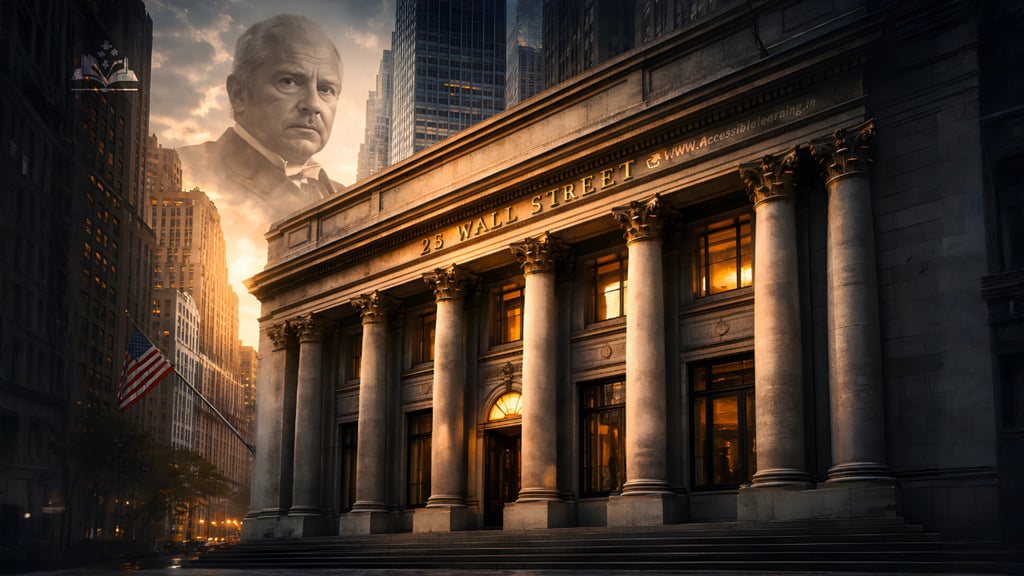
Pierpont Morgan shifted the business center to the famous New York address, 23 Wall Street, now on the national register of historical places. This location became synonymous with American financial power.
The Impact of Glass-Steagall Act (1933)
The empire was shattered by the Glass-Steagall Act of 1933, which erected a high wall between commercial banking and investment banking. This forced the Morgan empire to split its operations, fundamentally changing how American banking functioned for the next seven decades.
The Casino Age: Rebuilding After World War II
The postwar Casino Age comprised the years from 1948 to 1989, when the banking industry lost control over its clients in the fierce anonymous competition of global markets. This era marked the transition from personalized partnership banking to modern corporate finance.

JPMorgan Chase Today: The Modern Morgan Empire
Record-Breaking Performance in 2024
JPMorgan Chase posted record quarterly and annual earnings and revenue in 2024, reinforcing the company's status as the biggest and most profitable bank in U.S. history.
Fourth Quarter 2024 Financial Highlights:
Earnings per share of $4.81 versus the $4.11 estimate
Revenue of $43.74 billion compared to $41.73 billion expected
Profit rose 50% to $14 billion as noninterest expenses fell 7% from the previous year
Net interest income of $23.47 billion exceeded estimates by almost $400 million
Business Segments Driving Growth
JPMorgan Chase leads in investment banking, financial services for consumers and small businesses, commercial banking, financial transaction processing, and asset management.
J.P. Morgan Payments Division Performance:
Q4 2024 revenue of $4.7 billion marked a 6% year-over-year increase
Full-year 2024 revenues exceeded $18 billion, a record for the payments division
Fee revenue reached $1.9 billion, up 13% year-over-year
Deposit balances exceeded $800 billion, representing 10% year-over-year growth
Daily average processing volumes reached approximately $10 trillion, a 12% increase
What Makes JPMorgan Chase Different from Other Banks?
Unlike retail-focused banks, Morgan banking has no tellers, issues no consumer loans, and grants no mortgages—operating instead as an investment and commercial banking powerhouse. This focus on institutional and corporate clients mirrors the original Morgan banking philosophy.
The Morgan Legacy: Influence on Modern Finance
Lasting Innovations from the Morgan Era
Banking Practices Established:
Syndicated lending and underwriting
Corporate reorganization and restructuring
Investment banking as a distinct profession
International capital markets coordination
Relationship banking with corporate clients
Cultural Impact Beyond Banking
The Morgan family's influence extended beyond finance to include relationships with Charles Lindbergh, Henry Ford, Franklin Roosevelt, Nancy Astor, and Winston Churchill. This integration into political and social elite circles gave the Morgans unique influence over American and global policy.
Philanthropy and Social Capital
The Morgans were known for philanthropic endeavors, building social capital through respect and goodwill that transcended generations. The Morgan Library & Museum in New York stands as a testament to this legacy.
Understanding the Morgan Banking Philosophy
Conservative Business Principles
The Morgan approach centered on selectivity and caution. After the Panic of 1857, Junius Morgan lectured his son: "Slow and sure should be the motto of every young man."
Core Morgan Banking Principles:
Absolute Monarchy in Leadership: Clear decision-making authority
Selective Client Relationships: Quality over quantity
Long-term Thinking: Building lasting institutions
Reputation Above All: Ethical dealing as competitive advantage
Capital Conservation: Prudent risk management
The Rothschild Influence
Early on, the Morgans figured in family business plans, with Junius knowing the Rothschilds operated largely as a family enterprise, grooming sons to inherit businesses. This family succession model became central to the Morgan dynasty's longevity.
Challenges and Controversies
Monopolistic Practices and Public Scrutiny
The Morgans were at the forefront of the monopolistic culture that dominated the Gilded Age. This power attracted significant criticism and eventually led to government intervention through antitrust legislation.
Financial Crisis Management
Financial crises like the Panic of 1907 and the stock market crash of 1929 challenged the stability of the Morgan banking house, demonstrating that no institution is immune to economic forces.
Modern Regulatory Environment
Since the 2008 financial crisis, JPMorgan Chase has navigated increased regulatory scrutiny, stress testing requirements, and capital adequacy rules while maintaining profitability.
Leadership and Succession Planning
Current Leadership Questions
Analysts have questioned succession planning after Daniel Pinto, the No. 2 executive, announced he would step down as chief operating officer in June, with CEO Jamie Dimon signaling he would likely step down within five years.
The Future of Morgan Leadership
The transition from Jamie Dimon, who has led JPMorgan Chase since 2005, represents a pivotal moment. His tenure has been marked by navigating the 2008 financial crisis, acquiring Bear Stearns and Washington Mutual, and building the bank into its current position of dominance.
The Morgan Empire in Popular Culture
Ron Chernow's Definitive History
"The House of Morgan: An American Banking Dynasty and the Rise of Modern Finance" won the 1990 U.S. National Book Award for Nonfiction. This comprehensive history became the definitive account of the Morgan dynasty.
The Wall Street Journal acclaimed the book as "brilliantly researched and written," praising its rich, panoramic story of four generations.
Cultural References and Impact
While founders couldn't envision paying for a $7 million thirty-second advertisement, Morgan Stanley Investments did exactly that, demonstrating the enduring power of the Morgan brand.
What's Next for JPMorgan Chase?
2025 Outlook and Strategy
CFO Jeremy Barnum projected net interest income for 2025 would be approximately $94 billion. The bank enters 2025 with strong momentum from Wall Street activity and resilient consumer behavior.
Key Strategic Questions:
How will Federal Reserve rate policy impact operations?
Will regulatory relief materialize under the new administration?
How will the bank deploy excess capital?
What technology investments will drive future growth?
Investor Day 2025
JPMorgan Chase will hold an Investor Day in New York City on Monday, May 19, 2025, with presentations by executive management, providing insight into long-term strategy and priorities.

The Morgan Financial Empire represents more than a banking dynasty—it embodies the evolution of American capitalism itself. From Joseph Morgan III's 1812 entry into private banking to JPMorgan Chase's 2024 record-breaking performance with $4.0 trillion in assets, the Morgan story spans the entire arc of American financial history.
What distinguishes the Morgan legacy is not just longevity but continued relevance. While many Gilded Age dynasties faded, the Morgan name remains synonymous with financial power, stability, and innovation. The principles established by Junius and J.P. Morgan—selectivity in relationships, conservative risk management, and reputation as a competitive advantage—continue to influence banking practices today.
As JPMorgan Chase navigates the complexities of modern finance, from digital transformation to regulatory challenges, it carries forward a tradition that helped build modern America. The Morgan empire's influence on railroads, steel, electricity, and banking infrastructure created the foundation for twentieth-century American prosperity.
Understanding the Morgan Financial Empire offers crucial insights into how financial institutions shape economic history, how leadership and philosophy create lasting organizations, and how adaptability ensures survival across changing eras. Whether studying financial history, seeking investment insights, or understanding modern banking, the Morgan story remains an essential case study in building and sustaining institutional power.
FAQ's
Q: Who founded the Morgan banking empire?
Joseph Morgan III founded the financial dynasty when he joined private banking in 1812, but the empire reached global prominence under his grandson, J.P. Morgan (1837-1913).
Q: How much is JPMorgan Chase worth in 2024?
As of December 31, 2024, JPMorgan Chase holds $4.0 trillion in assets and $345 billion in stockholders' equity, making it America's largest bank.
Q: What is the difference between J.P. Morgan and JPMorgan Chase?
J.P. Morgan refers to the historical figure and the investment banking brand, while JPMorgan Chase & Co. is the modern corporation formed through various mergers, including the 2000 merger of J.P. Morgan & Co. with Chase Manhattan Corporation.
Q: What does "Morganization" mean in business history?
"Morganization" describes J.P. Morgan's strategy of consolidating industries by acquiring competing companies, eliminating competition, cutting costs, and creating more efficient monopolistic structures—particularly in railroads and steel.
Q: Is JPMorgan Chase still owned by the Morgan family?
No, JPMorgan Chase is a publicly traded corporation (NYSE: JPM) with millions of shareholders. The Morgan family no longer controls the company, though the Morgan name remains central to its brand identity.
Q: What happened during the Panic of 1907?
During the Panic of 1907, J.P. Morgan personally organized a private bailout of the banking system, gathering financiers to provide liquidity and restore confidence. His actions effectively demonstrated the need for a central bank, leading to the Federal Reserve's creation in 1913.
Q: How did the Glass-Steagall Act affect the Morgan empire?
The Glass-Steagall Act of 1933 forced the separation of commercial and investment banking, splitting the Morgan empire into J.P. Morgan & Co. (investment banking) and Morgan Guaranty Trust (commercial banking), fundamentally restructuring their operations.
Q: What industries did J.P. Morgan dominate?
J.P. Morgan revolutionized railroads, steel (creating U.S. Steel), electricity (backing Edison and General Electric), and modern investment banking, while also financing numerous industrial consolidations during the Gilded Age.
Q: How does JPMorgan Chase make money today?
JPMorgan Chase generates revenue through investment banking fees, trading operations, net interest income from lending, wealth management services, payment processing, and asset management for institutional and retail clients.
Q: Why is 23 Wall Street historically significant?
23 Wall Street served as J.P. Morgan's headquarters and became the symbolic center of American financial power. The building is now listed on the National Register of Historic Places.
Subscribe to Frontier Intelligence
All © Copyright reserved by Accessible-Learning Hub
| Terms & Conditions
Accessible Learning Hub — Actionable clarity for high-agency minds.
Weekly breakdowns on AI breakthroughs, capital flow, and human performance systems. Zero fluff.