

The Carnegie Industrial Empire: From Steel Baron to Philanthropic Legacy
Discover how Andrew Carnegie built America's largest steel empire through vertical integration, ruthless efficiency, and innovation—then gave away 90% of his fortune to libraries and education.
USAEMPIRES/HISTORYCOMPANY/INDUSTRYENTREPRENEUR/BUSINESSMAN
Sachin K Chaurasiya
1/23/202613 min read
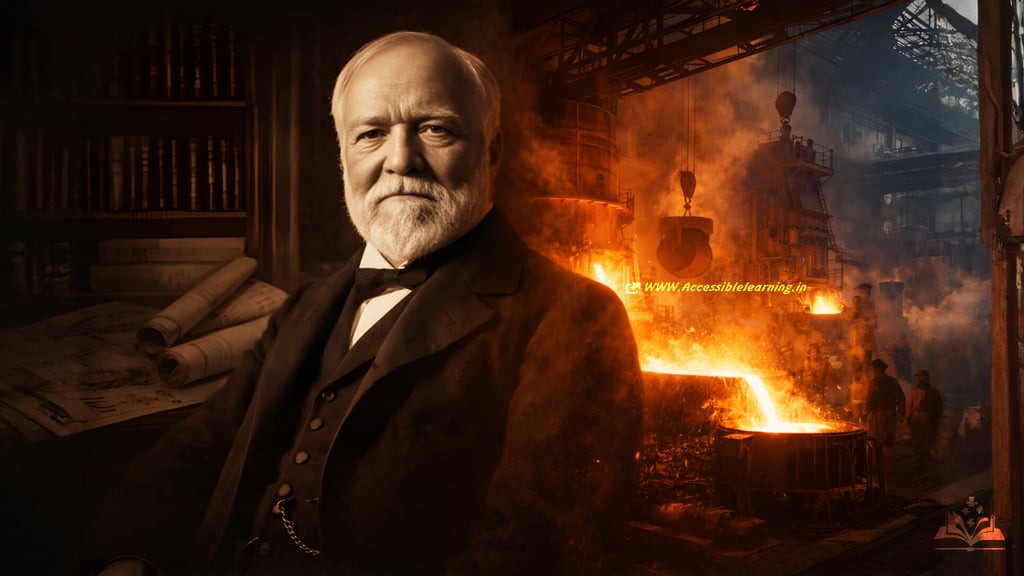
The Man Who Built America's Steel Backbone
Andrew Carnegie's industrial empire fundamentally transformed American manufacturing and established the blueprint for modern corporate consolidation. From humble beginnings as a Scottish immigrant to becoming one of history's wealthiest industrialists, Carnegie built a vertically integrated steel empire that supplied the materials for America's railroads, skyscrapers, and bridges during the nation's most explosive period of growth.
This comprehensive examination explores how Carnegie constructed his industrial dynasty, the business strategies that propelled his success, and the lasting impact of his empire on American industry and philanthropy.
Early Life and the Path to Industrial Power
From Bobbin Boy to Telegraph Operator
Born in Dunfermline, Scotland, in 1835, Andrew Carnegie immigrated to America with his family in 1848, settling in Allegheny, Pennsylvania. His first job as a bobbin boy in a cotton factory paid just $1.20 per week, but Carnegie's ambition and aptitude for learning quickly elevated him through various positions.
His breakthrough came when he secured a position as a telegraph operator for the Pennsylvania Railroad Company. This role proved transformative, exposing Carnegie to the inner workings of American business and providing crucial connections with influential industrialists and financiers.
Strategic Investments and Capital Accumulation
During his railroad years, Carnegie made strategic investments that laid the foundation for his future empire. He invested in sleeping car companies, iron works, oil lands, and bridge construction firms. By the early 1860s, his annual income from investments exceeded $45,000—an enormous sum at the time—providing the capital necessary to launch his steel ventures.
Building the Steel Empire: Vertical Integration and Innovation
The Keystone Bridge Company and Entry into Steel
Carnegie's first major venture into steel-related industries came with the founding of the Keystone Bridge Company in 1865. Recognizing that iron bridges were becoming obsolete, Carnegie positioned himself to capitalize on the growing demand for stronger, more durable steel bridges to support expanding railroad networks.
This venture demonstrated Carnegie's forward-thinking approach: he identified technological trends before they became mainstream and positioned his enterprises to benefit from coming changes.
The Edgar Thomson Steel Works: Revolutionary Production
In 1873, Carnegie founded the Edgar Thomson Steel Works in Braddock, Pennsylvania, marking his full commitment to steel manufacturing. This facility embodied Carnegie's core business philosophy: invest heavily in the most advanced technology, drive costs down through efficiency, and dominate through superior production capacity.
The Edgar Thomson Works was strategically located near Pittsburgh, providing access to:
Raw materials from nearby coal and iron ore deposits
Transportation via railroad and river networks
A growing labor force of immigrants
Proximity to major markets in the expanding eastern United States
Vertical Integration: Controlling Every Stage
Carnegie's genius lay in his systematic vertical integration strategy. Rather than relying on suppliers and distributors, Carnegie acquired:
Upstream Resources:
Iron ore mines in Minnesota's Mesabi Range
Coal fields in Pennsylvania
Limestone quarries for flux materials
Transportation Networks:
Railroad lines connecting mines to mills
Steamship lines for transporting ore across the Great Lakes
Barges and docking facilities
Production Facilities:
Blast furnaces for creating pig iron
Steel mills for refining and shaping
Rolling mills for creating finished products
This comprehensive control allowed Carnegie to reduce costs, ensure quality, eliminate middlemen, and respond rapidly to market demands. By the 1890s, Carnegie Steel Company could produce steel more cheaply than any competitor in the world.
The Bessemer Process and Technological Dominance
Embracing Revolutionary Technology
Carnegie's empire was built on the Bessemer process, a revolutionary method for mass-producing steel by blowing air through molten iron to remove impurities. While Carnegie didn't invent this technology, he recognized its transformative potential and implemented it more effectively than any American competitor.
Later, Carnegie adopted the open-hearth process, which allowed for even greater quality control and the production of specialized steel grades. His willingness to obsolete his own equipment in favor of superior technology became a defining characteristic of his business approach.
The Gospel of Efficiency
Carnegie famously posted signs in his mills reading, "Watch the costs, and the profits will take care of themselves." He employed detailed cost accounting methods unprecedented in American industry, tracking every expense down to fractions of cents per ton of steel produced.
This obsessive cost management, combined with economies of scale, allowed Carnegie to underprice competitors while maintaining healthy profit margins. During economic downturns, when other steel producers curtailed production, Carnegie often increased output, capturing market share and driving weaker competitors out of business.

Labor Relations and the Homestead Strike
The Dark Side of Industrial Progress
While Carnegie's business achievements were remarkable, his labor relations record remains controversial. The most notorious incident was the Homestead Strike of 1892 at Carnegie's Homestead Steel Works near Pittsburgh.
When the Amalgamated Association of Iron and Steel Workers rejected a wage reduction, Carnegie's partner Henry Clay Frick locked out workers and hired Pinkerton guards to protect replacement workers. The resulting confrontation turned violent, leaving several dead and many injured. The strike was ultimately crushed, dealing a severe blow to organized labor in the steel industry for decades.
Carnegie, conveniently in Scotland during the strike, publicly claimed to support workers' rights to organize while leaving the violent suppression to Frick. This contradiction between Carnegie's stated values and the realities of his business operations highlights the complex legacy of his industrial empire.
The Peak of Power: Carnegie Steel Company
Unprecedented Scale and Profitability
By 1900, Carnegie Steel Company was the largest and most profitable industrial enterprise in the world. The company produced:
More steel than all of Great Britain
Approximately 25% of American steel output
Annual profits exceeding $40 million
Carnegie's personal share of these profits made him one of the wealthiest individuals in human history, with an estimated fortune equivalent to over $300 billion in today's dollars.
The Management Team
Carnegie's success wasn't solely individual achievement. He assembled an exceptional management team, including
Henry Clay Frick: Ruthless business partner who expanded coke operations
Charles M. Schwab: Brilliant executive who managed day-to-day operations
Henry Phipps: Financial partner from Carnegie's early days
Carnegie pioneered the partnership model, offering key managers ownership stakes that aligned their interests with company success and incentivized innovation and cost reduction.
The Sale to J.P. Morgan and Formation of U.S. Steel
The Billion-Dollar Deal
In 1901, at age 65, Carnegie sold his steel empire to financier J.P. Morgan for $480 million—approximately $14 billion in current dollars. Morgan merged Carnegie Steel with several competitors to create United States Steel Corporation, the world's first billion-dollar corporation.
The sale represented the culmination of Morgan's effort to stabilize and rationalize the American steel industry. Carnegie, famously, sold out at the peak of the market, demonstrating the same keen timing that had characterized his entire business career.
According to legend, Morgan later told Carnegie, "You are now the richest man in the world," to which Carnegie supposedly replied with satisfaction about the price achieved.
Why Carnegie Sold
Several factors motivated Carnegie's decision to sell:
Age and desire to focus on philanthropy
Escalating competition and potential price wars
Morgan's willingness to pay a premium price
Carnegie's stated belief in his "Gospel of Wealth" philosophy
Carnegie's Business Philosophy and Strategies
The Gospel of Wealth
Carnegie articulated his business and social philosophy in his 1889 essay "The Gospel of Wealth." He argued that wealthy individuals had a moral obligation to use their fortunes for the public good during their lifetimes. This philosophy justified aggressive wealth accumulation while simultaneously creating an ethical framework for massive philanthropy.
Key Business Principles
Carnegie's empire was built on several core principles:
Technological Leadership: Continuously invest in the latest and most efficient production methods, even when it means scrapping functional but outdated equipment.
Cost Leadership: Focus relentlessly on reducing production costs to enable competitive pricing while maintaining profit margins.
Vertical Integration: Control all aspects of production from raw materials to finished products to eliminate dependencies and reduce costs.
Countercyclical Expansion: Invest and expand during economic downturns when asset prices are depressed and competition is weak.
Talent Development: Identify and reward exceptional managers with partnership opportunities and profit-sharing arrangements.
The Philanthropic Empire: Libraries, Universities, and Foundations
From Steelmaker to Philanthropist
After selling his business, Carnegie dedicated the remaining 18 years of his life to giving away his fortune. He donated approximately $350 million—roughly 90% of his wealth—to various causes, equivalent to billions in modern dollars.
Carnegie's Major Philanthropic Initiatives
Carnegie Libraries: Perhaps his most visible legacy, Carnegie funded 2,509 libraries worldwide, including 1,689 in the United States. His belief that free access to knowledge was essential to social mobility drove this massive library-building campaign.
Educational Institutions:
Carnegie Mellon University (originally Carnegie Technical Schools, founded 1900)
Carnegie Institution for Science in Washington, D.C.
Numerous other schools and educational foundations
The Carnegie Corporation of New York: Established in 1911 with $125 million, this foundation continues Carnegie's philanthropic work today, focusing on education, international peace, and democratic development.
The Carnegie Endowment for International Peace: Founded in 1910 to promote international understanding and prevent war.
Carnegie Hall: The famous New York concert venue, opened in 1891, which has hosted countless legendary performances.
The Industrial Legacy: Impact on American Manufacturing
Transforming American Industry
Carnegie's influence extended far beyond his own companies:
Manufacturing Standards: His cost accounting methods and efficiency standards became industry benchmarks adopted by manufacturers across sectors.
Corporate Structure: The vertical integration model influenced countless industries, from oil (Rockefeller's Standard Oil) to automobiles (Ford Motor Company).
Labor Relations: The aggressive anti-union stance of Carnegie Steel influenced labor relations in heavy industry for generations.
Technological Adoption: Carnegie's willingness to invest in new technology accelerated America's industrial modernization.
Infrastructure Development
Carnegie steel built America's physical infrastructure:
Railroad tracks crisscrossing the continent
Bridges spanning major rivers
Frameworks for early skyscrapers in growing cities
Naval vessels and armor plating
Machinery for countless factories


Criticisms and Controversies
The Contradictions of Carnegie's Legacy
Carnegie's legacy remains contested:
Labor Exploitation: Critics argue that Carnegie's fortune was built on the exploitation of workers who labored in dangerous conditions for low wages while Carnegie preached the Gospel of Wealth.
Homestead Strike: The violent suppression of workers at Homestead contradicted Carnegie's public statements supporting labor's right to organize.
Monopolistic Practices: Carnegie's aggressive competition drove many smaller producers out of business, concentrating economic power.
Philanthropy as Legacy Control: Some scholars argue Carnegie's philanthropy was partly motivated by a desire to control his public image and legacy rather than pure altruism.
Modern Perspectives
Contemporary historians generally view Carnegie as a complex figure who embodied both the remarkable creativity and troubling exploitation of the Gilded Age. His business achievements were genuine, his philanthropy was substantial, and his contradictions were profound.
Carnegie's Empire in the Context of the Gilded Age
The Era of Industrial Titans
Carnegie's empire emerged during America's Gilded Age (roughly 1870-1900), a period of rapid industrialization, technological innovation, massive immigration, and extreme inequality. Carnegie was one of several industrial titans who dominated this era:
John D. Rockefeller: Oil refining and Standard Oil
J.P. Morgan: Banking and financial consolidation
Cornelius Vanderbilt: Railroads and shipping
Henry Ford: Automobiles and assembly-line production (slightly later)
These industrialists accumulated unprecedented wealth while transforming American economic life. Carnegie's steel empire provided essential materials that enabled the expansion of railroads, cities, and manufacturing capacity.
Regulatory Response
The consolidation of economic power by Carnegie and his contemporaries eventually provoked a political response. The Progressive Era (1890s-1920s) brought:
Antitrust legislation (Sherman Antitrust Act of 1890)
Labor protections and regulations
Corporate taxation
Oversight of monopolistic practices
U.S. Steel, the company formed from Carnegie's empire, would later face antitrust challenges, though it was never broken up like Rockefeller's Standard Oil.
Lessons from Carnegie's Empire for Modern Business
Timeless Business Principles
Carnegie's empire offers several lessons relevant to contemporary business:
Innovation and Obsolescence: Carnegie's willingness to obsolete his own technology anticipates modern concepts of "creative destruction" and continuous innovation.
Operational Excellence: The relentless focus on cost reduction and efficiency remains central to competitive strategy.
Vertical Integration: While less common today, strategic control of supply chains remains crucial in many industries.
Timing and Market Cycles: Carnegie's countercyclical investing and well-timed exit demonstrate the importance of market timing and knowing when to harvest value.
Talent and Incentives: The partnership model and profit-sharing arrangements prefigure modern employee stock options and performance-based compensation.
Differences from Modern Business
Several aspects of Carnegie's empire reflect their historical period and wouldn't work in contemporary contexts:
Labor Relations: Modern labor laws, workplace safety regulations, and union rights prevent the exploitative practices common in Carnegie's era.
Environmental Regulations: Carnegie's mills operated with virtually no environmental controls, impossible in today's regulatory environment.
Market Concentration: Antitrust enforcement, though imperfect, prevents the kind of market dominance Carnegie achieved in steel.
Corporate Governance: Modern corporate structures, securities regulations, and shareholder rights differ dramatically from Carnegie's privately held partnership model.
Carnegie Mellon University: An Educational Legacy
From Technical School to World-Class University
Carnegie founded the Carnegie Technical Schools in Pittsburgh in 1900 with $1 million, later adding $19 million more. His vision was to provide practical technical education to working-class students, preparing them for skilled positions in Pittsburgh's industrial economy.
In 1967, Carnegie Tech merged with the Mellon Institute of Industrial Research to form Carnegie Mellon University, combining Carnegie's educational legacy with the research tradition established by the Mellon family (themselves Pittsburgh industrial titans).
Modern Reputation and Impact
Today, Carnegie Mellon University ranks among the world's premier research institutions, particularly in:
Computer science and artificial intelligence
Engineering and robotics
Business and economics
Fine arts and drama
The university embodies Carnegie's belief in education as the foundation for social mobility and economic progress, though its evolution far exceeded his original vision.

The Dual Legacy of Andrew Carnegie
Andrew Carnegie's industrial empire represents both the remarkable achievements and troubling contradictions of America's industrial age. He built the most efficient steel manufacturing operation in the world, supplied the materials for America's infrastructure expansion, pioneered modern business management practices, and gave away nearly his entire fortune to educational and cultural institutions that continue benefiting society today.
Yet this legacy was built on the backs of workers who labored in dangerous conditions for low wages, suppressed through violence when they organized for better treatment. Carnegie preached the Gospel of Wealth while his mills embodied wealth extraction. He championed education and social mobility while fighting unions that sought to improve workers' lives.
Understanding Carnegie's empire requires holding these contradictions in tension. His business genius was genuine. His philanthropy was substantial and lasting. His exploitation of workers was real. His impact on American industry and society was profound and multifaceted.
Today, Carnegie Mellon University, Carnegie libraries across America, and numerous foundations continue his philanthropic legacy. The business strategies he pioneered—vertical integration, technological innovation, and operational efficiency—remain relevant to modern enterprise. And the questions his career raises about wealth, power, labor, and social responsibility remain central to contemporary debates about capitalism and inequality.
The Carnegie industrial empire, in all its complexity, remains essential to understanding how modern America was built and the human costs and benefits of that construction.
Frequently Asked Questions
Q: How did Andrew Carnegie build his industrial empire?
Andrew Carnegie built his industrial empire through strategic vertical integration, technological innovation, and ruthless cost control. He started by investing railroad earnings in bridge building and iron works, then founded the Edgar Thomson Steel Works in 1873. Carnegie systematically acquired iron ore mines, coal fields, railroads, and steamships to control every stage of steel production. By adopting the Bessemer process and obsessively reducing costs, he underpriced competitors while maintaining high profits. His willingness to invest in new technology and expand during economic downturns allowed him to dominate the American steel industry by 1900.
Q: What made Carnegie Steel Company so successful?
Carnegie Steel's success stemmed from several factors: vertical integration that eliminated middlemen and reduced costs, adoption of cutting-edge production technology like the Bessemer and open-hearth processes, detailed cost accounting that tracked every expense, strategic location near raw materials and markets, and a partnership model that incentivized managers with profit-sharing. Carnegie's countercyclical strategy of expanding during recessions when costs were low also gave him competitive advantages. By 1900, the company produced more steel than all of Britain while generating over $40 million in annual profits.
Q: Why did Andrew Carnegie sell his steel company?
Carnegie sold his steel empire to J.P. Morgan in 1901 for $480 million for several reasons. At 65 years old, he wanted to devote his remaining years to philanthropy, consistent with his "Gospel of Wealth" philosophy. Escalating competition threatened future price wars that could reduce profitability. Morgan offered a premium price at what Carnegie recognized as the market peak. Additionally, Carnegie had achieved his financial goals and believed wealthy individuals should give away their fortunes during their lifetimes rather than pass them to heirs.
Q: What was the Homestead Strike, and how did it affect Carnegie's reputation?
The Homestead Strike of 1892 was a violent labor dispute at Carnegie's Homestead Steel Works. When workers rejected wage cuts, Carnegie's partner Henry Clay Frick locked them out and hired Pinkerton guards to protect replacement workers. The resulting confrontation left several dead and crushed the union. Carnegie, in Scotland during the strike, publicly claimed to support workers' rights while letting Frick handle the violent suppression. This contradiction between Carnegie's stated values and his business practices damaged his reputation and highlighted the exploitative labor conditions underlying his fortune.
Q: How much money did Andrew Carnegie donate to charity?
Andrew Carnegie donated approximately $350 million between 1901 and his death in 1919—roughly 90% of his fortune and equivalent to billions in today's dollars. His major philanthropic initiatives included funding 2,509 libraries worldwide, establishing Carnegie Mellon University, founding the Carnegie Corporation of New York with $125 million, creating the Carnegie Endowment for International Peace, building Carnegie Hall, and supporting numerous educational and scientific institutions. His "Gospel of Wealth" philosophy argued that the wealthy had a moral obligation to use their fortunes for public benefit during their lifetimes.
Q: What is the difference between Andrew Carnegie's empire and Carnegie Mellon University?
Andrew Carnegie's industrial empire refers to his steel manufacturing business, including Carnegie Steel Company and its vertically integrated operations (mines, mills, railroads, etc.). Carnegie Mellon University is an educational institution that Carnegie founded in 1900 as Carnegie Technical Schools to provide practical education to working-class students. In 1967, it merged with the Mellon Institute to become Carnegie Mellon University. While the university bears Carnegie's name and represents his philanthropic legacy, it is separate from his former business empire, which was sold to J.P. Morgan in 1901 and became part of U.S. Steel Corporation.
Q: How did Carnegie's vertical integration strategy work?
Carnegie's vertical integration strategy involved controlling every stage of steel production. He acquired iron ore mines in Minnesota's Mesabi Range, coal fields in Pennsylvania, and limestone quarries for raw materials. He purchased railroads, steamships, and barges to transport materials. He owned blast furnaces, steel mills, and rolling mills for processing. This comprehensive control eliminated dependence on suppliers, reduced costs by eliminating middlemen's profits, ensured quality and reliability, and allowed rapid response to market changes. By 1900, Carnegie Steel controlled production from mine to finished product, giving it unmatched cost advantages over competitors.
Q: What was Andrew Carnegie's Gospel of Wealth?
The "Gospel of Wealth" was Carnegie's 1889 essay articulating his philosophy about wealth and philanthropy. He argued that successful businessmen had a moral duty to accumulate wealth through their enterprises but then to distribute that wealth for public benefit during their lifetimes. Carnegie believed inherited wealth was harmful and that the wealthy should act as "trustees" for society, funding libraries, universities, and other institutions that promoted social mobility and progress. This philosophy justified aggressive wealth accumulation while creating an ethical framework for large-scale philanthropy, though critics argued it didn't excuse the exploitation underlying that wealth.
Q: How did Andrew Carnegie treat his workers?
Carnegie's treatment of workers reflected the harsh realities of Gilded Age industry. Workers in his steel mills faced dangerous conditions, long hours (often 12-hour shifts, seven days a week), and low wages compared to the enormous profits generated. The Homestead Strike of 1892 demonstrated Carnegie's willingness to use violence to suppress labor organizing, despite his public statements supporting workers' rights. However, Carnegie also pioneered profit-sharing partnerships for managers and believed in providing educational opportunities. His labor record remains controversial, embodying the contradiction between his public philanthropy and the exploitative conditions underlying his fortune.
Q: What happened to Carnegie's industrial empire after he sold it?
After Carnegie sold his steel company to J.P. Morgan in 1901, it was merged with several competitors to form United States Steel Corporation, the world's first billion-dollar corporation. U.S. Steel dominated American steel production throughout the 20th century, though its market share gradually declined due to competition and changing industry dynamics. The company still exists today as U.S. Steel (now much smaller relative to global competitors). Many of Carnegie's original facilities, including the Edgar Thomson Works in Braddock, Pennsylvania, continued operating for over a century, though most have since closed or been dramatically downsized as American steel production shifted and declined.
Subscribe to Frontier Intelligence
All © Copyright reserved by Accessible-Learning Hub
| Terms & Conditions
Accessible Learning Hub — Actionable clarity for high-agency minds.
Weekly breakdowns on AI breakthroughs, capital flow, and human performance systems. Zero fluff.