

Ford Industrial Empire: How Henry Ford Revolutionized Manufacturing and Built an American Powerhouse
Discover how Henry Ford built an industrial empire that revolutionized manufacturing, created the middle class, and transformed global industry through innovation and mass production.
WEALTHY FAMILYEMPIRES/HISTORYCOMPANY/INDUSTRY
Sachin K Chaurasiya
2/11/20267 min read
When Henry Ford introduced the Model T in 1908, he didn't just create a car—he sparked an industrial revolution that transformed American manufacturing, labor practices, and the very fabric of modern society. The Ford Industrial Empire became synonymous with innovation, efficiency, and the democratization of technology, principles that continue shaping global industry today.
The Foundation of Ford's Industrial Vision
Henry Ford founded the Ford Motor Company on June 16, 1903, in Detroit, Michigan, with just $28,000 in capital from twelve investors. Unlike his contemporaries who built luxury automobiles for the wealthy, Ford envisioned something radically different: a reliable, affordable vehicle that average American families could purchase.
This vision materialized in the Model T, affectionately nicknamed the "Tin Lizzie." Initially priced at $850, Ford's relentless pursuit of efficiency eventually drove the price down to $260 by 1925—equivalent to roughly $4,500 in today's dollars. This pricing strategy wasn't just competitive; it was revolutionary, making automobile ownership accessible to the middle class for the first time in history.
The Assembly Line Revolution: Manufacturing Reimagined
Ford's most transformative contribution wasn't the automobile itself but rather how it was built. In 1913, Ford implemented the moving assembly line at his Highland Park, Michigan, plant, fundamentally changing manufacturing forever.
How the Assembly Line Worked
Previous automobile manufacturing required skilled craftsmen to build entire vehicles from start to finish—a process taking over 12 hours per car. Ford's system broke production into 84 discrete steps, with workers stationed at fixed positions as vehicles moved past them on conveyor belts.
The results were staggering:
Assembly time dropped from 12.5 hours to 93 minutes per vehicle
Production capacity increased exponentially, reaching 9,000 cars daily by 1925
Manufacturing costs plummeted, enabling aggressive price reductions
Standardization became paramount, with Ford famously declaring customers could have "any color they wanted, as long as it was black" (black paint dried fastest)
This wasn't merely about speed—it represented a complete philosophical shift toward specialization, standardization, and continuous flow manufacturing. The principles Ford pioneered became known as "Fordism" and influenced industries worldwide, from electronics to food processing.
The $5 Workday: Labor Revolution and Profit Sharing
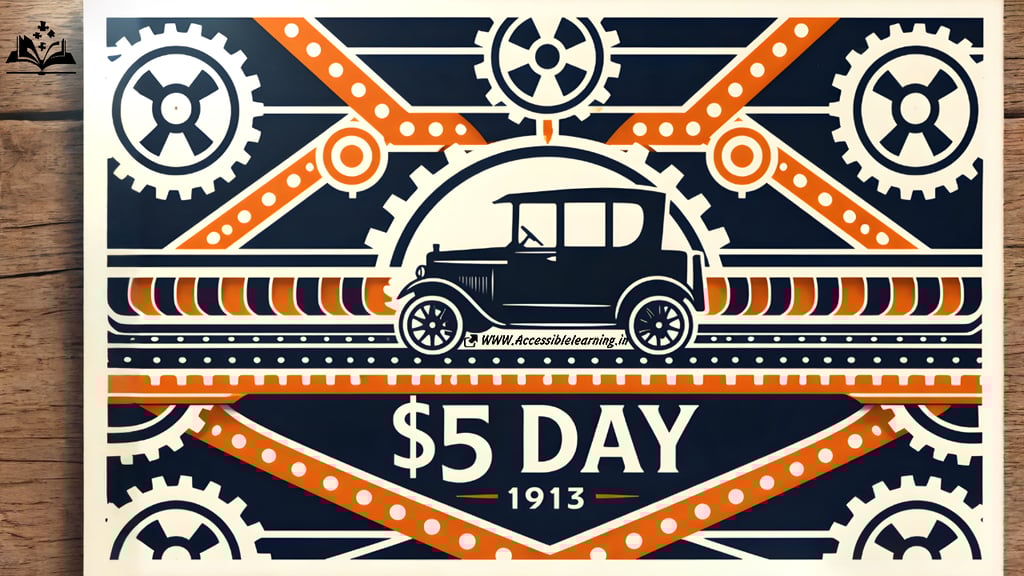
On January 5, 1914, Ford made another groundbreaking announcement that sent shockwaves through American industry: he would pay workers $5 per day—more than double the prevailing wage of $2.34—and reduce the workday from nine hours to eight.
Why This Mattered
Critics predicted financial ruin, but Ford's reasoning proved brilliantly strategic:
Reducing turnover: Annual employee turnover had reached 370% due to the monotonous, physically demanding assembly line work. The higher wage reduced turnover to 16%, saving enormous recruitment and training costs.
Creating customers: Ford understood that his workers needed sufficient income to purchase the cars they built. By paying higher wages, he expanded his customer base while building employee loyalty.
Increasing productivity: Well-compensated workers demonstrated higher morale, attendance, and efficiency. The policy paid for itself through increased output and quality.
Attracting top talent: Ford's factories attracted the best workers from across the country and globe, giving him first choice of the labor pool.
However, Ford's benevolence came with paternalistic strings attached. The company's "Sociological Department" investigated workers' private lives, ensuring they met Ford's standards for clean living, sobriety, and financial responsibility. Workers had to prove they deserved the higher wage through proper lifestyle choices—a controversial aspect of Ford's legacy.
The River Rouge Complex: Industrial Self-Sufficiency
Ford's ultimate expression of vertical integration was the River Rouge Plant in Dearborn, Michigan, which began production in 1918 and reached peak operations in the 1930s. This wasn't just a factory—it was an industrial city.
The Scale of River Rouge
At its peak, the River Rouge complex encompassed:
2,000 acres of floor space under roof
100,000 workers employed
93 buildings, including power plants, steel mills, glass factories, and assembly lines
16 million square feet of factory space
100 miles of railroad track for internal transportation
The facility achieved unprecedented vertical integration. Raw materials entered one end—iron ore, coal, limestone, rubber, and sand—and finished automobiles drove out the other. Ford owned the mines that produced the ore, the forests that provided lumber, the rubber plantations in Brazil, the glass factories, and the steel mills. A Ford vehicle could be manufactured from raw materials to finished product in just 81 hours.
This self-sufficiency provided enormous competitive advantages: cost control, quality assurance, supply chain reliability, and independence from suppliers. However, it also created inflexibility that would later challenge the company.

Global Expansion and the Fordson Tractor
Ford's industrial empire extended far beyond automobiles. The Fordson tractor, introduced in 1917, revolutionized agriculture just as the Model T transformed transportation.
Agricultural Revolution
The Fordson made mechanized farming affordable for average farmers, dramatically increasing agricultural productivity worldwide. By 1923, Ford had produced over 500,000 tractors, with significant exports to the Soviet Union, Ireland, and throughout Europe.
Ford also established manufacturing facilities globally:
Ford of Britain (1911)
Ford Canada (1904, later manufacturing vehicles)
Assembly plants in Argentina, South Africa, Australia, India, and numerous European countries
By the 1920s, Ford vehicles were sold in over 33 countries, making it one of the world's first truly global manufacturing enterprises.
Innovation Beyond Manufacturing
Ford's empire pioneered numerous industrial innovations still relevant today:
Mass production techniques: Breaking complex products into simple, repeatable tasks
Just-in-time inventory: Minimizing parts storage through precise timing
Vertical integration: Controlling the entire supply chain from raw materials to finished products
Worker welfare programs: Though paternalistic, they established precedents for corporate responsibility
Standardized parts: Interchangeable components that simplified repairs and reduced costs
Production efficiency metrics: Systematic measurement and optimization of manufacturing processes
The Empire's Challenges and Evolution
Despite its dominance, Ford's empire faced significant challenges by the 1930s:
Competition from General Motors: GM's strategy of offering multiple brands at various price points eroded Ford's market share. By 1936, GM had surpassed Ford in sales.
Resistance to change: Henry Ford's stubbornness—refusing to abandon the Model T until 1927, resisting safety glass, and initially opposing the V-8 engine—allowed competitors to innovate faster.
Labor conflicts: Ford violently resisted unionization throughout the 1930s, culminating in the notorious "Battle of the Overpass" in 1937. Ford was the last major automaker to recognize the United Auto Workers union in 1941.
Management succession: Henry Ford's aging and increasingly erratic behavior in the 1940s nearly destroyed the company. His grandson, Henry Ford II, saved the company after World War II by implementing modern management practices.
Ford's Industrial Legacy Today
The Ford Motor Company remains America's fifth-largest corporation by revenue, generating approximately $176 billion in 2023. While no longer the dominant force it once was, Ford continues innovating with
Electric vehicles: The F-150 Lightning electric pickup and Mustang Mach-E SUV
Autonomous vehicle research: Through partnerships with Argo AI and internal development
Connected vehicle technology: Integrating vehicles with digital ecosystems
Sustainable manufacturing: Investing in carbon-neutral factories and recycling programs
The River Rouge Complex still operates, now producing the F-150 pickup—America's best-selling vehicle for over four decades—though with just 6,000 workers compared to its historic peak.
The Broader Impact on American Industry
Ford's industrial empire fundamentally shaped modern capitalism and manufacturing:
The middle class: By paying high wages and producing affordable goods, Ford helped create America's prosperous middle class and demonstrated that mass consumption required mass purchasing power.
Industrial suburbs: Ford's factories spawned entire communities of workers, contributing to suburban development patterns still visible today.
Manufacturing philosophy: Fordism influenced global industry, from Japanese manufacturing (which refined it into "lean manufacturing") to modern supply chain management.
Corporate scale: Ford demonstrated that massive corporate enterprises could achieve unprecedented efficiency and market dominance, establishing templates for 20th-century capitalism.
Controversies and Dark Chapters
A complete account must acknowledge Ford's troubling legacy:
Anti-Semitism: Henry Ford published "The International Jew," a virulently anti-Semitic series of articles in his newspaper, The Dearborn Independent. He accepted Nazi Germany's Grand Cross of the German Eagle in 1938, and his writings influenced Adolf Hitler.
Union busting: Ford employed violence and intimidation against labor organizers, maintaining a private security force that harassed and assaulted union members.
Paternalistic control: The Sociological Department's invasions of workers' privacy and lives represented corporate overreach, investigating everything from cleanliness to marital status.
These aspects complicate Ford's legacy, reminding us that industrial progress doesn't guarantee moral progress.

An Empire That Reshaped the World
The Ford Industrial Empire represents far more than one man's business success. It embodied a transformative vision of industrial democracy—the idea that mass production and mass consumption could create widespread prosperity. Henry Ford proved that paying workers well and selling products affordably could generate enormous profits while elevating living standards.
Today, as manufacturers wrestle with automation, globalization, sustainability, and workers' rights, Ford's innovations and contradictions remain remarkably relevant. His empire demonstrated both the tremendous potential and serious pitfalls of industrial capitalism.
The assembly lines still hum in Dearborn, but they now build electric trucks alongside traditional vehicles—a fitting symbol of how Ford's legacy continues evolving. The industrial empire he built didn't just manufacture cars; it manufactured the modern world, for better and worse.
Frequently Asked Questions
Q: What made Henry Ford's assembly line revolutionary?
Ford's moving assembly line reduced car manufacturing time from over 12 hours to 93 minutes by breaking production into specialized tasks, enabling workers to focus on single repetitive operations as vehicles moved past them. This dramatically lowered costs and increased output, making affordable automobiles possible.
Q: How much did Ford pay workers compared to competitors?
In 1914, Ford introduced the $5 workday when the industry standard was $2.34. This more than doubled wages, reduced employee turnover from 370% to 16% annually, and created loyal workers who could afford to buy Ford products.
Q: What was the River Rouge Plant?
River Rouge was Ford's massive industrial complex in Dearborn, Michigan, spanning 2,000 acres with 93 buildings. It achieved complete vertical integration, processing raw materials like iron ore and coal into finished automobiles within 81 hours, employing 100,000 workers at peak operation.
Q: When did Ford surpass other automakers in production?
By 1920, Ford produced over half of all automobiles in America. In 1923, Ford manufactured 57% of the nation's cars. However, General Motors overtook Ford in sales by 1936 due to GM's multi-brand strategy and Ford's resistance to design changes.
Q: How did Ford's industrial methods influence other industries?
"Fordism"—the combination of assembly line production, standardization, and high wages—became the manufacturing blueprint worldwide. Industries from food processing to electronics adopted Ford's principles, and Japanese manufacturers later refined these concepts into lean manufacturing.
Q: What innovations did Henry Ford pioneer beyond the automobile?
Ford revolutionized industrial practices, including vertical integration, mass production techniques, standardized interchangeable parts, scientific management principles, worker welfare programs, and global manufacturing networks—all of which transformed modern industry.
Subscribe to Frontier Intelligence
All © Copyright reserved by Accessible-Learning Hub
| Terms & Conditions
Accessible Learning Hub — Actionable clarity for high-agency minds.
Weekly breakdowns on AI breakthroughs, capital flow, and human performance systems. Zero fluff.