

The Vanderbilt Railroad Empire: How Cornelius Vanderbilt Built America's Transportation Legacy
Discover how Cornelius Vanderbilt built America's railroad empire from humble beginnings, amassed historic wealth, and transformed U.S. transportation forever.
FINANCE, MARKETS & ECONOMY
Shiv Singh Rajput
1/21/20268 min read
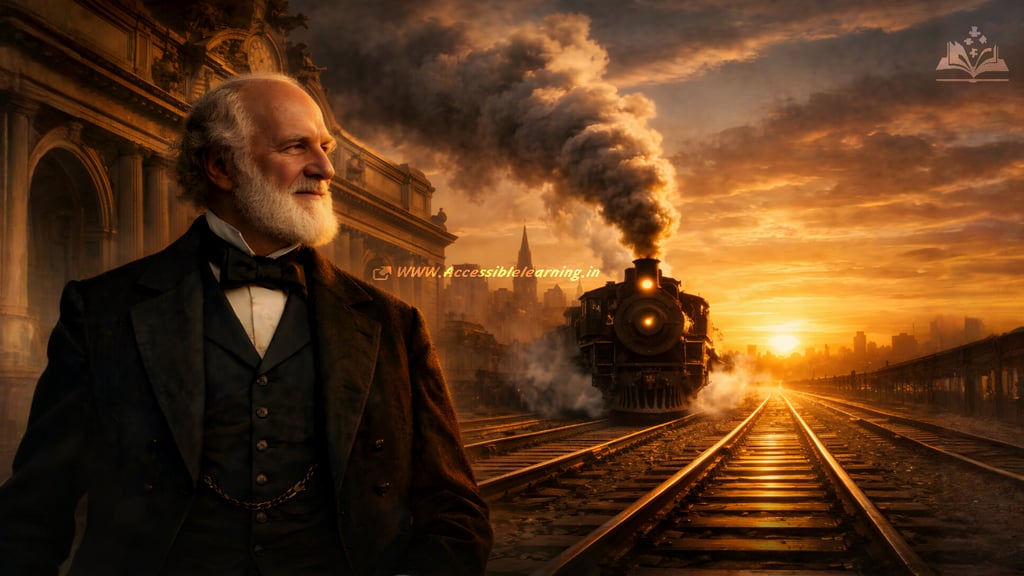
From Ferry Boy to Railroad Titan: The Extraordinary Rise of America's First Business Magnate
Cornelius Vanderbilt, known as "the Commodore," was born on May 27, 1794, and died on January 4, 1877. His journey from an 11-year-old school dropout working on his father's ferry to becoming one of the wealthiest Americans in history epitomizes the transformative power of ambition, strategic thinking, and relentless determination during America's industrial revolution.
Who Was Cornelius Vanderbilt, and Why Does He Matter?
Vanderbilt was a self-made multi-millionaire who became one of the wealthiest Americans of the 19th century, building empires in both shipping and railroads. His influence extended far beyond personal wealth—he fundamentally transformed American transportation infrastructure and established business practices that shaped modern corporate America.
Early Life: Humble Beginnings on Staten Island
Born into humble circumstances in Port Richmond on Staten Island, Vanderbilt descended from Dutch settlers who came to America in the mid-1600s. His parents, Cornelius and Phebe Hand Vanderbilt, worked a small farm, while his father also operated a ferry service using a periauger, a small two-masted sailboat that transported goods and passengers between Staten Island and Manhattan.
At age 11, young Cornelius left school to work alongside his father, learning the maritime trade that would become the foundation of his future empire. This early exposure to transportation logistics and customer service proved invaluable, teaching him practical business skills that no classroom could provide.
The Steamship Era: Building the Foundation of Wealth
Working for Thomas Gibbons: The Formative Years
In 1817, Vanderbilt became a steamship captain for wealthy businessman Thomas Gibbons, who operated a commercial steamboat service between New Jersey and New York. This position transformed Vanderbilt's understanding of large-scale business operations. Under Gibbons' mentorship, he learned to manage complex commercial enterprises, handle legal challenges, and compete aggressively in contested markets.
Gibbons once famously stated of Vanderbilt, "I am afraid of this man," recognizing his protégé's intense ambition and competitive drive.
The Nicaragua Route: Capitalizing on the Gold Rush
During the early 1850s California Gold Rush, Vanderbilt launched a steamship service transporting prospectors from New York to San Francisco via Nicaragua. His route proved faster than the established Panama crossing and dramatically speedier than sailing around Cape Horn at South America's southern tip—a journey that could take months.
This Nicaragua line became an instant financial success, earning more than $1 million annually (approximately $26 million in today's currency). The venture demonstrated Vanderbilt's ability to identify market opportunities, innovate transportation solutions, and execute complex logistics across international boundaries.
The Railroad Revolution: Vanderbilt's Greatest Achievement
Why Did Vanderbilt Shift from Ships to Railroads?
At age 70, encouraged by his son William, Vanderbilt decided to build a railroad empire. By the 1860s, he recognized that railroads represented the future of American transportation. The transcontinental vision taking shape across the nation offered unprecedented opportunities for those who could consolidate fragmented rail lines into efficient, integrated systems.
Strategic Acquisitions: Building the New York Central System
Vanderbilt's railroad empire emerged through a series of calculated acquisitions:
The New York and Harlem Railroad (1863): His first major railroad purchase, this struggling line ran through prime Manhattan real estate. Despite the company's financial troubles, Vanderbilt saw value in its route and began accumulating shares until he controlled the company.
He bought control of the Hudson River Railroad in 1864, the New York Central Railroad in 1867, and the Lake Shore and Michigan Southern Railway in 1869. Each acquisition was both defensive—protecting existing investments—and offensive, extending his network's reach.
The Consolidation of 1870: Vanderbilt consolidated two key lines into the New York Central and Hudson River Railroad in 1870, creating one of the first giant corporations in United States history. This consolidation exemplified his business philosophy: unified operations, standardized systems, and efficient management.
Connecting New York to Chicago: The Crown Jewel
When Vanderbilt added the Lake Shore and Michigan Southern Railroad in 1873, he could offer the first rail service from New York City to Chicago. This New York-to-Chicago connection represented the most extensive and busiest railway network in America at the time.
By standardizing rail service, Vanderbilt improved baggage and cargo transfers and introduced universal scheduling systems. These innovations seem mundane today but were revolutionary in an era of chaotic, uncoordinated rail operations.
Grand Central Terminal: A Lasting Monument
In 1869, Vanderbilt directed the Harlem Railroad to begin construction of the Grand Central Depot on 42nd Street in Manhattan, which was completed in 1871. He buried the tracks on 4th Avenue in a cut that later became a tunnel, transforming that thoroughfare into what we now know as Park Avenue.
The depot served as the terminus for his railroad lines in New York City and was later replaced by the iconic Grand Central Terminal in 1913—a building that still stands as a testament to Vanderbilt's vision and ambition.

Business Tactics: Captain of Industry or Robber Baron?
Competitive Strategies and Market Dominance
Vanderbilt is often described as either a "captain of industry" or a "robber baron" for his monopoly on shipping and railroads, facilitated partly through political manipulation. His business methods included:
Aggressive fare wars: He would undercut competitors' prices until they either went bankrupt or paid him to cease operations
Stock manipulation: He engaged in strategic buying and selling to control companies
Political influence: He worked with (and sometimes bribed) politicians to secure favorable legislation
Defensive acquisitions: He purchased competing lines to protect his existing investments
The Erie War: A Legendary Rivalry
One of Vanderbilt's most famous conflicts involved Jay Gould and James Fisk over control of the Erie Railroad. As Vanderbilt accumulated shares, Gould and associates issued increasingly more stock to prevent him from gaining majority control—a practice known as "watered stock." Gould eventually won by bribing the New York state legislature to authorize the stock as legal.
This battle exemplified the cutthroat nature of 19th-century corporate America, where few regulations existed to constrain aggressive business tactics.
Vanderbilt's Unprecedented Wealth: A Historical Perspective
How Rich Was Cornelius Vanderbilt Really?
Vanderbilt's peak wealth reached $105 million in 1877, which equals approximately $3.1 billion in 2024 dollars. However, this inflation-adjusted figure doesn't capture his true economic dominance.
According to "The Wealthy 100" by Michael Klepper and Robert Gunther, Vanderbilt would be worth $143 billion in 2007 dollars if his wealth as a share of the nation's GDP in 1877 were applied in that same proportion today. His $100 million estate represented 1/87th, or 1.1%, of the entire nation's GDP—essentially one out of every 87 dollars in the United States.
Ranking Among History's Wealthiest Americans
This GDP-based calculation would make Vanderbilt the second-wealthiest person in United States history, after Standard Oil co-founder John D. Rockefeller. Other calculations place him third, after Rockefeller and Andrew Carnegie. Regardless of the exact ranking, Vanderbilt indisputably stands among the wealthiest Americans ever.
Philanthropy and Legacy: More Than Just Money
Founding Vanderbilt University
In 1869, Vanderbilt married Frank Armstrong Crawford, whose influence convinced him to donate $1 million—the largest charitable gift in American history to that date—to found Vanderbilt University in Nashville, Tennessee. The university, named in his honor, remains one of the nation's premier educational institutions.
Other Charitable Contributions
Beyond the university, Vanderbilt donated to numerous churches throughout New York, including providing land for the Moravian Cemetery on Staten Island, where he chose to be buried. These philanthropic acts, while modest compared to his total wealth, demonstrated a growing awareness of social responsibility among America's industrial elite.
The Family Fortune: Distribution and Decline
The Will That Changed Everything
William Henry Vanderbilt, Cornelius's eldest son, received the bulk of the estate, while Cornelius Vanderbilt II received $5 million, and three younger sons received $2 million each. His daughters received between $250,000 and $500,000 each. To his younger son, Cornelius Jeremiah, whom he considered wasteful, he left only income from a $200,000 trust fund.
The Rapid Dissipation of Wealth
Despite this enormous inheritance, by a 1973 family reunion, not one of the 120 Vanderbilt descendants present was a millionaire. The family's wealth evaporated through lavish spending on mansions, poor investment decisions, expensive divorces, and the mathematical challenge of dividing wealth among increasingly numerous heirs.
The Vanderbilt story serves as a cautionary tale about wealth preservation, demonstrating that even the greatest fortunes can vanish without proper financial education, discipline, and planning across generations.
Impact on American Infrastructure and Commerce
Transforming the Geography of the United States
Vanderbilt's biographer T.J. Stiles noted that "he vastly improved and expanded the nation's transportation infrastructure, contributing to a transformation of the very geography of the United States." By creating efficient rail connections between major cities, Vanderbilt facilitated:
Westward expansion and settlement
Industrial growth through improved freight transportation
Standardization of railway operations
Development of corporate business structures
Integration of regional economies into a national marketplace
Recognition and Honors
In 1999, Cornelius Vanderbilt was inducted into the North America Railway Hall of Fame in the "Railway Workers & Builders: North America" category, recognizing his significant contributions to the railroad industry.

The Commodore's Enduring Influence
Cornelius Vanderbilt's railroad empire represented more than personal enrichment—it exemplified America's industrial transformation and the rise of modern corporate enterprise. His business methods, while controversial, established practices and structures that shaped American capitalism for generations.
From dropping out of school at 11 to becoming one of history's wealthiest individuals, Vanderbilt embodied the American Dream's promise that determination, strategic thinking, and willingness to take risks could generate extraordinary success. His railroad consolidations created infrastructure essential to America's emergence as a global economic power.
Today, more than 140 years after his death, Vanderbilt's name remains synonymous with wealth, ambition, and industrial innovation. His legacy endures not only in the physical infrastructure he built but in the corporate structures, competitive practices, and transportation systems that continue shaping modern American life.
The Vanderbilt story also serves as a powerful reminder about wealth preservation's challenges, demonstrating that even the greatest fortunes require intentional management, financial education, and careful planning to survive across generations—lessons as relevant today as they were in the Gilded Age.
Frequently Asked Questions
Q: How did Cornelius Vanderbilt make his money?
Vanderbilt built his initial fortune through steamship operations, then shifted focus to railroads in his seventies. He acquired and consolidated multiple rail lines connecting New York City to Chicago, creating America's first major railroad empire and one of the nation's first giant corporations.
Q: Was Cornelius Vanderbilt the richest person in America?
Yes, at his death in 1877, Vanderbilt was the wealthiest person in America with an estate worth over $100 million—more than the U.S. Treasury held at the time. His wealth represented approximately 1.1% of the entire national GDP, making him one of the richest Americans in history when adjusted for economic scale.
Q: What railroads did Vanderbilt own?
Vanderbilt controlled the New York and Harlem Railroad, Hudson River Railroad, New York Central Railroad, Lake Shore and Michigan Southern Railway, and Canada Southern Railway. He consolidated these into the New York Central and Hudson River Railroad system, creating the first continuous rail service from New York to Chicago.
Q: Why is Cornelius Vanderbilt called "the Commodore"?
Vanderbilt earned the nickname "the Commodore" during his steamship career, when other boatmen used this naval title to recognize his dominance and expertise in maritime transportation. The nickname stuck throughout his life, even after transitioning to railroads.
Q: Did Vanderbilt build Grand Central Station?
Vanderbilt initiated construction of the Grand Central Depot, which opened in 1871 as the terminus for his railroad lines. This original depot was later replaced by the current Grand Central Terminal in 1913, though a statue of Vanderbilt still stands at the terminal's south side.
Q: What happened to the Vanderbilt fortune?
Despite the massive initial wealth, the Vanderbilt fortune dissipated within three generations due to lavish spending on estates and social status, poor investment decisions, expensive divorces, and wealth division among numerous heirs. By 1973, no Vanderbilt descendants were millionaires.
Q: How did Vanderbilt's railroads change America?
Vanderbilt's integrated railroad system standardized operations, improved efficiency, reduced transportation costs, and connected major American cities. This infrastructure facilitated westward expansion, industrial development, and the creation of a truly national economy, fundamentally transforming how goods and people moved across the continent.
Q: Where can you see Vanderbilt's legacy today?
Vanderbilt's legacy remains visible in Grand Central Terminal (where his statue stands), Vanderbilt University in Nashville, Tennessee, and in the corporate structures and business practices he pioneered. The New York Central Railroad system he created continued operating well into the 20th century.
Subscribe to Frontier Intelligence
All © Copyright reserved by Accessible-Learning Hub
| Terms & Conditions
Accessible Learning Hub — Actionable clarity for high-agency minds.
Weekly breakdowns on AI breakthroughs, capital flow, and human performance systems. Zero fluff.