

The Austro-Hungarian Empire: A Comprehensive Guide to the Dual Monarchy (1867-1918)
Discover the Austro-Hungarian Empire's rise, cultural achievements, ethnic complexities, and dramatic collapse. Complete guide to the Dual Monarchy (1867-1918).
EMPIRES/HISTORYHISTORY
Kim Shin
2/20/202613 min read
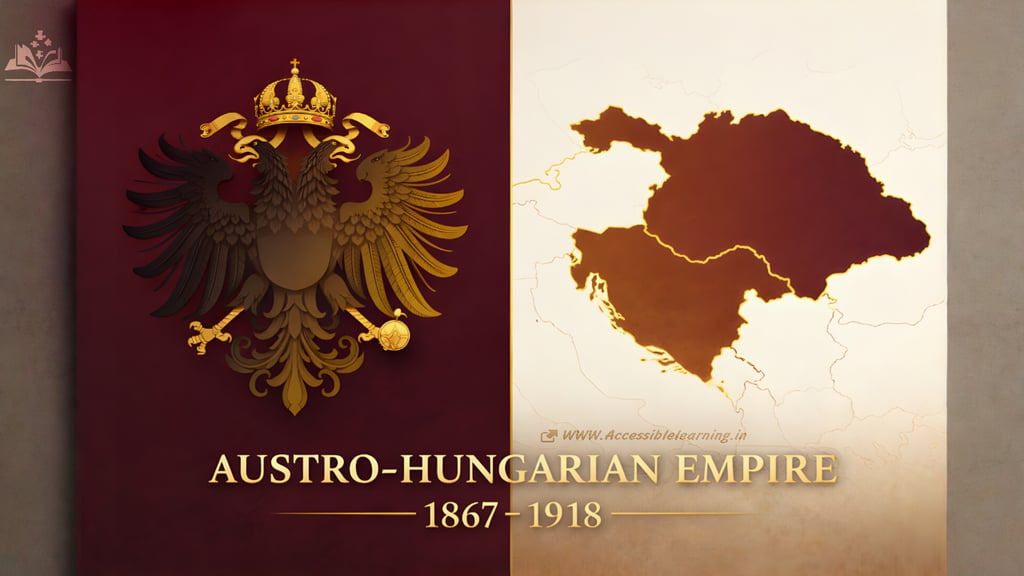
The Austro-Hungarian Empire, also known as the Dual Monarchy, stands as one of Europe's most complex and influential multinational states. This vast central European power shaped the continent's political landscape for over half a century before its dissolution following World War I. Understanding this empire reveals crucial insights into modern European history, ethnic nationalism, and the forces that continue to shape Central and Eastern Europe today.
What Was the Austro-Hungarian Empire?
The Austro-Hungarian Empire emerged in 1867 through the Austro-Hungarian Compromise, transforming the Austrian Empire into a dual constitutional monarchy. This unique political arrangement united two distinct kingdoms—the Austrian Empire (Cisleithania) and the Kingdom of Hungary (Transleithania)—under a single monarch who ruled as Emperor of Austria and King of Hungary simultaneously.
The empire controlled approximately 621,538 square kilometers at its height, making it the second-largest country in Europe after the Russian Empire. Its territories encompassed modern-day Austria, Hungary, the Czech Republic, Slovakia, Slovenia, Croatia, Bosnia and Herzegovina, and parts of Poland, Romania, Ukraine, Italy, Serbia, and Montenegro.
The Formation of the Dual Monarchy: Understanding the 1867 Compromise
The creation of Austria-Hungary emerged from political necessity rather than ideological vision. Following Austria's defeat in the Austro-Prussian War of 1866, Emperor Franz Joseph I faced mounting pressure from Hungarian nationalists who demanded greater autonomy. The Hungarian nobility, led by Ferenc Deák and Count Gyula Andrássy, negotiated the Ausgleich (Compromise) that fundamentally restructured imperial governance.
This compromise established a unique constitutional arrangement where Austria and Hungary maintained separate parliaments, governments, and legal systems while sharing a common monarch, unified foreign policy, joint military command, and coordinated fiscal policy. Three joint ministries managed foreign affairs, war, and finance for common expenditures, creating an intricate balance of shared sovereignty and national autonomy.
The Hungarian side of the arrangement gained substantial independence, including control over internal affairs, taxation, and administration of their territories. This settlement, however, excluded the empire's other major ethnic groups—Czechs, Poles, Ukrainians, Romanians, Serbs, Croats, and others—from similar autonomy, creating tensions that would eventually contribute to the empire's collapse.
Political Structure and Governance of Austria-Hungary
The Austro-Hungarian political system represented one of the most complex governmental arrangements in European history. Emperor Franz Joseph I, who reigned from 1848 until 1916, served as the unifying figure, holding titles as Emperor of Austria, Apostolic King of Hungary, and King of Bohemia, among numerous others.
In the Austrian half (Cisleithania), a bicameral Imperial Council (Reichsrat) included an upper house of appointed nobles and a lower house elected through a limited franchise that gradually expanded. The Austrian government administered seventeen crown lands, each with varying degrees of local autonomy. The Austrian portion encompassed diverse territories, including Bohemia, Moravia, Galicia, and the coastal regions of Dalmatia and Istria.
Hungary (Transleithania) maintained its historic Diet (parliament) and operated with considerably more autonomy than the Austrian territories. The Hungarian government controlled Croatia-Slavonia through a separate agreement, the Croatian-Hungarian Settlement of 1868, which granted Croatia limited self-governance while maintaining Hungarian supremacy.
Bosnia-Herzegovina occupied a unique position after Austria-Hungary's occupation in 1878 and formal annexation in 1908. This territory came under joint administration of both halves of the empire, governed directly by the common Ministry of Finance rather than belonging exclusively to either Austria or Hungary.
Economic Development and Industrialization in the Habsburg Lands
The Austro-Hungarian Empire experienced significant economic transformation during its five decades of existence. The empire ranked as the world's fourth-largest economy by the early twentieth century, though development varied dramatically across regions. The western Austrian lands and parts of Bohemia achieved industrialization levels comparable to Western Europe, while agricultural production dominated the Hungarian plains and peripheral territories.
Czech lands, particularly Bohemia and Moravia, emerged as the empire's industrial powerhouse. These regions produced machinery, textiles, chemicals, and armaments, with cities like Prague and Brno becoming major manufacturing centers. The Škoda Works in Pilsen developed into one of Europe's largest arms manufacturers and engineering firms.
Vienna served as the empire's financial and commercial hub, hosting major banks, insurance companies, and trading houses that financed projects throughout Central and Eastern Europe. The Vienna Stock Exchange facilitated capital formation, though the empire struggled with chronic fiscal challenges due to military expenditures and the complex dual budget system.
Hungary focused primarily on agricultural production, becoming a major grain exporter while also developing food processing industries, particularly milling. Budapest transformed into a modern metropolis, complete with sophisticated infrastructure, including one of the world's first underground railway systems, which opened in 1896.
Infrastructure development connected the empire's diverse regions through an extensive railway network exceeding 43,000 kilometers by 1913. Railways facilitated trade, military mobilization, and cultural exchange, though they also highlighted regional disparities in development.
Cultural Flourishing: The Arts, Science, and Intellectual Life
The Austro-Hungarian Empire fostered remarkable cultural and intellectual achievements despite—or perhaps because of—its political complexities. Vienna became synonymous with artistic innovation, hosting composers like Gustav Mahler, Arnold Schoenberg, and the Strauss family, who revolutionized classical music. The Vienna Secession movement, led by Gustav Klimt, challenged artistic conventions and contributed to the development of modern art.
Prague experienced a cultural renaissance as Czech nationalism fueled artistic expression. Writers like Franz Kafka, whose works explored alienation and bureaucratic absurdity, emerged from Prague's German-speaking Jewish community, while Czech composers Antonín Dvořák and Bedřich Smetana created music celebrating Slavic identity.
The empire made substantial contributions to science and medicine. Gregor Mendel's groundbreaking work in genetics occurred in Brno, Sigmund Freud developed psychoanalysis in Vienna, and numerous Nobel Prize winners conducted research at imperial universities. The Vienna Medical School achieved international renown, advancing public health and clinical practice.
Coffeehouse culture flourished throughout the empire, creating spaces where intellectuals, artists, writers, and political activists exchanged ideas. These establishments served as informal universities, fostering discussion and debate that shaped European thought well beyond the empire's borders.
Educational institutions expanded significantly, with universities in Vienna, Prague, Budapest, Krakow, and other cities training professionals and bureaucrats needed to administer the complex state. Literacy rates improved, though they varied considerably across regions and ethnic groups.
The Nationality Question: Managing Europe's Most Diverse Empire
The Austro-Hungarian Empire's greatest challenge stemmed from its extraordinary ethnic diversity. The 1910 census recorded approximately 51 million inhabitants speaking at least twelve major languages: German, Hungarian, Czech, Slovak, Polish, Ukrainian (Ruthenian), Romanian, Croatian, Serbian, Slovene, Italian, and others. No single ethnic group constituted a majority.
German speakers, comprising about 23 percent of the population, dominated the Austrian bureaucracy and military officer corps despite not forming a majority even in Cisleithania. Hungarians, representing roughly 20 percent of the total population, controlled their half of the empire and pursued Magyarization policies that attempted to assimilate other ethnic groups within Hungarian territories.
Czechs in Bohemia and Moravia demanded autonomy comparable to Hungary's status, advocating for a trialist arrangement that would grant the Czech lands equal standing. These demands went unfulfilled, generating resentment among one of the empire's most economically advanced and culturally sophisticated populations.
Southern Slavs—including Croats, Serbs, and Slovenes—increasingly looked toward independent Serbia as a potential unifier of South Slavic peoples. This pan-Slavic sentiment, often supported by Russia, posed a direct threat to Austro-Hungarian territorial integrity. The empire's annexation of Bosnia-Herzegovina intensified these tensions by bringing millions more Slavs under Habsburg rule.
Poles in Galicia enjoyed considerable autonomy, with Polish becoming the language of administration and education. This arrangement satisfied many Polish elites but did little to address Ukrainian grievances or broader nationalist aspirations for an independent Polish state.
Romanians, Italians, and other minority groups similarly agitated for greater rights, autonomy, or unification with co-ethnic states beyond imperial borders. The monarchy's inability to reconcile competing nationalist demands while maintaining imperial unity became increasingly apparent as the twentieth century progressed.
Foreign Policy and International Relations of the Dual Monarchy
Austria-Hungary's foreign policy navigated treacherous waters between great power competition and internal stability concerns. Following unification, Germany became the empire's closest ally, formalized through the Dual Alliance of 1879. This partnership expanded into the Triple Alliance with Italy in 1882, though Italy's loyalty remained questionable given territorial disputes over Italian-speaking Habsburg lands.
The empire's Balkan interests created persistent friction with Russia, which positioned itself as protector of Slavic peoples and Orthodox Christians. This rivalry intensified after the 1878 Congress of Berlin authorized Austrian occupation of Bosnia-Herzegovina, placing the empire in direct competition with Serbian and Russian ambitions in southeastern Europe.
Relations with the Ottoman Empire evolved from historical enmity to cautious cooperation as both multinational empires faced nationalist challenges. Austria-Hungary's 1908 annexation of Bosnia-Herzegovina, however, violated agreements with the Ottomans and triggered an international crisis that foreshadowed later conflicts.
The empire maintained complex relationships with its Italian neighbor, marked by mutual suspicion despite their formal alliance. Italian irredentism—demands for Austrian territories with Italian populations, particularly Trentino and Trieste—remained a constant irritant that would ultimately draw Italy into World War I against its former allies.
Austro-Hungarian diplomacy consistently aimed to maintain the European balance of power while containing nationalist movements that threatened imperial cohesion. This defensive posture left the empire increasingly reliant on German support and unwilling to accommodate internal reform demands that might encourage separatism.


Military Organization and Defense Strategy
The Austro-Hungarian armed forces reflected the empire's dual nature through a complicated command structure. Three distinct armies existed: the joint Imperial and Royal Army (k.u.k. Armee), the Austrian Landwehr, and the Hungarian Honvéd. This arrangement created coordination challenges and duplicated administrative functions, though it satisfied both halves' desires for national military institutions.
The joint army drew conscripts from throughout the empire, with units theoretically mixing ethnic groups to promote imperial identity. In practice, regiments often reflected regional ethnic compositions, and language barriers complicated training and command. Officers generally came from German-speaking or Hungarian backgrounds, creating resentment among other nationalities.
Naval forces, concentrated in the Adriatic, achieved notable technological advancements despite limited resources. The Austro-Hungarian Navy pioneered dreadnought battleship design and developed sophisticated naval aviation capabilities. Admiral Wilhelm von Tegetthoff's earlier victory at Lissa in 1866 remained a source of pride and influenced naval doctrine.
Military expenditure consumed substantial portions of the imperial budget, creating fiscal strain while failing to keep pace with other European powers. The empire's armed forces numbered approximately 450,000 in peacetime, expandable to over three million through mobilization, but equipment, training, and strategic planning often lagged behind Germany, France, and Britain.
The Road to World War I: Crisis, Assassination, and Collapse
The assassination of Archduke Franz Ferdinand and his wife, Sophie, in Sarajevo on June 28, 1914, triggered events leading to World War I and the empire's ultimate destruction. Franz Ferdinand, heir to the throne, had advocated for reforming the empire into a federal structure that might address nationalist grievances. His death eliminated a potential path toward internal reconciliation.
Austria-Hungary's response to the assassination reflected both genuine security concerns and accumulated frustrations with Serbian-supported nationalism. The July Ultimatum presented to Serbia included demands designed to be unacceptable, backed by German assurances of support. When Serbia's response proved unsatisfactory to Vienna, the empire declared war on July 28, 1914, setting in motion the alliance system that engulfed Europe in conflict.
The empire's military performance during World War I revealed systemic weaknesses. Initial campaigns against Serbia suffered humiliating defeats, while Russian offensives in Galicia caused catastrophic losses. Austro-Hungarian forces increasingly required German assistance and direction, transforming the relationship from alliance to de facto German command of Habsburg armies.
Internal strains intensified as the war progressed. Food shortages, inflation, and mounting casualties eroded civilian morale. National groups increasingly viewed the conflict as an opportunity for independence rather than an imperial cause worth defending. Czech, Polish, South Slav, and other nationalist movements gained strength, with leaders organizing exile groups abroad to lobby Allied powers for post-war independence.
Emperor Franz Joseph's death in 1916 removed the last unifying symbol connecting the empire to its past. His great-nephew Karl I attempted reforms and secret peace negotiations, but these efforts came too late to preserve the imperial structure.
The Empire's Final Years: Dissolution and Legacy (1917-1918)
The Austro-Hungarian Empire's disintegration accelerated during 1918 as military defeats mounted and internal cohesion collapsed. Allied support for national self-determination, articulated in President Woodrow Wilson's Fourteen Points, encouraged independence movements. Exiled leaders of Czech, Polish, and South Slav groups established provisional governments and negotiated with Allied powers.
Military collapse preceded political dissolution. The Battle of Vittorio Veneto in October 1918 shattered Austro-Hungarian forces in Italy, while campaigns on other fronts proved equally disastrous. As defeat became inevitable, the empire's constituent nations declared independence, creating facts on the ground before formal peace negotiations began.
On October 16, 1918, Emperor Karl issued a manifesto attempting to federalize the Austrian half of the empire, but this belated reform could not arrest centrifugal forces. Hungary terminated the 1867 Compromise on October 31. Czechoslovakia proclaimed independence on October 28, followed rapidly by Poland, the South Slavs' State of Slovenes, Croats and Serbs, and other national governments.
The empire officially ceased to exist on November 11, 1918, when Emperor Karl withdrew from state affairs without formally abdicating. The subsequent Treaty of Saint-Germain-en-Laye (1919) with Austria and Treaty of Trianon (1920) with Hungary formalized the empire's partition, creating or expanding multiple successor states.
Successor States and the Empire's Territorial Legacy
The empire's dissolution created or significantly enlarged several independent states, fundamentally redrawing Central European borders. Czechoslovakia united Czech lands and Slovakia, creating a new democratic state that inherited much of the empire's industrial capacity. The first Czechoslovak president, Tomáš Garrigue Masaryk, had spent years advocating for independence during the war.
Poland regained independence after more than a century of partition, incorporating former Galician territories along with lands from Germany and Russia. The Second Polish Republic faced the enormous challenge of integrating regions with different legal systems, economic development levels, and administrative traditions.
The Kingdom of Serbs, Croats and Slovenes, renamed Yugoslavia in 1929, united South Slavic territories under the Serbian monarchy. This new state faced immediate challenges similar to those that had plagued Austria-Hungary, struggling to reconcile different ethnic and religious groups within a unified framework.
Austria itself became a small, landlocked republic stripped of its empire, its population reduced from 51 million to merely 6.5 million. Many Austrians questioned the viability of this truncated state, with significant support emerging for union (Anschluss) with Germany, ultimately prohibited by the peace treaties.
Hungary suffered the most severe territorial losses proportionally, losing approximately two-thirds of its pre-war territory and one-third of Hungarian-speaking populations. The Treaty of Trianon transferred lands to Romania, Czechoslovakia, Yugoslavia, and Austria, creating grievances that influenced Hungarian politics for decades.
Romania and Italy gained substantial territories, with Romania acquiring Transylvania, Bukovina, and Bessarabia, nearly doubling its size. Italy obtained Trentino, South Tyrol, Trieste, and Istria, fulfilling many irredentist ambitions while inheriting new minority populations.

Economic and Social Consequences of Imperial Collapse
The empire's dissolution created severe economic disruption throughout Central Europe. Integrated economic zones suddenly faced new borders, tariffs, and currencies. Industrial centers in the Czech lands lost access to traditional markets, while agricultural regions faced similar barriers. The economic complementarity that had characterized the empire—Czech industry, Hungarian agriculture, and Galician resources—disappeared with political fragmentation.
Hyperinflation devastated Austrian and Hungarian economies during the early 1920s, wiping out savings and creating social instability. The successor states struggled to establish stable currencies, financial systems, and trade relationships. The global economic crisis of the 1930s hit Central European states particularly hard, contributing to political radicalization and the rise of authoritarian regimes.
Social upheaval accompanied economic crisis. Millions became refugees or found themselves transformed into minorities within new states. German speakers previously belonging to the dominant group in Austria faced minority status in Czechoslovakia, Poland, Romania, and Yugoslavia. These population transfers and status reversals generated resentment exploited by nationalist movements, particularly Nazi Germany.
Professional and administrative classes faced disrupted careers as new states preferentially employed members of majority nationalities. Imperial bureaucrats, military officers, and civil servants struggled to find positions in successor states, creating a displaced intelligentsia susceptible to revisionist political movements.
Cultural Memory and Historical Assessment
Historical assessment of the Austro-Hungarian Empire has evolved considerably since its dissolution. Initial post-war narratives, particularly in successor states, emphasized liberation from imperial oppression and celebrated national independence. This interpretation dominated during the interwar period and communist era when successor states promoted nationalist historical narratives.
More recent scholarship has presented nuanced perspectives, examining both the empire's failures and achievements. Historians recognize the monarchy's inability to resolve nationality conflicts while also noting its contributions to Central European development, cultural flourishing, and relative stability compared to subsequent periods.
The empire's multicultural character has attracted renewed interest amid contemporary debates about European integration, minority rights, and managing diversity. Some scholars suggest the Habsburg monarchy offered, despite its flaws, a model for accommodating multiple nationalities within a single state structure, though this remains controversial.
Nostalgia for the imperial era, sometimes termed "Habsburg myth," persists in former territories, often romanticizing the period's cultural achievements while overlooking its social inequalities and political rigidity. This nostalgia reflects disappointment with successor states' failures and the catastrophic violence that followed the empire's collapse.
The Austro-Hungarian Empire's Enduring Relevance
Understanding the Austro-Hungarian Empire remains essential for comprehending modern Central European history, contemporary ethnic conflicts, and ongoing debates about managing diversity within political systems. The empire's collapse reshaped European geography, created grievances that fueled World War II, and established patterns of ethnic tension persisting into the twenty-first century.
The Habsburg monarchy's attempts to balance competing national interests within a multinational framework, though ultimately unsuccessful, offer insights relevant to contemporary challenges facing diverse societies. The empire's cultural achievements, economic integration, and administrative innovations contributed significantly to Central European development, even as its political rigidity prevented necessary reforms.
The successor states established from imperial territories faced their own challenges accommodating minorities, managing economic transitions, and building stable democratic institutions. Many ultimately failed these tests during the interwar period, succumbing to authoritarianism, fascism, or communist control. This troubled legacy suggests the empire's dissolution, while inevitable, did not automatically produce more just or stable political arrangements.
Contemporary Europeans continue grappling with questions the empire faced but could not resolve: how to accommodate multiple nationalities within political frameworks, how to balance regional autonomy with central authority, and how to promote shared identity while respecting cultural differences. The Austro-Hungarian experience, with both its achievements and failures, provides historical perspective on these enduring challenges facing diverse societies worldwide.


Frequently Asked Questions
Q: When did the Austro-Hungarian Empire exist?
The Austro-Hungarian Empire existed from 1867 to 1918, a period of 51 years. The empire was formed through the Austro-Hungarian Compromise of 1867 and dissolved following defeat in World War I on November 11, 1918.
Q: What countries were part of Austria-Hungary?
The empire's territories encompass parts of modern-day Austria, Hungary, the Czech Republic, Slovakia, Poland, Ukraine, Romania, Italy, Slovenia, Croatia, Bosnia and Herzegovina, Serbia, and Montenegro. At its peak, the empire controlled approximately 621,538 square kilometers in Central Europe.
Q: Why did the Austro-Hungarian Empire collapse?
The empire collapsed due to multiple factors, including military defeat in World War I, unresolved ethnic tensions among its diverse populations, economic strain from prolonged warfare, the death of Emperor Franz Joseph I in 1916, Allied support for national self-determination, and the centrifugal force of nationalist movements seeking independence.
Q: What languages were spoken in Austria-Hungary?
The empire's populations spoke at least twelve major languages, including German, Hungarian, Czech, Slovak, Polish, Ukrainian, Romanian, Croatian, Serbian, Slovene, Italian, and Yiddish. No single language or ethnic group constituted a majority of the population, creating significant administrative and political challenges.
Q: Who was the last emperor of Austria-Hungary?
Emperor Karl I (also known as Charles I) served as the last Habsburg monarch, reigning from 1916 until the empire's dissolution in 1918. He succeeded his great-uncle Franz Joseph I and attempted unsuccessful reforms and peace negotiations before withdrawing from state affairs on November 11, 1918.
Q: What was the capital of the Austro-Hungarian Empire?
Vienna served as the empire's primary capital and seat of the emperor, while Budapest functioned as the capital of the Hungarian Kingdom within the dual monarchy. This reflected the empire's unique constitutional arrangement balancing Austrian and Hungarian interests.
Q: How did Austria-Hungary contribute to World War I?
Austria-Hungary's ultimatum to Serbia following Archduke Franz Ferdinand's assassination triggered the alliance system that escalated into World War I. The empire fought on multiple fronts against Russia, Serbia, Italy, and Romania, suffering approximately 1.2 million military deaths and eventual military collapse that contributed to its dissolution.
Subscribe to Frontier Intelligence
All © Copyright reserved by Accessible-Learning Hub
| Terms & Conditions
Accessible Learning Hub — Actionable clarity for high-agency minds.
Weekly breakdowns on AI breakthroughs, capital flow, and human performance systems. Zero fluff.