

The Russian Empire: A Comprehensive Historical Analysis
Explore the Russian Empire's 196-year history (1721-1917): from Peter the Great's reforms through Catherine's golden age to revolutionary collapse and lasting global impact.
HISTORYRUSSIAEMPIRES/HISTORY
Keshav Jha
2/18/202610 min read
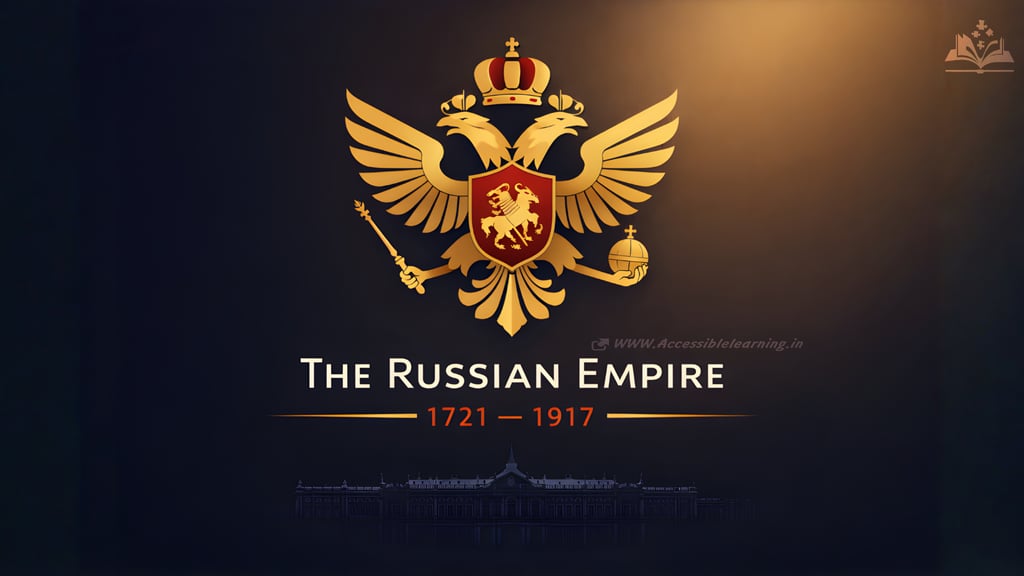
The Rise and Fall of Imperial Russia
The Russian Empire stands as one of history's most formidable political entities, spanning three centuries and stretching across three continents at its zenith. From its formal establishment under Peter the Great in 1721 to its dramatic collapse in 1917, this autocratic empire shaped global politics, culture, and territorial boundaries in ways that continue to resonate today.
This comprehensive examination explores the Russian Empire's evolution, from its transformation from the Tsardom of Russia into a European great power, through its golden ages and periods of reform, to its ultimate demise amid revolution and world war.
What Was the Russian Empire? Historical Context and Definition
The Russian Empire (Russian: Российская Империя, Rossiyskaya Imperiya) was a vast monarchical state that existed from 1721 to 1917, making it one of the last absolute monarchies to dominate European affairs. At its greatest territorial extent in the late 19th century, the empire encompassed approximately 22.8 million square kilometers (8.8 million square miles), making it the third-largest empire in world history by land area, surpassed only by the British and Mongol empires.
Key Characteristics of the Russian Empire
Political Structure: The Russian Empire operated as an absolute autocracy, with the Tsar (Emperor) wielding unlimited political power. The monarch claimed divine right to rule, supported by the Russian Orthodox Church, which served as a pillar of imperial authority.
Geographic Scope: The empire stretched from the Baltic Sea and Eastern Europe in the west to the Pacific Ocean in the east, from the Arctic Ocean in the north to the Black Sea, Caucasus Mountains, and Central Asian deserts in the south.
Population Diversity: By 1897, the empire's first comprehensive census recorded approximately 125.6 million subjects, representing over 100 distinct ethnic groups speaking dozens of languages and practicing various religions, though Orthodox Christianity remained the state religion.
The Foundation: Peter the Great and Imperial Transformation (1682-1725)
From Tsardom to Empire
The formal proclamation of the Russian Empire occurred on October 22, 1721, when the Senate and Synod conferred upon Tsar Peter I the titles of "Father of the Fatherland," "Emperor of All Russia," and "Peter the Great" following Russia's victory in the Great Northern War (1700-1721) against Sweden.
This transformation was not merely titular. Peter the Great fundamentally restructured Russian society, government, and culture through aggressive Westernization policies:
Administrative Reforms: Peter abolished the old boyar Duma, replacing it with a Senate and establishing the Table of Ranks in 1722, which created a meritocratic system for civil and military service based on competence rather than noble birth alone.
Military Modernization: He created Russia's first regular standing army and navy, introducing European military training, tactics, and technology. The navy, virtually nonexistent before his reign, grew to become a formidable Baltic fleet.
Cultural Revolution: Peter mandated Western dress codes for the nobility, forced the adoption of the Julian calendar, simplified the Cyrillic alphabet, and founded Russia's first newspaper. He even personally cut the traditional long beards of boyars who resisted his reforms.
Capital Relocation: Perhaps most symbolically, Peter founded St. Petersburg in 1703 on conquered Swedish lands along the Baltic Sea. This "window to Europe" became the imperial capital in 1712, representing Russia's westward orientation and maritime ambitions.
The Era of Palace Coups and Empresses (1725-1796)
Catherine I to Peter III: Political Instability
Following Peter the Great's death in 1725, Russia experienced nearly four decades of political turbulence characterized by frequent succession crises, palace coups, and the unprecedented prominence of women rulers. This period saw six different monarchs, including four empresses regnant.
Catherine I (1725-1727): Peter's widow, a former peasant, ruled briefly with the support of Peter's associates before her early death.
Anna Ioannovna (1730-1740): Her reign saw the rise of Baltic German influence at court and the expansion of Russia's southern borders through wars against the Ottoman Empire.
Elizabeth Petrovna (1741-1762): Peter the Great's daughter came to power through a palace coup. Her reign is remembered for cultural flourishing, the founding of Moscow University (1755), and Russia's participation in the Seven Years' War against Prussia.
Catherine the Great: The Golden Age (1762-1796)
Catherine II, a German-born princess who married the heir to the Russian throne, ascended to power after orchestrating a coup against her incompetent husband, Peter III, in 1762. Her 34-year reign represents one of Russian history's most transformative periods.
Territorial Expansion: Catherine pursued an aggressive expansionist policy, adding approximately 518,000 square kilometers to the empire. Through the three partitions of Poland (1772, 1793, 1795) conducted with Prussia and Austria, Russia absorbed enormous territories, including modern-day Belarus, Lithuania, and western Ukraine. Wars against the Ottoman Empire secured the northern Black Sea coast and Crimea (1783).
Enlightened Absolutism: Catherine corresponded with French philosophes like Voltaire and Diderot, positioning herself as an enlightened monarch. She convened the Legislative Commission in 1767 to codify Russian law, though its progressive recommendations were largely shelved after the Pugachev Rebellion (1773-1775).
Cultural Renaissance: Under Catherine, St. Petersburg flourished as a cultural capital. She founded the Hermitage Museum, established the Smolny Institute for noble girls (Russia's first state-financed higher education institution for women), and patronized arts and architecture extensively.
The Dark Side: Despite enlightened pretensions, Catherine's reign saw the intensification of serfdom, effectively binding millions of peasants to the land in conditions approaching slavery. The brutal suppression of Pugachev's Rebellion demonstrated the limits of her liberalism.
The 19th Century: Reform, Reaction, and Revolutionary Currents
Alexander I and the Napoleonic Wars (1801-1825)
Alexander I's reign began with reformist aspirations but was dominated by the existential threat posed by Napoleonic France.
The Patriotic War of 1812: Napoleon's invasion of Russia with the Grande Armée of over 600,000 men represents one of history's greatest military disasters. Russian scorched-earth tactics, harsh winter conditions, and strategic retreats decimated French forces. Napoleon's retreat from Moscow cost him approximately 90% of his army.
Congress of Vienna (1815): Russia emerged as one of Europe's dominant powers, with Alexander playing a key role in reshaping the post-Napoleonic European order. Russia gained Finland (from Sweden) and Congress Poland, expanding westward significantly.
The Decembrist Uprising (1825): Alexander's death sparked the first organized revolutionary movement when liberal officers attempted a coup in December 1825, demanding constitutional reforms. Though brutally suppressed, the Decembrists inspired future revolutionary movements.
Nicholas I: The Gendarme of Europe (1825-1855)
Nicholas I responded to the Decembrist challenge with increased authoritarianism, earning the epithet "the Gendarme of Europe" for his role in suppressing revolutionary movements both domestically and abroad.
Official Nationality: Nicholas's regime promoted the trinity of "Orthodoxy, Autocracy, and Nationality" as state ideology, emphasizing traditional values and Russian exceptionalism while resisting Western liberalism.
The Crimean War (1853-1856): Russia's humiliating defeat by an alliance of Britain, France, and the Ottoman Empire exposed the empire's technological and administrative backwardness, catalyzing the reform era that followed.
Alexander II: The Tsar Liberator (1855-1881)
The Crimean War's lessons prompted Alexander II to undertake the most comprehensive reform program in Russian imperial history.
Emancipation of the Serfs (1861): The February 19, 1861 manifesto freed approximately 23 million serfs, ending centuries of bondage. However, the terms proved disappointing—peasants received inadequate land allotments and remained burdened by redemption payments for 49 years. This compromise satisfied neither conservative nobles nor radical reformers.
Judicial Reform (1864): Alexander established an independent judiciary with trial by jury, public trials, and professional judges, bringing Russian legal practice closer to Western European standards.
Military Reform (1874): Universal military conscription replaced the previous system where only peasants served, reducing service terms and modernizing military education.
Zemstvo System (1864): Local self-government institutions gave communities limited autonomy in managing education, healthcare, and infrastructure, though under strict central oversight.
Assassination: Despite these reforms, radical revolutionaries from the People's Will organization assassinated Alexander II on March 13, 1881, believing reforms merely prolonged autocracy rather than ending it.
Alexander III: The Counter-Reformation (1881-1894)
Alexander III's response to his father's assassination reversed many liberal trends.
Russification: Policies of forced cultural assimilation targeted ethnic minorities, particularly in Poland, Finland, and the Baltic provinces. The Russian language became mandatory in education and administration.
Anti-Semitic Policies: The government implemented discriminatory laws restricting Jewish residence, education, and employment. Pogroms—violent anti-Jewish riots—erupted with tacit state approval, triggering mass emigration.
Industrial Expansion: Despite political conservatism, Alexander's reign saw rapid industrialization under Finance Minister Sergei Witte. Railway construction, particularly the Trans-Siberian Railway (begun 1891), facilitated economic integration and military mobility.
Nicholas II and the Twilight of Empire (1894-1917)
The Last Emperor
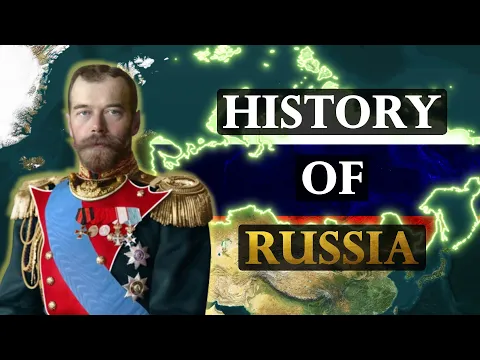
Nicholas II ascended the throne in 1894, ill-prepared for the challenges facing the rapidly modernizing empire. His reign would witness Russia's transformation from autocracy to constitutional monarchy to revolutionary chaos.
The Russo-Japanese War (1904-1905): Russia's defeat by Japan shocked the world and the empire itself. This first major Asian victory over a European power exposed Russia's military weaknesses and sparked domestic unrest.
The Revolution of 1905
Military humiliation combined with economic hardship and political repression ignited revolution.
Bloody Sunday (January 22, 1905): Troops fired on peaceful protesters in St. Petersburg, killing hundreds. This massacre destroyed the traditional myth of the Tsar as the people's benevolent protector.
The October Manifesto: Faced with strikes, mutinies (including the famous Potemkin mutiny), and peasant uprisings, Nicholas reluctantly issued the October Manifesto, promising civil liberties and an elected Duma (parliament).
The Fundamental Laws (1906): While establishing constitutional monarchy in form, these laws preserved autocratic power in substance. The Tsar retained authority over foreign policy and military command and could dissolve the Duma at will.
Attempted Stability: The Stolypin Era (1906-1911)
Prime Minister Pyotr Stolypin pursued a dual policy of repression and reform.
Land Reform: Stolypin's agrarian reforms aimed to create a class of prosperous peasant landowners by dissolving the traditional commune system. The plan showed promise but required decades to succeed—time Russia didn't have.
Political Crackdown: Simultaneously, Stolypin brutally suppressed revolutionaries. "Stolypin's necktie"—a euphemism for the hangman's noose—became infamous during this period of extensive executions.
World War I: The Final Crisis (1914-1917)
Russia entered World War I in August 1914 with patriotic enthusiasm, but the war exposed and exacerbated every structural weakness in the empire.
Military Disasters: Initial advances into East Prussia ended in catastrophic defeats at Tannenberg and the Masurian Lakes. By 1915, Russia had lost Poland and suffered over two million casualties.
Economic Collapse: War demands overwhelmed Russia's industrial capacity and transportation infrastructure. Food shortages plagued cities while railways prioritized military needs.
The Rasputin Affair: The mystic Grigori Rasputin's influence over Empress Alexandra, particularly regarding ministerial appointments, scandalized society and undermined the dynasty's credibility.
The February Revolution (1917): Bread riots in Petrograd (St. Petersburg's wartime name) escalated when troops refused to fire on protesters. Within days, the 300-year Romanov dynasty collapsed. Nicholas II abdicated on March 15, 1917, ending the Russian Empire.

Legacy and Historical Significance
Territorial Impact
The Russian Empire's borders largely established the framework for the Soviet Union and, to a significant extent, contemporary Russia and neighboring post-Soviet states. Many current geopolitical tensions trace to imperial-era territorial acquisitions, population movements, and russification policies.
Political Heritage
The empire's collapse directly enabled the Bolshevik Revolution and Soviet state formation. The autocratic traditions, weak civil society, and absence of democratic experience some historians argue influenced Soviet and post-Soviet political culture.
Cultural Contributions
Imperial Russia's cultural achievements—particularly in literature, music, and ballet—continue to enrich world culture. The aesthetic and intellectual traditions developed during this period remain influential.
The Nationality Question
The empire's failure to reconcile its multiethnic character with centralizing, russifying policies created tensions that exploded during revolution and civil war. This unresolved question haunted the Soviet Union and affects post-Soviet states today.
The Russian Empire represents a study in contradictions—a backward agrarian society producing world-class literature and culture, an autocratic system attempting selective modernization, a multiethnic empire pursuing russification, and a great power unable to match Western European development levels. Its history encompasses remarkable territorial expansion, cultural achievement, and reformist attempts alongside brutal repression, social inequality, and ultimate revolutionary collapse.
Understanding the Russian Empire remains essential for comprehending contemporary Eastern European and Eurasian geopolitics, Russia's political culture, and the region's ongoing struggles with questions of national identity, democratic governance, and territorial sovereignty. The empire's ghost continues to haunt the territories it once ruled, making its history not merely an academic exercise but a key to understanding present realities.
The empire's dramatic end in 1917 closed one chapter of Russian history while opening another that would prove equally tumultuous—the Soviet experiment that would dominate the 20th century. Yet many patterns established during the imperial era—centralized authority, suspicion of the West, multiethnic governance challenges, and the tension between modernization and tradition—would persist, demonstrating how deeply three centuries of imperial rule shaped the Russian experience.
Frequently Asked Questions
Q: When did the Russian Empire begin and end?
The Russian Empire officially began on October 22, 1721, when Peter I was proclaimed Emperor of All Russia following victory in the Great Northern War. It ended on March 15, 1917, when Nicholas II abdicated during the February Revolution, concluding 196 years of imperial rule.
Q: How large was the Russian Empire at its peak?
At its maximum extent in the late 19th century, the Russian Empire covered approximately 22.8 million square kilometers (8.8 million square miles), making it the third-largest empire in history by land area and spanning approximately one-sixth of Earth's landmass across Europe, Asia, and briefly North America (Alaska, until 1867).
Q: What caused the fall of the Russian Empire?
The empire's collapse resulted from multiple interconnected factors: the strains of World War I (military defeats, economic disruption, food shortages), long-standing structural problems (autocratic governance, agrarian crisis, ethnic tensions), the gap between educated society and the regime, rapid but disruptive industrialization, and the monarchy's inability to adapt to demands for political participation and social reform.
Q: Who was the last Tsar of Russia?
Nicholas II (1868-1918) was the last Emperor of Russia, ruling from 1894 until his abdication in 1917. He and his entire family were executed by Bolsheviks on July 17, 1918, in Yekaterinburg. The Russian Orthodox Church canonized the family as passion bearers in 2000.
Q: What was serfdom in the Russian Empire?
Serfdom was a system of hereditary bondage binding peasants to landed estates, where they owed labor obligations to landowners and required permission to marry, move, or change occupation. At its peak, approximately half of Russia's peasant population lived as serfs. Although legally distinct from chattel slavery, serfs could be sold, punished, and controlled by their masters. Serfdom was abolished in 1861 under Alexander II.
Q: How did the Russian Empire expand its territory?
Russian territorial expansion occurred through multiple methods: military conquest (Siberia, Caucasus, Central Asia), dynastic diplomacy (accession of parts of Ukraine in the 17th century), partition agreements (Poland), and purchases (Alaska before selling it to the United States in 1867). Expansion was justified through security concerns, commercial interests, and imperial civilizing missions.
Q: What were the major wars of the Russian Empire?
Significant conflicts included the Great Northern War (1700-1721) against Sweden, numerous Russo-Turkish Wars throughout the 18th and 19th centuries, the Napoleonic Wars (1803-1815), the Crimean War (1853-1856), the Russo-Japanese War (1904-1905), and World War I (1914-1917). These wars alternately expanded Russian territory, exposed military weaknesses, or precipitated domestic crises.
Q: What religions existed in the Russian Empire?
While Russian Orthodoxy was the state religion and the faith of the majority, the empire encompassed numerous religious communities: Muslims in the Caucasus and Central Asia, Jews in the Pale of Settlement, Catholics in Poland and Lithuania, Lutherans in the Baltic provinces, Buddhists among Kalmyks and Buryats, and various smaller Christian denominations. Religious minorities faced varying degrees of discrimination and legal restrictions.
Q: What was the October Manifesto of 1905?
The October Manifesto, issued by Nicholas II on October 30, 1905, in response to revolutionary unrest, promised civil liberties (freedom of speech, assembly, and association), broad participation in the State Duma (parliament), and that no law would take effect without Duma approval. While representing Russia's first step toward constitutional monarchy, the subsequent Fundamental Laws of 1906 preserved substantial autocratic power.
Q: Why did Russia sell Alaska to the United States?
Russia sold Alaska to the United States in 1867 for $7.2 million primarily because the territory was difficult and expensive to defend (particularly from potential British/Canadian seizure) and generated minimal revenue, and the cash could support modernization efforts after the Crimean War defeat. Additionally, selling to the United States served diplomatic purposes by strengthening a potential counterweight to British power.
Subscribe to Frontier Intelligence
All © Copyright reserved by Accessible-Learning Hub
| Terms & Conditions
Accessible Learning Hub — Actionable clarity for high-agency minds.
Weekly breakdowns on AI breakthroughs, capital flow, and human performance systems. Zero fluff.