

Old Money vs. New Money: Comparing Rockefeller/Rothschild Strategies with Modern Tech Billionaires
Discover the differences between old money and new money by comparing the Rothschilds and Rockefellers with modern tech billionaires, their wealth strategies, governance, and lasting legacy.
FINANCE, MARKETS & ECONOMY
Shiv Singh Rajput
7/21/20268 min read
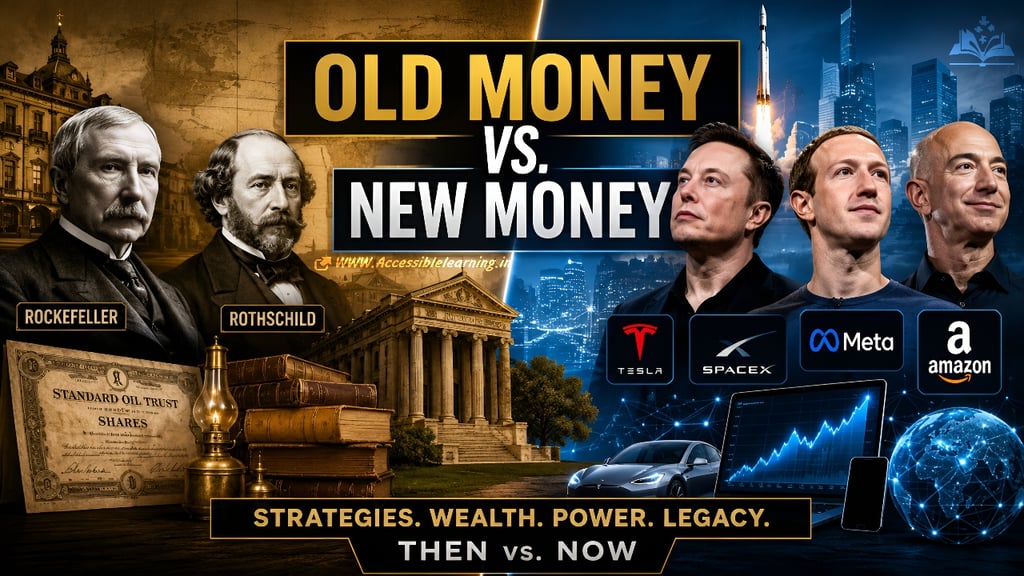

Old money refers to wealth preserved across multiple generations through trusts, family governance, diversified investments, and institutional influence. Families such as the Rockefellers and Rothschilds focused on capital preservation, succession planning, philanthropy, and political stability.
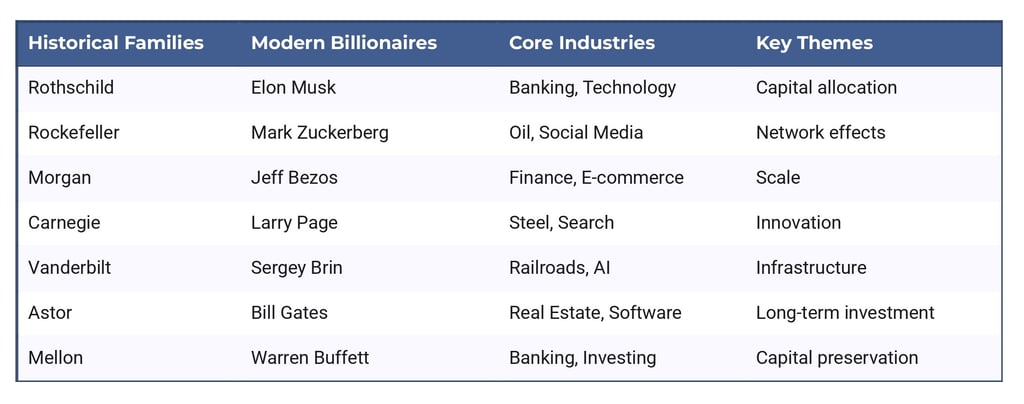
New money, represented by technology entrepreneurs such as Elon Musk, Mark Zuckerberg, Jeff Bezos, Larry Page, and Sergey Brin, typically originates from innovation-driven businesses that scale rapidly through technology and global markets. The key distinction is not wealth size but time horizon: old money prioritizes centuries, while new money often prioritizes decades.
Why Their Wealth Strategies Are Fundamentally Different
The world's wealthiest families and entrepreneurs have accumulated extraordinary fortunes through dramatically different approaches. The Rothschild banking dynasty and the Rockefeller industrial empire built systems designed to survive generations. Modern technology billionaires created wealth by disrupting existing industries at unprecedented speed.
Despite these differences, both groups share common principles: strategic capital allocation, ownership concentration, institutional influence, and continuous reinvestment.
Understanding these contrasting models explains why some fortunes disappear within two generations while others survive for centuries.
What Is the Difference Between Old Money and New Money?
The distinction is based less on wealth size than on how wealth is created, managed, and transferred.
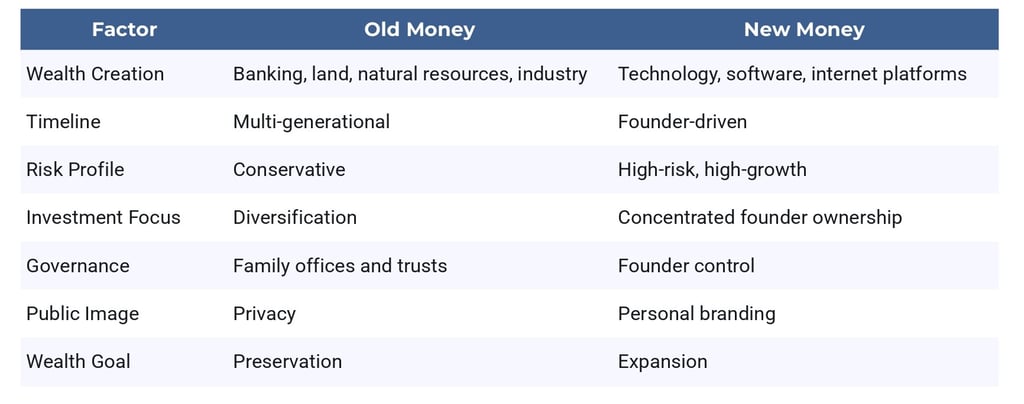
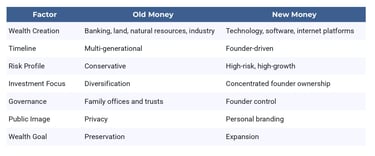
Old money typically evolves into institutional capital. New money usually begins as entrepreneurial capital.
How Did the Rothschild Family Build a Multi-Generational Financial Empire?
The Rothschild family's rise began with Mayer Amschel Rothschild (1744-1812) in Frankfurt, within the Holy Roman Empire.
Rather than keeping his business centralized, he positioned each of his five sons in Europe's major financial capitals:
Frankfurt
London
Paris
Vienna
Naples
This decentralized structure allowed the family to move information, capital, and government loans faster than competitors during the Napoleonic Wars (1803-1815). Instead of depending on one country, the family created one of Europe's first multinational banking networks.
Key Rothschild Strategies
Government bond financing
Cross-border banking
International correspondent networks
Precious metals trading
Diversified investments
Strict family partnerships
Conservative leverage
Multi-generational succession planning
By the mid-19th century, the Rothschild network financed railways, mining operations, canals, and sovereign governments across Europe.
How Did Rockefeller Build America's Greatest Industrial Fortune?
John D. Rockefeller (1839-1937) founded Standard Oil in 1870 in Cleveland, Ohio. Unlike the Rothschilds, Rockefeller focused on one rapidly expanding industry: petroleum.
Rather than drilling alone, Standard Oil controlled nearly every profitable stage of the supply chain:
Oil refining
Pipelines
Transportation
Storage
Distribution
Wholesale marketing
This strategy became known as vertical integration.
By approximately 1880, Standard Oil refined about 90% of U.S. petroleum, making it one of history's most dominant corporations. Following the Sherman Antitrust Act (1890), the U.S. Supreme Court ordered Standard Oil's breakup in 1911, resulting in more than thirty successor companies.
Many eventually became major energy firms, including Exxon, Mobil, Chevron, and Amoco. Ironically, Rockefeller's personal fortune increased because he retained shares across the newly independent companies.
Why Did Old Money Families Focus on Wealth Preservation Instead of Rapid Growth?
Families that accumulated fortunes over centuries learned one fundamental lesson:
Protecting wealth becomes more difficult than creating it.
Old money, therefore, evolved governance systems designed to minimize risks.
Typical structures included:
Dynasty trusts
Family constitutions
Investment committees
Professional trustees
Diversified portfolios
Long-term tax planning
Private partnerships
These structures reduced dependence on any single family member. The objective shifted from maximizing annual returns to maximizing generational survival.

How Do Modern Tech Billionaires Create Wealth Differently?
Technology entrepreneurs generally create wealth through equity ownership rather than inherited capital.
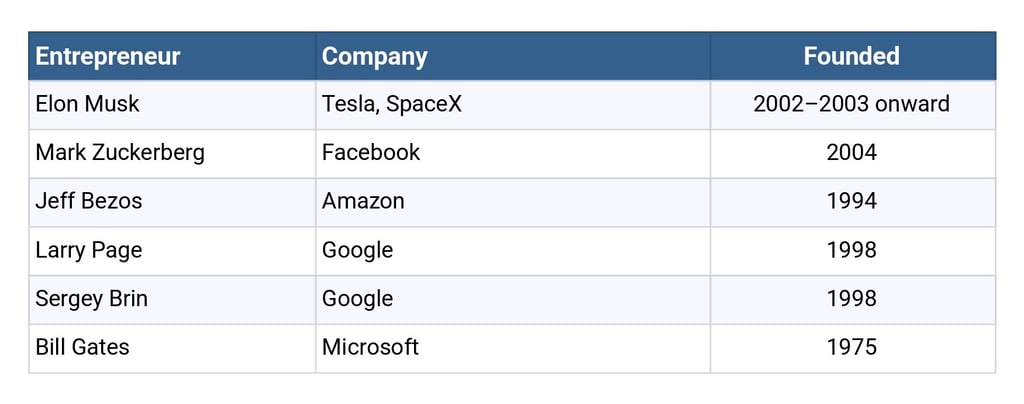
Their fortunes emerged from several common dynamics:
Software scalability
Venture capital financing
Global internet adoption
Network effects
Platform monopolies
Intellectual property
Founder voting control
Unlike industrial businesses, digital companies can expand globally with relatively low marginal costs.
Why Can Technology Wealth Grow Faster Than Industrial Wealth?
Technology companies benefit from economics that rarely existed during the Industrial Revolution. Major advantages include the following:
Near-zero distribution costs
Software can be copied millions of times with minimal additional expense.
Network effects
Platforms become more valuable as additional users join.
Global reach
Internet businesses can serve customers worldwide without constructing physical infrastructure in every market.
High operating margins
Successful software businesses often generate significantly higher profit margins than traditional manufacturing firms.
This explains why many technology entrepreneurs reached billionaire status within decades rather than generations.
How Do Ownership Structures Differ Between Old Money and New Money?
Ownership structures often determine whether fortunes endure.
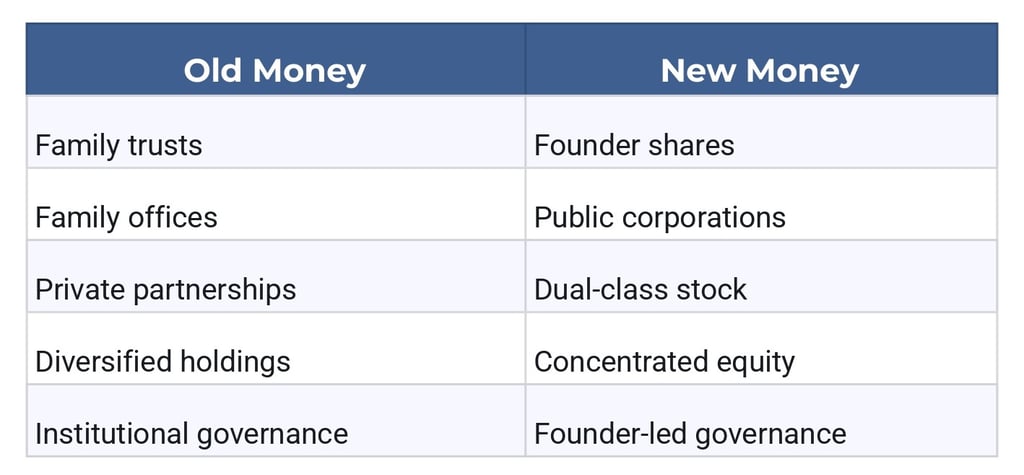
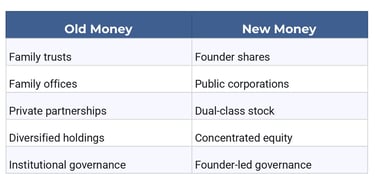
The Rothschilds distributed operational authority across family branches. Many modern founders instead retain voting control through dual-class share structures that preserve strategic decision-making after public listings.
How Do Philanthropy Strategies Compare?
Both old and new money invest heavily in philanthropy, but their methods differ.
Rockefeller Model
John D. Rockefeller created permanent institutions, including:
Rockefeller Foundation (1913)
University of Chicago support
Rockefeller Institute for Medical Research
These organizations funded public health, education, agriculture, and scientific research.
Modern Technology Model
Technology entrepreneurs frequently emphasize the following:
Global health
Artificial intelligence
Climate technology
Pandemic preparedness
Education technology
Space exploration
Many modern philanthropic initiatives also employ data-driven evaluation and measurable outcomes.
How Do Old Money Families Maintain Wealth Across Generations?
Research on family enterprises consistently identifies governance as more important than investment returns. Successful dynasties commonly implement the following:
Formal succession planning
Leadership transitions begin years before control changes.
Education
Younger generations receive financial education before inheriting significant assets.
Diversification
Family wealth expands beyond the industry that originally created it.
Professional management
Independent investment professionals increasingly replace family members in operational roles.
Legal structures
Trusts, foundations, and holding companies reduce fragmentation across generations.
Why Do Many New Money Fortunes Decline After the Founder?
Founder-led companies often depend heavily on one individual's vision.
Common challenges include:
Leadership succession
Ownership dilution
Competitive disruption
Regulatory scrutiny
Technological change
History shows that many first-generation fortunes fail to establish governance systems capable of surviving multiple generations. This represents one of the biggest contrasts with established old-money families.
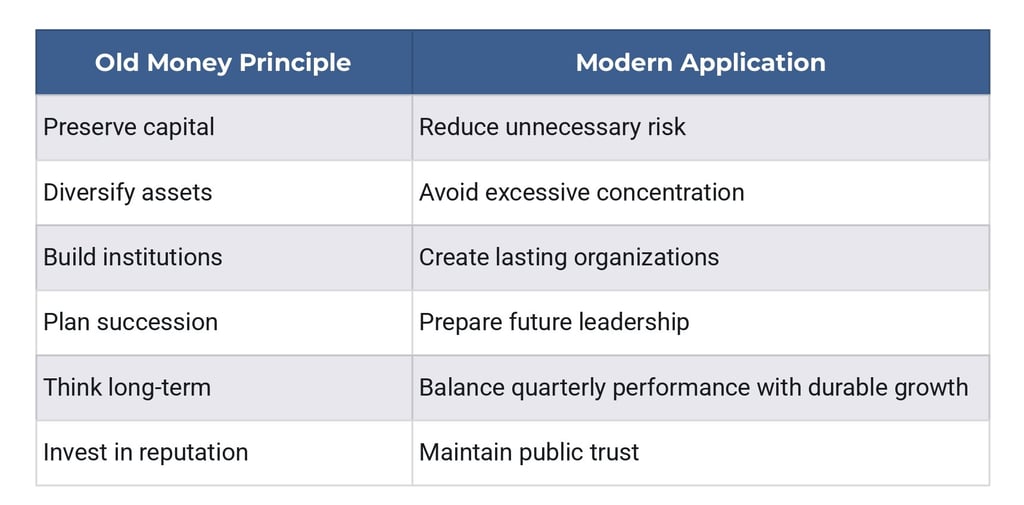
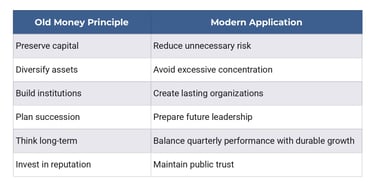
What Lessons Can Modern Entrepreneurs Learn from Old Money?
Several principles repeatedly appear across centuries of successful wealth preservation.

What Are the Biggest Differences Between Old Money and New Money Mindsets?
The contrast between old money and new money extends beyond investment strategy into psychology, lifestyle, and decision-making.
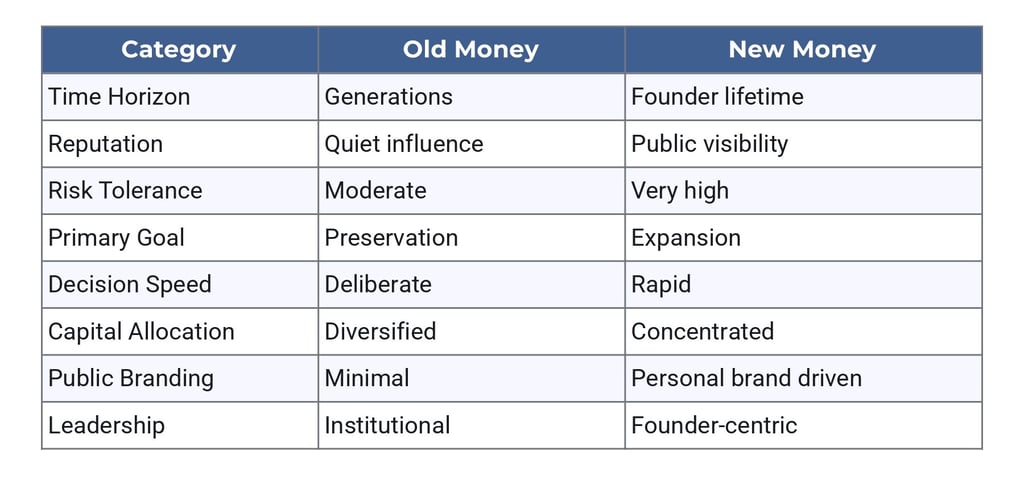
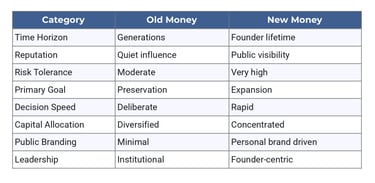
Old-money families often optimize for stability over centuries, whereas many modern entrepreneurs prioritize market leadership and innovation during relatively short business cycles.
How Do Family Offices Shape Long-Term Wealth?
One of the least understood components of old-money wealth is the family office.
A family office is a private organization established to manage investments, taxes, legal affairs, estate planning, philanthropy, risk management, and succession for wealthy families.
Typical responsibilities include:
Portfolio management
Private equity investments
Venture capital allocation
Tax optimization
Estate planning
Trust administration
Real estate management
Art and collectibles management
Philanthropic strategy
Cybersecurity and privacy
Many modern billionaires have established sophisticated family offices after liquidity events, reflecting a gradual shift toward the institutional governance long practiced by historic dynasties.
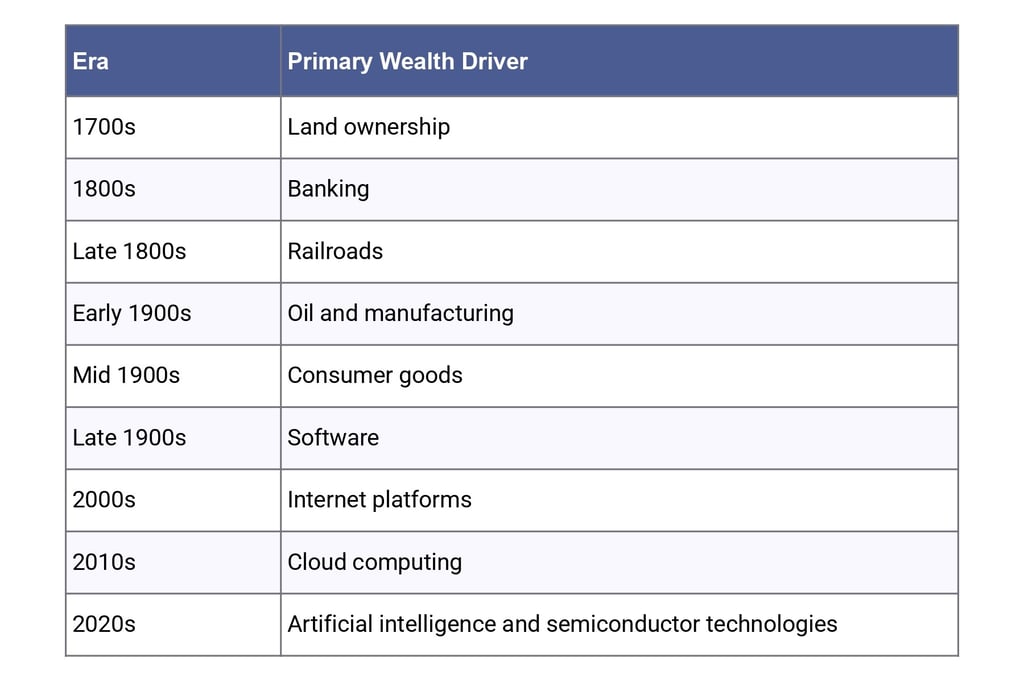
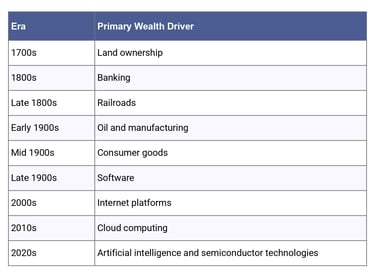
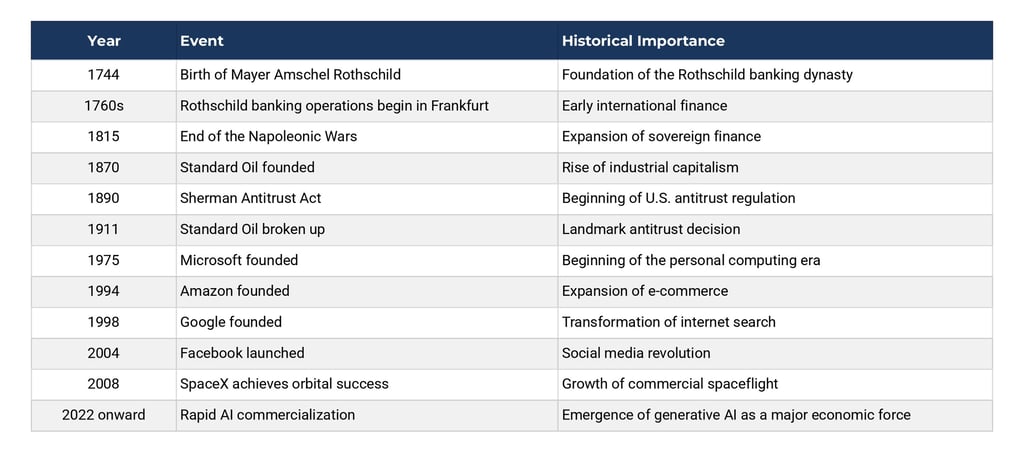
How Has Technology Changed Wealth Creation?
The speed of wealth creation has accelerated dramatically over the past century.
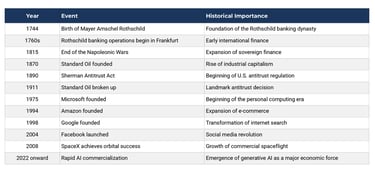

Which Wealth Strategy Has Been More Durable Throughout History?
Historical evidence suggests that wealth preservation has often proven more difficult than wealth creation.
Examples include:
Numerous industrial fortunes disappeared after the second or third generation due to fragmented ownership, poor governance, or changing markets.
Several European banking families survived wars, political upheavals, financial crises, and regime changes by diversifying geographically and institutionally.
Modern technology fortunes remain relatively young, making their long-term durability an ongoing historical question rather than a settled outcome.
The longevity of a fortune depends less on the industry that created it and more on governance, adaptability, and succession planning.
Which Wealth Model Is More Resilient?
Historical evidence suggests resilience depends on adaptation rather than origin. Old money can stagnate if it fails to innovate. New money can disappear if it fails to institutionalize governance.
The most durable fortunes combine both models:
Entrepreneurial innovation
Diversified investment
Professional governance
Long-term planning
Institutional philanthropy
Intergenerational succession
This hybrid approach increasingly characterizes many of today's largest family offices.
The Modern Legacy of Old Money and New Money
The comparison between the Rothschilds, Rockefellers, and modern technology billionaires reflects the evolution of capitalism itself.
The Rothschild banking network demonstrated how international finance, information flow, and disciplined succession could sustain wealth across political upheavals. Rockefeller showed how industrial integration and corporate scale could reshape entire markets, while his later philanthropic institutions illustrated how private fortunes could influence public health, education, and scientific research.
Modern technology founders have transformed global communication, commerce, software, artificial intelligence, and space exploration at a pace unimaginable in the nineteenth century. Their companies rely on digital platforms, intellectual property, network effects, and founder-led innovation rather than physical infrastructure alone.
Increasingly, the distinction between old money and new money is narrowing. As technology fortunes mature, many founders are adopting tools historically associated with established dynasties, including family offices, long-term trusts, diversified investment portfolios, structured succession planning, and permanent charitable foundations. Conversely, many historic family fortunes now invest heavily in venture capital, biotechnology, renewable energy, artificial intelligence, and private equity.
The enduring lesson is that creating wealth requires innovation, but preserving wealth requires governance. History suggests that fortunes lasting for generations are rarely the product of a single brilliant investment or entrepreneur. Instead, they result from adaptable institutions, disciplined capital management, and a strategic outlook measured not in years but in decades and generations.
Key Takeaways
Old money focuses on preserving wealth across multiple generations.
New money often prioritizes rapid innovation and business expansion.
Trusts, family offices, and succession planning are defining features of long-lived fortunes.
Modern technology billionaires increasingly adopt governance structures historically associated with established financial dynasties.
Long-term resilience depends on diversification, institutional governance, and disciplined capital management rather than the original source of wealth alone.
FAQ's
Q: What is the main difference between old money and new money?
Old money refers to wealth preserved over multiple generations through inheritance, trusts, and long-term investment strategies. New money is wealth created within the current generation, often through entrepreneurship, technology, finance, or entertainment.
Q: Are the Rothschilds and Rockefellers still wealthy today?
Yes. Although their influence differs from its historical peak, both families continue to manage substantial assets through diversified investments, family offices, philanthropic foundations, and private business interests. Precise net worth figures are not publicly known because much of their wealth is privately held.
Q: Can today's tech billionaires become old-money dynasties?
Yes. If their wealth is successfully preserved through trusts, succession planning, diversified investments, and effective governance across multiple generations, today's entrepreneurial fortunes can evolve into future old-money dynasties.
Q: Why did the Rockefeller fortune survive the breakup of Standard Oil?
When Standard Oil was divided in 1911, John D. Rockefeller retained ownership stakes in the successor companies. As many of those businesses grew significantly in value, his personal wealth increased despite the company's dissolution.
Q: Why were the Rothschilds so influential in European finance?
The Rothschild family established banking operations across major European cities, enabling efficient cross-border financing, sovereign lending, and information exchange during the late 18th and 19th centuries. Their multinational structure provided advantages in an era when communication and capital movement were relatively slow.
Q: Do modern billionaires use the same wealth structures as old-money families?
Increasingly, yes. Many founders establish family offices, irrevocable trusts, charitable foundations, and diversified investment vehicles as their wealth matures, reflecting governance practices long used by established dynasties.
Q: Which is riskier: the old-money or new-money approach?
Generally, new-money wealth creation involves higher entrepreneurial and market risk, while old-money wealth management emphasizes capital preservation through diversification, governance, and long-term planning. Both approaches require different forms of strategic decision-making.
Q: Which wealth strategy has historically lasted the longest?
History suggests that fortunes endure longest when they combine entrepreneurial wealth creation with disciplined governance, succession planning, diversified investments, and institutional structures. The source of wealth is less important than the systems used to preserve it over time.
Subscribe to Frontier Intelligence
All © Copyright reserved by Accessible-Learning Hub
| Terms & Conditions
Accessible Learning Hub — Actionable clarity for high-agency minds.
Weekly breakdowns on AI breakthroughs, capital flow, and human performance systems. Zero fluff.