

The Holy Roman Empire: A Thousand-Year Legacy That Shaped Modern Europe
Discover the Holy Roman Empire's complex history from 800 CE to 1806—its political structure, cultural impact, and why Voltaire called it "neither holy, nor Roman, nor an empire."
EUROPEAN UNIONEMPIRES/HISTORYHISTORY
Kim Shin
2/3/20268 min read
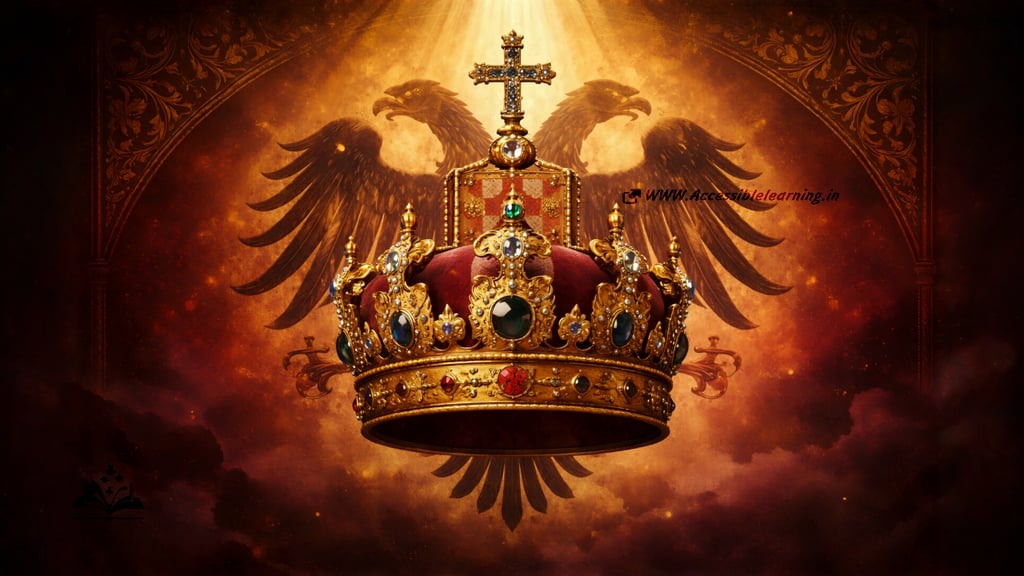
What Was the Holy Roman Empire?
The Holy Roman Empire stands as one of history's most misunderstood political entities. Lasting over a millennium (800/962–1806 CE), it was a multi-ethnic complex of territories in Central Europe that profoundly influenced European politics, culture, and religious development.
Unlike centralized nation-states, the Holy Roman Empire functioned as a decentralized confederation of kingdoms, principalities, duchies, and free cities under the nominal authority of an elected emperor. At its peak, it encompassed modern-day Germany, Austria, Switzerland, the Netherlands, Belgium, the Czech Republic, and parts of Italy, France, and Poland.
The Foundation: Charlemagne and the Carolingian Legacy
The Coronation of 800 CE
On Christmas Day, 800 CE, Pope Leo III crowned Charlemagne as "Emperor of the Romans" in St. Peter's Basilica. This coronation marked the symbolic revival of the Western Roman Empire, which had collapsed in 476 CE. The act established a crucial precedent: the fusion of Christian religious authority with imperial political power.
Charlemagne's empire stretched across Western Europe, unifying Germanic tribes under Christian rule and Latin literacy. His reign represented the Carolingian Renaissance—a cultural and intellectual revival that preserved classical knowledge through monastic scriptoria.
The Ottonian Foundation (962 CE)
After the Carolingian dynasty fragmented, Otto I of Germany revived the imperial title in 962 CE when Pope John XII crowned him emperor. This date is often cited as the "official" beginning of the Holy Roman Empire as a distinct political institution. Otto established the empire's German character and its intricate relationship with the papacy—a relationship that would define centuries of conflict and cooperation.
Political Structure: Organized Complexity
The Emperor and Electoral System
Contrary to hereditary monarchies, the Holy Roman Emperor was elected by a select group of prince-electors. The Golden Bull of 1356, issued by Emperor Charles IV, formalized this system:
The Seven Prince-Electors (1356-1648):
Three ecclesiastical electors: Archbishops of Mainz, Trier, and Cologne
Four secular electors: King of Bohemia, Count Palatine of the Rhine, Duke of Saxony, and Margrave of Brandenburg
This electoral system prevented the empire from becoming a centralized absolute monarchy. Emperors required constant negotiation with powerful territorial rulers, creating a unique form of federalism centuries before modern federal states emerged.
The Imperial Diet (Reichstag)
The Reichstag served as the empire's deliberative assembly, divided into three colleges:
Electoral College - The prince-electors
Princely College - Secular and ecclesiastical princes
Cities College - Representatives from Free Imperial Cities
Major decisions required consensus across these bodies, making legislation slow but representative of diverse interests. This structure influenced later parliamentary systems across Europe.
Imperial Circles (Reichskreise)
By the early 16th century, the empire was divided into ten Imperial Circles—regional administrative units responsible for
Tax collection
Military recruitment
Maintaining public peace
Enforcing imperial decisions
These circles provided practical governance in an otherwise fragmented political landscape.
The Investiture Controversy: Church vs. State
The Heart of Medieval Politics
The Investiture Controversy (1076–1122 CE) represented a fundamental power struggle between papal and imperial authority. The central question: Who had the right to appoint bishops and abbots—the Pope or the Emperor?
The Canossa Incident (1077): When Emperor Henry IV challenged Pope Gregory VII's authority, the Pope excommunicated him. Henry performed public penance in the snow outside Canossa Castle for three days before the Pope lifted the excommunication. This dramatic event symbolized the complex balance of power between secular and religious authorities.
The conflict concluded with the Concordat of Worms (1122), which established a compromise: the Church would grant spiritual authority while emperors retained some influence over temporal matters of bishops' territories.
The Empire and the Reformation
Religious Fragmentation
Martin Luther's 95 Theses (1517) ignited the Protestant Reformation, which fundamentally transformed the Holy Roman Empire. The religious unity that had justified imperial authority shattered as territories chose between Catholicism and various Protestant denominations.
Key Developments:
Diet of Worms (1521): Charles V declared Luther an outlaw
Peace of Augsburg (1555): Established cuius regio, eius religio (whose realm, his religion)—territorial rulers could determine their subjects' religion
Thirty Years' War (1618–1648): Devastating conflict that killed approximately 8 million people, roughly 20% of the empire's population
The Peace of Westphalia (1648)
The treaties ending the Thirty Years' War fundamentally restructured European politics:
Recognized Calvinism alongside Catholicism and Lutheranism
Granted near-complete sovereignty to imperial territories
Weakened imperial authority to ceremonial status
Established principles of state sovereignty that underpin modern international law
Switzerland and the Netherlands gained formal recognition as independent nations, no longer part of the empire.

Cultural and Intellectual Contributions
Universities and Scholarships
The Holy Roman Empire fostered intellectual development through numerous universities:
University of Prague (1348)—First university in Central Europe
University of Vienna (1365)
University of Heidelberg (1386)
These institutions preserved and transmitted classical knowledge, developed scholastic philosophy, and later became centers of Renaissance humanism and Reformation theology.
Artistic Legacy
The empire's territories produced remarkable artistic achievements:
Medieval Period:
Romanesque and Gothic cathedral architecture (Cologne Cathedral, Speyer Cathedral)
Illuminated manuscripts from monastic scriptoria
Imperial regalia and crown jewels showcasing goldsmithing mastery
Renaissance and Baroque:
Albrecht Dürer's revolutionary printmaking and painting
Hans Holbein the Younger's portraiture
Baroque architecture and music (Johann Sebastian Bach composed within imperial territories)
Legal Innovations
The empire developed sophisticated legal concepts:
Roman law revival through Italian universities influencing imperial jurisprudence
Imperial Chamber Court (Reichskammergericht, 1495) - Supreme judicial institution
Development of concepts like territorial sovereignty and international arbitration
Economic Organization
Trade Networks
Despite political fragmentation, the empire's territories formed interconnected economic zones:
The Hanseatic League: Northern German cities created a powerful trading confederation controlling Baltic and North Sea commerce. Cities like Lübeck, Hamburg, and Bremen accumulated enormous wealth through trade monopolies.
South German Banking: Augsburg families like the Fuggers and Welsers became Europe's leading bankers, financing emperors and kings. Jakob Fugger the Rich was arguably the wealthiest individual of the 16th century, with influence comparable to modern central banks.
Imperial Free Cities
Cities like Frankfurt, Nuremberg, and Strasbourg enjoyed direct imperial status, answering only to the emperor. These cities became centers of:
Manufacturing and guild organization
Banking and financial innovation
Cultural production and printing
Early republican governance experiments
The Habsburg Dynasty Dominance
Five Centuries of Power
From 1438 to 1740, the Habsburg family held the imperial throne almost continuously. Their strategy combined:
Strategic marriages - "Let others wage war; you, happy Austria, marry."
Accumulation of hereditary lands - Austria, Bohemia, Hungary
Spanish connection - Charles V ruled both the empire and Spanish territories
The Habsburgs transformed the imperial title into a tool for family aggrandizement rather than effective governance of the empire itself.
The Austrian Empire Emerges
By the 18th century, the Habsburg monarchy's Austrian territories had become more important than the imperial title itself. Maria Theresa (1740–1780) ruled the Austrian territories while her husband, Francis I, held the hollow imperial crown.
The Empire's Decline and Fall
Erosion of Authority
Multiple factors weakened imperial institutions:
Rise of Prussia: Frederick II (the Great) of Prussia challenged Habsburg dominance, culminating in the Seven Years' War (1756–1763). Prussia emerged as a rival power center within the empire.
Enlightenment Ideas: Concepts of national sovereignty and rational state administration undermined the empire's medieval structure.
French Revolutionary Wars: Napoleon's military campaigns exposed the empire's military impotence.
The Final Dissolution (1806)
Napoleon's creation of the Confederation of the Rhine (1806)—a French client state of 16 German princes—rendered the empire meaningless. On August 6, 1806, Francis II formally abdicated as Holy Roman Emperor, ending the institution after 844 years (or 1,006 years counting from Charlemagne).
Francis retained the title Emperor of Austria, which he had created in 1804 anticipating the Holy Roman Empire's demise.


Why It Matters: Legacy and Modern Relevance
Political Concepts
The Holy Roman Empire pioneered political ideas still relevant today:
Federalism: The empire's decentralized structure anticipated modern federal systems like Germany, Switzerland, and the European Union.
Elective Monarchy: The electoral system demonstrated alternatives to hereditary succession and absolute monarchy.
Subsidiarity: The principle that decisions should be made at the most local level possible—now central to EU governance—reflects imperial practice.
European Identity
The empire represented an early form of European integration—diverse peoples united under common (if weak) institutions. Modern European federalists sometimes cite it as a historical precedent for pan-European cooperation.
Cultural Continuity
Many European cultural institutions trace their roots to the empire:
German-speaking cultural sphere
Legal traditions in Central Europe
University systems
Urban governance models in free cities
Voltaire's Critique
The French philosopher Voltaire famously quipped that the Holy Roman Empire was "neither holy, nor Roman, nor an empire." While clever, this dismissal overlooks the empire's genuine influence on European development. It was:
Holy in its ideological foundation uniting Christian authority with political power
Roman in its claimed continuity with Rome and use of Roman law
An empire in its multi-ethnic, multi-territorial scope, if not in centralized administration
Understanding a Unique Political Experiment
The Holy Roman Empire defies simple categorization. Neither a nation-state nor a traditional empire, it represented a unique medieval and early modern political experiment—attempting to unite diverse peoples under shared Christian ideology and Roman legal traditions while respecting local autonomy.
Its legacy extends beyond its 1806 dissolution. Modern federal systems, European integration efforts, and concepts of shared sovereignty all echo the empire's innovative approach to multi-level governance. Understanding the Holy Roman Empire illuminates how pre-modern societies negotiated the tensions between unity and diversity, central authority and local autonomy, and religious ideology and political pragmatism.
For anyone seeking to understand European history, political development, or the roots of modern international systems, the Holy Roman Empire remains essential—a millennium-long case study in the possibilities and limitations of loose federal union among diverse peoples.
Frequently Asked Questions
Q: What language did the Holy Roman Empire speak?
The empire had no single official language. Latin served as the administrative and scholarly language, while German gradually became dominant in imperial institutions. However, territories used their own languages: German dialects, Czech, Italian, Dutch, French, and others coexisted throughout the empire's history.
Q: Why was the Holy Roman Empire so weak compared to other European monarchies?
The empire's elective monarchy and decentralized structure prevented strong centralization. Emperors constantly negotiated with powerful princes who controlled their own armies and finances. Unlike France or England, no emperor could build an absolute monarchy or centralized bureaucracy.
Q: How was the Holy Roman Empire different from the Roman Empire?
The original Roman Empire was a centralized Mediterranean state centered on Rome with a professional bureaucracy and standing army. The Holy Roman Empire was a decentralized Germanic federation in Central Europe with elected emperors and autonomous territories. They shared only symbolic continuity and the use of "Roman" in their names.
Q: Could the Holy Roman Empire be considered Germany?
Partially. The empire's core was German-speaking territories, and it's sometimes called the "Holy Roman Empire of the German Nation" (Heiliges Römisches Reich Deutscher Nation) after the 15th century. However, it also included non-German territories (Czech lands, northern Italy, and the Low Countries), and some German territories (like Prussia after 1701) existed outside imperial boundaries.
Q: Who was the most powerful Holy Roman Emperor?
Charles V (reigned 1519–1556) was arguably the most powerful, ruling territories including the Holy Roman Empire, Spain, the Netherlands, parts of Italy, and the Spanish colonial empire. His famous quote: "In my empire, the sun never sets." However, even he couldn't prevent the Protestant Reformation or create a centralized state.
Q: What happened to the Holy Roman Empire's territories after 1806?
Most territories became part of the German Confederation (1815–1866), then the German Empire (1871–1918) under Prussian leadership. Others became or remained independent states: Austria, Switzerland, Belgium, the Netherlands, the Czech lands (eventually Czechoslovakia), and parts incorporated into France and Italy. Many princely families retained their titles and properties even after losing political power.
Q: Did the Holy Roman Empire have a capital city?
No permanent capital existed. Emperors governed from their hereditary territories—Vienna for the Habsburgs and Prague under Charles IV. The imperial Diet met in various cities, eventually settling in Regensburg (1663–1806). The coronation city was traditionally Frankfurt, though some emperors were crowned in Aachen following Charlemagne's tradition.
Subscribe to Frontier Intelligence
All © Copyright reserved by Accessible-Learning Hub
| Terms & Conditions
Accessible Learning Hub — Actionable clarity for high-agency minds.
Weekly breakdowns on AI breakthroughs, capital flow, and human performance systems. Zero fluff.