

Greek Fire Explained: The Byzantine Weapon That Burned on Water
Discover the mystery of Byzantine Greek Fire, the secret weapon that burned on water, protected as a state secret and still impossible to fully recreate today.
HISTORY & CIVILIZATIONS
Kim Shin | Evangelia Oikonomou
7/24/202612 min read
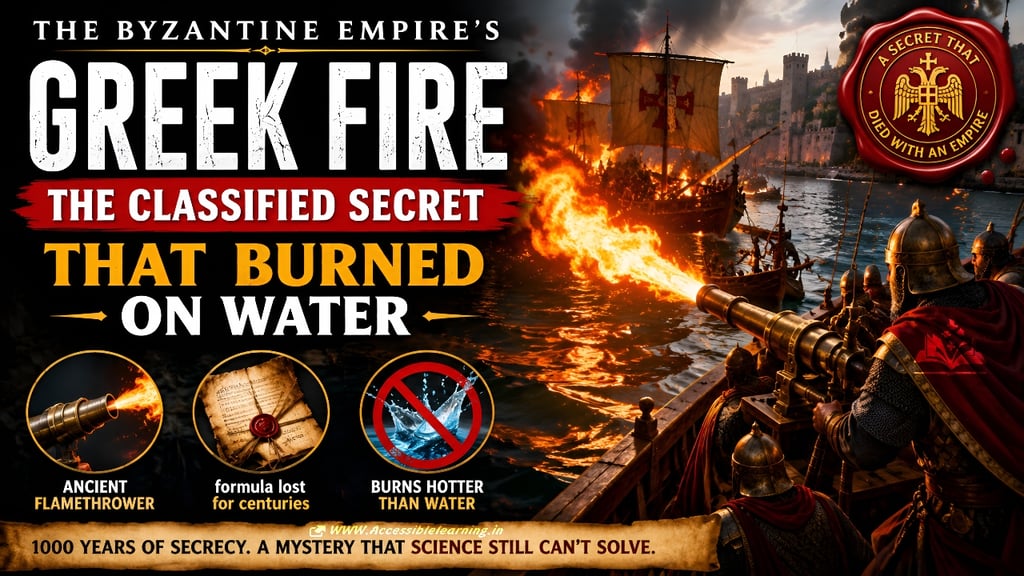
Imagine facing an enemy that sprays liquid fire across the sea. You throw buckets of water to save your ship... and the flames explode even harder. That nightmare wasn't medieval fantasy. For centuries, the Byzantine Empire possessed a mysterious chemical weapon known as Greek Fire, a weapon so terrifying and so carefully protected that its exact formula vanished forever when the empire fell. More than a thousand years later, scientists still cannot say with certainty how it worked.
Quick Facts
Weapon: Greek Fire
Civilisation: Byzantine Empire (Eastern Roman Empire)
First Recorded Use: Around 672 CE during Arab naval attacks against Constantinople
Primary Inventor: Traditionally credited to Kallinikos (Callinicus) of Heliopolis
Delivery Method: Pressurized bronze or brass siphons mounted on warships, handheld tubes, and ceramic grenades
Most Famous Feature: Continued burning on water, making naval warfare dramatically more dangerous
Formula: Never recorded in surviving documents and remains unknown
State Secret: Protected directly by the Byzantine government for centuries
Strategic Impact: Helped Constantinople survive multiple major sieges that might otherwise have destroyed the empire
Modern Status: No laboratory has recreated the weapon with complete confidence
What Was Greek Fire?
Greek Fire was a military weapon unlike anything its enemies had ever encountered.
Instead of arrows or stones, Byzantine warships projected streams of burning liquid through bronze tubes that worked much like primitive flamethrowers. Witnesses described bright flames roaring across the sea, sticking to ships, sails, soldiers, and wooden decks.
Unlike ordinary fire, this substance behaved in deeply unsettling ways.
Water often failed to extinguish it. Some medieval accounts even claim that water intensified the blaze, forcing sailors to experiment with sand, vinegar, blankets, or earth instead.
Whether every report is literally accurate is debated by historians, but one fact is beyond dispute: Greek Fire inspired absolute terror among Byzantine enemies.
Why Was the Byzantine Empire So Protective of Greek Fire?
Because it may have been the empire's greatest military advantage.
The Byzantine Empire ruled for over a thousand years despite facing enormous pressure from Persians, Arabs, Bulgars, Crusaders, and later the Ottoman Turks.
It often survived while surrounded by stronger armies because it relied on superior engineering, diplomacy, intelligence networks, and one terrifying naval weapon.
The formula for Greek Fire became one of the most closely guarded secrets in medieval history. Historical sources suggest only a tiny circle of trusted individuals knew how to prepare it.
That circle reportedly included:
The reigning emperor
Selected imperial military engineers
A handful of state chemists
Specialized operators trained to deploy the weapon
Knowledge was passed through highly restricted imperial channels rather than public manuscripts. Unlike blacksmithing or sword making, there were no instruction manuals circulating across Europe.
That decision would eventually erase the formula forever.
How Did Greek Fire Actually Work?
The honest answer is that nobody knows with complete certainty.
Several Byzantine writers intentionally avoided describing the recipe.
Even historians living within the empire admitted that the ingredients remained hidden.
Modern researchers believe the weapon likely combined several combustible materials, possibly including:
Petroleum or crude oil
Pine resin
Sulfur
Bitumen
Lime-based compounds
Various organic oils
Some scientists have proposed that quicklime (calcium oxide) played a role because it generates intense heat when mixed with water.
Others argue petroleum-based fuels alone explain much of the weapon's behavior.
The problem is that no surviving document provides an exact formula.
Every proposed recipe remains an educated reconstruction rather than a confirmed answer.


Did Greek Fire Really Burn on Water?
Historical evidence strongly suggests it did, although the chemistry remains debated. Numerous Byzantine, Arab, and later medieval accounts describe flames floating across the sea after being discharged.
Several explanations have been suggested.
One possibility is that the fuel floated because it contained petroleum products, allowing flames to spread over the water's surface.
Another idea is that certain ingredients reacted violently with moisture.
Some descriptions claim water actually intensified the fire.
Modern historians urge caution because eyewitnesses sometimes exaggerated battlefield events.
Still, even conservative interpretations agree on one point.
Greek Fire was extraordinarily difficult to extinguish using normal firefighting methods available during the Middle Ages.
Who Invented Greek Fire?
Most historical sources credit Kallinikos of Heliopolis, a Syrian architect or engineer who fled to Constantinople during the Arab invasions in the seventh century.
According to Byzantine chroniclers, he brought valuable chemical knowledge with him and presented the invention to Emperor Constantine IV.
Whether Kallinikos created the entire weapon himself or improved earlier incendiary mixtures remains uncertain. Ancient civilizations already knew about burning oils, flaming arrows, and pitch-based weapons.
Greek Fire appears to have been something far more advanced because it combined the following:
Specialized fuel
Pressurized delivery systems
Military engineering
Strict government secrecy
That combination transformed an old idea into a revolutionary weapon.
How Were Ancient Flamethrowers Built?
The Byzantine navy engineered remarkable delivery systems. Large warships carried bronze siphons mounted near the bow.
Inside the vessel, pumps forced the burning liquid through metal tubes before projecting it toward enemy ships. Imagine standing aboard a wooden vessel while a roaring stream of fire suddenly crossed the sea toward you.
There were no fire-resistant uniforms.
No modern extinguishers.
No steel hulls.
Just timber, rope, sails, tar, and panic.
The Byzantines also developed smaller versions.
Historical records mention:
Handheld siphons
Fire-filled ceramic grenades
Burning projectiles launched during sieges
This allowed Greek Fire to be used both at sea and during land battles.
Why Was Greek Fire So Effective Against Navies?
Because medieval ships were floating piles of fuel.
Warships relied heavily on:
Wooden hulls
Hemp ropes
Linen sails
Tar waterproofing
Pitch coatings
Every one of those materials burned easily.
Traditional naval battles involved boarding actions. Greek Fire changed everything. Instead of waiting to engage hand-to-hand, Byzantine crews could ignite enemy vessels before they even closed the distance.
Panic spread quickly.
Once one ship caught fire, nearby vessels often collided while attempting to escape.
The psychological damage was almost as valuable as the physical destruction.
Did Greek Fire Save Constantinople?
Very likely, yes.
Greek Fire became famous during the First Arab Siege of Constantinople (674–678 CE) and again during the Second Arab Siege (717–718 CE).
Arab fleets repeatedly attempted to overwhelm the Byzantine capital.
Instead, they encountered a weapon unlike anything in their arsenal.
Contemporary and later sources describe Byzantine ships launching streams of burning liquid that devastated attacking fleets.
Greek Fire was not the only reason Constantinople survived.
Massive defensive walls, skilled commanders, harsh winters, disease, and supply problems also played major roles.
Even so, many historians believe Greek Fire was one of the decisive advantages that prevented the city's capture for centuries.
Could Anyone Steal the Formula?
Apparently not.
Many enemies desperately wanted it.
Arab armies captured Byzantine soldiers.
Crusaders occupied Constantinople.
Foreign spies almost certainly tried to uncover the recipe. Yet nobody successfully reproduced the original weapon.
Some states created their own incendiary mixtures, but surviving descriptions suggest none matched Byzantine Greek Fire exactly.
The empire protected its military knowledge with extraordinary discipline.
Ironically, that success guaranteed its disappearance.
When Constantinople finally fell to the Ottoman Empire in 1453, whatever practical knowledge remained appears to have disappeared alongside the specialists who possessed it.
Why Can't Scientists Recreate Greek Fire Today?
Because historians possess descriptions of its effects, not its manufacturing instructions. Researchers have reconstructed many ancient technologies from surviving manuals.
Greek Fire presents a different challenge.
No complete recipe exists.
Instead, scholars work from the following:
Medieval chronicles
Enemy eyewitness reports
Military manuals
Archaeological discoveries
Chemical analysis of related materials
Numerous experimental mixtures have produced impressive flames.
Some float on water.
Some burn intensely.
Some resemble historical descriptions.
None satisfies every historical account simultaneously.
That makes Greek Fire one of history's greatest scientific mysteries.
Was Greek Fire the World's First Flamethrower?
Not exactly, but it was the first known flamethrower to become a decisive strategic weapon on such a large scale. Earlier civilizations experimented with burning oils, pitch, sulfur, and flaming projectiles.
The Byzantines went much further.
They combined chemistry with mechanical engineering, pressure systems, naval tactics, and strict state security.
That integration created something remarkably close to a medieval flamethrower centuries before modern versions appeared during the First World War.
Did Greek Fire Give the Byzantine Empire a Monopoly on Military Technology?
For a significant period, it gave the empire an advantage that no rival could fully duplicate. Greek Fire was not a magical superweapon that guaranteed victory.
The Byzantines still lost battles, territories, and emperors. However, its existence changed strategic calculations across the eastern Mediterranean. Enemy fleets had to prepare for a weapon they barely understood and could rarely counter effectively.
That technological edge helped the Byzantine Empire remain one of history's longest-lasting states, surviving for more than 1,100 years after the fall of the Western Roman Empire.
What Did Eyewitnesses Say About Greek Fire?
Some of the most vivid descriptions come from Byzantine, Arab, and Crusader writers who witnessed or recorded its effects.
The 12th-century Byzantine princess and historian Anna Komnene described Greek Fire as a weapon projected through tubes with a deafening roar, comparing it to fiery lightning. She emphasized that it terrified enemies before it even reached them.
Arab chroniclers also recorded encounters with the weapon, describing ships suddenly engulfed in flames that spread rapidly across decks. While medieval writers sometimes exaggerated battlefield events, the consistency across both Byzantine and enemy accounts suggests the weapon's psychological impact was very real.
One recurring description is that the fire clung to surfaces rather than behaving like an ordinary flame, making escape far more difficult than with conventional incendiaries.
How Did Byzantine Engineers Keep the Weapon Operational at Sea?
Operating Greek Fire aboard a moving ship required remarkable engineering. The flame projector wasn't simply a pipe filled with burning liquid. It likely consisted of several coordinated components:
A sealed storage tank
A manual pressure pump
Bronze or brass delivery pipes
A nozzle shaped to focus the stream
An independent ignition system
Many historians believe the fuel itself was not always burning inside the storage tank. Instead, ignition probably occurred at or near the nozzle as the liquid exited the siphon. This would have reduced the chance of catastrophic explosions aboard Byzantine ships.
Even with these precautions, operating Greek Fire was dangerous. A strong wind blowing in the wrong direction could potentially send flames back toward friendly vessels.
Why Didn't Other Civilizations Build Their Own Version?
Many tried.
The Arabs developed incendiary weapons known in medieval texts as naft weapons, based largely on petroleum products. Chinese military engineers later created powerful gunpowder-based flame weapons, while Europeans experimented with fire pots and combustible mixtures during sieges.
None of these, however, can be confirmed as identical to Byzantine Greek Fire.
The Byzantine weapon wasn't just about chemistry. Its effectiveness came from combining:
Specialized fuel
Advanced delivery equipment
Highly trained operators
Strict military doctrine
State-controlled production
Reproducing only one of those elements wasn't enough.
Why Was Constantinople the Perfect Place to Protect the Secret?
The Byzantine capital was uniquely suited for safeguarding sensitive military technology.
Constantinople possessed the following:
Imperial workshops directly controlled by the Emperor
Highly educated engineers and craftsmen
Restricted military arsenals
Strong internal intelligence networks
One of the medieval world's most sophisticated bureaucracies
Unlike many medieval kingdoms where weapons production was decentralized, Byzantine emperors could keep strategic technologies under direct government supervision. That centralized control helped preserve the monopoly for centuries.

What Is the "Book of Ceremonies" and Why Doesn't It Reveal the Formula?
The De Ceremoniis, compiled under Emperor Constantine VII Porphyrogenitus, discusses the symbolic importance of Greek Fire but deliberately avoids revealing its composition.
According to tradition recorded in Byzantine sources, the Emperor warned that the formula had been divinely entrusted to the empire and must never be shared with foreigners.
Whether this story reflects genuine religious belief or simply reinforced state secrecy is still debated by historians. Either way, the message was clear: protecting the formula was considered a matter of national survival.
What Countermeasures Did Enemies Use?
Although there was no perfect defense, opposing fleets developed several survival strategies.
Historical accounts mention attempts to:
Avoid close-range naval engagements.
Attack during unfavorable weather for flame projection.
Use wet hides or thick felt to shield vulnerable surfaces.
Throw sand or earth onto burning areas instead of water.
Disable Byzantine siphons with arrows or siege engines before they could fire.
These tactics sometimes reduced the weapon's effectiveness, but none completely neutralized it.
Could Greek Fire Have Exploded Accidentally?
Probably yes. Any highly combustible chemical mixture stored aboard a wooden warship posed obvious risks. Because of this, historians believe Greek Fire crews were elite specialists who underwent extensive training.
The weapon likely wasn't deployed in every battle. Instead, it was reserved for situations where its strategic value outweighed the danger to the operators themselves.
This limited use may also explain why archaeological evidence is relatively scarce.
Why Has Archaeology Struggled to Solve the Mystery?
The biggest obstacle is that Greek Fire was mostly made from organic or volatile materials.
After more than a thousand years:
Fuel residues have largely decomposed.
Wooden delivery systems have rotted away.
Metal siphons were often melted down or recycled.
Imperial workshops disappeared after the fall of Constantinople.
Archaeologists have recovered fragments of bronze tubes and ceramic incendiary containers, but none preserves enough chemical evidence to reveal the complete formula.
Did Greek Fire Influence Later Weapons?
Although its exact recipe disappeared, the concept survived. Military engineers across Europe, the Middle East, and Asia continued experimenting with:
Flame projectors
Incendiary grenades
Fire arrows
Petroleum-based siege weapons
Gunpowder flamethrowers
Centuries later, modern military flamethrowers used during the First and Second World Wars followed the same basic principle: project a combustible liquid toward the enemy under pressure.
The technology changed, but the tactical idea remained remarkably similar.
The Greatest Irony of Greek Fire
The Byzantine Empire succeeded so completely in protecting its greatest military secret that it guaranteed its extinction.
Most revolutionary inventions eventually spread through trade, espionage, or conquest. Greek Fire appears to have escaped all three. When the last specialists disappeared after the empire's decline, the knowledge vanished with them.
That makes Greek Fire one of the few technologies in world history whose reputation is universally recognized while its exact method of manufacture remains genuinely unknown.

What Are the Biggest Myths About Greek Fire?
Myth: Scientists know the exact recipe.
They do not. Every proposed formula remains hypothetical.
Myth: It was literally impossible to extinguish.
Historical sources describe it as extremely difficult to stop, but some suggest sand, vinegar, or thick coverings could sometimes suppress the flames.
Myth: It was used everywhere in Byzantine warfare.
Its production appears to have been limited because of secrecy and complexity.
Myth: Greek Fire was just ordinary burning oil.
Most historians reject this idea because contemporary accounts consistently describe unusual behavior beyond conventional incendiaries.
Why This Matters Today
Greek Fire reminds us that the most powerful technology isn't always the one with the biggest explosion. Sometimes the greatest advantage comes from knowledge that nobody else possesses.
Modern governments guard stealth technology, hypersonic missiles, cyber capabilities, encryption systems, semiconductor manufacturing processes, and certain military research with extraordinary secrecy. The Byzantine Empire followed the same principle more than thirteen centuries ago. Instead of protecting digital algorithms or classified engineering blueprints, it protected a chemical formula that could decide the outcome of wars.
There's also a lesson in what happened afterward. Because the Byzantines kept the recipe so tightly controlled, it was never widely documented. When the empire disappeared, the knowledge disappeared with it. Today, historians can describe the weapon's battlefield effects in remarkable detail, but the exact formula remains one of history's enduring mysteries.
Greek Fire stands as a rare example of a technology that shaped the course of civilizations, terrified generations of enemies, and then vanished so completely that modern science can only reconstruct its shadow.
FAQ's
Q: What was Greek Fire?
Greek Fire was a highly secret Byzantine incendiary weapon first used in the 7th century CE. It was a combustible liquid projected through bronze siphons or handheld tubes or thrown in ceramic grenades, and it became famous for its devastating effect in naval warfare.
Q: Why was Greek Fire so dangerous?
Greek Fire was exceptionally dangerous because it could continue burning on the surface of water, making it extremely difficult to extinguish. It also stuck to ships, sails, and other surfaces, causing widespread destruction and panic among enemy fleets.
Q: What was Greek Fire made of?
No one knows for certain. Historians believe it may have contained petroleum, pine resin, sulfur, bitumen, and possibly quicklime, but the exact formula has never been discovered because the Byzantine Empire kept it as a closely guarded state secret.
Q: Who invented Greek Fire?
Greek Fire is traditionally credited to Kallinikos (Callinicus) of Heliopolis, a Syrian engineer who reportedly introduced the weapon to the Byzantine Empire during the reign of Emperor Constantine IV in the late 7th century.
Q: Why couldn't other civilizations copy Greek Fire?
The Byzantine government tightly controlled the production process, limiting knowledge of the formula to a small group of trusted imperial officials and military engineers. Because the recipe was never publicly recorded, it disappeared after the empire declined.
Q: Did Greek Fire really burn on water?
Historical accounts from Byzantine and Arab sources consistently describe Greek Fire burning on the surface of water. While historians debate the exact chemistry behind this behavior, most agree it was far more difficult to extinguish than ordinary fire.
Q: How did the Byzantine Empire use Greek Fire?
The Byzantines primarily used Greek Fire in naval battles. Warships mounted bronze or brass siphons that sprayed the burning liquid at enemy vessels. It was also deployed during sieges using handheld siphons and fire-filled ceramic grenades.
Q: Did Greek Fire save Constantinople?
Greek Fire played a significant role in defending Constantinople during major Arab sieges in the 7th and 8th centuries. Although the city's massive walls, military strategy, and logistics were also important, Greek Fire gave the Byzantine navy a major tactical advantage.
Q: Can modern scientists recreate Greek Fire?
Not exactly. Researchers have produced several experimental mixtures that resemble Greek Fire, but none perfectly match the historical descriptions. The original formula remains one of history's greatest unsolved military mysteries.
Q: Why is Greek Fire still important today?
Greek Fire demonstrates how technological innovation and tightly protected knowledge can influence global power. It is often compared to modern classified military technologies, showing that information security has been a strategic asset for more than a thousand years.
Subscribe to Frontier Intelligence
All © Copyright reserved by Accessible-Learning Hub
Accessible Learning Hub — Actionable clarity for high-agency minds.
Weekly breakdowns on AI breakthroughs, capital flow, and human performance systems. Zero fluff.