

The Roman Empire: A Complete Guide to Ancient Rome's Rise, Legacy, and Enduring Influence
Discover the Roman Empire's rise, legacy, and lasting influence on modern civilization. Explore ancient Rome's history, culture, engineering, and enduring impact on law and society.
EMPIRES/HISTORYEUROPEAN UNIONHISTORY
Kim Shin
2/13/202610 min read
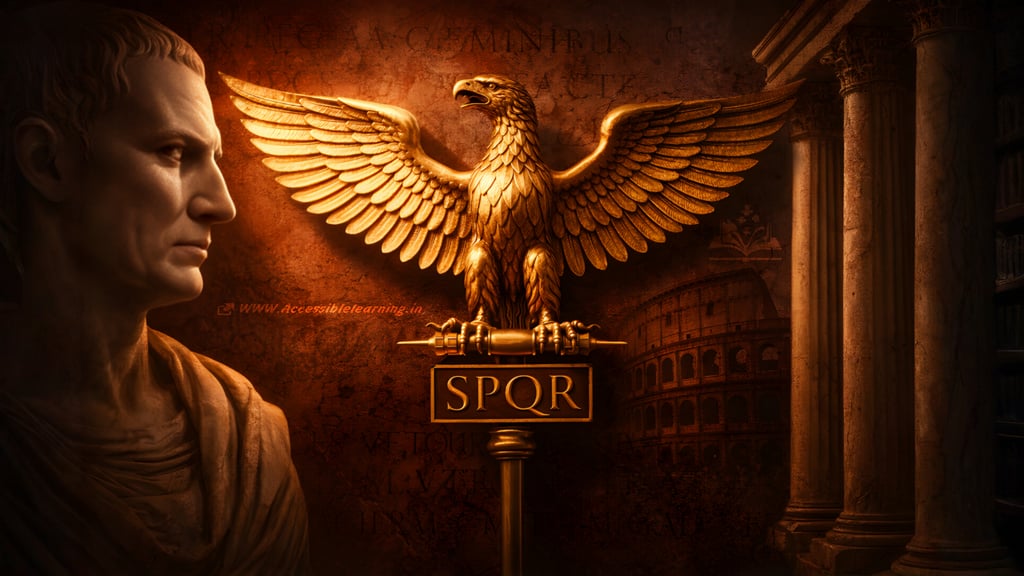
What Made the Roman Empire One of History's Most Powerful Civilizations?
The Roman Empire stands as one of humanity's most influential civilizations, spanning nearly 1,500 years and leaving an indelible mark on law, language, architecture, engineering, and governance that shapes our world today. From its legendary founding in 753 BCE to the fall of Constantinople in 1453 CE, Rome's journey from a small settlement along the Tiber River to a vast empire controlling the Mediterranean world represents one of history's most remarkable transformations.
Understanding the Roman Empire: Definition and Historical Context
The Roman Empire refers to the post-Republican period of ancient Roman civilization, traditionally dated from 27 BCE when Augustus became the first emperor, though some historians extend this definition to include the entire period of Roman dominance. At its territorial peak under Emperor Trajan in 117 CE, the empire controlled approximately 5 million square kilometers, encompassing regions across three continents: Europe, Asia, and Africa.
Key Periods of Roman History
The Roman Kingdom (753-509 BCE): Rome's mythical founding by Romulus established a monarchical system ruled by seven legendary kings. This period laid the groundwork for Roman identity, religious practices, and early territorial expansion.
The Roman Republic (509-27 BCE): Following the overthrow of the last king, Rome developed a complex republican government featuring elected consuls, the Senate, and popular assemblies. This era witnessed Rome's expansion throughout Italy and the Mediterranean, punctuated by conflicts like the Punic Wars against Carthage and internal civil wars that ultimately transformed the Republic into an Empire.
The Roman Empire - Principate (27 BCE-284 CE): Augustus inaugurated this period by maintaining republican facades while consolidating imperial power. The Pax Romana, a period of relative peace lasting approximately 200 years, facilitated unprecedented economic prosperity, cultural development, and territorial stability.
The Roman Empire - Dominate (284-476 CE in the West; 284-1453 CE in the East): Emperor Diocletian's reforms created a more autocratic imperial system. The empire split into Eastern and Western halves, with the Western Roman Empire falling in 476 CE while the Eastern Byzantine Empire continued for another millennium.
The Rise of Rome: From City-State to Mediterranean Superpower
Early Expansion and Military Innovation
Rome's ascent stemmed from several strategic advantages. The Roman military's legendary discipline, innovative tactics like the manipular formation and later the cohort system, and engineering prowess in building roads and fortifications enabled systematic conquest. The construction of the Via Appia in 312 BCE exemplified how infrastructure supported both military campaigns and economic integration.
The Punic Wars: Rome's Defining Conflict
The three Punic Wars (264-146 BCE) against Carthage proved transformative. Despite Hannibal's devastating invasion of Italy during the Second Punic War, Rome's resilience and the strategic genius of commanders like Scipio Africanus ultimately secured victory. Carthage's destruction in 146 BCE established Rome as the undisputed Mediterranean power.
Republican Expansion and Internal Crisis
Military success brought wealth and slaves to Rome but also social upheaval. The Gracchi brothers' reform attempts in the late 2nd century BCE highlighted growing inequality. Military strongmen like Marius, Sulla, Pompey, and Julius Caesar increasingly dominated politics, culminating in civil wars that destroyed the Republican system.
The Imperial System: How Roman Emperors Governed an Empire
Augustus and the Principate
Octavian's victory at the Battle of Actium in 31 BCE ended decades of civil war. Accepting the title Augustus in 27 BCE, he masterfully created an imperial system while preserving republican institutions. The Senate remained, but real power resided with the emperor, who controlled the military, finances, and foreign policy.
Imperial Administration and Provincial Governance
The empire's administrative genius enabled governance of diverse populations. Provinces fell into two categories: senatorial provinces (peaceful regions governed by the Senate) and imperial provinces (militarized frontier regions under direct imperial control). Roman governors, supported by a professional bureaucracy, collected taxes, maintained order, and administered justice.
The Roman Military Machine
Roman legions formed the empire's backbone. Each legion comprised approximately 5,000 heavily armed infantry supported by auxiliary units of cavalry and specialized troops. Military camps evolved into permanent settlements, many becoming major cities. The army's role extended beyond warfare to include engineering projects, policing, and spreading Roman culture.


Society and Daily Life in Ancient Rome
Social Hierarchy and Class Structure
Roman society operated on rigid hierarchical principles. At the apex stood the emperor and imperial family, followed by senatorial and equestrian orders representing the elite. Below them existed the plebeians (common citizens), freedmen (former slaves), and slaves (comprising perhaps 20-30% of the population in some periods).
Urban Life in Rome and Major Cities
Rome itself reached a population exceeding one million inhabitants by the 1st century CE, a size unmatched in the West for over 1,500 years. Multi-story apartment buildings (insulae) housed the working classes, while the wealthy occupied spacious villas. Public amenities included bathhouses, forums, theaters, amphitheaters like the Colosseum, and the Circus Maximus for chariot racing.
Roman Family Structure and Gender Roles
The Roman family centered on the paterfamilias, the male head possessing absolute authority. Women, while legally subordinate, often wielded significant informal influence, particularly in elite families. Education varied by class, with wealthy children receiving extensive tutoring in literature, rhetoric, and Greek philosophy.
Roman Engineering and Architectural Achievements
Infrastructure and Public Works
Roman engineering prowess produced enduring monuments. The road network exceeded 250,000 miles at its peak, facilitating military movement, trade, and communication. Aqueducts like the Pont du Gard transported fresh water across vast distances using precise gravitational engineering. The Pantheon's unreinforced concrete dome, spanning 43 meters, remained the world's largest for over 1,300 years.
Architectural Innovation and Urban Planning
Romans perfected the arch, vault, and dome, enabling construction of massive structures. Concrete (opus caementicum) revolutionized building techniques. Roman urban planning featured grid patterns, central forums, public buildings, and sophisticated sanitation systems, including public latrines and sewers like the Cloaca Maxima.
Military Engineering
Roman military engineering supported conquest and defense. Temporary marching camps could be established by an entire legion in mere hours. Permanent fortifications like Hadrian's Wall in Britain (73 miles long) and the Limes Germanicus marked imperial boundaries. Siege equipment and bridge-building capabilities gave Roman armies tactical advantages.
Roman Law and Governance: Foundations of Western Legal Systems
Development of Roman Law
Roman law evolved from customary practices and the Twelve Tables (450 BCE) into sophisticated legal theory. The distinction between ius civile (law for citizens) and ius gentium (law of peoples) accommodated the empire's diversity. Legal experts (jurisprudentes) developed precedents and principles still foundational to civil law systems.
The Corpus Juris Civilis
Emperor Justinian I's codification of Roman law in the 6th century CE (the Corpus Juris Civilis, or "Body of Civil Law") preserved Roman legal knowledge for posterity. This comprehensive compilation influenced medieval European law and remains fundamental to modern legal systems across continental Europe, Latin America, and beyond.
Citizenship and Rights
Roman citizenship conferred legal protections, property rights, and political participation. Initially restricted to Rome's inhabitants, citizenship gradually expanded. The Edict of Caracalla (212 CE) granted citizenship to nearly all free inhabitants of the empire, unifying diverse populations under common legal frameworks.
Economy and Trade in the Roman Empire
Agricultural Foundations
Agriculture formed the economic base, with most people engaged in farming. Large estates (latifundia) worked by slaves produced grain, wine, and olive oil. Italy imported grain from Egypt, North Africa, and Sicily, with Rome alone consuming approximately 200,000 tons annually at its peak.
Trade Networks and Commerce
The Mediterranean became a "Roman lake," facilitating trade. Merchant ships transported luxury goods like silk from China (via the Silk Road), spices from India, and amber from the Baltic. Roman coinage, standardized across the empire, enabled long-distance commerce. Archaeological evidence reveals trade connections extending to Southeast Asia and sub-Saharan Africa.
Economic Challenges and Inflation
Economic difficulties plagued the later empire. Military expenditures, plague outbreaks (like the Antonine Plague of 165-180 CE and the Cyprian Plague of 249-262 CE), and debased currency caused inflation. The 3rd-century crisis witnessed economic contraction, though Diocletian's reforms temporarily stabilized conditions.
Religion in Ancient Rome: From Polytheism to Christianity
Traditional Roman Religion
Roman religion emphasized practical reciprocity with deities through sacrifices and rituals. Major gods like Jupiter, Juno, Mars, and Venus received state-sponsored worship. The emperor cult, particularly after Augustus, integrated political loyalty with religious observance. Romans generally tolerated foreign religions provided practitioners also honored Roman gods.
Mystery Religions and Eastern Cults
The imperial period saw growing interest in mystery religions offering personal salvation. The cults of Isis (from Egypt), Mithras (originating in Persia), and Cybele attracted devotees. These religions featured initiation rituals, moral teachings, and promises of afterlife rewards, contrasting with traditional Roman religious pragmatism.
The Rise of Christianity
Christianity emerged as a Jewish sect in the 1st century CE, spreading rapidly through urban centers. Early Christians faced periodic persecution, most notably under Nero (64 CE), Decius (250-251 CE), and Diocletian (303-311 CE). The Edict of Milan (313 CE) granted religious tolerance, and by 380 CE under Theodosius I, Christianity became the empire's official religion, fundamentally transforming Roman civilization.

The Decline and Fall of the Western Roman Empire
Multiple Causation Theory
Modern historians reject single-cause explanations for Rome's fall, recognizing complex, interrelated factors operating over centuries.
Military Challenges: Pressure from Germanic tribes (Goths, Vandals, and Franks), Huns, and later Sassanid Persia strained resources. The sack of Rome by Visigoths under Alaric in 410 CE and by Vandals in 455 CE demonstrated the empire's vulnerability.
Economic Decline: Inflation, currency debasement, taxation burdens, and reduced trade disrupted economic stability. The cost of maintaining frontiers and armies exceeded revenues, forcing reliance on Germanic foederati (allied tribes) for defense.
Political Instability: The 3rd century witnessed the "Crisis of the Third Century" (235-284 CE) with over 50 emperors in 50 years, most dying violently. Later periods saw weak rulers dominated by military strongmen and court factions.
Administrative Division: Diocletian's division of the empire into Eastern and Western halves (285 CE) addressed administrative challenges but created competing power centers. The establishment of Constantinople as the Eastern capital (330 CE) shifted resources and attention eastward.
Sociocultural Transformation: Christianity's rise altered traditional values and institutions. The closing of pagan temples and philosophical schools represented cultural discontinuity. However, the Church also preserved classical learning and provided administrative continuity.
The Fall of the Western Empire
The traditional date of 476 CE marks when Germanic chieftain Odoacer deposed the last Western emperor, Romulus Augustulus. However, this represented a gradual transformation rather than a sudden collapse. Germanic kingdoms in the West maintained Roman administrative structures, laws, and cultural practices, representing continuity amid change.
The Byzantine Empire: Rome's Eastern Continuation
Constantinople and Eastern Survival
The Eastern Roman Empire, later called Byzantine, survived the West's collapse by a millennium. Strategic advantages included Constantinople's defensible position, wealthier provinces, more urbanized population, and shorter frontiers. The eastern empire maintained Roman identity, law, and traditions while developing a distinctive Greek cultural character.
Justinian's Reconquest and Legacy
Emperor Justinian I (527-565 CE) temporarily reconquered portions of the Western Mediterranean, including North Africa, Italy, and southern Spain. His legal codification, architectural projects (Hagia Sophia), and administrative reforms represented the last great flourishing of classical Roman civilization. However, plague, wars, and overextension weakened the empire.
Byzantine Continuation Until 1453
The Byzantine Empire persisted through numerous challenges, including Arab conquests, Slavic migrations, and Crusades (ironically, the Fourth Crusade sacked Constantinople in 1204). The Ottoman conquest of Constantinople in 1453 CE by Mehmed II finally ended the Roman political tradition, though Byzantine scholars fleeing west helped spark the Italian Renaissance.
The Roman Legacy: Enduring Influence on Modern Civilization
Legal and Political Foundations
Roman law underpins civil law systems globally. Legal concepts like habeas corpus, precedent, contracts, and property rights trace to Roman origins. Republican ideals influenced the American founding fathers and modern democratic systems. The separation of powers, checks and balances, and representative institutions reflect Roman precedents.
Language and Literature
Latin evolved into Romance languages (Italian, French, Spanish, Portuguese, and Romanian) spoken by nearly one billion people. Scientific, medical, and legal terminology worldwide derives from Latin. Roman authors like Virgil, Ovid, Cicero, and Seneca shaped Western literature and philosophy for millennia.
Architecture and Engineering
Roman architectural innovations persist in government buildings, monuments, and infrastructure worldwide. The dome, arch, and concrete construction techniques influence modern engineering. Urban planning concepts, grid-pattern cities, and public amenities trace to Roman models.
Cultural and Intellectual Heritage
Roman absorption and transmission of Greek philosophy, science, and culture preserved classical learning. The Christian Church, structured along Roman administrative lines, became medieval Europe's primary institution, preserving literacy and education. The Renaissance recovered and celebrated Roman art, literature, and political ideals.
Calendar and Timekeeping
The Julian calendar, introduced by Julius Caesar in 45 BCE, formed the basis for the Gregorian calendar used globally today. Month names (January from Janus, March from Mars, July from Julius, and August from Augustus) and day structures reflect Roman origins.


Understanding Rome's Timeless Relevance
The Roman Empire's extraordinary millennium-long dominance of the Mediterranean world and its profound influence on subsequent civilizations make it essential to understanding Western civilization and global history. From legal principles governing modern societies to languages spoken by billions, from architectural forms gracing capital cities to political ideals shaping democracies, Roman legacy permeates contemporary life.
Rome's story offers timeless lessons about power, governance, cultural integration, military strategy, and societal transformation. The empire's ability to assimilate diverse peoples and cultures while maintaining cohesion for centuries demonstrates organizational genius. Conversely, its gradual decline illustrates how even seemingly invincible civilizations face challenges from economic pressures, military threats, political dysfunction, and cultural change.
For students, scholars, and history enthusiasts, the Roman Empire represents an inexhaustible subject revealing insights into human civilization, leadership, cultural development, and historical change. As we navigate our own era's complexities, Rome's successes and failures provide valuable perspective on building lasting institutions, managing diversity, and adapting to transformation while maintaining core values and identity.
Frequently Asked Questions
Q: When did the Roman Empire begin and end?
The Roman Empire traditionally began in 27 BCE when Augustus became the first emperor and ended in the West in 476 CE with the deposition of Romulus Augustulus. The Eastern Byzantine Empire continued until 1453 CE when Constantinople fell to the Ottoman Turks.
Q: What was the largest extent of the Roman Empire?
The Roman Empire reached its maximum territorial extent under Emperor Trajan in 117 CE, controlling approximately 5 million square kilometers and encompassing an estimated 50-90 million people, roughly 20-25% of the world's population at that time.
Q: What language did Romans speak?
Romans primarily spoke Latin, though Greek remained the lingua franca in the Eastern Mediterranean. Classical Latin was used in literature, law, and formal contexts, while Vulgar Latin (common speech) evolved into the Romance languages.
Q: Why did the Roman Empire fall?
The Western Roman Empire's fall resulted from multiple interconnected factors, including military pressures from Germanic tribes, economic decline, political instability, administrative challenges, and cultural transformation. Modern historians reject single-cause explanations, emphasizing gradual transformation rather than sudden collapse.
Q: What was daily life like in ancient Rome?
Daily life varied dramatically by social class. Elite Romans enjoyed spacious homes, formal education, and leisure pursuits. Common citizens lived in crowded apartments, worked various trades, and enjoyed public entertainments like gladiatorial games and chariot races. The majority engaged in agriculture. Slavery was widespread, with slaves performing diverse roles from manual labor to skilled professions.
Q: What were the greatest achievements of ancient Rome?
Roman achievements include sophisticated legal systems influencing modern law, engineering marvels like aqueducts and roads, architectural innovations including concrete and the dome, military organization and tactics, the spread of urbanization and literacy, and the preservation of Greek culture and knowledge.
Q: How did Rome influence modern governments?
Roman republican ideals influenced modern democratic systems, including concepts of citizenship, representative government, separation of powers, and checks and balances. Roman law forms the foundation of civil law systems across continental Europe, Latin America, and many other regions.
Q: What caused the division of the Roman Empire?
Administrative challenges governing vast territories led Diocletian to divide the empire into Eastern and Western halves in 285 CE. This division addressed military threats and bureaucratic complexity but created competing power centers that ultimately contributed to the West's decline while the East survived.
Subscribe to Frontier Intelligence
All © Copyright reserved by Accessible-Learning Hub
| Terms & Conditions
Accessible Learning Hub — Actionable clarity for high-agency minds.
Weekly breakdowns on AI breakthroughs, capital flow, and human performance systems. Zero fluff.