

Top 12 Greatest Kings of India in History: The Legendary Rulers Who Shaped a Civilization
India's greatest kings include Ashoka the Great, Chandragupta Maurya, Akbar the Great, Chandragupta II (Vikramaditya), Krishnadevaraya, Raja Raja Chola I, Harshavardhana, Prithviraj Chauhan, Shivaji Maharaj, Ranjit Singh, Bindusara, and Kanishka the Great. These rulers are celebrated for military conquests, administrative genius, cultural patronage, and enduring legacies that continue to define Indian civilization.
INDIAN HISTORYEMPIRES/HISTORYHISTORY
Jagdish Nishad
3/5/202614 min read
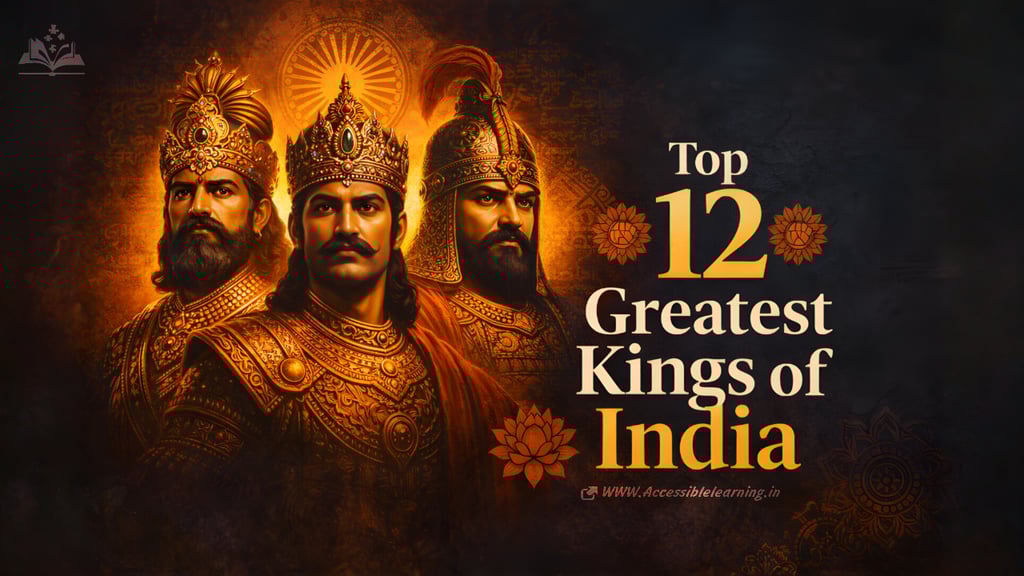
Why India's Ancient Kings Still Matter Today
India is not just a country; it is a living archive of empires, dynasties, and monarchs whose decisions shaped the course of human history. From the snow-capped Himalayas to the tropical shores of Cape Comorin, India's greatest kings ruled over some of the most prosperous, intellectually vibrant, and culturally rich civilizations the ancient world had ever seen.
When we ask, "Who were the most powerful kings in Indian history?" or "Which Indian rulers had the biggest impact on world civilization?" we are really asking a deeper question: what does great leadership look like across centuries?
This article explores the top 12 greatest kings of India in history, ranked by a combination of military achievement, administrative innovation, cultural legacy, territorial extent, and lasting historical influence. Whether you are a student, a history enthusiast, or someone preparing for competitive exams, this guide offers authoritative, well-researched insight into India's royal heritage.
How Were These 12 Kings Selected?
The selection criteria blend multiple historical dimensions:
Military power and territorial expansion: how far did their empire reach?
Administrative and governance reforms: did they create systems that outlasted them?
Economic prosperity: did their reign bring wealth and stability to their people?
Cultural and religious patronage: what arts, architecture, and philosophy did they promote?
Historical legacy and global influence: are they studied, revered, and remembered globally?
No list of this kind is without nuance. India's history spans over 5,000 years and hundreds of dynasties. What follows is a carefully researched, historically grounded, and deeply human portrait of twelve monarchs who transcended their era.

Ashoka the Great (c. 268–232 BCE): The Emperor Who Chose Peace Over Power
Dynasty: Maurya | Region: Pan-Indian subcontinent | Capital: Pataliputra (modern Patna)
Who Was Ashoka?
Ashoka Maurya is arguably the most iconic king in Indian history and one of the most remarkable rulers in all of human civilization. He began his reign as a ferocious conqueror, expanding the Mauryan Empire to its greatest territorial extent, covering most of the Indian subcontinent, Afghanistan, and parts of Persia.
Then came the Battle of Kalinga (c. 261 BCE). Witnessing the catastrophic human cost of war an estimated 100,000 dead and 150,000 displaced Ashoka underwent one of history's most dramatic moral transformations. He converted to Buddhism, renounced aggressive warfare, and spent the rest of his reign propagating Dhamma (righteous living, compassion, and non-violence).
Why Ashoka Is Considered Great
Ashoka pioneered concepts that feel startlingly modern: animal welfare laws, religious tolerance, a welfare state, free medical care for both humans and animals, and a network of roads and rest houses spanning his empire. His edicts, carved on pillars and rocks across the subcontinent, are among the earliest examples of a ruler communicating directly with his people in their own regional languages.
His Lion Capital, the national emblem of India today, and the Ashoka Chakra on the Indian national flag are testaments to his enduring relevance.
Legacy
Ashoka sent Buddhist missionaries to Sri Lanka, Central Asia, and the Hellenistic world, making him one of the most consequential figures in the spread of Buddhism globally. Modern scholars like Amartya Sen and historians like Romila Thapar have written extensively about how Ashoka's governance model anticipated pluralist democracy.
Key Facts at a Glance:
Ruled approximately 36 years
Empire spanned ~5 million km²
Author of the earliest known welfare edicts in world history
His symbol is literally on India's flag
Chandragupta Maurya (c. 321–297 BCE): The Founder Who Built an Empire from Scratch
Dynasty: Maurya (founder) | Region: Northern and central India | Capital: Pataliputra
The Rise of a Revolutionary
Chandragupta Maurya's story reads like a myth: a low-born young man, mentored by the brilliant strategist Chanakya (Kautilya), who overthrew the powerful Nanda dynasty and went on to establish the first pan-Indian empire. He defeated the Greek satrapies left behind by Alexander the Great's retreating generals, unifying vast swathes of the subcontinent under one rule for the first time in history.
Governance and Statecraft
The Arthashastra, Chanakya's legendary treatise on statecraft, was the governing philosophy of Chandragupta's administration. It described a sophisticated state apparatus: a spy network, a standing army, taxation systems, judicial procedures, and municipal governance that rival anything in the ancient Mediterranean world.
The Greek ambassador Megasthenes wrote extensively about Pataliputra as a glittering, well-organized metropolis of remarkable sophistication during Chandragupta's reign.
Later Life
In a finale as dramatic as his rise, Chandragupta abdicated his throne, became a Jain monk, and, according to tradition, fasted unto death (Sallekhana) at Shravanabelagola in Karnataka, a site still revered by Jains today.
Key Facts at a Glance
Founded the Maurya Empire ~321 BCE
Negotiated a peace treaty with Seleucus I, receiving Afghan territories
First ruler to politically unite most of the Indian subcontinent
Akbar the Great (1542–1605 CE): The Mughal Emperor Who Built a Nation on Tolerance
Dynasty: Mughal | Region: Northern and central India | Capital: Agra, then Fatehpur Sikri
The Architect of Mughal India
Akbar (Abu'l-Fath Jalal-ud-din Muhammad Akbar) ascended the Mughal throne at just 13 years of age. Over the next half-century, he expanded Mughal control across most of the Indian subcontinent, not just through military conquest, but through diplomacy, strategic marriage alliances, and what modern scholars call a remarkably progressive political philosophy.
Religious Innovation and Social Reform
Akbar's most celebrated achievement may be his policy of Sulh-i-Kul ("peace with all"), which promoted religious tolerance across his multi-faith empire. He abolished the jizya (a tax on non-Muslims), welcomed Hindu Rajput nobles into his inner court, and created the syncretic spiritual movement. Din-i-Ilahi was an attempt to blend the best elements of Islam, Hinduism, Zoroastrianism, and Christianity.
Akbar was functionally illiterate, yet he maintained one of the most intellectually vibrant courts in the world, patronizing artists, poets, musicians, and architects whose work defined Mughal aesthetics for generations.
Administrative Genius
His revenue minister, Todar Mal, introduced the Zabti system, a sophisticated land survey and revenue assessment that formed the backbone of Mughal taxation and influenced Indian land administration well into the British colonial era.
Key Facts at a Glance
Reigned 49 years (1556–1605 CE)
Empire covered ~4 million km² at peak
Nine extraordinary ministers (Navaratnas) in his court, including Birbal and Tansen
His court language produced some of the finest Urdu and Persian literature
Chandragupta II "Vikramaditya" (c. 375–415 CE): India's Golden Age Emperor
Dynasty: Gupta | Region: Northern India | Capital: Pataliputra, later Ujjain
The Gupta Golden Age
If Ashoka represents India's moral apex and Akbar its multicultural renaissance, Chandragupta II Vikramaditya represents India's intellectual and artistic summit. His reign marked the height of the Gupta Empire, a period so culturally prolific that historians routinely call it India's "Golden Age."
Achievements Under His Reign
Under Chandragupta II, India produced Kalidasa (considered the Shakespeare of Sanskrit literature), the astronomer-mathematician Aryabhata (who proposed that the Earth rotates on its axis and calculated the value of pi with remarkable accuracy), and the physician Sushruta, whose medical texts described surgical techniques centuries ahead of the West.
The Nine Gems (Navaratnas) of his court, including Kalidasa, Aryabhata, Varahamihira, and Amarasimha, represent perhaps the greatest single concentration of intellectual talent in the ancient world.
Military and Diplomatic Achievements
Chandragupta II expanded the Gupta Empire through both warfare and strategic marriages. His conquest of the Western Kshatrapas (Sakas) in Western India in the early 5th century CE secured control of vital trade routes to the Arabian Sea, dramatically boosting India's maritime trade with the Roman Empire and Southeast Asia.
Chinese Buddhist pilgrim Fa Hien visited India during this reign and wrote about a prosperous, well-governed society with little crime and free hospitals.
Key Facts at a Glance
Patronized art, science, literature, and mathematics
India's GDP during the Gupta period is estimated at ~33% of global output
Sanskrit literature, astronomy, and mathematics flourished uniquely during this era

Krishnadevaraya (1509–1529 CE): The Warrior-Poet King of the South
Dynasty: Tuluva (Vijayanagara Empire) | Region: Southern India | Capital: Hampi (Vijayanagara)
The Greatest King of South India
Krishnadevaraya is widely regarded as the greatest ruler of the Vijayanagara Empire and one of the most accomplished kings in South Indian history. He was a military genius who never lost a battle, a poet of extraordinary refinement, and a patron of arts and literature unmatched in peninsular India.
Military Supremacy
He decisively defeated the Bijapur Sultanate at the Battle of Diwani (1512 CE) and later captured Raichur (1520 CE), humiliating the combined forces of the Deccan Sultanates. Portuguese traders, who maintained a presence on the Malabar Coast, considered him the most powerful king in India and forged trade alliances with him.
The Cultural Crown
Krishnadevaraya's court hosted the Ashtadiggajas, eight legendary Telugu poets. He himself composed Amuktamalyada, a masterpiece of Telugu literature, as well as Sanskrit and Kannada works. He built the magnificent Vittala Temple complex at Hampi, whose Musical Pillars stone columns that produce musical notes when struck remain an architectural wonder to this day.
Key Facts at a Glance
Reigned just 20 years but achieved extraordinary results
Extended Vijayanagara Empire to its greatest limits
Hampi (his capital) is now a UNESCO World Heritage Site
Raja Raja Chola I (985–1014 CE): The Emperor Who Turned the Sea into His Kingdom
Dynasty: Chola | Region: Southern India and Sri Lanka | Capital: Thanjavur
The Chola Naval Colossus
Raja Raja Chola I transformed the Chola kingdom from a regional power into a formidable empire that controlled much of South India and Sri Lanka and extended its reach across the Indian Ocean. He is remembered as the emperor who militarized the sea, building what was perhaps the first significant naval force in Indian history.
Conquests and Administration
He conquered Kerala, Sri Lanka (Anuradhapura), the Maldive Islands, and parts of the Malay Peninsula, giving the Chola Empire unparalleled dominance over Indian Ocean trade routes. His administrative system dividing the empire into mandalam, valanadu, and nadu was a model of decentralized efficiency.
The Brihadeeswarar Temple
His greatest cultural monument is the Brihadeeswarar Temple (also called the Big Temple) in Thanjavur, completed in 1010 CE. Built entirely of granite, it was the tallest temple in the world at the time of its construction. Its vimana (tower) rises 66 meters, and the single capstone at its top weighs an estimated 80 tonnes, a feat of engineering that still puzzles modern experts. It is a UNESCO World Heritage Site.
Key Facts at a Glance
First Indian ruler to conduct sustained naval campaigns beyond the subcontinent
Thanjavur Brihadeeswarar Temple is one of India's greatest architectural achievements
His reign gave Tamil art, music, and bronze sculpture their classical form
Harshavardhana (606–647 CE): The Last Great Emperor of Northern India
Dynasty: Pushyabhuti/Vardhana | Region: Northern India | Capital: Kannauj
A King Who Was Also a Scholar
Harshavardhana ascended the throne at just 16 after the death of his elder brother and within a few years built an empire stretching from the Punjab to Bengal. He is one of the few Indian kings known to have personally authored literary works; his three Sanskrit plays (Ratnavali, Priyadarshika, and Nagananda) are still studied in classical literature courses today.
Rule and Religious Policy
Though a Shaivite by birth, Harsha converted to Buddhism and became one of its most generous royal patrons. He held the famous Kumbha Mela at Prayag, where, by accounts he gave away all the royal treasury's wealth to monks, priests, and the poor and then reportedly borrowed back his own clothes.
Chinese Buddhist pilgrim Xuanzang (Hiuen Tsang) spent significant time at Harsha's court and left detailed accounts of a prosperous, intellectually vibrant kingdom in his travelogue Great Tang Records on the Western Regions.
Legacy
Harsha's death in 647 CE without an heir plunged Northern India into fragmentation, ending the era of large unified empires in the north for centuries. He remains the last great king to unite most of North India before the Mughal period.
Key Facts at a Glance
One of only a handful of Indian kings who was also a noted literary figure
Supported universities like Nalanda, the ancient world's greatest center of learning
His reign is one of the most documented in ancient Indian history, thanks to Xuanzang's accounts
Prithviraj Chauhan (c. 1166–1192 CE): The Last Hindu Emperor of Delhi
Dynasty: Chahamana (Chauhan) | Region: Northern India | Capital: Ajmer, then Delhi
The Rajput Legend
Prithviraj Chauhan III is one of the most romantically celebrated figures in Indian history, a courageous Rajput warrior-king whose story of valor, love, and tragic defeat has inspired epics, films, and folk ballads for eight centuries. He ruled the Chahamana dynasty and commanded the loyalty of most Rajput clans in northern India.
Military Campaigns
Prithviraj defeated the Afghan sultan Muhammad of Ghor at the First Battle of Tarain (1191 CE) a stunning military victory that temporarily halted Muslim expansion into northern India. However, at the Second Battle of Tarain in 1192 CE, he was defeated and captured, marking a turning point in Indian history and ushering in the Delhi Sultanate era.
The Poetry of Chand Bardai
His court poet Chand Bardai composed Prithviraj Raso, one of the earliest major works in the Apabhramsha language, which immortalized Prithviraj's exploits and his legendary romance with Princess Sanyogita. While parts of the text are mythologized, it remains a cornerstone of early Hindi/Rajasthani literature.
Key Facts at a Glance
Last independent Hindu ruler of Delhi
His defeat at Tarain II (1192 CE) changed the political history of India permanently
Romanticized as an embodiment of Rajput chivalry and honor
Shivaji Maharaj (1630–1680 CE): The Father of the Maratha Nation
Dynasty: Bhonsle (Maratha Empire) | Region: Western and central India | Capital: Raigad
The Mountain Fox
Chhatrapati Shivaji Bhonsle is one of India's most beloved historical figures a brilliant military tactician, an enlightened administrator, and a symbol of resistance against Mughal domination. Born in the Deccan highlands, he carved out an independent Maratha kingdom through guerrilla warfare, strategic brilliance, and indomitable personal courage.
Military Innovation
Shivaji is credited with pioneering Ganimi Kava guerrilla warfare tactics that exploited the Sahyadri mountain terrain with devastating effectiveness against larger Mughal forces. He built a powerful navy, constructed and maintained dozens of mountain forts, and created a professional military bureaucracy decades before similar concepts appeared in Mughal administration.
His daring escape from Agra (1666 CE), where he was held under Mughal captivity, is one of history's great escape stories; he concealed himself in a fruit basket to flee from Aurangzeb's court.
Governance and Philosophy
Shivaji was notable for his religious tolerance; he respected Islam, protected mosques, and had Muslims in his army and administration. He is credited with coining the term Hindavi Swarajya ("self-rule of the people"), which resonated centuries later during India's independence movement.
Key Facts at a Glance
Coronated as Chhatrapati (sovereign) at Raigad fort in 1674 CE
Built a powerful naval fleet to challenge Portuguese and Mughal dominance
Became the inspiration for the Maratha Confederacy that later challenged the Mughals across India

Ranjit Singh (1780–1839 CE): The Lion of Punjab
Dynasty: Sikh Empire (Sukerchakia misl) | Region: Punjab, Sindh, Kashmir, Khyber | Capital: Lahore
The One-Eyed Lion
Maharaja Ranjit Singh "Sher-e-Punjab" (Lion of Punjab) is one of the most extraordinary rulers of the 18th and 19th centuries. Rising to power in a fractured post-Mughal Punjab, he unified the Sikh misls (confederacies), conquered Lahore at age 19, and built the last great independent empire before British colonization swallowed the subcontinent.
Military and Diplomatic Prowess
Ranjit Singh built a modernized Sikh army, the Khalsa Army, trained by European military officers, armed with the latest weapons technology, and organized on Napoleonic military lines. He extended his empire to include the Punjab, Kashmir, Sindh, Peshawar, and parts of present-day Afghanistan territories no Indian ruler had controlled since the Mughals.
He was the only Indian ruler who successfully negotiated with the British East India Company as an equal, maintaining his kingdom's independence through a combination of military strength and astute diplomacy.
Secular Governance
Ranjit Singh's court was strikingly cosmopolitan; Hindu, Muslim, and Sikh ministers served together. He never destroyed mosques or temples in conquered territories. The renowned scholar and British political agent Sir Henry Fane wrote that Ranjit Singh possessed "the most extraordinary mind" he had ever encountered.
The famous Koh-i-Noor diamond, now part of the British Crown Jewels, was acquired by Ranjit Singh and remained in the Sikh treasury until the British annexation of Punjab in 1849.
Key Facts at a Glance
Built the only Indian empire that held the British at bay diplomatically
Died 1839 CE; the British annexed Punjab a decade after his death (1849 CE)
His Khalsa Army was considered one of the finest fighting forces in Asia
Bindusara (c. 297–272 BCE): The Forgotten Mauryan Emperor
Dynasty: Maurya | Region: Indian subcontinent | Capital: Pataliputra
The Underrated Conqueror
Bindusara, son of Chandragupta Maurya and father of Ashoka, is one of history's most underrated kings, overshadowed by his legendary relatives. Yet his military campaigns expanded the Mauryan Empire further south than his father had ever reached, earning him the Greek epithet Amitrochates ("destroyer of enemies").
Reign and Achievements
Bindusara maintained the sophisticated administrative machinery built by Chandragupta and Chanakya and expanded diplomatic relations with the Seleucid Empire and Ptolemaic Egypt. Greek sources mention that he requested figs, wine, and a Greek philosopher from Antiochus I, a charming glimpse of cross-cultural curiosity.
He suppressed revolts in Taxila (twice) and is believed to have conquered 16 nations in the southern peninsula, laying the groundwork for the vast Mauryan Empire that Ashoka would inherit at its peak.
Key Facts at a Glance
Ruled for approximately 25 years
Continued his father's policy of administrative efficiency
Maintained diplomatic ties with Greek kingdoms in the West
Kanishka the Great (c. 127–150 CE): The Emperor of the Silk Road
Dynasty: Kushan | Region: Central Asia, Northwestern India, Ganges plain | Capital: Purushapura (modern Peshawar)
The Silk Road Emperor
Kanishka I is one of the most important and least popularly known kings in Indian history. As ruler of the Kushan Empire, he controlled territories from the Aral Sea to the Gangetic plain, making his empire a critical junction point of the Silk Road trade network connecting China, India, Persia, and Rome.
Patron of Buddhism and Arts
Kanishka was a fervent Buddhist patron. He convened the Fourth Buddhist Council in Kashmir a landmark event that formalized Mahayana Buddhist doctrine and led to the systematic transmission of Buddhism to Central Asia, China, and East Asia. Without Kanishka's patronage, the shape of East Asian civilization might look very different.
Gandhara art, the distinctive school that blended Hellenistic, Indian, and Central Asian artistic traditions, reached its zenith under the Kushan Empire. Many of the earliest iconic images of the Buddha in human form (as opposed to earlier symbolic representations) were created during this period.
Economic Power
The Kushan Empire under Kanishka was fabulously wealthy. Gold coins minted by Kushan emperors have been found from Ukraine to Vietnam, evidence of the vast commercial network his empire anchored.
Key Facts at a Glance
Controlled the most strategically important trade routes of the ancient world
Fourth Buddhist Council under his patronage defined Mahayana Buddhism
Gandhara art under his reign influenced Buddhist iconography across all of Asia
The Enduring Legacy of India's Greatest Kings
India's royal history is not simply a chronicle of battles won and lost. It is a story of ideas about justice, tolerance, governance, art, trade, and the relationship between a ruler and the ruled.
What unites Ashoka's compassion, Chandragupta's ambition, Akbar's pluralism, Krishnadevaraya's artistry, Shivaji's courage, and Ranjit Singh's pragmatic statesmanship is a quality that transcends era and dynasty: the capacity to envision something larger than themselves and build toward it.
These twelve kings did not merely conquer land; they built systems of thought, monuments of beauty, and institutions of learning that outlasted their empires by millennia.
India's national symbols its emblem, its wheel, its temples, and its very sense of civilizational continuity bear the fingerprints of these men. Understanding them is not an exercise in nostalgia. It is a window into what visionary leadership, at its finest, can achieve.
FAQ's
Q: Who is considered the greatest king of India of all time?
Most historians and popular consensus name Ashoka the Great as the greatest king in Indian history. His unprecedented moral transformation from conqueror to compassionate ruler, combined with his governance innovations, enduring edicts, and global influence in spreading Buddhism, set him apart. However, Chandragupta Maurya (for founding the first unified empire) and Akbar the Great (for his multicultural, progressive rule) are also frequently cited.
Q: Who was the most powerful king of India in terms of military might?
In terms of sheer military power and territorial control, Chandragupta Maurya and Ranjit Singh stand out. Chandragupta defeated Alexander's successors and unified most of the subcontinent. Ranjit Singh built a modernized army that held the British Empire at bay a remarkable feat in the 19th century.
Q: Which king ruled the largest empire in Indian history?
The Mauryan Empire under Ashoka covered approximately 5 million km², making it the largest empire in Indian history by territorial extent. The Mughal Empire under Aurangzeb (not in this list due to contested legacy) reached a similar scale, but Ashoka's empire remains a close rival in size.
Q: Who was the greatest king of South India?
Krishnadevaraya of the Vijayanagara Empire is widely regarded as the greatest king of South India, while Raja Raja Chola I is considered the most powerful Chola ruler. Both left extraordinary cultural and architectural legacies.
Q: Is Shivaji Maharaj considered one of the greatest Indian kings?
Yes, absolutely. Chhatrapati Shivaji Maharaj is widely regarded as one of India's greatest kings for his military innovation, secular administration, naval strategy, and inspirational leadership that ignited the Maratha movement. He is a national hero in Maharashtra and deeply revered across India.
Q: Which Indian king had the most influence on world history?
Ashoka the Great arguably had the most global influence, as his sponsorship of Buddhism led to its spread across Asia reshaping the cultural and philosophical foundations of China, Japan, Korea, Southeast Asia, and Sri Lanka. Kanishka the Great also played a pivotal role in transmitting Mahayana Buddhism to East Asia via the Silk Road.
Q: Who was the first king to unify India?
Chandragupta Maurya, guided by his mentor Chanakya, is generally credited as the first ruler to politically unify most of the Indian subcontinent under a single administration, around 321 BCE.
Q: Which Indian king was known for religious tolerance?
Both Akbar the Great and Ashoka are celebrated for their religious tolerance. Akbar's Sulh-i-Kul policy and abolition of the non-Muslim tax (jizya) remain landmark moments. Ashoka's edicts explicitly protected all religions and communities in his empire. Shivaji Maharaj and Ranjit Singh also maintained notably secular and tolerant governance.
Q: What is the significance of the Gupta period in Indian history?
The Gupta period (approximately 320–550 CE), especially under Chandragupta II Vikramaditya, is called India's "Golden Age" because it produced extraordinary advances in mathematics (Aryabhata's calculation of pi and the concept of zero), astronomy, medicine, literature (Kalidasa's works), and art (classical Indian sculpture). India's GDP during this period may have represented approximately a third of global economic output.
Q: Who were the greatest kings of India from the medieval period?
The medieval period (roughly 600–1600 CE) produced several extraordinary rulers, including Harshavardhana, Raja Raja Chola I, Krishnadevaraya, Prithviraj Chauhan, Akbar the Great, and Shivaji Maharaj, all of whom appear on this list.
Subscribe to Frontier Intelligence
All © Copyright reserved by Accessible-Learning Hub
| Terms & Conditions
Accessible Learning Hub — Actionable clarity for high-agency minds.
Weekly breakdowns on AI breakthroughs, capital flow, and human performance systems. Zero fluff.