

The Vijayanagara Empire: India's Medieval Golden Age of Architecture, Culture, and Commerce
Discover the Vijayanagara Empire (1336-1646), South India's greatest medieval kingdom. Explore Hampi's UNESCO heritage sites, Krishna Deva Raya's golden age, architectural marvels, trade networks, and the empire's lasting cultural legacy in this comprehensive guide.
INDIAN HISTORYEMPIRES/HISTORYHISTORY
Jagdish Nishad
2/28/202610 min read
The Empire That Rose from Ashes
In 1336, amid the political turbulence of medieval South India, two brothers founded what would become one of the most powerful and culturally vibrant empires in Indian history. The Vijayanagara Empire, whose name translates to "City of Victory," dominated the Deccan plateau for over two centuries, creating a legacy of architectural marvels, economic prosperity, and cultural renaissance that continues to captivate historians and travelers today.
Located in present-day Karnataka, the ruins of Vijayanagara near modern Hampi stand as a UNESCO World Heritage Site, bearing witness to an empire that once controlled most of peninsular India south of the Krishna River. This article explores the rise, glory, and eventual fall of this remarkable empire that served as the last great Hindu kingdom before colonial rule.
The Foundation: How the Vijayanagara Empire Began
The Sangama Dynasty and Early Origins
The Vijayanagara Empire was established in 1336 by Harihara I and Bukka Raya I, two brothers who served as treasury officers under the Kakatiya dynasty. According to traditional accounts, they were captured by the Delhi Sultanate, converted to Islam, and later sent south as governors. However, they reconverted to Hinduism under the guidance of the sage Vidyaranya and founded their own kingdom.
The empire's foundation coincided with a period when the Delhi Sultanate's power in South India was waning. This power vacuum allowed the Sangama brothers to consolidate territories and establish Vijayanagara (modern Hampi) as their capital, strategically positioned near the Tungabhadra River with natural fortifications provided by surrounding hills.
Strategic Geographic Positioning
The choice of Hampi as the capital demonstrated exceptional strategic foresight. The rocky terrain provided natural defense mechanisms, while the Tungabhadra River ensured a water supply for agriculture and daily needs. The location also sat at the intersection of major trade routes connecting the Arabian Sea ports with the eastern coast, facilitating commercial prosperity.
The Golden Age: Vijayanagara at Its Peak
Krishna Deva Raya: The Greatest Emperor
The empire reached its zenith under Krishna Deva Raya (1509-1529), considered the greatest ruler of the Vijayanagara dynasty. His reign represented the empire's golden age in military conquests, administrative efficiency, cultural patronage, and economic prosperity.
Krishna Deva Raya expanded the empire's boundaries through successful military campaigns against the Bahmani Sultanate, the Gajapatis of Odisha, and various other regional powers. By the time of his reign, Vijayanagara controlled an estimated 360,000 square kilometers, making it one of the largest empires in Indian history.
The emperor was not merely a warrior but also a poet, scholar, and patron of the arts. He authored the Telugu work "Amuktamalyada" and patronized the Ashtadiggajas (eight great poets) of Telugu literature. His court became a center of learning, attracting scholars from across India and beyond.
Economic Prosperity and Trade Networks
Vijayanagara's economy was remarkably sophisticated for its time. The empire controlled crucial ports on both the western and eastern coasts, facilitating extensive maritime trade with Persia, Arabia, Southeast Asia, China, and even Europe. Portuguese travelers who visited the capital described it as one of the wealthiest cities in the world.
The empire's economic strength rested on several pillars:
Agriculture formed the backbone, with an extensive irrigation system including tanks, canals, and dams. The empire invested heavily in water management infrastructure, which supported multiple crops annually and sustained a large population.
Textile production represented a major industry, with cotton and silk fabrics from Vijayanagara finding markets across Asia and Europe. The empire became famous for producing fine muslins, printed cottons, and embroidered silks.
Mining and metallurgy thrived, particularly iron smelting and diamond trading. The famous Golconda diamonds passed through Vijayanagara's markets before reaching international buyers.
Currency and taxation systems were well-organized, with gold coins called "varaha" or "pagoda" serving as the primary currency. The empire maintained a relatively light tax burden compared to contemporary kingdoms, which encouraged economic activity.
Foreign visitors consistently marveled at the empire's wealth. Domingo Paes, a Portuguese traveler who visited during Krishna Deva Raya's reign, wrote extensive accounts describing the grandeur of the capital, the prosperity of its markets, and the sophistication of its administration.


Architectural Marvels: Stone Poetry of Vijayanagara
The Hampi Complex: A City Carved in Stone
The architectural legacy of Vijayanagara represents one of humanity's great artistic achievements. The ruins at Hampi spread across 26 square kilometers, encompassing royal centers, sacred complexes, urban settlements, and defensive structures that showcase the empire's architectural genius.
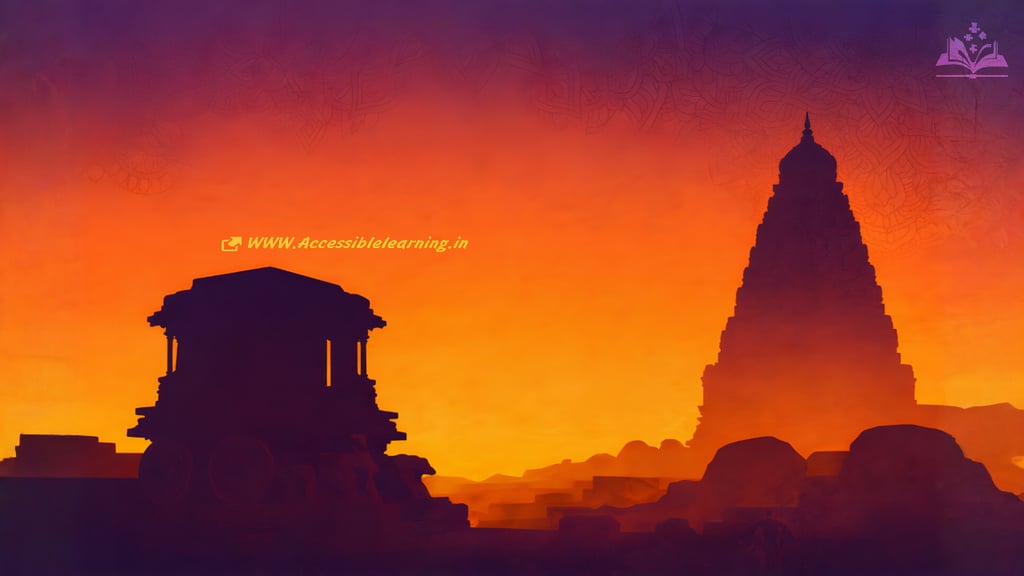
The Vittala Temple stands as the crown jewel of Vijayanagara architecture. Built during the reign of Krishna Deva Raya, this temple complex features the iconic stone chariot, musical pillars that produce different tones when struck, and intricate sculptures depicting scenes from Hindu epics. The technical sophistication required to create pillars that produce musical notes demonstrates the advanced understanding of acoustics and material science possessed by Vijayanagara craftsmen.
The Virupaksha Temple, dedicated to Shiv Ji, has been in continuous worship since the empire's founding and remains active today. Its towering gopuram (gateway tower) rises 50 meters high, featuring thousands of sculptures and serving as a landmark visible for miles.
The Lotus Mahal exemplifies Indo-Islamic architecture, blending Hindu and Islamic design elements. This structure, located in the zenana (women's quarters), features cusped arches, domed pavilions, and geometric patterns that reflect the empire's cultural synthesis.
The Hazara Rama Temple served as the royal family's private temple, with walls covered in bas-reliefs depicting the entire Ramayana epic. The quality and detail of these narrative sculptures provide invaluable insights into the artistic standards and religious devotion of the Vijayanagara court.
Engineering and Urban Planning
Beyond individual monuments, the empire demonstrated sophisticated urban planning. The capital city was divided into distinct zones: the sacred center with temple complexes, the royal center with palaces and administrative buildings, and the urban core with markets and residential areas. This organized layout reflected careful planning and administrative efficiency.
The empire's engineers designed an elaborate water management system, including aqueducts, canals, tanks, and stepwells. The Kamalapura tank, covering several acres, still holds water today, a testament to the engineering prowess of Vijayanagara builders.
Military Organization and Warfare
Army Structure and Strategy
The Vijayanagara military was among the most formidable in medieval India, consisting of cavalry, infantry, elephants, and specialized units. The empire maintained a standing army supplemented by feudal levies from subordinate chiefs called nayakas.
The military organization included several innovative features. The empire employed Muslim mercenaries and military commanders, demonstrating pragmatism in military affairs despite religious differences. Portuguese travelers noted the presence of firearms and cannons in the Vijayanagara arsenal, showing the empire's willingness to adopt new military technologies.
The fortification system around Hampi consisted of seven concentric walls with strategic checkpoints, making the capital nearly impregnable under normal circumstances. These fortifications incorporated natural features like hills and boulders into defensive structures, creating a formidable barrier against invaders.
Naval Power and Coastal Control
Though primarily a land-based empire, Vijayanagara maintained naval forces to protect its coastal trade routes and ports. The empire controlled important ports like Goa (before Portuguese conquest), Bhatkal, and ports along the Coromandel Coast, requiring naval capability to defend these commercial lifelines.
Cultural and Religious Life
Religious Tolerance and Patronage
Despite being known as a Hindu empire, Vijayanagara demonstrated remarkable religious tolerance. The empire patronized Hinduism primarily, but Jain temples and Islamic monuments also received support. The rulers employed Muslims in administrative and military positions based on merit rather than religious affiliation.
The empire became a patron of the Bhakti movement, which emphasized personal devotion over ritual orthodoxy. Saints and poets like Purandaradasa, considered the father of Carnatic music, flourished under royal patronage. This cultural environment fostered both religious devotion and artistic innovation.
Temple institutions in Vijayanagara served multiple functions beyond worship. They operated as economic centers managing land and trade, educational institutions teaching Sanskrit and regional languages, and cultural venues for music and dance performances. The devadasi system, where women dedicated themselves to temple service, included highly trained dancers and musicians who preserved classical art forms.
Literary and Artistic Achievements
The Vijayanagara period witnessed a flowering of literature in multiple languages. Telugu literature experienced a golden age with poets like Allasani Peddana, Nandi Thimmana, and Tenali Ramakrishna producing masterworks. Sanskrit scholarship continued under royal patronage, while Kannada literature also flourished.
The empire's artistic output extended beyond literature to sculpture, painting, music, and dance. The bronze casting tradition reached new heights, producing exquisite images of deities. Wall paintings in temples depicted mythological scenes with sophisticated technique and vivid colors, some of which survive today.
The Decline and Fall
The Battle of Talikota (1565)
The Vijayanagara Empire's dramatic collapse came at the Battle of Talikota in 1565, also known as the Battle of Rakshasa-Tangadi. The empire faced a coalition of Deccan Sultanates (Ahmadnagar, Bijapur, Golconda, and Bidar) who united against their common rival.
The battle occurred during the reign of Rama Raya, who had antagonized the Sultanates through aggressive military campaigns and diplomatic manipulation. Despite having a large army, the Vijayanagara forces suffered a catastrophic defeat due to several factors: the defection of Muslim commanders at critical moments, the superior artillery of the Sultanates, and tactical errors by Vijayanagara leadership.
Following the battle, the victorious Sultanate armies sacked Hampi for months, destroying temples, palaces, and public buildings. The once-magnificent capital was reduced to ruins, and the empire's power was irreversibly broken.
Aftermath and Successor States
Though the empire officially continued under the Aravidu dynasty until the 17th century, it never recovered its former glory. The capital shifted to Penukonda and later to Chandragiri, but these were pale shadows of Hampi's grandeur. By the mid-17th century, the empire had fragmented into smaller kingdoms ruled by former nayakas, ending over 300 years of unified rule.
Legacy and Historical Significance
Enduring Cultural Impact
The Vijayanagara Empire's legacy extends far beyond its ruins. The empire preserved Hindu traditions and culture during a period of Islamic expansion in India, serving as a bulwark that protected South Indian temples and cultural practices. The classical South Indian arts of Carnatic music, Bharatanatyam dance, and temple architecture all received crucial patronage during the Vijayanagara period.
Many traditions established during this period continue today. The Dasara festival celebration, particularly in Mysore, traces its elaborate format to Vijayanagara court traditions. The empire's administrative systems influenced successor states and even British colonial administration.
Modern Recognition and Tourism
Today, the ruins at Hampi attract hundreds of thousands of visitors annually, offering a glimpse into India's medieval glory. UNESCO designated the site as a World Heritage Site in 1986, recognizing its outstanding universal value. The Archaeological Survey of India continues preservation efforts, though the site faces challenges from weathering, vegetation, and human activity.
The Vijayanagara Empire has inspired modern cultural productions, including films, novels, and historical research. Indian states, particularly Karnataka, celebrate the empire's legacy as part of regional identity and cultural heritage.

Remembering Vijayanagara's Glory
The Vijayanagara Empire stands as one of medieval India's most remarkable achievements, combining military prowess, economic prosperity, architectural genius, and cultural sophistication. For over two centuries, this empire protected and promoted South Indian culture, creating monuments and traditions that endure today.
The ruins at Hampi continue to inspire wonder, reminding visitors of an age when this site was a thriving metropolis rivaling any city in the world. The empire's legacy lives on in South India's cultural practices, architectural traditions, and regional identity. Understanding the Vijayanagara Empire provides crucial insights into India's medieval history and the resilience of cultural traditions across centuries.
As we walk among the stone temples and ruined palaces of Hampi, we connect with a civilization that understood the power of beauty, the importance of trade, and the value of cultural patronage. The Vijayanagara Empire may have fallen, but its spirit remains carved in stone, waiting for each new generation to discover its timeless story.
Frequently Asked Questions
Q: What was the Vijayanagara Empire known for?
The Vijayanagara Empire was known for its magnificent architecture (especially the Hampi temples), economic prosperity through extensive trade networks, military strength, patronage of arts and literature, and serving as a major Hindu kingdom in medieval South India. The empire represented a golden age of South Indian culture, producing masterpieces in temple architecture, Telugu literature, and classical arts.
Q: Who founded the Vijayanagara Empire, and when?
Brothers Harihara I and Bukka Raya I founded the Vijayanagara Empire in 1336 CE. They established the first dynasty, known as the Sangama dynasty, which ruled until 1485. The brothers set up their capital at Vijayanagara (modern Hampi) on the banks of the Tungabhadra River in present-day Karnataka.
Q: Why did the Vijayanagara Empire fall?
The Vijayanagara Empire fell primarily due to its catastrophic defeat at the Battle of Talikota in 1565, where a coalition of Deccan Sultanates defeated the empire's forces. The subsequent sacking of the capital, Hampi, destroyed the empire's economic and administrative center. Contributing factors included internal conflicts, the defection of key military commanders, and the growing power of the Deccan Sultanates. Though the empire nominally continued until the 17th century, it never recovered from this devastating blow.
Q: What language did the Vijayanagara Empire speak?
The Vijayanagara Empire was multilingual, with administration conducted in Sanskrit, Kannada, and Telugu. The royal court patronized literature in all these languages, along with Tamil. Sanskrit served as the language of official inscriptions and scholarly works, while Kannada was widely spoken in the core territories. Telugu literature experienced a golden age during this period, particularly under Krishna Deva Raya's patronage.
Q: How big was the Vijayanagara Empire at its peak?
At its peak under Krishna Deva Raya in the early 16th century, the Vijayanagara Empire controlled approximately 360,000 square kilometers, encompassing most of peninsular India south of the Krishna River. The empire extended from the Arabian Sea to the Bay of Bengal and from the Krishna River in the north to the tip of the Indian peninsula in the south, making it one of the largest empires in Indian history.
Q: What happened to Hampi after the empire fell?
After the Battle of Talikota in 1565, victorious Sultanate forces sacked Hampi for several months, destroying temples, palaces, and infrastructure. The city was abandoned and fell into ruin. The monuments suffered from weathering, vegetation, and stone robbing over centuries. Today, Hampi exists as an extensive archaeological site and UNESCO World Heritage Site, with ongoing preservation efforts by the Archaeological Survey of India. Many structures remain remarkably well-preserved, offering insights into the empire's glory.
Q: What was the economy of Vijayanagara based on?
The Vijayanagara economy was based on agriculture (supported by extensive irrigation systems), textile manufacturing (cotton and silk production), mining (particularly diamonds and iron), and extensive maritime trade with Arabia, Persia, Southeast Asia, and Europe. The empire controlled major ports on both coasts, facilitating commercial exchange. Currency based on gold pagodas maintained economic stability, and relatively light taxation encouraged economic activity.
Q: What religion was the Vijayanagara Empire?
The Vijayanagara Empire was predominantly Hindu in character, with rulers patronizing Hindu temples, festivals, and traditions. However, the empire demonstrated religious tolerance, employing Muslims in military and administrative positions and allowing Jain communities to flourish. The empire became a major patron of the Bhakti movement and preserved Hindu traditions during a period of Islamic expansion in India.
Subscribe to Frontier Intelligence
All © Copyright reserved by Accessible-Learning Hub
| Terms & Conditions
Accessible Learning Hub — Actionable clarity for high-agency minds.
Weekly breakdowns on AI breakthroughs, capital flow, and human performance systems. Zero fluff.