

The Spanish Empire: Rise, Global Dominance, and Lasting Legacy
Discover how the Spanish Empire rose to global dominance from 1492-1976. Explore its conquests, economic power, cultural legacy, and lasting impact on modern world history.
HISTORY & CIVILIZATIONS
Kim Shin
2/15/20268 min read
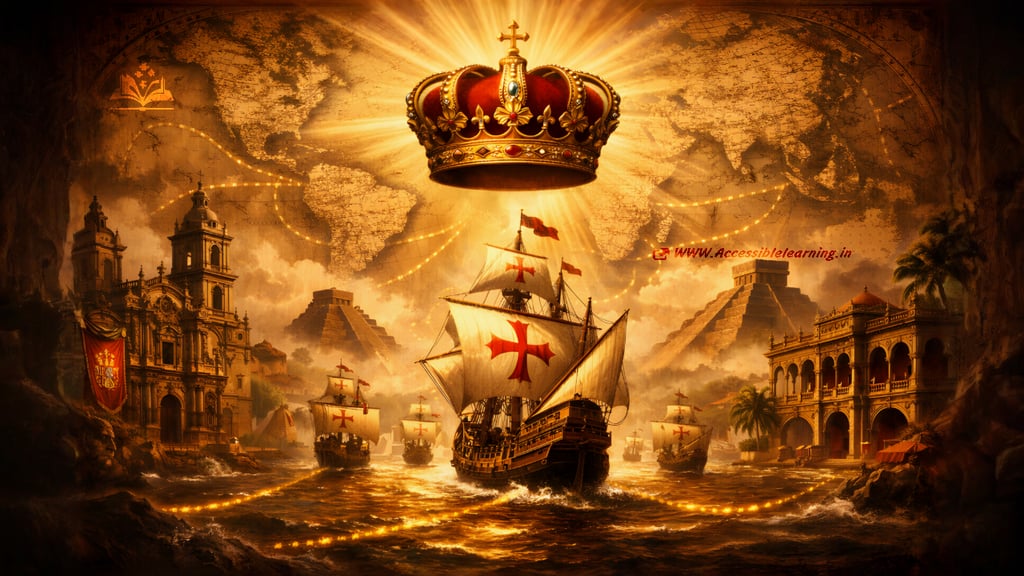
For nearly four centuries, the Spanish Empire shaped world history through exploration, conquest, and cultural exchange. From the late 15th century to the early 19th century, Spain controlled vast territories across four continents, creating the first empire where "the sun never set." This comprehensive exploration examines how a single European kingdom transformed into a global superpower and why its influence persists today.
What Was the Spanish Empire?
The Spanish Empire (Imperio español) was one of history's largest and most influential colonial powers, spanning from 1492 to 1976. At its zenith during the late 16th and early 17th centuries, Spanish territories stretched across approximately 13.7 million square kilometers, encompassing lands in the Americas, Europe, Africa, Asia, and Oceania.
Unlike other colonial ventures, the Spanish Empire distinguished itself through its integration of conquered territories into a unified administrative system, widespread Catholic evangelization, and the creation of a mestizo culture that blended European, Indigenous, and African elements.
The Foundation: How Did Spain Become an Empire?
The Reconquista and National Unity
Spain's imperial journey began not with overseas expansion but with internal consolidation. The Reconquista—the centuries-long campaign to reclaim Iberian territories from Muslim rule—concluded in 1492 when Granada fell to the Catholic Monarchs, Ferdinand II of Aragon and Isabella I of Castile. This victory freed resources and military expertise for exploration.
The marriage of Ferdinand and Isabella in 1469 unified Spain's two largest kingdoms, creating the political stability necessary for ambitious overseas ventures. Their sponsorship of Christopher Columbus's 1492 voyage across the Atlantic opened unprecedented opportunities.
The Age of Exploration Begins
Columbus's arrival in the Caribbean islands marked a turning point in world history. Initially seeking a western route to Asia's spice markets, Spanish explorers instead encountered entire continents unknown to Europeans. The Treaty of Tordesillas (1494) divided newly discovered lands between Spain and Portugal, granting Spain rights to most of the Americas.
Expansion Across Continents: The Empire Takes Shape
Conquest of the Americas
The Aztec Empire Falls (1519-1521)
Hernán Cortés's conquest of the Aztec Empire demonstrated Spanish military tactics that would be replicated throughout the Americas. With fewer than 1,000 Spanish soldiers, Cortés defeated Moctezuma II's empire of millions through strategic alliances with indigenous groups hostile to Aztec rule, superior weaponry, and, inadvertently, European diseases like smallpox that devastated native populations.
The Inca Empire Crumbles (1532-1572)
Francisco Pizarro's conquest of the Inca Empire followed a similar pattern. Capturing Emperor Atahualpa in 1532, Spanish forces exploited internal divisions within the Inca state and leveraged technological advantages. The fall of the Inca capital Cusco opened South America's vast mineral wealth to Spanish exploitation.
Territorial Expansion
By the mid-16th century, Spanish territories in the Americas extended from present-day California and Florida through Central America, the Caribbean, and most of South America (excluding Brazil). The empire established viceroyalties—administrative regions governed by representatives of the Spanish crown—including:
Viceroyalty of New Spain (1535): Covering Mexico, Central America, the Caribbean, and the Philippines
Viceroyalty of Peru (1542): Encompassing most of Spanish South America
Viceroyalty of New Granada (1717): Including modern Colombia, Venezuela, Ecuador, and Panama
Viceroyalty of Río de la Plata (1776): Comprising Argentina, Bolivia, Paraguay, and Uruguay
European Dominance
Spain's European holdings grew through strategic marriages, inheritance, and military conquest. When Charles I of Spain inherited the Habsburg domains in 1519, becoming Holy Roman Emperor Charles V, Spanish influence stretched across the Netherlands, parts of Italy, Austria, and portions of Germany.
The empire's European territories provided military recruits, financial resources, and diplomatic leverage that supported Spanish global ambitions.
Asian and Pacific Presence
The Manila Galleon trade route (1565-1815) connected Spanish America with Asian markets through the Philippines, which Spain controlled from 1565 to 1898. This transpacific commerce brought Chinese silk, porcelain, and spices to Mexico in exchange for American silver, creating the first truly global trade network.


The Golden Age: Economic Power and Cultural Flourishing
The Silver Economy
American silver mines, particularly at Potosí (in modern Bolivia) and Zacatecas (Mexico), fueled the Spanish economy and transformed global commerce. Between 1500 and 1800, approximately 150,000 tons of silver flowed from the Americas to Spain, representing roughly 80% of the world's silver production.
This wealth financed Spanish military campaigns, court expenditures, and patronage of the arts. However, the influx of precious metals also triggered inflation throughout Europe, a phenomenon economists call the "Price Revolution."
The Encomienda System and Colonial Labor
The Spanish colonial economy relied heavily on the encomienda system, which granted Spanish settlers control over indigenous labor and tribute. While theoretically designed to protect and Christianize native populations, the system frequently resulted in exploitation and abuse.
The devastating decline of indigenous populations—due to disease, overwork, and violence—led to the importation of enslaved Africans, particularly to Caribbean sugar plantations and coastal regions. This forced migration profoundly shaped demographic patterns throughout the Americas.
Cultural and Intellectual Achievements
The Spanish Golden Age (Siglo de Oro) produced remarkable cultural achievements. Writers like Miguel de Cervantes, whose "Don Quixote" (1605) became a foundational text of Western literature, and Lope de Vega created enduring works. Artists including Diego Velázquez and El Greco developed distinctive styles that influenced European painting for centuries.
Spanish missionaries, despite their role in cultural suppression, preserved indigenous knowledge through chronicles and codices. The University of Santo Domingo (1538), the first in the Americas, and subsequent universities in Mexico City and Lima became centers of learning that blended European and indigenous intellectual traditions.
Why Did the Spanish Empire Decline?
Military Overextension
Spain's vast territories required constant military presence to maintain control. Costly wars against Protestant Dutch rebels (1568-1648), conflicts with England, and involvement in European religious wars drained the treasury despite American silver imports.
The defeat of the Spanish Armada (1588) by England marked a psychological and strategic turning point, though Spain remained formidable for another century.
Economic Mismanagement
Rather than investing silver wealth in domestic industries, Spain imported manufactured goods from northern Europe, creating trade deficits that ultimately undermined economic stability. The expulsion of Jews (1492) and Moriscos (converted Muslims, finally expelled 1609-1614) removed skilled artisans and merchants, weakening Spain's productive capacity.
Repeated state bankruptcies—six between 1557 and 1647—reflected chronic fiscal mismanagement and the burden of military expenditures.
The War of Spanish Succession and Territorial Losses
The War of Spanish Succession (1701-1714) reshaped European power dynamics. The Treaty of Utrecht (1713) stripped Spain of European territories, including the Spanish Netherlands, parts of Italy, Gibraltar, and Minorca, leaving Spain primarily as an American colonial power.
Independence Movements in the Americas
Napoleon's invasion of Spain (1808) and the subsequent political vacuum triggered independence movements throughout Spanish America. Leaders like Simón Bolívar, José de San Martín, and Miguel Hidalgo led successful revolutions between 1808 and 1826.
By 1825, Spain retained only Cuba, Puerto Rico, the Philippines, and scattered Pacific islands. The Spanish-American War (1898) cost Spain these remaining significant colonies, marking the empire's effective end. Spain's last African colonies gained independence in 1968 (Equatorial Guinea) and 1976 (Western Sahara).
What Is the Spanish Empire's Lasting Legacy?
Linguistic Impact
Spanish is now the world's second-most spoken native language, with approximately 493 million native speakers across 21 countries. The language's spread through colonization created a vast linguistic community that facilitates cultural, economic, and diplomatic connections.
Religious and Cultural Transformation
Catholic Christianity remains the dominant religion in Latin America, where approximately 425 million Catholics reside—roughly 40% of the world's Catholic population. The synthesis of Catholic and indigenous spiritual traditions created unique religious expressions like the Virgin of Guadalupe cult in Mexico.
Spanish colonial architecture, from baroque churches to planned colonial cities, defines urban landscapes throughout Latin America and the Philippines. UNESCO World Heritage sites in former Spanish territories preserve this architectural legacy.
Legal and Administrative Systems
Spanish colonial law, based on Roman legal traditions and codified in documents like the Laws of the Indies (1680), influenced legal systems throughout Latin America. The concept of community land ownership and municipal governance structures reflects Spanish colonial precedents.
Demographic and Genetic Mixing
The Spanish Empire's relative openness to racial mixing (mestizaje) created societies with complex caste systems but also populations that transcended simple racial categories. This demographic legacy distinguishes Latin America from regions with stricter segregation policies.
Economic Patterns and Inequality
Colonial economic structures emphasizing resource extraction and large landholdings (latifundios) established patterns that persist in contemporary Latin American economies. Debates about land reform, resource nationalism, and economic inequality trace their roots to colonial arrangements.
How Did the Spanish Empire Compare to Other Colonial Powers?
British Empire Contrasts
While the British Empire eventually surpassed Spain in territorial extent and economic power, the Spanish Empire pioneered global colonialism. British colonies often maintained greater ethnic separation, whereas Spanish colonies developed more integrated mestizo societies.
Spanish colonial administration was more centralized, with direct crown control, while British territories often enjoyed greater local autonomy. These differences shaped post-colonial political cultures.
Portuguese Colonial Parallels
Spain's Iberian neighbor Portugal pursued similar colonial strategies, particularly in Brazil. Both empires emphasized Catholic evangelization, resource extraction, and racial mixing. The Treaty of Tordesillas structured their respective spheres of influence, though Portuguese territories remained more geographically concentrated.
French Colonial Differences
French colonialism, developing later than Spanish expansion, focused heavily on North America and parts of Africa and Southeast Asia. Like Spain, France emphasized cultural assimilation and Catholic missions, but French colonial territories never matched Spanish America's extent or integration.

the Spanish Empire's Contemporary Relevance
The Spanish Empire's legacy shapes our interconnected world in profound ways. Contemporary debates about immigration, cultural identity, and historical memory in both Spain and former colonies reflect colonial experiences and their interpretations.
In Latin America, discussions about indigeneity, racism, and social justice grapple with colonial hierarchies and their persistence. Spain's own reckoning with its imperial past influences national identity and international relations with former colonies.
Understanding this empire's rise, dominance, and decline offers insights into how global systems of power develop, persist, and ultimately transform—lessons that remain relevant for comprehending contemporary geopolitics and cultural dynamics.
The Spanish Empire wasn't simply a historical footnote but rather a foundational force that shaped languages, religions, legal systems, demographic patterns, and cultural practices affecting billions of people today. Its complex legacy—encompassing both remarkable cultural achievements and profound human suffering—continues to generate discussion, research, and debate about colonialism's lasting impacts on our modern world.
Frequently Asked Questions
Q: When did the Spanish Empire begin and end?
The Spanish Empire conventionally dates from 1492, with Columbus's arrival in the Americas, to 1976, when Spain relinquished Western Sahara. The empire's peak occurred during the 16th and early 17th centuries, while major contraction came with Latin American independence movements (1808-1826) and the Spanish-American War (1898).
Q: What was the largest extent of the Spanish Empire?
At its maximum territorial extent in the late 18th century, the Spanish Empire controlled approximately 13.7 million square kilometers across five continents, making it one of history's largest empires by land area.
Q: How did Spain justify its conquests and colonial rule?
Spanish authorities justified colonization through the doctrine of papal authority (the Pope granted Spain dominion over discovered lands), the mission to spread Catholic Christianity, and later, claims of bringing civilization and proper governance to indigenous peoples. The Valladolid Debate (1550-1551) reflected internal Spanish discussions about the treatment and rights of indigenous peoples.
Q: What role did disease play in Spanish conquests?
European diseases, particularly smallpox, measles, and typhus, devastated indigenous American populations lacking immunity. Scholars estimate that disease killed between 50% and 95% of native populations in some regions within the first century of contact, profoundly facilitating Spanish military conquest and colonization.
Q: How did the Spanish Empire affect indigenous cultures?
Spanish colonization resulted in massive cultural disruption, including suppression of indigenous religions, destruction of native political structures, and forced cultural assimilation. However, indigenous languages, agricultural practices, artistic traditions, and knowledge systems persisted and blended with Spanish culture, creating syncretic traditions that continue today.
Q: What was the Black Legend, and how did it affect perceptions of Spanish colonialism?
The Black Legend (Leyenda Negra) refers to anti-Spanish propaganda emphasizing Spanish cruelty and oppression in the Americas, often promoted by Protestant European rivals during the 16th-17th centuries. While Spanish colonial practices certainly included violence and exploitation, the Black Legend exaggerated and selectively highlighted Spanish abuses while downplaying similar practices by other colonial powers.
Q: How did Spanish colonization differ in the Philippines compared to the Americas?
In the Philippines, Spain encountered established kingdoms and more developed trade networks connected to Asian commerce. Spanish control relied more heavily on alliances with local elites and indirect rule through existing structures. The Philippines also maintained stronger cultural connections to Asia while adopting Spanish religion and administrative systems.
Q: What happened to the wealth extracted from Spanish colonies?
Despite enormous silver imports, Spain itself did not industrialize or develop sustained economic growth. Wealth flowed through Spain to northern European manufacturing centers, particularly the Netherlands and later England. Military expenditures, court luxury, and debt payments consumed most colonial revenues.
Subscribe to Frontier Intelligence
All © Copyright reserved by Accessible-Learning Hub
| Terms & Conditions
Accessible Learning Hub — Actionable clarity for high-agency minds.
Weekly breakdowns on AI breakthroughs, capital flow, and human performance systems. Zero fluff.