

The British Empire: Complete History, Timeline & Legacy (1583-1997)
Explore the British Empire's 400-year history: from its rise to global dominance, covering 24% of Earth, through decolonization, to its lasting legacy today.
HISTORYUNITED KINGDOMEMPIRES/HISTORY
Kim Shin
12/25/202512 min read
Understanding the Empire That Shaped the Modern World
The British Empire stands as the largest empire in human history, spanning nearly a quarter of the Earth's land surface and ruling over approximately 458 million people at its zenith in 1920. From tiny island beginnings to global dominance, the British Empire's influence continues to shape international politics, economics, language, and culture in the 21st century.
What Was the British Empire?
The British Empire comprised the dominions, colonies, protectorates, mandates, and territories ruled or administered by the United Kingdom and its predecessor states. Beginning in the late 16th century with overseas possessions and trading posts established by England, the empire grew to become the foremost global power during the 19th and early 20th centuries.
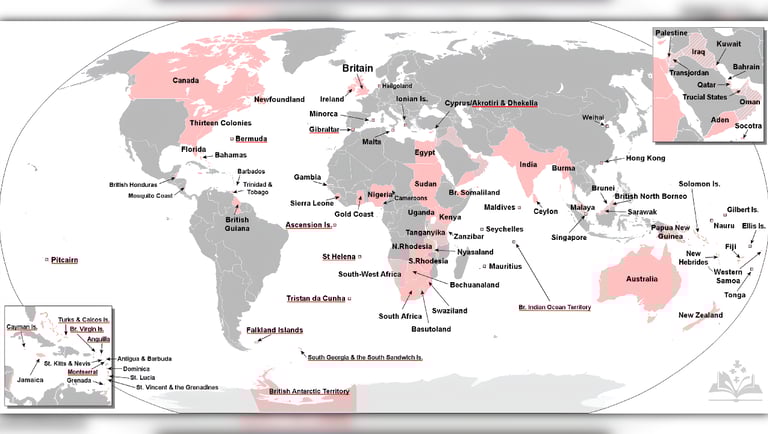
At its territorial peak, the British Empire covered approximately 35.5 million square kilometers (13.71 million square miles), earning the famous phrase "the empire on which the sun never sets" due to its global reach across multiple time zones.
The First British Empire: Mercantile Foundations (1583-1783)
Early Colonial Ventures
England's imperial ambitions began modestly in the late 1500s. The establishment of Roanoke Colony in 1585 (though ultimately unsuccessful) marked England's first attempt at permanent settlement in North America. More successful ventures followed:
Jamestown, Virginia (1607): The first permanent English settlement in North America
Plymouth Colony (1620): Established by Puritan separatists seeking religious freedom
Barbados (1627): Became the template for profitable Caribbean sugar plantations
East India Company expansion: Gained footholds in India beginning in the early 1600s
The Triangular Trade System
The First British Empire operated primarily on mercantile principles, with the infamous triangular trade route connecting Britain, Africa, and the Americas. This system involved:
Manufactured goods shipped from Britain to Africa
Enslaved Africans transported to the Americas (the Middle Passage)
Raw materials and cash crops returned to Britain
This brutal system generated enormous wealth for British merchants and colonial planters while causing immeasurable human suffering. Between the 16th and 19th centuries, British ships transported approximately 3.1 million enslaved Africans across the Atlantic.
Loss of the American Colonies
The American Revolutionary War (1775-1783) represented a catastrophic blow to the First British Empire. The loss of the Thirteen Colonies forced Britain to reconsider its imperial strategy, leading to significant reforms in how the empire would be administered moving forward.
The Second British Empire: Global Dominance (1783-1945)
The Age of Imperial Expansion
Following American independence, Britain redirected its imperial energies toward Asia, Africa, and the Pacific. This "Second British Empire" became far more extensive and strategically minded than its predecessor.
Key expansion periods
Late 18th century: Consolidation of power in India following victories at Plassey (1757) and subsequent conquests
Early 19th century: Acquisition of Cape Colony, Ceylon (Sri Lanka), and various Caribbean islands following the Napoleonic Wars
Mid-19th century: Expansion into Southeast Asia (Burma, Malaya, Singapore)
Late 19th century: The "Scramble for Africa" resulted in British control over vast African territories
The Victorian Empire
During Queen Victoria's reign (1837-1901), the British Empire reached its greatest extent and power. This period witnessed:
The formal establishment of the British Raj in India (1858) following the Indian Rebellion
The colonization of Australia and New Zealand, displacing Indigenous populations
Aggressive expansion in Africa, including control of Egypt, Sudan, Kenya, Uganda, Nigeria, and South Africa
The Opium Wars with China, forcing open Chinese markets to British trade
By 1913, the British Empire controlled approximately 412 million people, roughly 23% of the world's population, and covered about 24% of Earth's total land area.
Economic Exploitation and Development
The Second British Empire operated on principles of economic extraction and strategic control:
Raw material extraction: Colonies provided cotton, rubber, tea, coffee, precious metals, and countless other resources at minimal cost to British manufacturers.
Captive markets: Colonial populations were required to purchase British manufactured goods, creating a system where colonies couldn't develop their own industries.
Infrastructure for extraction: Railways, ports, and telegraph systems were built primarily to facilitate resource extraction rather than benefit local populations, though they did create some modernization.
Financial control: The City of London became the world's financial center, with British banks financing global trade and investment.
The Crown Jewel: British India
India represented the most valuable and populous part of the British Empire. The British East India Company initially controlled much of the subcontinent through a system of alliances and military conquest before the British Crown assumed direct control in 1858.
British rule in India involved:
Systematic deindustrialization of India's textile industry to protect British manufacturers
Creation of vast plantation systems for tea, cotton, and indigo
Construction of extensive railway networks (by 1929, India had 66,000 km of rail)
Imposition of British legal and educational systems
Devastating famines, including the Bengal Famine of 1943 which killed approximately 3 million people
The extraction of wealth from India significantly funded Britain's industrial revolution and global power, with some economic historians estimating that Britain drained approximately $45 trillion from India during colonial rule (in today's currency values).
The British Empire During the World Wars
World War I (1914-1918)
The empire contributed massively to Britain's war effort:
Over 2.5 million soldiers from India served in the British Indian Army
Canadian forces played crucial roles at Vimy Ridge and other battles
ANZAC (Australian and New Zealand Army Corps) forces fought at Gallipoli and the Western Front
African colonies provided troops and essential resources
The war strained the empire's resources and began shifting power dynamics, as dominions like Canada and Australia gained greater autonomy in recognition of their contributions.
World War II (1939-1945)
World War II marked the beginning of the end for the British Empire:
Over 2.5 million Indian soldiers fought for the British Empire
African, Caribbean, and Pacific colonies contributed troops and resources
Burma Campaign involved forces from across the empire
Economic devastation left Britain dependent on American aid
The fall of Singapore to Japan (1942) shattered the myth of British invincibility
The war bankrupted Britain and exposed the unsustainability of maintaining such a vast empire. The United States and the Soviet Union emerged as superpowers, relegating Britain to secondary status.
Decolonization: The Empire's Decline (1945-1997)
The Rapid Unraveling
The post-war period saw an accelerated dismantling of the British Empire, driven by multiple factors:
Economic exhaustion: Britain emerged from WWII heavily indebted and unable to maintain colonial administrations and military garrisons worldwide.
Rising nationalism: Independence movements gained strength across the empire, often led by Western-educated elites who demanded self-determination.
International pressure: Both the United States and the Soviet Union opposed European colonialism (for different reasons), and the newly formed United Nations championed decolonization.
Moral shift: The rhetoric of fighting for freedom against Nazi tyranny made it increasingly difficult to justify denying freedom to colonized peoples.
Major Independence Movements
Indian Independence (1947): The "Jewel in the Crown" gained independence in August 1947, though partition created India and Pakistan amid communal violence that killed between 200,000 and 2 million people and displaced 10-20 million.
Palestine Mandate ending (1948): Britain withdrew from Palestine, leading to the creation of Israel and the first Arab-Israeli war, conflicts that persist today.
African independence: The 1950s-1960s saw rapid decolonization across Africa:
Ghana (1957) became the first sub-Saharan African colony to gain independence
The "Wind of Change" speech by Prime Minister Harold Macmillan (1960) acknowledged the inevitable end of empire
Kenya (1963) after the Mau Mau uprising
Nigeria (1960), Tanzania (1961), Uganda (1962), and many others followed
Caribbean independence: Jamaica and Trinidad & Tobago (1962), Barbados (1966), and other Caribbean nations gained independence throughout the 1960s-1980s.
Hong Kong handover (1997): The return of Hong Kong to China marked the symbolic end of the British Empire.
The Falklands War (1982)
One notable exception to peaceful decolonization was the Falklands War between Britain and Argentina over the Falkland Islands (Islas Malvinas). Britain's victory demonstrated its continued willingness to defend remaining territories but also highlighted how diminished its global reach had become.
The Commonwealth of Nations: Empire's Successor
From Empire to Association
The Commonwealth of Nations evolved from the British Empire as a voluntary association of independent states. Originally conceived for white-majority dominions, it expanded to include former colonies across Africa, Asia, the Caribbean, and the Pacific.
Current status: As of 2024, the Commonwealth comprises 56 member countries with a combined population of 2.5 billion people (approximately one-third of the world's population).
Structure: Unlike the empire, membership is voluntary, and countries can leave (as Zimbabwe did in 2003) or join (as Mozambique and Rwanda did, despite never being British colonies).
Purpose: The Commonwealth focuses on promoting democracy, human rights, good governance, rule of law, gender equality, and sustainable development, though its effectiveness remains debated.
Head of the Commonwealth: Following Queen Elizabeth II's death in 2022, King Charles III became the head of the Commonwealth, though this position is symbolic rather than hereditary or automatic.

The British Empire's Complex Legacy
Economic Impact
Wealth extraction: Economic historians estimate that colonial exploitation extracted trillions of dollars (in modern value) from colonized territories, funding Britain's industrial revolution and prosperity while impoverishing colonies.
Infrastructure development: While railways, ports, and telegraph systems were built for extraction purposes, they did create infrastructure that independent nations inherited, though often in configurations serving former imperial needs rather than national development.
Economic dependency: Many former colonies remain economically dependent on exporting raw materials and importing manufactured goods, a pattern established during colonial rule.
Financial systems: British-established legal and financial frameworks continue to influence global commerce, with English common law used in many former colonies.
Political Legacy
Borders and conflicts: Arbitrary colonial borders drawn without regard for ethnic, linguistic, or cultural boundaries have caused countless conflicts, from India-Pakistan tensions to conflicts across Africa.
Westminster systems: Many former colonies adopted parliamentary democracy modeled on the British system, with varying degrees of success.
Civil service structures: British administrative systems shaped governance in former colonies, sometimes creating bureaucratic efficiency but also entrenching hierarchical and centralized power structures.
Divide and rule: British tactics of exploiting ethnic and religious divisions to maintain control created lasting tensions in places like India, Iraq, Sudan, and Myanmar.
Cultural and Social Impact
English language: English became the world's dominant language for international business, diplomacy, science, and popular culture, providing both opportunities and challenges for linguistic diversity.
Education systems: British-style education spread across the empire, creating both opportunities for social mobility and the imposition of European cultural values.
Legal systems: Common law traditions spread throughout the empire, influencing legal frameworks in dozens of countries.
Sports: Cricket, rugby, football (soccer), and other British sports became globally popular through colonial spread.
Cultural suppression: Indigenous languages, religions, customs, and knowledge systems were often suppressed or destroyed, representing an irreplaceable cultural loss.
Human Rights Atrocities
A complete assessment must acknowledge the empire's dark legacy:
Slavery: British involvement in the transatlantic slave trade transported millions of Africans in brutal conditions, with countless deaths during the Middle Passage.
Famines: Preventable famines in India, Ireland, and elsewhere killed tens of millions of people, often exacerbated by British policies prioritizing exports over local food security.
Violence and massacres: From the Amritsar Massacre (1919), where British troops killed hundreds of peaceful protesters, to the brutal suppression of independence movements, systematic violence maintained imperial control.
Concentration camps: British forces pioneered concentration camp use during the Second Boer War (1899-1902), where 26,000 Afrikaner women and children and approximately 20,000 Black Africans died.
Indigenous displacement: In Australia, Canada, and elsewhere, Indigenous peoples faced systematic displacement, cultural destruction, and, in Australia's case, the forced removal of children (the Stolen Generations).
Exploitation and forced labor: Indentured servitude, forced labor, and economic exploitation caused immense suffering across the empire.
Contemporary Perspectives and Debates
The Controversy Over Imperial History
Modern Britain remains deeply divided over how to remember and teach imperial history:
Nationalist perspective: Some argue the empire spread democracy, rule of law, and economic development and ended practices like sati (widow burning) and thuggee (ritual murder), representing a net positive for humanity.
Critical perspective: Others emphasize the empire's foundation on violence, exploitation, and racism, arguing that any positive developments were incidental to extraction and control and that colonized peoples would have developed their own institutions without imperial domination.
Academic consensus: Most historians acknowledge both the empire's developmental aspects and its fundamental basis in exploitation and violence, emphasizing the need for nuanced understanding rather than simplistic celebration or condemnation.
Calls for Accountability
Reparations debate: Activists and some former colonies have called for Britain to pay reparations for slavery and colonial exploitation, though British governments have consistently rejected such calls.
Museum controversies: Major British museums hold countless artifacts acquired during colonial rule, with increasing demands for repatriation. The British Museum, for instance, holds the Benin Bronzes, Elgin Marbles, and other contested items.
Educational curriculum: Debates continue about how British schools should teach imperial history, balancing national pride with historical accountability.
Apologies: Britain has issued some limited apologies for specific incidents (like the 2013 apology for torture during Kenya's Mau Mau uprising) but has not issued comprehensive apologies for colonialism itself.
The British Empire in the 21st Century
Remaining British Territories
Britain retains 14 Overseas Territories with varying degrees of autonomy:
Gibraltar
Bermuda
Cayman Islands
British Virgin Islands
Turks and Caicos Islands
Falkland Islands
Anguilla
Montserrat
Saint Helena, Ascension and Tristan da Cunha
Pitcairn Islands
South Georgia and the South Sandwich Islands
British Antarctic Territory
British Indian Ocean Territory
Sovereign Base Areas of Akrotiri and Dhekelia (Cyprus)
Most of these territories have chosen to remain British through referendums, valuing economic benefits and British citizenship, though controversies persist (particularly regarding the Chagos Islands/British Indian Ocean Territory).
Ongoing Influence
Language and education: English remains crucial for global communication, and British universities attract students worldwide.
Financial center: London remains one of the world's leading financial centers, partly due to networks established during imperial times.
Cultural exports: British music, literature, television, and film continue to have global influence.
Soft power: Britain ranks highly in global soft power indices, trading on cultural prestige partly derived from its imperial past.
Strategic relationships: The "Five Eyes" intelligence alliance (UK, US, Canada, Australia, and New Zealand) and other partnerships reflect continued influence in former colonies.

Frequently Asked Questions
Q: How long did the British Empire last?
The British Empire lasted approximately 400 years, from the establishment of the first permanent colonies in the early 1600s until the handover of Hong Kong to China in 1997. The empire reached its territorial peak around 1920 following World War I.
Q: Why did the British Empire fall?
The British Empire declined due to multiple interconnected factors: economic exhaustion from two world wars, rising nationalist movements in colonies demanding independence, changing international attitudes toward colonialism, the emergence of the United States and the Soviet Union as superpowers, and the moral contradictions of maintaining an empire after fighting for freedom in World War II.
Q: How many countries were part of the British Empire?
At its height, the British Empire included territories that would become approximately 60-70 modern nation-states. Today, 56 countries are members of the Commonwealth of Nations, most of which are former British colonies or territories, though membership is voluntary and includes some countries that were never British colonies.
Q: What was the largest empire in history?
The British Empire was the largest empire in history by both land area (approximately 35.5 million square kilometers) and population (approximately 458 million people at its peak in 1920). It covered roughly one-quarter of the Earth's land surface and one-quarter of its population.
Q: How did the British Empire affect India?
British rule in India (1757-1947) had profound and complex effects: economic exploitation and deindustrialization impoverished the region; famines killed tens of millions; infrastructure like railways was built primarily for extraction; English education created new opportunities for some while suppressing indigenous culture; and arbitrary partition in 1947 caused massive violence and displacement. Economic historians estimate Britain extracted approximately $45 trillion (in today's values) from India during colonial rule.
Q: What was the British Empire's role in slavery?
British merchants and ships transported approximately 3.1 million enslaved Africans to the Americas between the 16th and 19th centuries, generating enormous wealth for British traders and plantation owners. However, Britain also became the first major power to abolish the slave trade (1807) and slavery itself (1833), though this decision was partly motivated by economic changes and enslaved people's resistance rather than pure moral enlightenment. Abolition itself caused controversy as the British government compensated slave owners rather than formerly enslaved people.
Q: Is the British Empire still around today?
The British Empire as a formal political entity ended with Hong Kong's handover in 1997. However, Britain retains 14 Overseas Territories, and the Commonwealth of Nations maintains voluntary associations with 56 countries. The empire's legacy continues to shape global politics, economics, language, and culture in the 21st century.
Q: Why did the sun never set on the British Empire?
The phrase "the sun never sets on the British Empire" referred to the empire's vast global extent across multiple time zones. At any given time, it was daylight somewhere in the empire. At its peak, British territories existed in the Americas, the Caribbean, Africa, the Middle East, Asia, Australia, and the Pacific, creating truly global coverage.
Q: What did the British Empire trade?
The British Empire traded extensively in raw materials (cotton, rubber, tea, coffee, spices, timber, and minerals) exported from colonies; manufactured goods (textiles, machinery, and weapons) exported from Britain; enslaved people during the slave trade era; and agricultural products (sugar, tobacco, and indigo). This trade system was designed to enrich Britain while preventing industrial development in colonies.
Q: How did the British Empire influence modern borders?
The British Empire significantly shaped modern political boundaries through arbitrary border-drawing that often ignored ethnic, linguistic, cultural, and geographic realities. Examples include the partition of India and Pakistan, borders across Africa (particularly the straight-line borders characteristic of colonial division), Middle Eastern boundaries (including Iraq, Jordan, and Palestine), and divisions in Southeast Asia. These colonial borders have contributed to numerous ongoing conflicts and tensions.
The British Empire represents one of history's most significant and complex phenomena. Its legacy cannot be reduced to simple narratives of either pure progress or pure exploitation—it was both simultaneously, though the balance heavily favors the latter when considering the experiences of colonized peoples.
Understanding the British Empire requires grappling with uncomfortable truths: that democratic Britain was built partly on authoritarian colonial rule; that British prosperity derived significantly from colonial exploitation; that infrastructure development served extraction rather than local benefit; and that imperial ideology relied on racist assumptions of European superiority.
At the same time, historical understanding demands acknowledging that imperial subjects were not passive victims but active agents who resisted, negotiated, adapted, and eventually achieved independence. The empire's fall resulted as much from the determination of colonized peoples to be free as from Britain's declining capacity to maintain control.
For former colonies, the empire's legacy remains deeply present in political boundaries, economic structures, language, legal systems, and social institutions. For Britain, the imperial past continues to shape national identity, international relationships, and domestic debates about history, race, and national purpose.
As we move further into the 21st century, honest engagement with imperial history—acknowledging both its complexity and its fundamental injustices—becomes increasingly important for building more equitable global relationships and understanding the roots of contemporary challenges from border conflicts to economic inequality to linguistic dominance.
The British Empire shaped the modern world profoundly and often brutally. Understanding this history in all its complexity remains essential for anyone seeking to comprehend contemporary global politics, economics, and culture.
Subscribe To Our Newsletter
All © Copyright reserved by Accessible-Learning Hub
| Terms & Conditions
Knowledge is power. Learn with Us. 📚

