

The Khwarazmian Empire: The Ultimate Geopolitical "F Around and Find Out"
Discover how the Khwarazmian Empire triggered one of history's greatest disasters by insulting Genghis Khan's diplomats, leading to a devastating Mongol invasion.
HISTORY & CIVILIZATIONS
Kim Shin | Do Kyung Hee
7/25/20269 min read
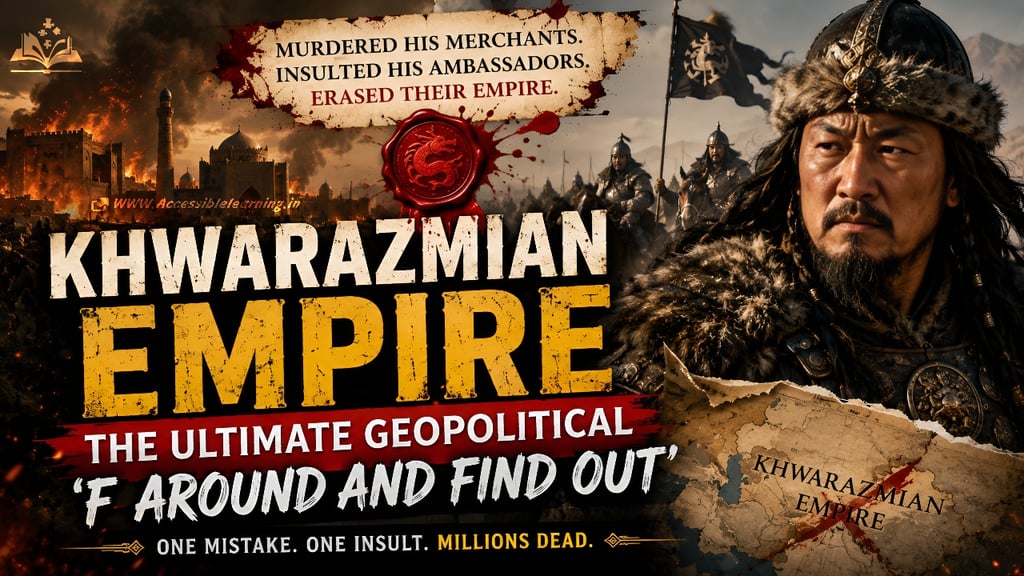
Genghis Khan Didn't Want War. He Wanted to Trade. The Khwarazmian Empire Responded by Murdering His Merchants and Humiliating His Diplomats.
Imagine receiving a business proposal from the most powerful rising leader on Earth.
Now imagine murdering his employees, stealing their merchandise, publicly humiliating his diplomats, and sending one of them home... without his head.
That is exactly what the Khwarazmian Empire did in 1218.
Within only a few years, one of the richest empires in the Islamic world no longer existed. Entire cities vanished. Millions were dead. Trade routes collapsed. Rivers were redirected over ruined settlements. The ruler responsible died alone on an island, hunted across his own collapsing empire.
Historians often debate the biggest military mistakes in history.
The Khwarazmian diplomatic disaster is rarely a debate.
It may be the single most expensive diplomatic insult ever committed.
Quick Facts
Empire: Khwarazmian Empire
Date: 1218–1221 CE
Main Figures: Genghis Khan and Sultan Muhammad II
Original Goal: Establish peaceful trade between the Mongol Empire and Central Asia
Trigger: A Mongol trade caravan was seized and its merchants executed in Otrar
Second Mistake: Genghis Khan's ambassadors were insulted, one executed, and the others sent back after having their beards shaved
Result: The Mongols invaded with overwhelming force and destroyed the Khwarazmian Empire
Historical Significance: One diplomatic disaster permanently changed the political map of Eurasia
Why Did Genghis Khan Want Peace Instead of War?
Because war wasn't his first choice.
By 1218, Genghis Khan had already united the Mongol tribes and conquered northern China. His empire was growing at astonishing speed, but he understood something many conquerors ignored.
Trade generated wealth more reliably than endless warfare.
The Khwarazmian Empire stretched across much of modern Uzbekistan, Turkmenistan, Iran, Afghanistan, and Kazakhstan. It controlled major Silk Road cities, including Samarkand, Bukhara, and Urgench.
A peaceful relationship would have benefited both sides.
Instead of invading immediately, Genghis Khan assembled a caravan reportedly consisting of around 450 merchants accompanied by several officials, often rounded to roughly 500 people in popular accounts. They carried expensive textiles, silver, furs, and luxury goods.
Their mission was simple.
Open trade.
Nothing more.
What Happened to the Mongol Trade Caravan?
It never reached its destination. When the caravan arrived in the frontier city of Otrar, its governor, Inalchuq (also known as Ghayir Khan), became suspicious.
He believed the merchants were spies. Whether he truly believed this or simply wanted their valuable cargo remains uncertain.
Either way, he arrested the caravan.
Then confiscated everything.
Then ordered the merchants killed.
It wasn't just theft.
It was mass murder carried out against officially recognized commercial envoys. Even then, this violated long-established diplomatic and commercial customs across Eurasia.
Most rulers understood that merchants carrying official credentials were protected. Otrar ignored those rules completely.
Did Genghis Khan Immediately Declare War?
Surprisingly, no.
This is one of the biggest misconceptions about Genghis Khan.
He didn't instantly launch an invasion. Instead, he chose diplomacy.
He sent three ambassadors directly to Sultan Muhammad II.
One was Muslim, making it harder to accuse the mission of cultural hostility.
Their request was remarkably modest.
Punish the governor responsible. Return justice.
Restore peaceful relations. That was all.
For one last moment, war remained completely avoidable.
Why Was Shaving the Ambassadors' Beards Such a Massive Insult?
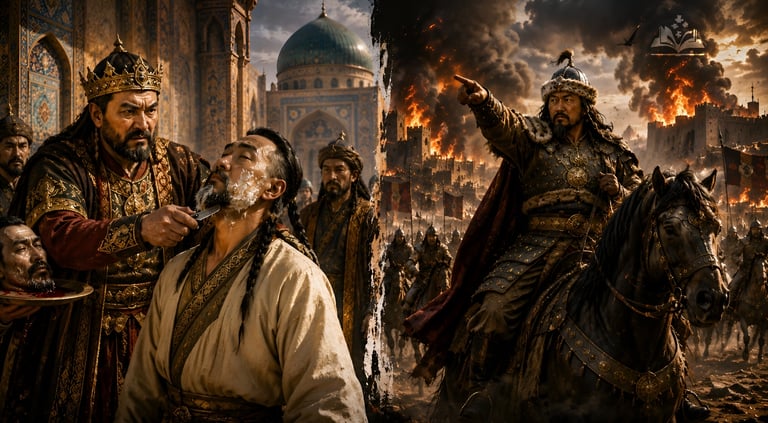
Because in medieval Central Asia, a beard represented honor, maturity, and personal dignity. Sultan Muhammad II didn't simply reject the request.
He escalated it dramatically. According to Persian chroniclers, one ambassador was executed.
The surviving envoys had their beards forcibly shaved.
Then they were sent back to Genghis Khan carrying the message.
Today, shaving someone's beard may sound embarrassing.
In the thirteenth century, it was political theater.
It declared:
"We do not respect you."
"We do not fear you."
"We are humiliating you in front of the world."
Diplomatic immunity was already a widely recognized principle across many cultures. Violating it shocked even contemporary observers.
Did Genghis Khan Really Cry Before Going to War?
Many medieval sources say he did.
According to traditional accounts preserved in works such as the Secret History of the Mongols and later Persian histories, Genghis Khan climbed a mountain alone after receiving news of the ambassadors.
There he prayed to Eternal Heaven.
Some accounts describe him remaining there for three days.
Others say he openly wept.
Whether every detail is literally accurate cannot be proven with certainty.
What historians generally agree on is that the killings transformed what had been a commercial dispute into a deeply personal and political crisis.
For Genghis Khan, the issue was no longer stolen property.
His authority had been publicly challenged.
His envoys, protected under long-standing diplomatic custom, had been murdered and humiliated.
That demanded a response.
How Did the Mongols Destroy an Entire Empire So Quickly?
By refusing to fight the way anyone expected. In 1219, the Mongol invasion began. Sultan Muhammad expected the invaders to follow traditional siege routes.
Instead, Genghis Khan split his forces into multiple independent armies. They crossed deserts considered nearly impossible to traverse.
Cities believed themselves safe. Then Mongol armies appeared from directions no one thought possible.
Bukhara fell.
Samarkand followed.
Otrar eventually collapsed after a prolonged siege.
Each defeat isolated the next city.
The Khwarazmian defensive system never recovered.
Instead of fighting one large army, local commanders faced coordinated attacks from several directions at once.
It was operational warfare centuries ahead of its time.
Was the Khwarazmian Empire Really Wiped Off the Map?
For practical purposes, yes. The empire ceased to exist within only a few years. Sultan Muhammad II fled repeatedly as Mongol armies closed in.
He eventually died in exile on an island in the Caspian Sea. His son, Jalal al-Din, continued resisting for several years and became famous for his bravery, but he never rebuilt the empire.
Many major cities suffered catastrophic destruction.
Some recovered decades later.
Others never regained their previous importance.
The Khwarazmian state itself disappeared permanently.
Its territory became divided among new rulers shaped by the Mongol conquest.
Did the Mongols Really Divert Rivers to Erase Cities?
Sometimes, yes.
The most famous example involves Urgench, one of the wealthiest cities in Central Asia. Historical accounts describe extensive destruction after its capture.
Some medieval writers report that canals and waterways were redirected, contributing to flooding that devastated parts of the city.
Modern historians debate the exact engineering methods and the scale described in later chronicles.
What is beyond dispute is that Urgench experienced extraordinary devastation and never fully recovered its former position as one of Central Asia's greatest commercial centers.
Whether every dramatic description was literally accurate, the overall outcome was unmistakable. The city that had once flourished along the Silk Road became a shadow of its former self.
Could This Have Been Avoided?
Probably. That is what makes the story so astonishing.
Genghis Khan initially sought commerce, not conquest.
If Sultan Muhammad II had punished the governor of Otrar, compensated the merchants, and respected diplomatic norms, history might have taken a very different course.
Instead, each decision made the crisis worse.
First, the merchants were killed.
Then justice was refused.
Then the ambassadors were humiliated.
Then one was executed.
Every opportunity for peace disappeared because pride kept replacing diplomacy.

Why Is This Considered One of History's Biggest Diplomatic Blunders?
Because the consequences extended far beyond one empire.
The Mongol conquest reshaped Eurasia.
Trade networks changed.
Political borders shifted.
New empires eventually emerged from the vacuum.
Knowledge, technology, diseases, religions, and cultures spread across continents in ways that permanently altered world history.
All of that accelerated after a diplomatic crisis that began with one governor's decision and one emperor's refusal to admit a mistake.
Few moments demonstrate more clearly how a handful of political choices can redirect the course of civilization.
Why This Matters Today
Modern governments still rely on the same principle that failed in 1218: diplomatic protection.
Today, ambassadors are safeguarded under international agreements because nations understand that communication must continue even during periods of tension. When diplomatic norms collapse, the risk of conflict rises dramatically.
The Khwarazmian Empire also offers a timeless lesson about leadership. Pride can make admitting an error feel impossible, but refusing to correct a mistake often carries a far greater price. Sultan Muhammad II could have disciplined a provincial governor, compensated a caravan, and preserved peace. Instead, he doubled down at every stage until no peaceful exit remained.
The story also echoes modern geopolitics and even corporate life. Companies, governments, and organizations still face moments when a small dispute can either be resolved through dialogue or allowed to spiral into a crisis that damages everyone involved. The names and technologies have changed, but the underlying dynamic has not.
History remembers Genghis Khan as one of the greatest conquerors ever to live.
It remembers the Khwarazmian Empire for something else.
Not because it lost a war.
Because it accidentally picked the worst possible person in history to insult.
What Was the Khwarazmian Empire Before Its Fall?
Before its spectacular collapse, the Khwarazmian Empire was one of the wealthiest states in the Islamic world. At its peak under Sultan Muhammad II, it stretched from the Persian Gulf toward the Aral Sea and controlled many of the Silk Road's busiest commercial hubs.
The empire's prosperity came from trade. Caravans carrying silk, spices, precious metals, horses, textiles, and luxury goods regularly passed through its territory. Cities such as Samarkand, Bukhara, Merv, Nishapur, and Urgench attracted merchants from China, India, Persia, and the Mediterranean.
Ironically, the very trade network that made the empire rich was the same network Genghis Khan wanted to join peacefully.
Instead of becoming the Mongols' largest trading partner, the Khwarazmian Empire became their biggest military target.
How Big Was the Mongol Response?
It was one of the largest and best-coordinated military operations of the Middle Ages.
Modern historians estimate that Genghis Khan mobilized somewhere between 100,000 and 200,000 troops for the campaign. While exact numbers remain debated, there is broad agreement that this was one of the Mongol Empire's largest expeditions up to that point.
What made the force extraordinary was not only its size but also its organization.
Every soldier could ride multiple horses, allowing the army to travel remarkable distances without exhausting its mounts. Units operated independently yet remained coordinated through disciplined command structures, rapid messengers, and carefully planned objectives.
Many defenders expected slow-moving siege armies.
Instead, they faced highly mobile cavalry that seemed capable of appearing almost anywhere.
The invasion became a masterclass in logistics as much as warfare.
Which Cities Suffered the Most During the Invasion?
Several of Central Asia's greatest cities experienced destruction on a scale rarely seen in medieval history.
Otrar endured months of siege before finally falling. Its governor, whose actions had triggered the conflict, was captured and executed according to later Persian accounts.
Bukhara surrendered after fierce resistance. Genghis Khan is traditionally credited with delivering a speech inside the city's main mosque, warning that its rulers had brought disaster upon themselves by opposing him.
Samarkand, one of the richest cities in the Islamic world, possessed impressive defensive walls and a large garrison. Even so, it fell within days after internal divisions weakened its defense.
Merv and Nishapur suffered especially devastating massacres recorded by contemporary chroniclers. Medieval population figures are often exaggerated, but historians agree that both cities experienced catastrophic losses that echoed across the region for generations.

How Did This Invasion Change World History?
The destruction of the Khwarazmian Empire created a political vacuum across Central Asia.
The Mongols gained direct access to Persia, the Caucasus, and eventually Eastern Europe. Within a generation, Mongol armies reached the borders of Hungary, Poland, Syria, and Iraq.
The campaign also transformed global trade.
Although the initial conquest brought enormous devastation, the later Mongol Empire established what historians often call the Pax Mongolica. For roughly a century, merchants, scholars, diplomats, and travelers could move across much of Eurasia with greater security than had existed for centuries.
This period enabled increased exchange of technology, scientific knowledge, artistic ideas, religious beliefs, and commercial practices between East and West.
Even famous travelers such as Marco Polo benefited from routes that became safer under Mongol rule.
The destruction of one empire unexpectedly laid the foundation for one of history's largest interconnected trade networks.
What Do Historians Still Debate About This Story?
The broad sequence of events is well established, but several details remain subjects of scholarly discussion.
Historians continue to debate:
The exact size of the original Mongol caravan.
Whether Governor Inalchuq genuinely suspected espionage or simply wanted to seize valuable goods.
The precise number of people killed during the conquest, since medieval chroniclers often used symbolic or exaggerated figures.
Whether every account describing rivers being redirected over destroyed cities reflects literal engineering projects or later embellishment based on real flooding and canal damage.
The exact words spoken by Genghis Khan before and during the campaign, as surviving accounts were written years after the events.
These debates do not change the central historical fact.
The diplomatic killings occurred.
The ambassadors were mistreated.
Genghis Khan invaded.
The Khwarazmian Empire ceased to exist within only a few years.
Frequently Asked Questions
Q: Did Genghis Khan actually want peace first?
Yes. Most historians agree that his initial objective was to establish diplomatic and commercial relations with the Khwarazmian Empire through officially sanctioned trade.
Q: Why were ambassadors considered untouchable?
Across much of Eurasia, diplomats were generally granted safe passage because they represented rulers rather than themselves. Killing or humiliating them risked making peaceful negotiation impossible.
Q: Did the governor act alone?
Probably not. While Governor Inalchuq ordered the arrest of the caravan, Sultan Muhammad II refused to punish him and instead endorsed his actions, making the conflict an official dispute between states.
Q: How long did it take to destroy the empire?
The main Mongol campaign lasted roughly from 1219 to 1221. By the end of that period, the Khwarazmian Empire had effectively collapsed as a unified state.
Q: Is this really history's greatest diplomatic mistake?
Many historians describe it as one of the worst diplomatic blunders ever recorded because a solvable trade dispute escalated into the complete destruction of a major empire.
Subscribe to Frontier Intelligence
All © Copyright reserved by Accessible-Learning Hub
Accessible Learning Hub — Actionable clarity for high-agency minds.
Weekly breakdowns on AI breakthroughs, capital flow, and human performance systems. Zero fluff.