

The Gupta Empire: India's Golden Age of Art, Science, and Cultural Flourishing
Discover the Gupta Empire's Golden Age: revolutionary mathematics, stunning art, scientific breakthroughs, and cultural achievements that shaped world civilization.
EMPIRES/HISTORYINDIAN HISTORYHISTORY
Shiv Singh Rajput | Sachin K Chaurasiya
1/20/202614 min read


The Gupta Empire stands as one of ancient India's most remarkable civilizations, often called the "Golden Age" for its unprecedented achievements in art, literature, mathematics, astronomy, and governance. Spanning from approximately 320 to 550 CE, this empire transformed the Indian subcontinent into a beacon of learning and prosperity that influenced civilizations across Asia and beyond.
What Was the Gupta Empire, and Why Does It Matter?
The Gupta Empire was an ancient Indian dynasty that ruled over large portions of the Indian subcontinent during the 4th to 6th centuries CE. Founded by Maharaja Sri Gupta around 240-280 CE and consolidated by Chandragupta I around 320 CE, this empire established its capital at Pataliputra (modern-day Patna, Bihar) and extended its influence across northern, central, and parts of southern India.
What makes the Gupta period particularly significant is its holistic advancement across multiple domains simultaneously. While many civilizations excel in specific areas, the Guptas achieved remarkable progress in mathematics, astronomy, medicine, metallurgy, literature, art, architecture, and political administration—all during the same historical period.
The Rise of the Gupta Dynasty: From Regional Power to Imperial Dominance
Early Foundations and Chandragupta I's Strategic Vision
The Gupta lineage began modestly as a regional power in Magadha. The transformation from a minor kingdom to an empire occurred when Chandragupta I (not to be confused with Chandragupta Maurya of the earlier Mauryan Empire) ascended to power around 320 CE. His strategic marriage alliance with the Lichchhavi princess Kumaradevi proved pivotal, combining Gupta military strength with Lichchhavi political legitimacy and resources.
Chandragupta I adopted the title "Maharajadhiraja" (King of Kings), signaling imperial ambitions. He established the Gupta Era calendar starting in 319-320 CE, which became widely used across northern India for centuries.
Samudragupta: The Napoleon of India
Chandragupta I's son, Samudragupta (c. 335-375 CE), transformed the Gupta kingdom into a true empire through an extraordinary combination of military conquest and diplomatic finesse. The Allahabad Pillar inscription, composed by court poet Harisena, provides detailed accounts of Samudragupta's achievements.
Samudragupta's military campaigns followed a strategic pattern: he completely annexed kingdoms in the Gangetic plains and northern India, while adopting a "conquest and release" policy (dharma-vijaya) for southern kingdoms, allowing defeated rulers to retain their thrones as vassals. This approach created a network of tributary states that acknowledged Gupta supremacy while maintaining local administration.
His conquests extended Gupta influence from the Himalayas to the Narmada River and from the Brahmaputra to the Yamuna. Beyond military prowess, Samudragupta was a patron of arts and learning, earning the title "Kaviraja" (King of Poets). He's depicted on coins playing the veena, symbolizing the Gupta ideal of the warrior-scholar king.
Chandragupta II Vikramaditya: The Zenith of Gupta Power
The Gupta Empire reached its cultural and territorial peak under Chandragupta II (c. 375-415 CE), known as Vikramaditya ("Sun of Valor"). His reign represents the classical image of the Gupta Golden Age.
Chandragupta II's conquest of the Western Kshatrapas gave the Guptas control over Gujarat's prosperous ports, opening lucrative trade routes with the Roman Empire, Southeast Asia, and China. This economic windfall funded unprecedented cultural patronage.
His court at Ujjain became a magnet for scholars, poets, artists, and scientists. The legendary "Navaratna" (Nine Gems) included luminaries like Kalidasa (Sanskrit poet and playwright), Aryabhata (mathematician and astronomer), Dhanvantari (physician), and Varahamihira (astronomer). While the exact composition of the nine gems varies across sources, their collective presence symbolizes the intellectual vitality of the era.
The Chinese Buddhist monk Faxian (Fa-Hsien) visited India during Chandragupta II's reign and left detailed accounts describing prosperous cities, efficient administration, low taxation, minimal crime, and a generally contented populace—rare praise from a foreign observer.
Gupta Empire Territory and Administrative Structure
Geographic Extent and Regional Variations
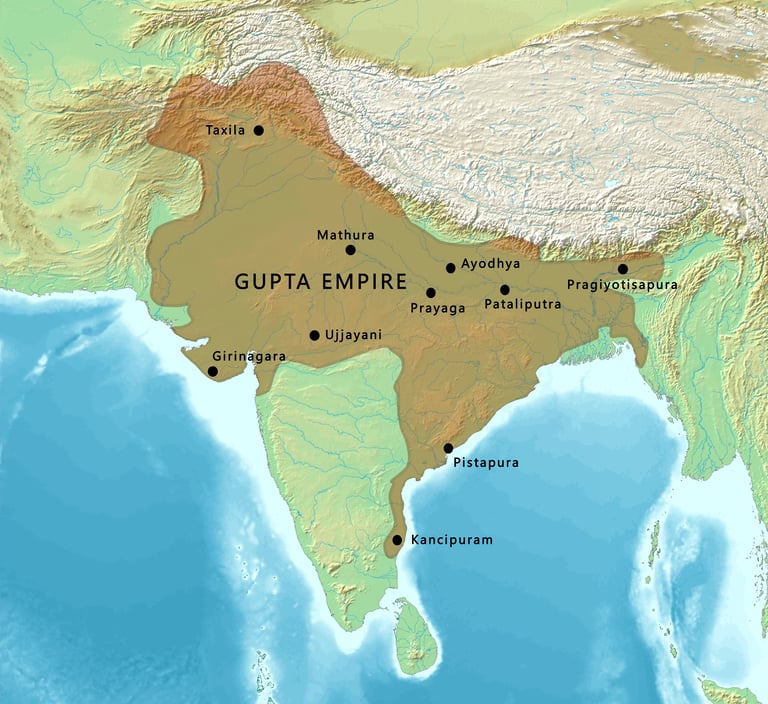
At its height under Chandragupta II, the Gupta Empire's direct control extended across northern India from the Indus River to the Bay of Bengal and from the Himalayan foothills to the Narmada River. Beyond this core territory, numerous tributary kingdoms in central and parts of southern India acknowledged Gupta overlordship.
The empire encompassed diverse geographical regions: the fertile Gangetic plains, the western coastal areas of Gujarat and Saurashtra, the forests of central India, and the mineral-rich regions of eastern India. This geographic diversity contributed to economic prosperity through varied agricultural products, minerals, and trade goods.
Administrative Innovation and Decentralization
The Gupta administrative system balanced centralized authority with significant regional autonomy. The empire was divided into provinces (bhuktis or desas), governed by officials called uparikas. Provinces were subdivided into districts (vishayas) administered by vishayapatis, which were further divided into villages (gramas) managed by village headmen.
What distinguished the Gupta administration was its pragmatic flexibility. Local councils and assemblies retained considerable power over local affairs. Cities had their own administrative councils (nagarapatis), and merchant guilds (shrenis) regulated commerce with minimal imperial interference. This decentralization fostered local initiative while maintaining imperial cohesion.
The Guptas generally avoided heavy-handed bureaucratic control. Land revenue, the primary income source, was typically one-sixth of agricultural produce—modest compared to many contemporary empires. This light taxation contributed to economic prosperity and political stability.

Scientific and Mathematical Achievements: Foundations of Modern Knowledge
Aryabhata and the Revolution in Mathematics and Astronomy
The Gupta period witnessed mathematical and astronomical breakthroughs that fundamentally shaped global scientific development. Aryabhata (476-550 CE), working during the late Gupta period, stands as one of history's most influential mathematicians.
In his seminal work "Aryabhatiya" (499 CE), Aryabhata presented concepts that were centuries ahead of their time. He calculated pi (π) to four decimal places as 3.1416, remarkably accurate for his era. He explained the apparent westward motion of stars as resulting from Earth's rotation on its axis—a heliocentric insight that wouldn't gain acceptance in Europe for over a thousand years.
Aryabhata developed sophisticated methods for solving quadratic equations, created algorithms for extracting square and cube roots, and advanced trigonometry with his sine tables. His astronomical calculations of planetary positions and eclipse predictions demonstrated exceptional precision.
The Decimal System and Zero: India's Gift to Mathematics
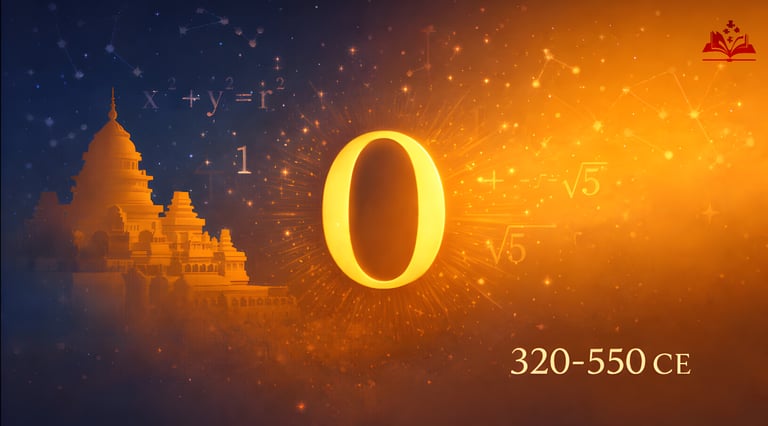
Perhaps the most transformative mathematical development was the full conceptualization of the decimal place-value system, including zero (shunya). While earlier Indian mathematicians had developed aspects of this system, Gupta-era scholars refined and popularized it.
The Bakshali manuscript, though its exact dating remains debated, contains some of the earliest uses of a symbol for zero. Gupta mathematicians understood zero not merely as a placeholder but as a number with mathematical properties—a conceptual leap that revolutionized calculation.
This decimal system, including zero, eventually transmitted to the Islamic world through trade and scholarly exchanges, then to medieval Europe, where it became known as "Arabic numerals"—though its Indian origins are now widely acknowledged. Modern computing, digital technology, and advanced mathematics would be impossible without this Gupta-era innovation.
Advances in Metallurgy: The Iron Pillar of Delhi
The Gupta period's metallurgical sophistication is dramatically demonstrated by the Iron Pillar of Delhi, erected during Chandragupta II's reign around 402 CE. Standing over seven meters tall and weighing more than six tons, this wrought iron pillar has resisted corrosion for over 1,600 years despite exposure to Delhi's monsoons.
Recent scientific analysis reveals that the pillar's rust resistance results from a combination of high phosphorus content, low sulfur levels in the iron, and the formation of a protective passive layer. The metallurgical knowledge and technical skill required to forge such a massive, pure iron object without modern technology remain impressive by contemporary standards.
Medical Knowledge and Ayurvedic Systematization
Gupta physicians systematized Ayurvedic medicine, building on earlier texts like the Charaka Samhita and Sushruta Samhita. Medical practitioners developed sophisticated diagnostic techniques, surgical instruments, and treatments for various ailments.
The concept of plastic surgery, including rhinoplasty techniques, was documented in detail. Gupta medical texts described over 700 medicinal plants, sophisticated anatomical knowledge, and theories of disease that, while different from modern germ theory, showed empirical observation and systematic categorization.
Literary Brilliance: Kalidasa and the Sanskrit Renaissance
Kalidasa's Enduring Masterpieces
The Gupta era witnessed Sanskrit literature reach its classical pinnacle, with Kalidasa representing the supreme literary achievement. Often called "India's Shakespeare," Kalidasa crafted works of such beauty and sophistication that they remain central to Sanskrit literary culture.
His play "Abhijnanasakuntalam" (The Recognition of Shakuntala) tells the story of King Dushyanta and the hermit-maiden Shakuntala with such emotional depth and poetic beauty that it influenced world literature. When translated into European languages in the 18th century, it deeply impressed Goethe and other Romantic writers.
"Meghaduta" (The Cloud Messenger), a lyric poem describing a yaksha's message to his beloved carried by a monsoon cloud, showcases Kalidasa's mastery of natural description and human emotion. His epic poem "Kumarasambhava" narrates the birth of the war god Kartikeya, combining mythology with sublime poetry.
"Raghuvamsha" traces the lineage of the Raghu dynasty (Rama's ancestors), blending history, legend, and political philosophy. These works weren't merely entertainment but sophisticated explorations of dharma (duty/righteousness), love, separation, nature, and the human condition.
Other Literary Achievements
Beyond Kalidasa, the Gupta period produced numerous significant literary works. The final compilation of the Puranas (ancient stories and genealogies) occurred during this era, standardizing Hindu mythology and religious narratives.
The legal text "Narada Smriti" and the refined "Kamasutra" by Vatsyayana both emerged during this period, addressing law, governance, and human relationships with systematic rigor.
Buddhist literature also flourished, with scholars like Asanga and Vasubandhu developing Mahayana Buddhist philosophy at Nalanda, which became a major center of learning.
Artistic and Architectural Magnificence
Sculpture: The Classical Indian Aesthetic
Gupta sculpture established the classical standard for Indian art, characterized by graceful proportions, serene expressions, and spiritual idealism combined with naturalistic detail. The standing Buddha from Sarnath, with its translucent drapery and meditative calm, exemplifies Gupta sculptural perfection.
The Udayagiri caves near Vidisha contain some of the finest Gupta rock-cut sculptures, including a massive relief of Vishnu as the boar-avatar Varaha rescuing the earth goddess. These sculptures balance divine power with aesthetic refinement.
Gupta sculptors developed iconographic conventions for representing Hindu deities that influenced Indian art for centuries. The ideal proportions, symbolic gestures (mudras), and attributes (ayudhas) of gods and goddesses were systematized during this period.
Temple Architecture: Laying the Foundation
While earlier Indian religious architecture focused on stupas and rock-cut caves, the Gupta period saw the development of free-standing structural temples that would become the dominant form of Hindu architecture.
The Dashavatara Temple at Deogarh (c. 500 CE) represents one of the earliest surviving stone temples, featuring a square sanctum with entrance porches and elaborate sculptural panels depicting Vishnu's incarnations. The temple's design established architectural principles that later evolved into the complex temple forms of medieval India.
The brick Bhitargaon Temple demonstrates Gupta architectural innovation in terracotta decoration, with elaborate panels depicting various deities and mythological scenes integrated into the building's structure.
Cave Temples: Ajanta and Ellora
Though the Ajanta cave paintings span several centuries, some of the finest work occurred during the Gupta period (5th century CE). These Buddhist cave temples contain murals depicting Jataka tales (Buddha's previous lives), celestial beings, and courtly scenes with extraordinary artistic sophistication.
The Ajanta paintings demonstrate advanced understanding of perspective, composition, and color theory. The pigments, derived from minerals and plants, have retained their vibrancy for over 1,500 years. The artists created a visual language that combines narrative clarity with spiritual expression and aesthetic beauty.
Religion and Philosophy: Synthesis and Tolerance
Hindu Revival and Puranic Hinduism
The Gupta period witnessed what scholars call the "Hindu synthesis"—the development of classical Hinduism as we recognize it today. The Guptas, primarily Vaishnavite (Vishnu worshippers) themselves, patronized Brahmanical Hinduism while maintaining religious tolerance.
The Bhakti movement, emphasizing personal devotion to a chosen deity (ishta-devata), gained momentum. The Puranas were compiled into their final forms, providing accessible mythology and religious guidance to common people beyond the elite Sanskrit-educated class.
The concept of the Trimurti (Brahma-Vishnu-Shiva as creator-preserver-destroyer) became standardized, along with elaborate temple worship rituals (puja) and pilgrimage traditions. The Gupta period established many religious practices that remain central to Hinduism today.
Buddhist Flourishing: Nalanda University
Despite the Gupta rulers' Hindu affiliation, Buddhism thrived during this period. The establishment of Nalanda University (c. 427 CE) during Kumaragupta I's reign created one of the world's first residential universities and the greatest center of Buddhist learning in Asia.
Nalanda attracted scholars from across Asia—China, Korea, Japan, Tibet, Central Asia, and Southeast Asia. At its peak, it housed over 10,000 students and 2,000 teachers, with a massive library complex called Dharmaganja containing hundreds of thousands of manuscripts.
The university's curriculum extended beyond Buddhist philosophy to logic, grammar, medicine, mathematics, astronomy, and other subjects. This intellectual openness created a vibrant scholarly environment where different philosophical schools debated and refined their ideas.
Religious Tolerance and Coexistence
The Gupta period demonstrated remarkable religious pluralism. Hindu, Buddhist, and Jain communities coexisted with minimal conflict. Gupta inscriptions record donations to Buddhist monasteries by Hindu rulers, while Buddhist monks enjoyed royal patronage.
This tolerance wasn't merely passive acceptance but active engagement across religious boundaries. Philosophical debates between different schools sharpened intellectual rigor, and artistic styles influenced each other, creating a rich cultural synthesis.
Economic Prosperity: Trade, Agriculture, and Urban Life
Agricultural Foundations and Land Management
The Gupta economy rested primarily on agriculture, with the fertile Gangetic plains providing abundant harvests. Irrigation systems, including wells and tanks, supported cultivation. The state encouraged land grants (agrahara) to brahmanas and temples, promoting agricultural expansion into forested areas.
Land revenue remained moderate, allowing peasants to retain most of their produce. This fostered agricultural surplus, supporting urban centers, trade, and specialized crafts. The relative prosperity of the rural population created a stable economic foundation.
Trade Networks: Connecting India to the World
Gupta India participated actively in Indian Ocean trade networks connecting the Roman Empire, Southeast Asia, China, and East Africa. Major ports like Tamralipti (in Bengal), Sopara, and Bharuch facilitated maritime commerce.
Indian merchants exported textiles (especially fine cotton and silk), spices, precious stones, pearls, ivory, and indigo. Imports included gold, silver, horses, dates, and luxury goods. Roman gold coins circulated widely, reflecting robust trade with the Mediterranean world.
Overland trade routes connected India to Central Asia, Persia, and China. The Silk Road's southern branches passed through Gupta territory, bringing foreign merchants and ideas to Indian cities.
Guilds, Currency, and Urban Centers
Merchant and craft guilds (shrenis) played crucial roles in urban economic organization. These guilds regulated quality standards, set prices, settled disputes, and sometimes functioned as banking institutions accepting deposits and making loans.
The Guptas issued high-quality gold coins (dinars) with various designs depicting rulers performing ceremonies, hunting, or playing musical instruments. These coins circulated widely, reflecting monetary stability and economic confidence.
Major urban centers like Pataliputra, Ujjain, Ayodhya, Kausambi, and Varanasi thrived as commercial, administrative, and cultural hubs. Archaeological evidence reveals planned urban layouts, sophisticated drainage systems, and diverse economic activities.
The Decline of the Gupta Empire: Multiple Challenges Converge
Internal Fragmentation and Succession Disputes
After Kumaragupta I (c. 415-455 CE) and Skandagupta (c. 455-467 CE), the empire faced increasing internal challenges. Succession disputes weakened central authority, and provincial governors (uparikas) began asserting independence.
The decentralized administrative structure that had provided flexibility during the empire's rise became a liability during its decline. Regional powers emerged, reducing imperial territories and revenues.
The Huna Invasions
The most immediate external threat came from the Hunas (Hephthalites or White Huns), Central Asian nomadic tribes who invaded northwestern India repeatedly from the late 5th century onward. Skandagupta successfully repelled initial invasions, but the constant military campaigns drained imperial resources.
Later Gupta rulers proved less capable of resisting Huna pressure. By the early 6th century, Huna chieftains like Toramana and Mihirakula controlled significant portions of northern India, disrupting trade routes and devastating urban centers.
Economic and Administrative Challenges
Prolonged warfare disrupted agriculture and trade, reducing tax revenues precisely when military expenditures increased. The quality of gold coinage declined, indicating monetary debasement and economic stress.
The land grant system, which initially promoted agricultural expansion, gradually eroded the tax base as more land received tax-exempt status. This reduced imperial revenues while strengthening local landowners at the empire's expense.
Regional Kingdoms and the Post-Gupta Period
By the mid-6th century, the Gupta Empire fragmented into smaller regional kingdoms. The Later Guptas of Magadha, the Maukharis of Kanauj, the Maitrakas of Valabhi, and various other dynasties emerged from Gupta territories.
Though these successor states lacked the Guptas' territorial extent, many maintained cultural continuity, preserving artistic traditions, literary patronage, and administrative practices developed during the Gupta period.
The Gupta Legacy: Enduring Influence Across Centuries
Cultural Foundation of Classical India
The Gupta period established cultural templates that shaped Indian civilization for centuries. Sanskrit literary conventions, artistic iconography, temple architecture, religious practices, and philosophical frameworks developed during this era remained influential through medieval and early modern periods.
The concept of a "golden age" itself became a reference point for later Indian rulers, who often claimed to restore Gupta-era glory. The title "Vikramaditya" was adopted by numerous later kings seeking to associate themselves with Chandragupta II's legendary reign.
Global Scientific Impact
Gupta mathematical and astronomical achievements influenced world civilization profoundly. The decimal system and zero transformed global mathematics and eventually enabled modern science, technology, and computing.
Indian astronomical texts translated into Arabic during the Islamic Golden Age influenced medieval European astronomy. Aryabhata's works were studied in Baghdad's House of Wisdom, contributing to Islamic scientific advancement.
Southeast Asian Cultural Influence
Gupta artistic styles, Sanskrit literature, Hindu and Buddhist religious concepts, and political ideals spread to Southeast Asia through trade and cultural exchange. The classical civilizations of Cambodia, Thailand, Indonesia, and other Southeast Asian regions drew heavily on Gupta cultural models.
Angkor Wat in Cambodia, Prambanan in Indonesia, and numerous other Southeast Asian temples reflect architectural and iconographic principles developed during the Gupta period, demonstrating the empire's far-reaching cultural influence.
Modern Recognition and Archaeological Discoveries
Archaeological excavations continue revealing new insights into Gupta civilization. Sites like Nalanda, Vikramashila, and various temple complexes provide material evidence of Gupta achievements.
Modern India recognizes the Gupta period as a foundational era. The period's emphasis on learning, artistic excellence, and cultural synthesis resonates with contemporary values, making Gupta achievements relevant to ongoing discussions about Indian identity and cultural heritage.
Comparing the Gupta Empire to Contemporary Civilizations
Understanding the Gupta Empire's significance requires historical context. During the Gupta period (4th-6th centuries CE), the Roman Empire was transitioning to Byzantine rule, Western Europe was entering the early medieval period, and China was experiencing the Northern and Southern Dynasties period.
The Guptas achieved scientific and mathematical breakthroughs that contemporary European civilizations wouldn't match for centuries. Their political administration balanced centralization with local autonomy more successfully than the highly bureaucratized late Roman Empire. In artistic achievement, Gupta sculpture and painting rank among humanity's finest artistic productions from any civilization of that era.
The Gupta Empire represents a pinnacle of classical Indian civilization, demonstrating how political stability, economic prosperity, intellectual freedom, and cultural patronage can converge to produce extraordinary human achievement. Its legacy continues shaping not only Indian culture but also global civilization through mathematical innovations, artistic traditions, and philosophical insights that remain relevant over fifteen centuries after the empire's decline. Understanding the Gupta period provides essential context for appreciating both India's historical contributions to world civilization and the foundations of classical Indian culture that persist today.
Frequently Asked Questions
Q: What were the major achievements of the Gupta Empire?
The Gupta Empire's major achievements include developing the decimal number system with zero, advancing astronomy and mathematics through scholars like Aryabhata, creating classical Sanskrit literature through poets like Kalidasa, establishing sophisticated artistic and architectural traditions, creating the Nalanda University, achieving remarkable metallurgical feats like the Iron Pillar of Delhi, systematizing Ayurvedic medicine, and fostering religious and cultural tolerance that allowed multiple traditions to flourish simultaneously.
Q: Who founded the Gupta Empire, and when?
The Gupta dynasty was founded by Maharaja Sri Gupta around 240-280 CE, but the empire truly consolidated under Chandragupta I around 320 CE. Chandragupta I established the Gupta Era calendar in 319-320 CE and transformed the dynasty from a regional power into an empire through strategic alliances, particularly his marriage to Lichchhavi princess Kumaradevi.
Q: Why is the Gupta period called the Golden Age of India?
The Gupta period earned the designation "Golden Age" because it witnessed unprecedented simultaneous advancement across multiple fields: literature, art, architecture, science, mathematics, astronomy, medicine, metallurgy, and philosophy. The period combined political stability, economic prosperity, cultural brilliance, and intellectual achievement in ways rarely matched in human history. The era established classical standards in Indian arts and sciences that influenced civilization for centuries.
Q: What caused the fall of the Gupta Empire?
The Gupta Empire declined due to multiple converging factors: repeated invasions by the Hunas (White Huns) that drained military resources, internal succession disputes that weakened central authority, the decentralized administrative structure that allowed regional governors to assert independence, economic stress from prolonged warfare disrupting trade and agriculture, and the erosion of the tax base through extensive land grants. By the mid-6th century, these combined pressures fragmented the empire into smaller regional kingdoms.
Q: How did the Gupta Empire contribute to mathematics?
Gupta mathematicians made revolutionary contributions, including refining and popularizing the decimal place-value system, conceptualizing zero as both a placeholder and a number with mathematical properties, calculating pi to remarkable accuracy, developing sophisticated algebra and trigonometry, creating algorithms for solving equations and extracting roots, and advancing astronomical calculations. These innovations, transmitted westward through Islamic scholars, fundamentally shaped global mathematical development.
Q: What was the extent of the Gupta Empire at its peak?
At its peak under Chandragupta II Vikramaditya (c. 380-415 CE), the Gupta Empire's direct control extended from the Indus River to the Bay of Bengal east-west and from the Himalayan foothills to the Narmada River north-south. Beyond this core territory, numerous tributary kingdoms in central and parts of southern India acknowledged Gupta overlordship, creating a sphere of influence much larger than territories under direct administration.
Q: What languages were used during the Gupta period?
Sanskrit served as the primary language of literature, administration, and scholarly discourse during the Gupta period. However, Prakrit languages (vernacular Indo-Aryan languages) remained widely spoken by common people and were used in some inscriptions and Buddhist texts. The standardization of classical Sanskrit grammar by earlier grammarian Panini gained widespread acceptance during the Gupta era, establishing Sanskrit as the pan-Indian lingua franca for educated elites.
Q: How did the Gupta Empire manage religious diversity?
The Gupta Empire practiced remarkable religious tolerance despite the rulers' personal Hindu (primarily Vaishnavite) faith. Buddhist and Jain communities received patronage and protection, with Gupta rulers donating to Buddhist monasteries and supporting the establishment of Nalanda University. This pluralism wasn't merely tolerance but active engagement, with philosophical debates between different schools encouraged. The period saw Hinduism, Buddhism, and Jainism coexisting and influencing each other's artistic, philosophical, and cultural development.
Subscribe to Frontier Intelligence
All © Copyright reserved by Accessible-Learning Hub
| Terms & Conditions
Accessible Learning Hub — Actionable clarity for high-agency minds.
Weekly breakdowns on AI breakthroughs, capital flow, and human performance systems. Zero fluff.