

The Empire That Made Iran!
The Safavid Empire ruled Persia from 1501 to 1736 and permanently shaped the Middle East we know today. This is the full story of how they did it.
EMPIRES/HISTORYHISTORYHARSH REALITYIRAN
Jagdish Nishad
3/19/202610 min read
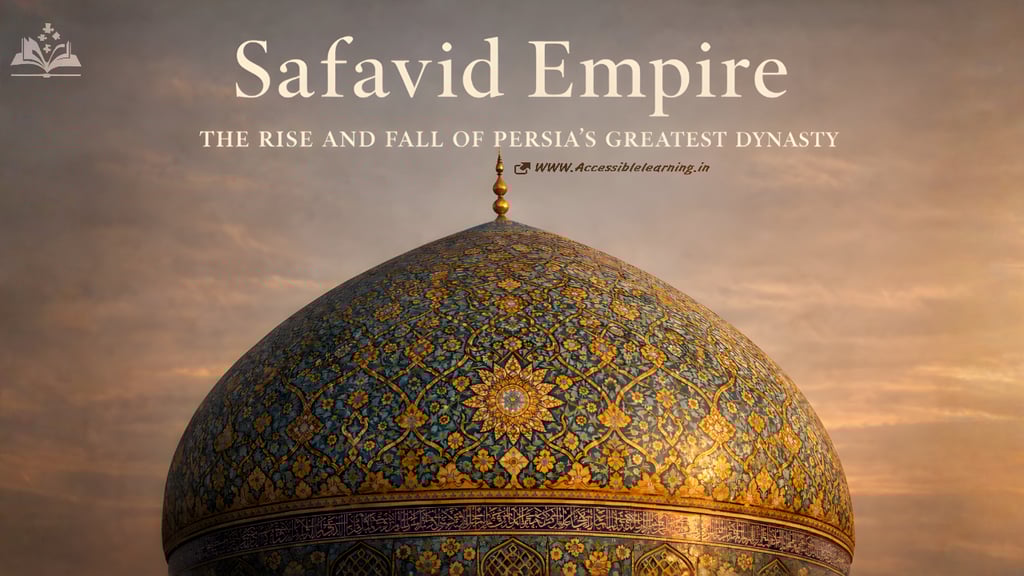
Most people have never heard of the Safavid Empire. That's a shame, because it explains more about the modern Middle East than almost anything else you'll find in a history book. The borders, the religious tensions, the art, the architecture. If you've ever wondered why Iran is Shia Muslim while most of the Arab world is Sunni, the Safavids are your answer.
They ruled Persia from 1501 to 1736. In that time they turned a fractured region into something you could actually call a nation.
It Started With a Religious Brotherhood
The Safavids didn't come from royalty. They came from a Sufi order called the Safaviyya, founded in the city of Ardabil around 1301 by Sheikh Safi al-Din Ardabili, the man the dynasty is named after. For nearly two centuries the order quietly built followers, theological credibility, and eventually an armed force of devoted fighters called the Qizilbash, which means "Red Heads," after the crimson turbans they wore.
The Qizilbash weren't just soldiers. They were true believers who saw their leader as a near-divine figure. That kind of loyalty is worth more than numbers on a battlefield, and Ismail used it well.
In 1501, a teenager named Ismail led those fighters to victory over the ruling Aq Qoyunlu confederation in Tabriz, declared himself Shah, and immediately did something that would echo for five centuries. He converted Persia from Sunni to Shia Islam. Not gradually. Not diplomatically. Clergy who refused were killed. The entire state was reoriented around Twelver Shia doctrine almost overnight.
To staff the new religious establishment, Ismail imported Shia scholars from Lebanon, Bahrain, and Iraq, since Persia itself didn't have enough trained Shia clergy to run the system he was building. Over generations, those imported scholars trained local ones, and Shia Islam grew roots deep enough that no later ruler could pull them out. That decision is the founding act of the Safavid Empire, and it set the tone for everything that followed.
The Ottoman Problem
A Shia state on the Ottoman Empire's eastern border was not something the Ottomans were going to tolerate. They were the self-appointed guardians of Sunni Islam, and Ismail's new empire was both a religious provocation and a territorial threat. There were also Shia sympathizers inside Ottoman territory who looked toward Ismail as a spiritual leader, which worried the Ottomans considerably.
In 1514, Sultan Selim I marched into Safavid territory with a more modern army and, crucially, better artillery. At the Battle of Chaldiran, the Ottoman forces destroyed the Qizilbash cavalry and briefly occupied Tabriz. The Safavids had valor and fanaticism. The Ottomans had cannons. The Cannons won.
Ismail never really recovered from it. He died in 1524 looking nothing like the confident young conqueror he had been at fourteen. But the empire survived, and the loss planted a seed. The Safavids understood they needed to modernize their military or face the same result again.
The two empires would fight on and off for over a century. They contested Mesopotamia, the Caucasus, and Azerbaijan in a series of wars that reshaped the map. The Ottomans occupied Baghdad twice. The Safavids took it back. This back-and-forth wasn't just territorial. Each side saw itself as the legitimate center of the Islamic world, and neither was willing to concede that.
Shah Abbas and the Golden Age
Shah Abbas I came to power in 1588 with the empire under pressure from both the Ottomans in the west and the Uzbeks in the east. Internal rebellions made things worse. By most measures he inherited a mess.
By the time he died in 1629, he had built one of the most sophisticated empires in the world.
He started by fixing the military. The Qizilbash were loyal but politically dangerous, and their tribal chiefs had accumulated too much influence over the throne. Abbas built a new standing army composed largely of converted Georgian, Armenian, and Circassian soldiers, many of them enslaved as boys and raised in the royal household, who answered directly to him rather than to tribal loyalties. He added musketeers and an artillery corps. The military that got destroyed at Chaldiran was replaced by something genuinely modern and, more importantly, controllable.
He then rebuilt the economy. He relocated a large Armenian merchant community from Julfa in Azerbaijan to a purpose-built suburb of Isfahan called New Julfa, knowing they had established trade networks reaching deep into Europe. He granted trading privileges to the English East India Company around 1616 and welcomed Dutch merchants too. Silk from the Caspian provinces became the empire's primary export, moving through Armenian intermediaries to European markets. The Safavids were running a sophisticated international trade operation.
Abbas also had a talent for diplomacy. He sent ambassadors to European courts, partly to build commercial relationships and partly to find allies against the Ottomans. A Sherley brother from England, Robert Sherley, actually helped train Safavid artillery units. The Safavid court was genuinely cosmopolitan.
Then he built Isfahan.
Isfahan
There is a Persian saying from this period: Isfahan nesf-e jahan ast. Isfahan is half the world.
Abbas moved the capital there in 1598 and spent the next three decades turning it into the most spectacular city of its era. The planning was deliberate and ambitious. He laid out a grand boulevard called the Chahar Bagh, flanked by gardens and pavilions, running through the city to the river. The centerpiece was Naqsh-e Jahan Square, one of the largest public squares ever constructed, nearly 500 meters long, surrounded by the Shah Mosque, the Sheikh Lotfollah Mosque, the Ali Qapu Palace, and a covered bazaar that still operates today.
The Shah Mosque alone took nearly twenty years to build and contains around eighteen million tiles. The geometry of the muqarnas vaulting, the way the light moves through the dome, and the scale of the courtyard were all calculated to communicate the power and piety of the Safavid state. It did, and still does.
Isfahan also had a functioning infrastructure. A network of caravanserais, bridges, bathhouses, madrasas, and hospitals. The Khaju Bridge, built under Abbas II, doubled as a dam and a gathering place. The Armenian quarter of New Julfa had its own churches, and the Vank Cathedral there, completed in 1664, blends Persian architectural forms with Armenian Christian iconography in a way that is entirely unique.
The square is a UNESCO World Heritage Site now. It is also just a place where families walk in the evenings and kids kick footballs around. That mix of the monumental and the ordinary is somehow very Safavid.

Art, Ideas, and Culture
The court that Abbas built was genuinely intellectual, not just decorative.
Persian miniature painting hit its peak in Safavid royal studios. The kitabkhana, or royal library-studio, employed master artists who worked on illustrated manuscripts, album paintings, and portraits. The artist Reza Abbasi, working in the late Safavid period, developed a style known for fluid lines and psychologically expressive figures that broke from earlier conventions. His work influenced Persian painting for a century after his death. These manuscripts are in major museum collections around the world today, and serious ones fetch serious money at auction.
Carpet weaving became a high art under royal patronage. The Ardabil Carpet, completed in 1539 and likely made in the shrine city the dynasty came from, is the oldest dated carpet in existence. It contains around 25 million knots and took an estimated 25 million hours of labor to produce. It lives in the Victoria and Albert Museum in London and still stops people in their tracks.
Metalwork, ceramics, textile production, and bookbinding all reached extraordinary levels under Safavid patronage. The bazaars of Isfahan were essentially a permanent showcase of the empire's craft traditions.
The philosophical tradition was equally serious. The School of Isfahan produced Mir Damad and his student Mulla Sadra, who spent his life working through the relationship between reason, mystical experience, and religious revelation. Sadra's system, called Transcendent Wisdom, synthesized Aristotelian logic, the Illuminationist philosophy of Suhrawardi, and Shia theology into a coherent framework. His work is still taught in Iranian seminaries. That is not a footnote. That is a living intellectual tradition with direct roots in the Safavid court.
Society and Daily Life
The Safavid Empire was ethnically diverse and managed that diversity with varying degrees of success. The population included Persians, Azerbaijanis, Kurds, Arabs, Armenians, Georgians, and others. Persian was the language of administration and culture, but Azerbaijani Turkish was widely spoken at court, particularly in the early period.
Urban life in Isfahan was relatively cosmopolitan. The city had a significant Armenian Christian community, Jewish quarters, and even small communities of European traders and missionaries. Coffeehouses became important social spaces in Safavid cities, places where men gathered to talk, listen to poetry, and play chess. The Safavid state periodically tried to shut them down on moral grounds and periodically failed.
Women of the upper classes had access to education, and some Safavid queens and royal women exercised real influence behind the scenes. The harem was not simply a place of confinement. It was a political institution with its own hierarchies and power dynamics. The mothers and wives of shahs frequently played significant roles in court politics, particularly during periods of weak rule.
Outside the cities, the majority of the population were farmers and pastoralists living in conditions that changed relatively little over the empire's duration. The Safavid state taxed them, conscripted them, and occasionally impressed them into labor. The grand buildings of Isfahan were built on the agricultural surplus of a much larger and mostly invisible population.
Religion in Practice
Twelver Shia Islam shaped the rhythm of Safavid life in ways that went well beyond formal theology.
The commemoration of Ashura, mourning the death of Imam Husayn at the Battle of Karbala in 680, became an elaborate public ritual under Safavid sponsorship. Passion plays called taziyeh, dramatizing Husayn's martyrdom, developed into a sophisticated theatrical tradition. Public mourning processions were encouraged by the state as expressions of Shia identity and loyalty. Some of these traditions remain central to Iranian religious life today.
The shrine cities of Mashhad and Qom grew in importance during the Safavid period. Mashhad, containing the tomb of the eighth Imam Ali al-Ridha, became a major pilgrimage destination and received substantial royal patronage. Since the Safavids positioned themselves as protectors of Shia holy places, investing in these shrines was both genuinely pious and politically useful.
The relationship between the Safavid shahs and the Shia clergy was complicated. The clergy provided religious legitimacy for the state. The state funded the clergy and enforced Shia doctrine. But the clerics also maintained an independent institutional base and a tradition of scholarship that gave them authority the shahs could not simply override. This tension between political and religious authority in Shia Iran did not begin with the Islamic Republic. It goes back to the sixteenth century.
How It Ended
The fall was slow and then very fast.
Later Safavid shahs were kept in the harem as boys, deliberately isolated from politics and military life to prevent coups. The intention made sense. The result was rulers who had no real governing experience. Shah Abbas I himself had started the practice, blinding or killing his own sons to eliminate rivals, which meant that when he died the throne passed to a grandson who had never left the palace. Real power drifted to court factions, eunuchs, harem officials, and the religious establishment. The shahs became increasingly ceremonial.
Shah Suleiman, who ruled from 1666 to 1694, was reportedly more interested in wine and his harem than in governance. His son Shah Sultan Husayn was pious and gentle and completely unsuited to ruling an empire facing serious external threats.
Those threats materialized in 1722 when Mir Mahmud Hotaki, leading the Ghilzai Afghan confederation, invaded and put Isfahan under siege. Sultan Husayn held out for seven months as the city starved around him. When he finally surrendered, he reportedly handed his crown to Mahmud personally. What followed was systematic looting. Contemporary Persian and European accounts describe a city stripped of its moveable wealth, palaces ransacked, and libraries dispersed.
The Russians under Peter the Great used the chaos to seize Safavid territory along the Caspian coast. The Ottomans took parts of the west. The empire that Abbas had built was being divided by opportunists while its last rulers stood by helplessly.
A Safavid pretender held on in parts of Persia for another decade with the help of a brilliant military commander named Nader. Once Nader had used the Safavid name to consolidate his own power, he had no further use for it. In 1736 he formally deposed the last claimant, Tahmasp II's infant son Abbas III, and declared himself Shah of Persia. The Safavid dynasty was over.


What They Left Behind
The Safavids have been gone for nearly three centuries. Their influence has not.
Iran is the only country in the world where Twelver Shia Islam is the official state religion. That is not geography or coincidence. It is a policy decision made in 1501 and enforced for two and a half centuries until it became simply the way things were. The clerical establishment that governs the Islamic Republic today is the direct institutional descendant of the religious structures the Safavids built. The theological colleges of Qom, the position of senior jurists, and the whole framework of Shia religious authority in Iran—all of it has Safavid roots.
The Iran-Iraq border follows, roughly, the line drawn in the 1639 Treaty of Zuhab, which ended one of the later Safavid-Ottoman wars. Two countries whose modern relationship has been defined by a brutal eight-year war and ongoing rivalry are still, in a sense, living inside a boundary drawn by two empires that no longer exist.
The Sunni-Shia tension running through contemporary Middle Eastern politics, including the rivalry between Saudi Arabia and Iran, the conflict in Yemen, and the fault lines in Lebanon and Bahrain and Iraq, all of it has roots that go back centuries. The Safavid decision to make Shia identity the cornerstone of Persian statecraft was the moment that tension was institutionalized.
The art is in museums. The carpets are in auction houses. The philosophy is in seminaries. The architecture is in Isfahan, mostly intact, waiting for visitors.
Founded: 1501 by Shah Ismail I Ended: 1736 Capitals: Tabriz, then Qazvin, then Isfahan Religion: Twelver Shia Islam Greatest ruler: Shah Abbas I, 1588 to 1629 Peak territory: Roughly 2.9 million square kilometers
FAQ's
Q: Who founded the Safavid Empire?
Shah Ismail I, who was fourteen when he captured Tabriz in 1501. He came from a Sufi religious order called the Safaviyya, not from a royal family.
Q: Why did the Safavids convert Persia to Shia Islam?
Partly genuine religious conviction, partly politics. A distinct Shia identity separated the Safavids from their Sunni Ottoman rivals and gave the dynasty a unique claim to religious authority. It also gave the Persian state an identity that set it apart from the broader Sunni Islamic world surrounding it.
Q: What was the Battle of Chaldiran?
A decisive 1514 battle in which Ottoman forces defeated the Safavid army. The Ottomans had superior artillery and firearms. The Safavid cavalry-based force was not equipped to counter them. It was a shock that forced the Safavids to eventually modernize their military, which Shah Abbas I later did.
Q: Why did the empire fall?
Primarily weak leadership. The practice of isolating princes in the harem produced shahs who had no political or military experience. When the Afghan invasion came in 1722, the last effective Shah had neither the ability nor the institutions around him to mount a real defense.
Q: What is their biggest legacy?
Shia Iran, without question. Everything else, the architecture, the art, the philosophy, and the trade networks, grew from or alongside that original decision to build a Shia Persian state. That state still exists, in a different form, today.
Subscribe to Frontier Intelligence
All © Copyright reserved by Accessible-Learning Hub
| Terms & Conditions
Accessible Learning Hub — Actionable clarity for high-agency minds.
Weekly breakdowns on AI breakthroughs, capital flow, and human performance systems. Zero fluff.