

The East India Company: The Corporation That Had an Army Bigger Than Britain's
Discover how the East India Company became history's most powerful corporation, commanding a 250,000-man army, conquering kingdoms, and fueling the global opium trade.
UNITED KINGDOMINDIAN HISTORYEMPIRES/HISTORYHARSH REALITY
Jagdish Nishad
8/6/202611 min read


Imagine if Amazon, BlackRock, and a private military company merged into one organization, then received permission to wage wars, print money, overthrow governments, collect taxes, and sell narcotics across continents.
That sounds like dystopian fiction.
It actually happened.
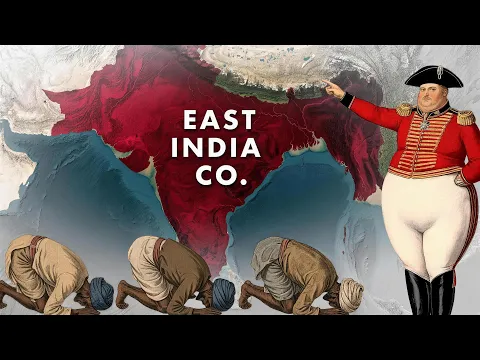
The English East India Company was not just a trading business. At its peak during the late 18th and early 19th centuries, it controlled around 250,000 private soldiers, roughly twice the size of Britain's regular standing army. It ruled tens of millions of people, minted its own coins, maintained its own courts, negotiated treaties, and launched full-scale military invasions, all while answering primarily to shareholders interested in quarterly profits.
History remembers the British Empire.
But one of its most astonishing chapters belongs to a corporation.
Quick Facts
Founded: December 31, 1600, under a royal charter from Queen Elizabeth I.
Official Name: The Governor and Company of Merchants of London Trading into the East Indies.
Purpose: Trade spices, silk, cotton, tea, and luxury goods.
Peak Army: Over 250,000 private soldiers, exceeding Britain's standing military.
Corporate Powers: Wage war, sign treaties, collect taxes, build forts, mint coins, and administer justice.
Turning Point: Victory at the Battle of Plassey (1757) transformed a trading company into a territorial ruler.
Most Profitable Commodity: Tea, financed largely through the opium trade with China.
Estimated Territory Controlled: Much of the Indian subcontinent before British Crown rule.
Corporate Collapse: Government intervention after repeated scandals and the Indian Rebellion of 1857.
Dissolved: 1874.
What Exactly Was the East India Company?
It began as a business, not an empire.
When Queen Elizabeth I granted its royal charter in 1600, the East India Company received exclusive rights to English trade across much of Asia. Investors expected ships to return filled with pepper, cinnamon, cloves, silk, porcelain, and other luxury goods that Europeans eagerly purchased.
At first, the company looked much like any ambitious multinational.
It opened trading posts.
It negotiated commercial agreements.
It competed with Portuguese and Dutch merchants.
Then everything changed.
Rather than simply buying products, company executives discovered that controlling territory produced much larger profits than competing in open markets. Commerce slowly transformed into conquest.
Why Did a Private Company Need an Army?
Because trade became warfare.
European powers fought fiercely for Asian markets during the 17th and 18th centuries. Ships carrying valuable cargo became military targets, while local rulers often demanded military alliances or protection.
The East India Company responded by hiring soldiers.
Lots of them.
Initially, these forces guarded warehouses and ships.
Eventually they became one of the largest private military organizations the world has ever seen.
By the early nineteenth century, Company records show approximately the following:
Around 200,000–260,000 soldiers, depending on the year.
Thousands of European officers.
Massive artillery divisions.
Powerful cavalry units.
Three separate presidency armies in Bengal, Madras, and Bombay.
Many of these troops were Indian soldiers known as sepoys, commanded primarily by British officers.
This wasn't security.
It was a full-scale corporate military machine.
How Did a Corporate Clerk Conquer an Empire?
Through one of history's most remarkable acts of political manipulation. The central figure was Robert Clive.
He wasn't born into royalty.
He wasn't a famous general.
He arrived in India as a relatively low-ranking Company clerk struggling with depression and debt.
Yet within a few years, he became one of Britain's richest men.
His opportunity arrived in 1757.
What Happened at the Battle of Plassey?
The answer is surprisingly simple.
Money defeated manpower.
The ruler of Bengal, Siraj ud-Daulah, assembled roughly 50,000 soldiers, dozens of artillery pieces, cavalry, and French military advisers.
Robert Clive commanded only around the following:
3,000 Company troops
Roughly 900 European soldiers
Around 2,100 sepoys
On paper, defeat looked inevitable.
Instead, Clive secretly bribed several of Siraj's senior commanders, including Mir Jafar, promising enormous rewards if they refused to fight.
When the battle began, large sections of Bengal's army simply stood still.
Some never entered combat.
Others quietly switched allegiance.
After several hours, Siraj's forces collapsed.
It remains one of history's clearest examples of political corruption deciding the outcome of a battle.
Plassey wasn't won through superior tactics alone.
It was won with corporate bribery.


How Rich Did Robert Clive Become?
Almost unbelievably rich.
Following Plassey, Company officials seized Bengal's treasury.
Clive personally received an enormous fortune in gifts, bonuses, land revenues, and payments.
Modern economic estimates vary, but his wealth has been compared to hundreds of millions of dollars in today's purchasing power, with some analyses placing the effective value far higher depending on the method of comparison.
Back in Britain, people nicknamed him "Clive of India."
His fortune sparked outrage.
Parliament later investigated accusations of corruption.
Clive famously defended himself by declaring he was astonished by his own restraint.
It became one of history's most infamous examples of corporate executives enriching themselves after military conquest.
How Did a Trading Company End Up Collecting Taxes?
Because victory brought something even more valuable than trade. Revenue. After Plassey, the Company gradually acquired the right to collect taxes across Bengal, one of the wealthiest regions on Earth.
Suddenly it wasn't merely buying goods. It became the government.
Company officials now controlled:
Tax collection
Civil administration
Criminal courts
Local policing
Military defense
Infrastructure decisions
Land revenue systems
Shareholders in London effectively earned dividends funded by taxes collected thousands of miles away. The line between corporation and state almost disappeared.
Why Did Profit Become More Important Than People?
Because shareholders expected constant returns.
Every military campaign, tax reform, or commercial decision eventually answered one question:
Would it increase revenue?
This relentless financial pressure had devastating consequences.
During the Bengal Famine of 1770, millions died amid crop failures, disease, and food shortages. Historians continue to debate the exact death toll, commonly estimating around 7 to 10 million deaths. Company tax demands often remained high despite the catastrophe, and many historians argue that its policies worsened the humanitarian disaster, even though drought and environmental factors also played major roles.
Profits continued.
Dividends continued.
Human suffering became secondary.
The crisis triggered intense criticism in Britain and eventually led Parliament to impose greater oversight.
Why Did the Company Become the World's Biggest Drug Dealer?
Because Britain desperately wanted Chinese tea.
China had something Britain couldn't produce enough of:
Tea
Silk
Porcelain
Chinese merchants preferred payment in silver.
That created a massive trade imbalance.
The East India Company needed another currency.
It found one.
Opium.
How Did the Opium Trade Actually Work?
It operated like an enormous international business strategy.
The Company encouraged farmers across parts of India, especially in Bengal and Bihar, to cultivate opium under tightly controlled systems. Many cultivators faced strong economic pressure through contracts and government-backed monopolies that limited alternatives.
The process looked like this:
Indian farmers produced opium.
Company-controlled auctions sold it to private merchants.
Merchants smuggled it into China, where importing opium was illegal.
Chinese buyers paid in silver.
That silver purchased Chinese tea.
Tea sailed to Britain.
British consumers drank tea while Company profits soared.
The Company often avoided directly smuggling the drug itself, instead relying on licensed private traders while maintaining the production monopoly that made the trade possible.
It was an extraordinarily profitable system.
It also fueled one of history's largest narcotics markets.
Did This Drug Trade Really Lead to War?
Yes.
Chinese officials repeatedly attempted to suppress illegal opium imports because addiction had become widespread. In 1839, imperial commissioner Lin Zexu confiscated and destroyed large quantities of opium at Canton.
Britain responded militarily. The result was the First Opium War (1839–1842). Britain's victory forced China to accept unequal treaty terms, expand foreign trade privileges, and cede Hong Kong.
Although the British government directed the war, the commercial interests built by the East India Company had helped create the conditions that made conflict likely. Few businesses in history have influenced global geopolitics on such a scale.
Was the East India Company Actually More Powerful Than Many Countries?
For long periods, yes.
Consider what it possessed simultaneously:
A quarter-million soldiers.
A massive naval presence.
Tax authority over millions of people.
International diplomatic powers.
Independent courts.
Currency production.
Fortifications across Asia.
Vast shipping fleets.
One of the world's largest commercial networks.
Many recognized states had fewer powers. The Company functioned as a government whose primary mission remained generating returns for investors.

The Company Had Its Own Flag, Currency, and Postal System
The East India Company looked increasingly like an independent nation rather than a business.
Across its territories, it issued its own coins; operated postal routes; maintained official seals; flew Company flags over forts and ships; and kept detailed administrative records. Many people living under Company rule dealt with Company officials far more often than representatives of the British Crown.
For ordinary citizens, the distinction between "company" and "government" became almost meaningless.
How Did Shareholders Influence an Empire?
Unlike a monarchy, the East India Company answered to investors.
Major shareholders voted for directors at the Company's headquarters on London's Leadenhall Street. Those directors made decisions affecting military campaigns, taxation, trade, diplomacy, and appointments across Asia.
This created an unusual chain of command:
Investors wanted higher dividends.
Directors demanded greater revenue.
Officials in India increased tax collection and commercial output.
Military expansion often followed economic opportunity.
It may be one of history's earliest examples of shareholder expectations influencing international geopolitics.
Why Was Bengal So Valuable?
Because it was one of the richest manufacturing regions on Earth.
During the early eighteenth century, Bengal produced world-famous
Fine muslin textiles
Silk fabrics
Saltpeter (essential for gunpowder)
Sugar
Rice
Indigo dye
European merchants competed fiercely for access to these goods. Control of Bengal meant access to immense wealth long before the Industrial Revolution transformed Britain.
Some economic historians estimate Bengal accounted for a significant share of global manufacturing output in the early 1700s, making it one of the most economically productive regions in the world.
What Was the Company's Intelligence Network Like?
Surprisingly sophisticated. The Company relied on merchants, translators, diplomats, local informants, spies, and political agents scattered across ports, royal courts, and marketplaces.
These networks gathered information on:
Rival European powers
Local rulers
Trade prices
Military movements
Political disputes
Agricultural production
Long before modern intelligence agencies existed, the Company understood that information could be just as valuable as soldiers.
Why Did the Company Build So Many Forts?
Because warehouses were never just warehouses. Major trading settlements such as Bombay, Madras, and Calcutta gradually evolved into heavily fortified military and commercial centers.
These forts served multiple purposes:
Protecting valuable cargo
Housing troops
Storing weapons
Defending harbors
Acting as regional administrative headquarters
Over time, these coastal trading posts became the foundations of British expansion across the Indian subcontinent.
How Did Corruption Become a Serious Problem?
Because fortunes could be made almost overnight. Company officials often accepted expensive gifts, negotiated private trading deals, or used political influence for personal gain.
The term "nabob" entered British vocabulary to describe Company employees who returned from India with extraordinary wealth, lavish lifestyles, and enormous estates.
Many Britons viewed these fortunes with suspicion, believing they had been accumulated through exploitation rather than honest commerce.
Parliamentary investigations during the late eighteenth century repeatedly examined allegations of corruption within Company administration.
Why Did Parliament Eventually Distrust the Company?
Because it had become too powerful to fail.
By the 1770s, the Company was simultaneously:
One of Britain's largest employers
A dominant trading organization
A territorial ruler
A military power
Financially unstable despite enormous revenues
When poor management and military expenses pushed it toward financial crisis, the British government faced an uncomfortable reality.
The corporation was so deeply tied to Britain's economy that allowing it to collapse threatened national financial stability.
This has led some historians to describe government intervention as one of the earliest examples of rescuing a systemically important corporation.


Did the Company Influence the American Revolution?
Indirectly, yes. The East India Company's financial troubles contributed to the Tea Act of 1773, which allowed it to sell surplus tea directly to the American colonies while reducing certain taxes.
Many colonists viewed the measure as an attempt to strengthen a monopoly.
Their response became one of history's most famous acts of protest:
The Boston Tea Party, where protesters dumped the company's tea into Boston Harbor.
Ironically, one corporation helped ignite political events that eventually led to the independence of the United States.
What Was the Company's Greatest Weakness?
Success. As the Company accumulated more land, soldiers, and administrative responsibilities, governing became vastly more difficult than trading.
Running an empire required the following:
Roads
Courts
Schools
Tax administration
Diplomacy
Public order
Disaster response
Military logistics
A corporation designed to maximize profits gradually found itself trying to govern millions of people, a task far beyond its original purpose. That contradiction eventually proved impossible to sustain.
Why Didn't Britain Shut It Down Earlier?
Because it made enormous amounts of money. The British government benefited through taxes, trade expansion, strategic influence, and growing imperial power. At the same time, Parliament repeatedly worried about corruption, monopoly power, and financial instability.
Several laws attempted to increase oversight, including the Regulating Act of 1773 and Pitt's India Act of 1784, which gradually expanded government supervision while allowing the Company to continue operating.
The relationship resembled a government struggling to control a corporation that had become too powerful to ignore.
What Finally Ended the Company's Rule?
The Indian Rebellion of 1857 fundamentally changed everything.
The uprising spread across large areas of northern and central India and exposed deep dissatisfaction with Company rule, military practices, political annexations, and economic policies.
The British government reached a simple conclusion.
A private corporation should never again govern such a vast territory.
In 1858, the British Crown formally assumed direct control over most Company territories under the Government of India Act.
The East India Company survived only as a legal shell before being formally dissolved in 1874.
Its corporate empire was over.
Was This the World's First Multinational Super-Corporation?
Many historians would argue it was among the earliest and most influential examples.
The East India Company pioneered ideas that later became common in global business:
Shareholder ownership.
International supply chains.
Overseas subsidiaries.
Corporate lobbying.
Large-scale logistics.
Global commodity markets.
Sophisticated accounting systems.
Unlike modern corporations, however, it also possessed powers that businesses today generally do not: it could wage war, annex territory, and govern millions.
That combination has never been comfortably repeated.
Why Does the East India Company Still Fascinate Historians?
Because it challenges the way people think about empires. When most people picture imperial expansion, they imagine kings, queens, and governments. The East India Company reminds us that investors, executives, and shareholders can also reshape the world.
Its story is packed with contradictions.
It accelerated global trade while fueling exploitation.
It expanded financial innovation while encouraging corruption.
It connected continents while helping trigger famines, wars, and addiction crises.
Few organizations have left such an enormous footprint on world history.
Why This Matters Today
The East India Company feels surprisingly modern because many of today's largest corporations operate across dozens of countries, influence governments through lobbying, control complex supply chains, and generate revenues larger than the economies of some nations.
The difference is that modern corporations generally cannot legally raise private armies, conquer territory, collect taxes, or negotiate international treaties as sovereign powers.
Even so, the Company's history remains a warning about what can happen when commercial incentives outpace meaningful oversight. It shows how profit, political influence, and concentrated power can combine in ways that reshape societies far beyond the boardroom.
Four centuries later, the East India Company is more than a historical curiosity. It is a case study in how a business became a state, how shareholders became imperial stakeholders, and how one corporation changed the course of global history.
FAQ's
Q: Did the East India Company really have more soldiers than Britain?
Yes. At its peak in the early nineteenth century, the Company employed roughly 250,000 private troops, while Britain's regular standing army was significantly smaller. Most Company soldiers were Indian sepoys commanded by British officers.
Q: Was the East India Company owned by the British government?
No. It was a joint-stock corporation owned by private shareholders. Although it operated under royal charters and later came under increasing parliamentary oversight, it remained a commercial company rather than a government department for most of its existence.
Q: Did Robert Clive actually defeat a much larger army?
Yes. At the Battle of Plassey (1757), Clive commanded about 3,000 Company troops against the Nawab of Bengal's force of around 50,000. The outcome was heavily influenced by secret negotiations and the defection or inaction of key commanders loyal to Mir Jafar.
Q: Did the Company directly sell opium in China?
The Company maintained a monopoly over opium production in parts of India and auctioned the drug to licensed private merchants, who then smuggled it into China. This system generated enormous profits while allowing the Company to distance itself from the final stage of the illegal trade.
Q: Why was tea so important?
Tea became Britain's favorite drink during the eighteenth century, creating huge demand. Since China accepted little British merchandise, the East India Company used silver, and later profits from the opium trade, to finance massive tea imports.
Q: Was the East India Company the first multinational corporation?
Not exactly, but it was one of the first truly global joint-stock corporations with shareholders, international operations, overseas administration, and military power. Its scale and influence helped shape the modern multinational business model.
Q: Why was the East India Company abolished?
The Indian Rebellion of 1857 exposed the failures of Company rule. In 1858, the British government transferred control of its territories to the Crown, ending Company governance. The corporation itself remained on paper until it was formally dissolved in 1874.
Q: Could anything like the East India Company exist today?
Not in the same form. Modern corporations can become economically powerful, but they generally cannot legally maintain standing armies, annex territory, collect taxes, or exercise sovereign authority over millions of people. The East India Company remains a unique example of a corporation functioning as both a business and a state.
Subscribe To Our Newsletter
All © Copyright reserved by Accessible-Learning Hub
| Terms & Conditions
Knowledge is power. Learn with Us. 📚

