

The DeFi–TradFi Bridge: How Retail Investors Are Accessing Institutional Yield
Explore how the DeFi–TradFi bridge is transforming finance by connecting traditional financial assets with blockchain infrastructure. Learn how tokenization, institutional DeFi, and yield-bearing digital assets are opening institutional-grade investment opportunities to retail investors.
BANKING/CASH-FLOWSTOCK MARKET
Vishwajeet Chaurasiya
4/2/20267 min read
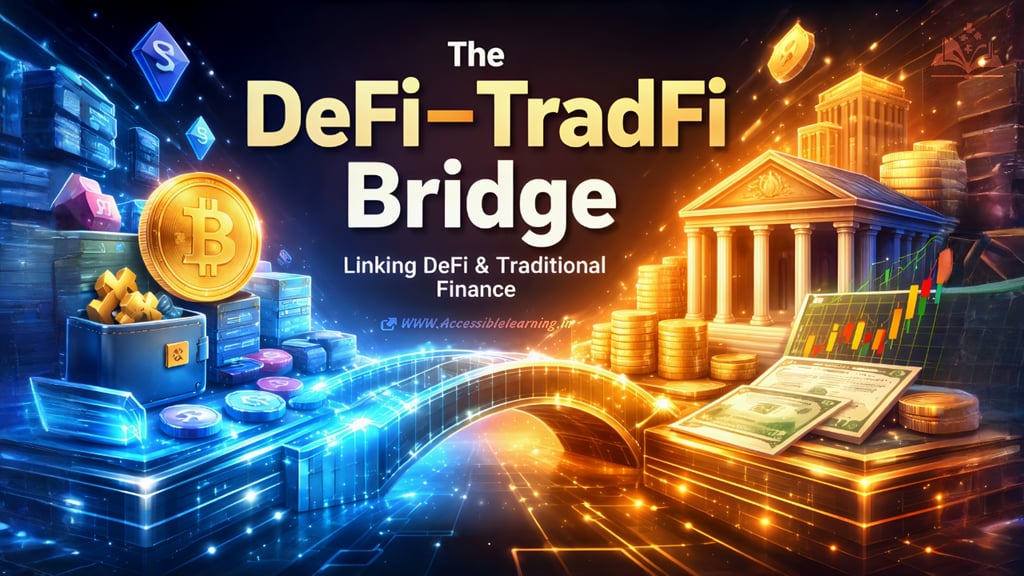
The financial system is going through a quiet transformation. For decades, large financial institutions controlled access to high-quality yield opportunities such as government bonds, private credit markets, and structured investment products. Retail investors often had limited access to these opportunities, or they could only participate indirectly through funds and intermediaries.
Today, blockchain technology is beginning to change that structure. The rise of decentralized finance (DeFi) is creating new infrastructure that can connect traditional finance (TradFi) with open digital networks. This emerging connection is often described as the “DeFi–TradFi bridge.”
At its core, the bridge allows institutional financial products to operate on blockchain networks, opening the door for retail investors to participate in yield opportunities that were previously reserved for banks, hedge funds, and large asset managers.
Understanding the DeFi–TradFi Bridge
Traditional finance refers to the established financial ecosystem that includes banks, stock exchanges, asset managers, insurance companies, and regulated financial institutions. These organizations manage global capital flows through structured systems that rely on intermediaries, regulatory oversight, and centralized infrastructure.
DeFi represents a different model. Instead of centralized institutions controlling financial services, DeFi uses smart contracts on blockchain networks to automate financial activities such as lending, trading, borrowing, and asset management.
The bridge between these two worlds forms when traditional financial assets are introduced into blockchain systems while maintaining compliance, security, and institutional standards. This connection is made possible through several key developments:
Tokenized real-world assets
Stablecoins and digital settlement layers
On-chain lending markets
Tokenized investment funds
Institutional DeFi platforms
Together, these components allow traditional financial assets to interact with decentralized infrastructure.
Why Institutions Are Entering DeFi
Institutional investors historically avoided decentralized finance due to concerns about regulation, risk management, and infrastructure maturity. However, the landscape has evolved significantly over the past few years. Several factors are now attracting institutional participation.
Capital Efficiency
Blockchain settlement can occur within minutes instead of days. Traditional markets often rely on clearing systems that take two or three business days to finalize transactions. On-chain infrastructure dramatically reduces this delay and allows institutions to manage capital more efficiently.
Programmable Financial Systems
Smart contracts allow financial logic to be embedded directly into code. Lending, collateral management, yield distribution, and settlement can all occur automatically without manual intervention. This reduces operational overhead and increases transparency.
Continuous Market Access
Traditional financial markets operate within fixed hours and are limited by geographic boundaries. Blockchain networks operate 24 hours a day, allowing capital to move continuously across global markets.
New Yield Opportunities
DeFi protocols enable lending markets, liquidity pools, and tokenized asset markets that generate yield in ways that traditional infrastructure cannot easily replicate. Institutions are increasingly exploring these opportunities as part of diversified investment strategies.
Tokenized Real-World Assets (RWAs)
One of the most important elements of the DeFi–TradFi bridge is the rise of tokenized real-world assets.
Tokenization is the process of converting ownership of a traditional asset into a digital token on a blockchain. These tokens represent claims on real financial instruments and can be transferred, traded, or used within DeFi protocols.
Assets that are commonly being tokenized include:
Government treasury bonds
Corporate debt
Real estate
Private credit loans
Infrastructure investments
Once tokenized, these assets can function inside decentralized financial systems. For example, a token representing a Treasury bond could be used as collateral in a lending protocol or held as a yield-generating asset within a digital portfolio.
Tokenization also introduces fractional ownership, which means large institutional assets can be divided into smaller units. This significantly lowers the barrier to entry for retail investors.
Yield-Bearing Stablecoins
Stablecoins have become the foundation of many decentralized financial markets. These digital assets are designed to maintain stable value by being linked to fiat currencies such as the U.S. dollar.
A new category known as yield-bearing stablecoins has emerged. Instead of simply holding a fixed value, these tokens distribute yield generated from underlying financial assets.
The yield often comes from sources such as:
Short-term government bonds
Money market instruments
Institutional lending strategies
On-chain liquidity markets
For investors, these tokens behave similarly to digital savings accounts or money market funds. The difference is that they operate on blockchain networks, allowing users to transfer, trade, or integrate them into decentralized financial systems.

Tokenized Institutional Funds
Another major development in the DeFi–TradFi bridge is the launch of tokenized funds. Asset managers are beginning to issue blockchain-based tokens that represent shares in traditional investment vehicles. These funds may hold assets such as Treasury bills, private credit portfolios, or diversified fixed-income products.
Instead of purchasing shares through traditional brokerage systems, investors can hold tokens that represent ownership in these funds. Benefits of tokenized funds include:
Faster settlement
Lower operational costs
Increased transparency
Global accessibility
Compatibility with DeFi platforms
This model effectively allows traditional asset managers to distribute institutional investment strategies through blockchain infrastructure.
Institutional DeFi Lending Markets
Lending has always been a core activity in both traditional and decentralized finance. In DeFi, lending protocols allow users to supply assets and earn interest from borrowers.
A new generation of institutional DeFi lending markets has emerged to accommodate regulated participants. These systems often include features such as identity verification, permissioned liquidity pools, and enhanced risk management frameworks.
Institutional lending pools allow professional borrowers to access capital from decentralized markets while maintaining compliance with financial regulations.
Retail investors can participate by providing liquidity to these pools, earning yield generated by institutional borrowers.
How Retail Investors Access Institutional Yield
The most significant impact of the DeFi–TradFi bridge is the democratization of financial opportunity.
Historically, retail investors were excluded from many high-yield financial strategies. Access to private credit markets, institutional lending platforms, or structured financial products was typically limited to large investors.
Blockchain infrastructure is beginning to change this dynamic.
Fractional Asset Ownership
Tokenization allows large financial assets to be divided into smaller units. Retail investors can purchase fractional portions of assets that previously required large capital commitments.
On-Chain Lending Platforms
Users can deposit stablecoins or tokenized assets into lending protocols and earn interest generated by borrowers in the system.
Tokenized Government Bonds
Blockchain tokens backed by treasury securities provide exposure to government bond yields without requiring traditional brokerage infrastructure.
Liquidity Provision
Investors can supply capital to decentralized liquidity pools and earn fees generated by trading activity within those markets.
Through these mechanisms, retail investors gain exposure to yield sources that historically existed only in institutional portfolios.
The Rise of Institutional DeFi
As the DeFi–TradFi bridge expands, a new financial category is emerging: Institutional DeFi. Institutional DeFi combines the transparency and efficiency of blockchain networks with the compliance frameworks required by traditional finance.
These systems often include:
identity verification and compliance procedures
regulated custodial infrastructure
audited smart contracts
controlled access to lending markets
risk monitoring tools
By integrating these safeguards, institutional DeFi platforms aim to attract large financial institutions while maintaining the accessibility and efficiency of decentralized networks.
Benefits of the DeFi–TradFi Bridge
The integration of decentralized and traditional financial systems offers several advantages.
Greater Financial Inclusion
Investors around the world can access financial products that were previously restricted to large institutions or specific geographic markets.
Transparency
Blockchain ledgers provide clear records of transactions, collateral, and asset flows, which can improve market visibility.
Lower Barriers to Investment
Tokenization allows investors to participate in financial markets with smaller amounts of capital.
Faster Settlement
Blockchain transactions settle almost instantly compared with traditional systems that require multiple intermediaries.
Continuous Financial Markets
Digital financial infrastructure operates around the clock, allowing capital to move freely across time zones and markets.

Challenges and Risks
Despite the potential advantages, the DeFi–TradFi bridge also introduces new challenges.
Smart Contract Vulnerabilities
Bugs or security flaws in smart contracts can lead to financial losses if exploited.
Regulatory Uncertainty
Governments and financial regulators are still developing frameworks to govern tokenized assets and decentralized financial systems.
Liquidity Fragmentation
Multiple blockchain networks and protocols may divide liquidity across ecosystems, reducing efficiency.
Operational Complexity
Hybrid financial systems that combine on-chain and off-chain infrastructure require careful coordination and oversight.
Addressing these challenges will be essential for the long-term growth of institutional DeFi.
The Future of Institutional Yield for Retail
The DeFi–TradFi bridge is still evolving, but its trajectory suggests a major shift in global financial infrastructure. Several developments are likely to shape the next phase of this transformation:
Expansion of tokenized government securities
growth of yield-bearing digital assets
development of regulated DeFi platforms
institutional adoption of blockchain settlement systems
integration of traditional asset managers into decentralized ecosystems
As these systems mature, the financial world may move toward a hybrid architecture where traditional assets and blockchain networks interact seamlessly.
In that environment, the line between institutional finance and retail investing becomes increasingly blurred. Retail participants gain access to a broader range of income-generating assets, while institutions benefit from faster, more efficient financial infrastructure.
The DeFi–TradFi bridge represents more than a technological upgrade. It signals a shift toward a financial system where access, transparency, and efficiency expand beyond the boundaries of traditional markets.
Frequently Asked Questions
Q: What is the DeFi–TradFi bridge?
The DeFi–TradFi bridge refers to the integration of decentralized finance systems with traditional financial markets. It allows traditional assets such as government bonds, private credit, and institutional funds to be represented on blockchain networks, making them accessible through decentralized platforms.
Q: How does the DeFi–TradFi bridge benefit retail investors?
The bridge allows retail investors to access yield opportunities that were historically limited to institutions. Through tokenized assets, lending protocols, and yield-bearing stablecoins, individuals can participate in income-generating financial strategies using blockchain infrastructure.
Q: What are tokenized real-world assets (RWAs)?
Tokenized real-world assets are traditional financial assets converted into blockchain-based tokens. These tokens represent ownership or exposure to assets such as real estate, treasury bonds, private credit, or infrastructure investments. Tokenization allows these assets to be traded, transferred, or used in DeFi platforms.
Q: What is institutional yield in DeFi?
Institutional yield refers to returns generated from financial instruments typically used by large investors, such as government bonds, credit markets, and institutional lending. When these assets are tokenized or integrated into DeFi systems, retail investors can access similar yield opportunities.
Q: Are tokenized treasury products safe for investors?
Tokenized treasury products are generally backed by government bonds or similar low-risk assets. However, they still involve risks related to smart contract security, platform reliability, and regulatory frameworks. Investors should evaluate the platform and custody infrastructure before participating.
Q: Why are financial institutions exploring DeFi infrastructure?
Financial institutions are exploring DeFi because blockchain technology offers faster settlement, lower operational costs, improved transparency, and global market access. These advantages can improve capital efficiency compared to traditional financial systems.
Q: What role do stablecoins play in the DeFi–TradFi bridge?
Stablecoins act as a digital settlement layer between traditional and decentralized finance. They allow investors to move funds quickly across blockchain networks while maintaining stable value linked to fiat currencies.
Q: How does tokenization lower investment barriers?
Tokenization divides large financial assets into smaller digital units. This fractional ownership allows investors to participate in markets that previously required large capital commitments, making institutional-grade investments more accessible.
Q: Can DeFi replace traditional finance completely?
Most experts believe DeFi will not replace traditional finance but will instead integrate with it. The future financial system is likely to be a hybrid model where traditional institutions use blockchain infrastructure while maintaining regulatory compliance.
Q: What is the future of the DeFi–TradFi bridge?
The future will likely include greater adoption of tokenized securities, institutional DeFi lending markets, blockchain-based settlement systems, and global regulatory frameworks. These developments could create a more efficient and inclusive financial ecosystem.
Subscribe to Frontier Intelligence
All © Copyright reserved by Accessible-Learning Hub
| Terms & Conditions
Accessible Learning Hub — Actionable clarity for high-agency minds.
Weekly breakdowns on AI breakthroughs, capital flow, and human performance systems. Zero fluff.