

RWA Tokenization Explained: How Investors Can Own 1% of a New York Skyscraper
Discover how RWA tokenization is transforming real estate investment, allowing investors to buy fractional ownership of high-value properties like New York skyscrapers. Learn how blockchain, smart contracts, and digital tokens are opening global access to premium assets while reshaping the future of property ownership.
STOCK OPERATORSTOCK MARKETBANKING/CASH-FLOWENTREPRENEUR/BUSINESSMAN
Vishwajeet Chaurasiya
3/28/20267 min read
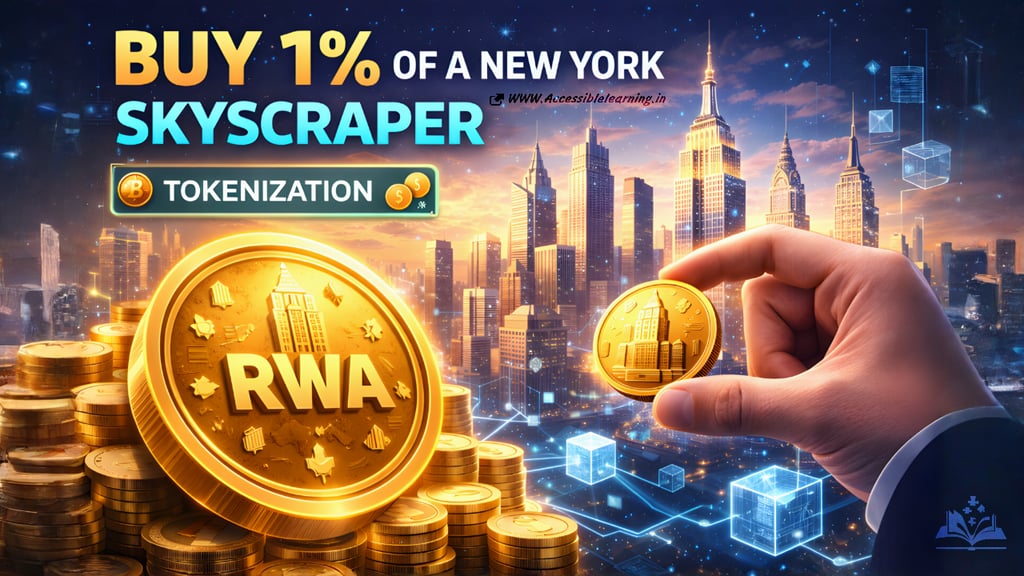
For decades, owning part of a landmark building in New York City was something only billionaires, institutional investors, and large real estate funds could afford. Today, a new financial innovation called Real World Asset (RWA) tokenization is starting to challenge that model.
By converting physical assets into blockchain-based digital tokens, investors can buy fractional ownership of real estate properties that were previously inaccessible. In theory, someone could own 1% of a Manhattan skyscraper through tokenized shares, just like buying a stock in a company.
This approach blends traditional finance, blockchain technology, and real estate markets, creating a new model of ownership that could redefine how assets are bought, sold, and managed worldwide.
Understanding Real World Asset (RWA) Tokenization
RWA tokenization refers to the process of digitizing ownership rights of physical assets on a blockchain.
Instead of a single entity owning the entire asset, ownership is divided into thousands or even millions of digital tokens. Each token represents a small share of the asset.
These tokens can represent ownership of assets such as:
Commercial real estate
Residential properties
Infrastructure projects
Commodities like gold and oil
Corporate bonds and government securities
Art collections and luxury collectibles
When investors purchase these tokens, they effectively gain fractional ownership of the underlying asset. This model allows physical assets to function more like tradable digital financial instruments.
Why Tokenization Is Transforming Real Estate
Real estate is one of the largest investment markets in the world, valued at hundreds of trillions of dollars. Yet it has always been difficult for individual investors to access high-value properties. Tokenization introduces several improvements that make real estate more flexible and accessible.
Lower Capital Requirements
Large commercial properties require huge upfront investments. Tokenization allows ownership to be divided into smaller pieces, enabling participation with smaller amounts of capital.
Faster Transactions
Traditional property transactions involve legal reviews, financing approvals, and paperwork that can take months. Blockchain-based token transfers can occur within minutes once regulatory requirements are met.
Global Investment Opportunities
Tokenized assets allow international investors to participate in markets like New York or London without needing complex cross-border structures.
Transparent Asset Records
Blockchain provides a permanent and transparent ledger that records ownership transfers, helping reduce disputes and fraud.
Continuous Market Access
Unlike traditional real estate markets that operate through periodic deals, tokenized assets may eventually trade continuously on digital marketplaces.

How Someone Could Buy 1% of a New York Skyscraper
The concept sounds futuristic, but the underlying structure is actually quite practical.
Asset Structuring
The building is first placed under a Special Purpose Vehicle (SPV). This legal entity owns the property and manages revenue, expenses, and operations.
Token Creation
The ownership of the SPV is divided into blockchain-based tokens. Each token represents a fractional share of the entity and therefore the property. Example structure:
Building value: $800 million
Total tokens issued: 800,000
Token value: $1,000
If an investor purchases 8,000 tokens, they effectively hold 1% ownership of the building.
Investor Onboarding
To comply with financial regulations, investors typically go through identity verification procedures before purchasing tokens.
Income Distribution
If the building generates revenue from leases or tenants, token holders receive proportional income distributions.
These payments may be automated through blockchain smart contracts.
Token Trading
Some platforms allow tokens to be traded on secondary markets, allowing investors to sell their ownership stakes without waiting for the property to be sold.
Blockchain Technology Behind Tokenized Real Estate
Several technological components work together to support tokenized assets.
Smart Contracts
Smart contracts are self-executing programs stored on a blockchain. They automatically manage processes such as:
Token issuance
Ownership transfers
Revenue distribution
Investor compliance rules
This automation reduces the need for multiple intermediaries.
Distributed Ledgers
Blockchain systems store transaction records across decentralized networks, ensuring that ownership records are transparent and tamper-resistant.
Digital Wallets
Investors store tokenized assets in secure digital wallets. These wallets allow them to hold, transfer, or trade asset tokens.
Asset Verification Systems
Professional auditors, legal teams, and asset managers verify that the real-world asset backing the tokens actually exists and is properly structured.
Institutional Interest in Tokenized Assets
Large financial institutions are increasingly exploring tokenized real-world assets because they offer improvements over traditional asset markets. Banks and asset managers see several advantages:
Reduced settlement times
Lower operational costs
Greater market accessibility
Enhanced transparency
Automated financial operations
Many global financial firms are now testing tokenized securities, digital bonds, and blockchain-based settlement systems. This institutional interest is accelerating the development of RWA infrastructure.
Key Advantages for Investors
Tokenized real estate offers several compelling benefits.
Fractional Ownership
Investors no longer need millions of dollars to participate in prime real estate deals.
Portfolio Diversification
Instead of investing in a single property, investors can spread funds across multiple buildings in different cities.
Passive Income Streams
Rental income generated by commercial properties can be distributed periodically to token holders.
Greater Market Accessibility
Investors from around the world can potentially access premium property markets without relocating or forming local companies.
Potential Liquidity
If token markets mature, real estate ownership could become significantly more liquid than it is today.
Economic Impact of RWA Tokenization
Tokenization could reshape how large infrastructure and real estate projects are financed. Developers may gain access to global capital pools, allowing projects to attract funding from thousands of investors instead of a few institutions.
This model could accelerate development in sectors such as:
Urban commercial real estate
Renewable energy projects
Transportation infrastructure
Large-scale housing developments
By reducing funding barriers, tokenization may enable faster economic growth in many regions.

Regulatory Landscape
One of the most important factors shaping the future of tokenized assets is regulation. In most jurisdictions, tokenized real-world assets are treated as security tokens, meaning they must comply with financial regulations governing investment products.
Regulatory requirements may include:
Investor identity verification
Anti-money laundering compliance
Securities registration
Investor protection frameworks
Regulators are gradually developing policies to address these new digital asset models. Clear regulations will play a major role in determining how quickly tokenized asset markets expand.
Challenges That Still Exist
Despite its potential, RWA tokenization faces several obstacles.
Legal Complexity
The legal structure connecting tokens to real-world assets must be clearly defined to protect investors.
Limited Liquidity
Secondary markets for tokenized real estate are still emerging and may not yet offer deep liquidity.
Platform Risk
Investors must trust the platform managing the asset tokenization and distribution process.
Market Education
Many investors still lack familiarity with blockchain-based investment products, which slows adoption.
Regulatory Fragmentation
Different countries have different rules regarding digital assets, making global adoption more complicated.
Real Projects Already Demonstrating the Model
Tokenized real estate is already being tested in multiple markets.
Several platforms have successfully launched fractional ownership projects involving:
Commercial office towers
Luxury residential developments
Hospitality properties such as hotels
Mixed-use urban developments
These early experiments are helping refine the legal frameworks, investor protections, and technological infrastructure needed for large-scale adoption.
The Future of Asset Ownership
The concept of owning 1% of a New York skyscraper reflects a much broader transformation in finance.
Over the next decade, tokenization could expand to include:
Infrastructure projects
Renewable energy plants
Private equity funds
Intellectual property rights
Global commodity reserves
In the future, investors might manage portfolios composed of digital tokens representing ownership in dozens of real-world assets across multiple industries. This would blur the line between traditional finance and blockchain-based financial systems.
RWA tokenization is emerging as one of the most significant developments in the evolution of global finance. By transforming physical assets into blockchain-based digital tokens, it introduces a new model of ownership that is more accessible, transparent, and flexible.
The possibility of buying a fractional stake in a New York skyscraper illustrates how dramatically investment markets may change in the coming years.
While regulatory frameworks and infrastructure are still evolving, the momentum behind tokenized real-world assets continues to grow. If adoption continues at its current pace, tokenization could reshape how people invest in real estate and other high-value assets across the world.


Frequently Asked Questions
Q: What is RWA tokenization in blockchain?
RWA (Real World Asset) tokenization is the process of converting ownership of physical assets such as real estate, commodities, bonds, or infrastructure into digital tokens on a blockchain. Each token represents a fractional share of the underlying asset, allowing investors to buy, sell, or trade ownership digitally while the physical asset remains in the real world.
Q: Can someone really buy a fraction of a skyscraper through tokenization?
Yes. Through tokenized real estate platforms, large properties can be divided into thousands of digital tokens. Each token represents a percentage of ownership in the asset. Investors who buy a certain number of tokens effectively own a proportional share of the building and may receive income generated from it.
Q: How does tokenized real estate generate income for investors?
Tokenized real estate typically generates revenue through rental income or property appreciation. When the building earns income from tenants, the profits can be distributed to token holders based on their ownership percentage. Some platforms automate these payouts using blockchain smart contracts.
Q: Is RWA tokenization legal?
In many countries, tokenized real-world assets are classified as security tokens, meaning they must follow financial regulations such as investor verification, anti-money laundering rules, and securities compliance. The legal framework is still evolving, but many jurisdictions are beginning to establish regulations for tokenized assets.
Q: What are the benefits of investing in tokenized real estate?
Tokenized real estate offers several advantages, including:
Fractional ownership of expensive properties
Lower minimum investment amounts
Access to global real estate markets
Potential rental income distribution
Improved transparency through blockchain records
Possibility of secondary market trading
Q: What risks should investors consider with RWA tokenization?
Although promising, tokenized assets also involve risks such as regulatory uncertainty, platform reliability, limited secondary market liquidity, and legal complexities related to ownership structures. Investors should understand how the token relates to the actual asset before participating.
Q: How big could the RWA tokenization market become?
Many analysts believe tokenized real-world assets could grow into a multi-trillion-dollar market within the next decade. As blockchain infrastructure improves and regulations become clearer, industries such as real estate, bonds, commodities, and infrastructure financing are expected to adopt tokenization at a larger scale.
Q: Why is real estate one of the most common assets for tokenization?
Real estate is highly valuable but traditionally illiquid and difficult for small investors to access. Tokenization allows properties to be divided into smaller ownership units, making them easier to buy, sell, and distribute among a larger group of investors. This makes real estate one of the most practical use cases for RWA tokenization.
Subscribe to Frontier Intelligence
All © Copyright reserved by Accessible-Learning Hub
| Terms & Conditions
Accessible Learning Hub — Actionable clarity for high-agency minds.
Weekly breakdowns on AI breakthroughs, capital flow, and human performance systems. Zero fluff.