

Mahatma Gandhi: The Life, Legacy, and Philosophy of India's Father of the Nation
Discover Mahatma Gandhi's life, philosophy of nonviolent resistance, and enduring legacy. Learn how Satyagraha shaped India's independence and inspired global movements.
BIOGRAPHY/HISTORYINCINDIAN HISTORY
Keshav Jha
12/31/20259 min read
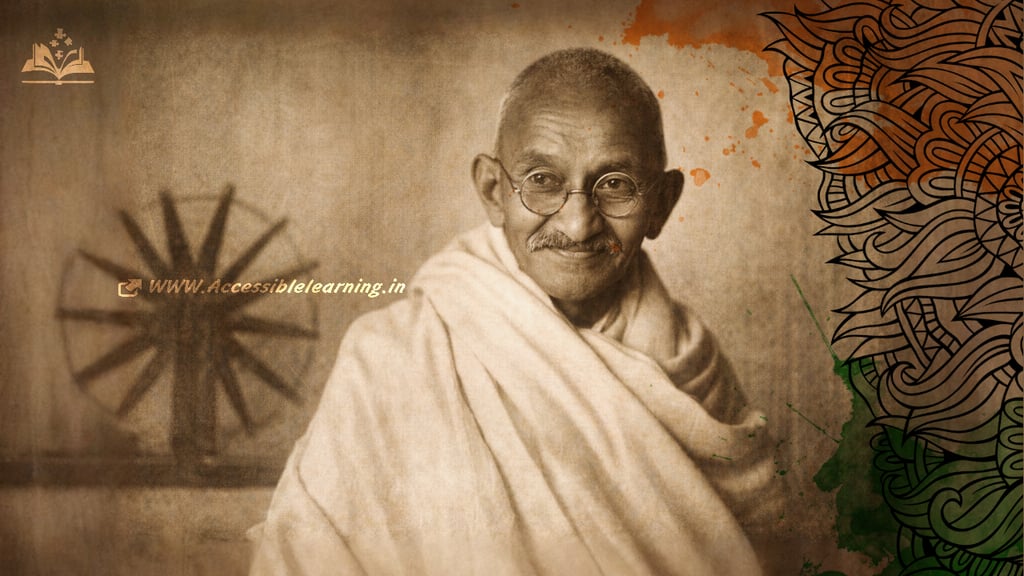
Who Was Mahatma Gandhi?
Mahatma Gandhi, born Mohandas Karamchand Gandhi on October 2, 1869, remains one of history's most influential figures in nonviolent resistance and civil rights movements. Known as the "Father of the Nation" in India, Gandhi's philosophy of Satyagraha (truth-force) and Ahimsa (nonviolence) transformed the landscape of peaceful protest and inspired global leaders from Martin Luther King Jr. to Nelson Mandela.
This comprehensive guide explores Gandhi's life journey, his revolutionary methods of resistance, his enduring legacy, and how his principles continue shaping modern social justice movements worldwide.
Early Life and Education: The Making of a Leader
Childhood in Porbandar and Rajkot
Mohandas Gandhi was born in Porbandar, a coastal town in present-day Gujarat, India, into a Hindu merchant caste family. His father, Karamchand Gandhi, served as the diwan (chief minister) of Porbandar state, while his mother, Putlibai, was deeply religious and instilled in young Mohandas the values of nonviolence, vegetarianism, fasting for self-purification, and mutual tolerance between different creeds and sects.
Gandhi's early years were marked by:
Traditional Hindu upbringing with strong religious influences
Marriage to Kasturba Makhanji at age 13 (arranged marriage common in that era)
Average academic performance but strong moral foundation
Early exposure to Jainism's principle of ahimsa through his mother's faith
Legal Education in London
In 1888, at age 18, Gandhi traveled to London to study law at University College London. This period proved transformative as he:
Adopted vegetarianism as a deliberate choice rather than just cultural practice
Studied the Bhagavad Gita in English translation, which became his spiritual guidebook
Encountered the Bible, particularly the Sermon on the Mount, which reinforced his beliefs in nonviolence
Developed his identity as both Indian and global citizen
Qualified as a barrister in 1891 before returning to India
South Africa: The Crucible of Satyagraha (1893-1914)
The Pivotal Train Incident
Gandhi's political awakening occurred in South Africa, where he traveled in 1893 for legal work. The famous Pietermaritzburg railway station incident—where he was forcibly removed from a first-class train compartment despite holding a valid ticket due to racial discrimination—became the catalyst for his lifelong fight against injustice.
Development of Nonviolent Resistance
During his 21 years in South Africa, Gandhi:
Organized the Indian community against discriminatory laws
Coined the term "Satyagraha" (holding firmly to truth) in 1906 to describe his method of nonviolent resistance
Led campaigns against the Black Act requiring registration and fingerprinting of Indians
Established Phoenix Settlement and Tolstoy Farm as experimental communities for simple living
Refined his philosophy through practical application and study of texts by Leo Tolstoy, John Ruskin, and Henry David Thoreau
The South African experience transformed Gandhi from a struggling lawyer into a political activist and social reformer with a proven methodology for challenging oppression without violence.

Return to India: Leading the Independence Movement (1915-1947)
Early Campaigns and National Recognition
Gandhi returned to India in 1915, heeding his mentor Gopal Krishna Gokhale's advice to observe the country for a year before engaging in politics. His early campaigns demonstrated the power of his methods:
Champaran Satyagraha (1917): Gandhi's first major movement in India addressed the plight of indigo farmers forced to grow indigo on a portion of their land and sell it at fixed prices to British planters. The successful campaign established Gandhi as a national leader.
Kheda Satyagraha (1918): Supporting farmers in Gujarat who couldn't pay taxes due to crop failure and plague, Gandhi's intervention led to tax relief and suspension of collection.
Ahmedabad Mill Strike (1918): Gandhi's first hunger strike in India resulted in a settlement favoring textile mill workers seeking fair wages.
Major Nationwide Movements
Non-Cooperation Movement (1920-1922)
Launched in response to the Jallianwala Bagh massacre and the repressive Rowlatt Act, this movement called for
Boycott of British goods, courts, and educational institutions
Surrender of titles and honors granted by the British
Promotion of khadi (hand-spun cloth) and swadeshi (indigenous products)
Massive participation across India's diverse population
The movement was suspended after the Chauri Chaura incident in 1922, where protesters turned violent, demonstrating Gandhi's unwavering commitment to nonviolence even at the cost of momentum.
Civil Disobedience Movement and the Salt March (1930)
Perhaps Gandhi's most iconic act of resistance, the Salt March (Dandi March) began on March 12, 1930. Gandhi and 78 followers walked 240 miles over 24 days from Sabarmati Ashram to the coastal village of Dandi to produce salt from seawater, directly violating the British salt monopoly.
This simple yet powerful act:
Captured international attention and sympathy
Sparked nationwide civil disobedience
Led to Gandhi's arrest along with 60,000 others
Resulted in the Gandhi-Irwin Pact (1931)
Demonstrated how ordinary people could challenge unjust laws
Quit India Movement (1942)
Launched during World War II with the famous call "Do or Die," this movement demanded immediate British withdrawal from India. Despite mass arrests of Congress leadership, including Gandhi's detention until 1944, the movement signaled the beginning of the end for British rule.
Partition and Final Years
Gandhi opposed the partition of India but ultimately supported it to prevent further bloodshed. His final years were marked by:
Efforts to stop Hindu-Muslim violence during partition
Fasts unto death to quell communal riots in Calcutta and Delhi
Advocacy for Muslim rights in newly independent India
Assassination on January 30, 1948, by Nathuram Godse, a Hindu nationalist who opposed Gandhi's tolerance toward Muslims
Gandhi's Core Philosophy and Principles
Satyagraha: Truth-Force
Satyagraha, Gandhi's signature contribution to political philosophy, represents far more than passive resistance. It embodies:
Active pursuit of truth through nonviolent action
Willingness to suffer rather than inflict suffering
Appeals to the opponent's conscience rather than coercion
Recognition of the opponent's humanity
Transformation of both resistor and oppressor
Ahimsa: Nonviolence in Thought, Word, and Deed
Gandhi's concept of ahimsa extended beyond physical nonviolence to encompass:
Absence of hatred toward opponents
Nonviolence in speech and thought
Compassion for all living beings
Vegetarianism as an expression of nonviolence
Self-purification as prerequisite for political action
Swaraj: Self-Rule and Self-Governance
For Gandhi, swaraj meant more than political independence:
Individual self-discipline and moral autonomy
Village-level self-sufficiency and decentralization
Economic independence through khadi and village industries
Freedom from both foreign rule and internal social evils
Spiritual and moral development alongside political freedom
Sarvodaya: Welfare of All
Influenced by John Ruskin's "Unto This Last," Gandhi's vision of sarvodaya emphasized:
Good of all rather than the greatest good for the greatest number
Dignity of labor and equality of all occupations
Trusteeship concept where wealthy act as trustees of their wealth for society
Simple living and high thinking
Eradication of untouchability and social inequality
Gandhi's Social Reform Agenda
Fight Against Untouchability
Gandhi called untouchables "Harijans" (children of God) and made their upliftment central to his work:
Admitted Harijans to his ashrams
Undertook fasts to oppose untouchability
Campaigned for temple entry rights
Promoted inter-caste dining and marriages
Women's Empowerment
Gandhi recognized women's crucial role in independence and social reform:
Encouraged women's participation in political movements
Advocated for women's education and rights
Opposed child marriage and supported widow remarriage
Believed in women's moral superiority and their special capacity for nonviolent resistance
Economic Philosophy and Village Industries
Gandhi's economic vision centered on:
Decentralized village-based economy
Promotion of khadi and cottage industries
Opposition to mechanization that displaced labor
Bread labor—the idea that everyone should engage in productive manual work
Trusteeship as an alternative to both capitalism and communism
Global Influence and Contemporary Relevance
Leaders Inspired by Gandhi
Gandhi's methods influenced numerous global movements and leaders:
Martin Luther King Jr.: Applied Gandhian principles to the American Civil Rights Movement
Nelson Mandela: Used nonviolent resistance against apartheid before transitioning to armed struggle
Cesar Chavez: Led farmworkers' movement using fasting and nonviolent tactics
Dalai Lama: Advocates for Tibetan autonomy through nonviolent means
Aung San Suu Kyi: Led democracy movement in Myanmar using nonviolent resistance
Modern Applications of Gandhian Principles
Gandhi's philosophy remains relevant in contemporary contexts:
Environmental movements using civil disobedience
Anti-globalization protests emphasizing sustainable development
Restorative justice approaches in criminal justice reform
Conflict resolution techniques in international relations
Ethical consumption and voluntary simplicity movements
Criticisms and Controversies
A complete understanding of Gandhi requires acknowledging criticisms:
His views on race during early South African years (later evolved)
Controversial sleeping arrangements with young women to test celibacy
Opposition to industrialization viewed as impractical by some economists
Complex relationship with caste system despite fighting untouchability
Criticized by B.R. Ambedkar for paternalistic approach to Dalit rights

Gandhi's Literary and Intellectual Contributions
Major Works
Gandhi was a prolific writer whose works include:
"Hind Swaraj" (1909): Critique of modern civilization and blueprint for Indian self-rule
"An Autobiography: The Story of My Experiments with Truth" (1927-1929): Candid account of his spiritual and political journey
"Satyagraha in South Africa" (1928): Documentation of his South African campaigns
Thousands of articles in newspapers including Young India and Harijan
Key Concepts from Gandhi's Writings
Gandhi's intellectual legacy encompasses
Critique of modernity and industrialization
Vision of village republics and decentralized governance
Religious pluralism and interfaith harmony
Constructive program for social transformation
Theory of nonviolent conflict resolution
Commemorations and Memorials
Gandhi Jayanti and International Day of Non-Violence
October 2, Gandhi's birthday, is celebrated as
Gandhi Jayanti: A national holiday in India
International Day of Non-Violence: Designated by the United Nations in 2007
Occasion for promoting Gandhi's message of nonviolence globally
Major Memorials and Institutions
Gandhi's legacy is preserved through:
Raj Ghat: Memorial site in New Delhi where Gandhi was cremated
Gandhi Smriti: Museum at the site of his assassination
Sabarmati Ashram: Gandhi's residence in Ahmedabad, now a museum
Numerous Gandhi institutions: Research centers, museums, and educational institutions worldwide
Mahatma Gandhi's life journey from a shy lawyer to the world's preeminent advocate of nonviolent resistance demonstrates the transformative power of moral courage and unwavering commitment to truth. His assassination on January 30, 1948, silenced his physical voice but amplified his message across generations and continents.
Gandhi's legacy transcends Indian independence. He proved that ordinary people armed with truth and nonviolence could challenge mighty empires, that political change need not require bloodshed, and that the means of struggle matter as much as the ends. His concept of Satyagraha offered the world a third way between passive acceptance of injustice and violent revolution.
In an era marked by polarization, violence, and environmental crisis, Gandhi's emphasis on nonviolence, simple living, village-centered economics, and religious harmony offers pathways toward more sustainable and peaceful coexistence. His experiments with truth remind us that personal transformation and political change are inseparable and that lasting social progress begins with individual moral commitment.
Whether inspiring civil rights movements, environmental activism, or interfaith dialogue, Gandhi's philosophy continues shaping how people resist oppression and work toward justice. His life stands as a testament to the enduring power of nonviolent resistance and the potential within each individual to become an agent of positive change.
As we navigate the complexities of the 21st century, Gandhi's question remains as relevant as ever: "What difference does it make to the dead, the orphans and the homeless whether the mad destruction is wrought under the name of totalitarianism or in the holy name of liberty or democracy?" His answer—choosing the path of nonviolence, truth, and universal compassion—continues lighting the way toward a more humane world.
Frequently Asked Questions
Q: What does "Mahatma" mean, and who gave Gandhi this title?
"Mahatma" means "great soul" in Sanskrit. The title was first conferred upon Gandhi by Rabindranath Tagore, India's first Nobel laureate in literature, around 1915, recognizing his spiritual and moral leadership.
Q: Why is Gandhi called the Father of the Nation in India?
Gandhi earned this title for leading India's independence movement through nonviolent resistance, mobilizing millions of ordinary Indians, and providing moral leadership that united diverse communities toward the common goal of freedom from British rule.
Q: What was Gandhi's role in India's independence?
Gandhi transformed the Indian National Congress into a mass movement, developed the philosophy and tactics of nonviolent resistance, led major campaigns like the Non-Cooperation Movement, Salt March, and Quit India Movement, and negotiated with British authorities while maintaining pressure through civil disobedience.
Q: Did Gandhi ever win the Nobel Peace Prize?
Despite being nominated five times between 1937 and 1948, Gandhi never received the Nobel Peace Prize. The Nobel Committee later acknowledged this as their greatest omission. In 1989, when the Dalai Lama received the prize, the Committee chairman stated it was "in part a tribute to the memory of Mahatma Gandhi."
Q: How did Gandhi influence Martin Luther King Jr.?
King discovered Gandhi's philosophy through reading while studying theology. He traveled to India in 1959 to study Gandhian principles firsthand and applied Satyagraha methods to the Civil Rights Movement, including nonviolent protests, boycotts, and civil disobedience that proved instrumental in achieving civil rights legislation.
Q: What was Gandhi's daily routine like?
Gandhi followed a strict routine, including early morning prayers, spinning on the charkha (spinning wheel), walking, writing correspondence, meetings with followers and visitors, simple vegetarian meals, evening prayers, and retiring early. He believed in the discipline of routine for spiritual development.
Q: What did Gandhi eat, and why was his diet important?
Gandhi followed a strict vegetarian diet that evolved over time, eventually eliminating milk products. His dietary experiments were part of his broader philosophy connecting physical health, spiritual development, and ethical living. He believed simple, natural food supported both bodily health and mental clarity.
Q: How many times did Gandhi fast, and why?
Gandhi undertook 17 major fasts during his life for various reasons, including self-purification, protest against violence, pressure on British authorities, and to stop Hindu-Muslim riots. His fasts were both spiritual discipline and a political tool, demonstrating his willingness to sacrifice for his principles.
Q: What languages did Gandhi speak and write in?
Gandhi was fluent in Gujarati (his mother tongue), Hindi, and English. He also had knowledge of Sanskrit, Tamil, and Urdu. He primarily wrote in Gujarati and English, with his autobiography written in Gujarati and later translated into English.
Q: Is Gandhi's philosophy still relevant today?
Gandhi's principles remain highly relevant for addressing contemporary challenges, including environmental degradation, economic inequality, communal violence, and international conflicts. His emphasis on nonviolence, sustainability, grassroots democracy, and ethical living offers alternative approaches to modern problems rooted in materialism and violence.
Subscribe To Our Newsletter
All © Copyright reserved by Accessible-Learning Hub
| Terms & Conditions
Knowledge is power. Learn with Us. 📚

