

Living in Russia as a Foreigner: 12 Years of Challenges and Experiences
Discover the hidden realities of living in Russia as a foreigner after 12 years, including residency challenges, bureaucracy, culture, and long-term expat life.
TRAVEL LIFERUSSIANEPOTISM/SOCIAL ISSUES
Jagdish Nishad | Kim Shin
7/7/20267 min read
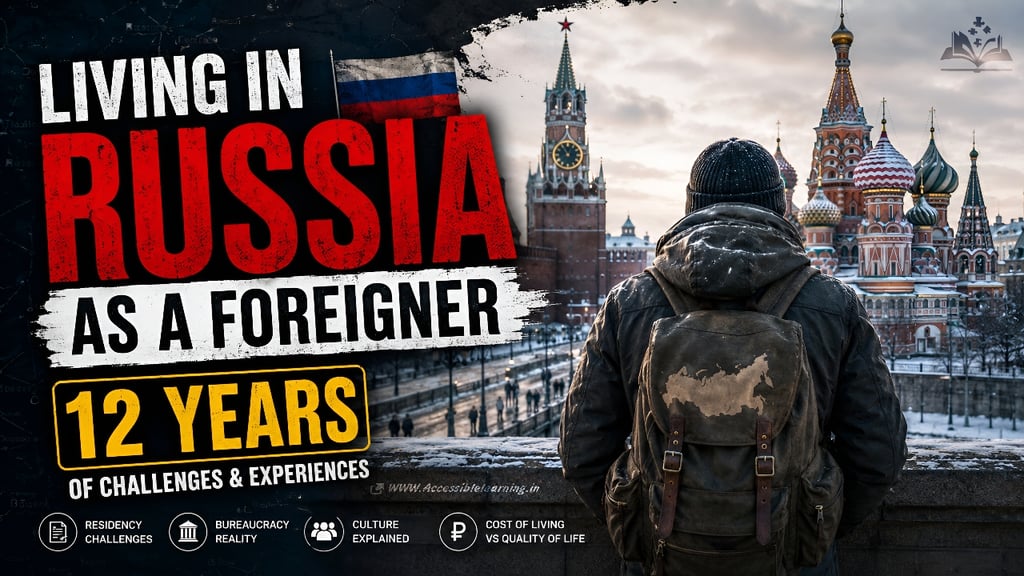
Most articles about Russia focus on architecture, winter, politics, or stereotypes. They tell you what to visit, what to eat, or how cold it gets in January. That version of Russia disappears surprisingly fast.
After twelve years, your relationship with the country has very little to do with onion domes or snow-covered streets. It becomes about renewing legal status, understanding unspoken social rules, adapting to an economy shaped by sanctions and policy shifts, and learning that being accepted is very different from simply being welcomed.
This is not a tourist's perspective. This is what long-term expat life in Russia actually looks like.
The Illusion of Arrival
The first year feels exciting.
You learn enough Russian to order food, navigate the metro, and survive conversations at local markets. Riding the Circle Line of the Moscow Metro becomes routine. Weekend walks through Kitay-Gorod, Patriarch Ponds, or Nevsky Prospekt in Saint Petersburg begin to feel familiar rather than exotic.
Eventually you stop photographing every Orthodox cathedral.
You begin comparing supermarkets instead.
That is the first sign you've crossed an invisible line.
After several years, Russia no longer feels foreign during daily routines. You know which pharmacy stocks imported medicine. You understand why apartments are heated almost excessively during winter. You recognize that a cashier's lack of smiling rarely reflects hostility.
Life settles into ordinary rhythms.
But ordinary life is where the real challenges begin.
The hidden realities of living in Russia only appear once the novelty disappears.
The Cold Shower
Here is the unvarnished truth.
Russia is surprisingly easy to visit.
Building an entire life there is something else entirely.
No matter how fluent your Russian becomes, many systems continue treating you as someone temporary.
Banks ask additional questions.
Employers often require updated migration documentation.
Rental agreements sometimes become unnecessarily complicated simply because the owner prefers dealing with Russian citizens.
Medical appointments occasionally involve extra administrative verification. Nothing feels impossible. Everything simply requires more energy.
That constant friction creates a psychological tax few people discuss openly. Ironically, the challenge is rarely outright discrimination. It is accumulation.
Every small administrative hurdle reminds you that your life depends on permissions that locals rarely think about.
After twelve years, you stop asking whether you belong socially.
You begin wondering whether the system itself will ever consider your presence permanent.
That question quietly follows many foreigners throughout their entire stay.
The Bureaucratic Reality (Legal Anchoring)
This is where many glossy relocation guides become useless.
Russia's migration system is structured around registration, legal status, and continuous compliance rather than informal flexibility.
Upon arrival, foreigners generally require migration registration, commonly completed through a hotel, landlord, or host. This registration remains one of the foundations of legal residence and must accurately reflect where you live.
For longer stays, foreigners typically rely on one of several legal pathways.
Some remain under work visas sponsored by employers.
Highly qualified professionals may qualify through the Highly Qualified Specialist (HQS) framework, which provides simplified procedures for eligible high-income foreign employees.
Others obtain temporary residence through the Temporary Residence Permit (RVP) before progressing toward a Permanent Residence Permit (Vid na Zhitelstvo).
Each category carries different rights, renewal requirements, and employment conditions. The agencies overseeing these matters have also evolved.
Migration administration now operates primarily under the Main Directorate for Migration Affairs (GUVM) within the Ministry of Internal Affairs of Russia, replacing the former Federal Migration Service.
Every address change, registration update, document renewal, employment modification, or residency application eventually leads back into this administrative framework.
Recent years have added further complexity.
International sanctions, geopolitical tensions, banking restrictions, and changing migration policies have altered practical realities for foreigners. International payment systems became less predictable. Some foreign bank cards stopped functioning domestically. Currency transfers often require alternative financial arrangements that did not exist a decade earlier.
Employment opportunities also shifted.
Many multinational corporations reduced or ended operations following 2022, while local companies increasingly became the primary employment option for foreign residents.
For entrepreneurs, compliance extends beyond immigration.
Business registration, taxation, accounting requirements, and reporting obligations require continuous attention. Missing deadlines can create consequences that extend well beyond simple financial penalties.
The emotional burden is not the paperwork itself.
It is knowing that paperwork quietly governs nearly every long-term decision you make.

Understanding Russian Society
What no one tells you before you pack your bags is this. Russian society often appears emotionally distant during first encounters.
That impression is frequently misunderstood. Public warmth is not distributed freely. It is earned. This cultural pattern has deep historical roots.
Centuries of centralized government, repeated political transformations, economic instability during the 1990s, and long periods where personal trust mattered more than institutional trust created a society where relationships develop slowly but often become exceptionally loyal once established.
Small talk plays a relatively minor role compared with many Western countries.
People may seem reserved until genuine familiarity develops.
Once it does, invitations to family gatherings, countryside dachas, birthdays, or New Year celebrations often become surprisingly sincere.
Government institutions also reflect historical preferences for documentation, verification, and centralized administration.
From an outsider's perspective, this may appear unnecessarily rigid.
From within Russia's institutional history, extensive documentation represents stability and administrative control.
Understanding this historical context does not eliminate frustration. It simply makes the system more understandable.
Cost of Living vs Quality of Life in Russia
The conversation around the cost of living vs quality of life in Russia has become increasingly nuanced. Housing outside central Moscow remains considerably more affordable than in many major European capitals.
Public transportation is efficient, extensive, and inexpensive by international standards. Healthcare quality varies significantly depending on region and whether private services are used.
Domestic internet infrastructure remains fast in most urban areas. Daily necessities can still be reasonably priced. Imported products often are not.
Technology, specialized equipment, certain medicines, and international brands have become more expensive or harder to obtain due to supply chain changes and sanctions.
Quality of life therefore depends less on headline prices and more on how connected your lifestyle remains to international goods, travel, or financial systems.
For many long-term residents, adaptation eventually replaces comparison.
The Social Ceiling
Perhaps the hardest lesson arrives after many years. Language alone does not unlock complete integration.
You may speak Russian fluently.
You may celebrate local holidays.
You may know the unwritten etiquette of apartment buildings, workplaces, trains, and neighborhood shops.
Yet moments still remind you that you were not born into the system.
Political conversations become cautious.
Historical topics require sensitivity.
Certain cultural references remain inaccessible because they belong to childhood experiences you never shared.
You can become deeply respected.
You may never become entirely local.
Accepting that distinction often brings far more peace than fighting it.
The Russia Nobody Advertises
Search results frequently emphasize dramatic headlines.
Daily life feels much quieter.
Parents still walk children to school.
Grandmothers still sell berries near train stations.
Commuters still crowd metro platforms every weekday morning.
People complain about housing prices, inflation, salaries, and bureaucracy much like citizens elsewhere.
The extraordinary eventually becomes ordinary.
That transformation is perhaps the most authentic part of living abroad.
Russia stops being a geopolitical headline.
It becomes where you buy groceries after work.


The Reality of Permanent Integration
At the end of the day, permanent integration is not measured by citizenship documents alone. It is measured by routine. Knowing which neighborhood bakery opens earliest after heavy snowfall.
Understanding when to avoid government offices because everyone else has the same appointment day. Recognizing seasonal rhythms without checking the calendar. Feeling comfortable enough that silence during dinner no longer feels awkward.
Yet one reality remains.
The legal system may always classify you according to permits, registrations, or residency categories before anything else.
That is simply how the administrative structure functions.
For some foreigners, this constant awareness eventually becomes exhausting.
For others, it becomes another predictable part of life.
The hidden realities of living in Russia are rarely dramatic.
They are cumulative.
After twelve years, you realize home is not defined by perfect acceptance.
It is defined by whether you continue choosing the place despite understanding every compromise it asks of you. That is the difference between visiting Russia and truly living there.
FAQ's
Q: Is Russia a good country for long-term expats?
Russia can offer a rewarding experience for long-term expats, particularly in major cities like Moscow and Saint Petersburg, where infrastructure, public transport, and cultural opportunities are strong. However, long-term success depends on adapting to the language, bureaucracy, and evolving residency regulations rather than expecting a lifestyle similar to Western Europe.
Q: What are the biggest Russia residency challenges for foreigners?
The biggest Russia residency challenges include maintaining valid migration registration, renewing residence permits on time, complying with employment regulations, opening financial services, and keeping up with changing immigration policies. Administrative requirements can significantly impact daily life if overlooked.
Q: What is the cost of living vs quality of life in Russia?
The cost of living in Russia is generally lower than in many Western European countries, especially outside central Moscow. Public transportation and utilities are affordable, but imported goods, international travel, and certain foreign products can be expensive. Overall quality of life depends largely on income, location, and how much your lifestyle relies on international services.
Q: Can foreigners get permanent residency in Russia?
Yes. Foreign nationals may become eligible for permanent residency after meeting the requirements under the appropriate legal pathway, such as obtaining a Temporary Residence Permit (RVP) or qualifying through other residency programs. Eligibility depends on individual circumstances, employment, family ties, or other legal grounds established by Russian immigration law.
Q: Is learning Russian necessary for long-term expat life in Russia?
Absolutely. While basic English is spoken in some business and tourist areas, everyday life becomes much easier with Russian language skills. Speaking Russian helps when dealing with government offices, healthcare providers, landlords, local businesses, and building meaningful relationships within the community.
Q: Can foreigners buy property in Russia?
Yes, foreigners can generally purchase residential property in Russia, although certain restrictions apply to land ownership in border regions, agricultural land, and other strategically designated areas. Property ownership does not automatically grant residency or citizenship.
Q: Is it difficult to open a bank account in Russia as a foreigner?
Opening a bank account is possible, but requirements vary depending on your residency status, visa category, and the bank's internal policies. Due to recent international sanctions and financial restrictions, foreigners may also encounter limitations when using foreign-issued bank cards or transferring money internationally.
Q: What should every foreigner know before moving to Russia?
The most important lesson is that adapting to Russia involves more than preparing for the climate. Understanding the legal residency system, respecting local cultural norms, learning Russian, staying informed about policy changes, and preparing for administrative processes are essential for building a stable, long-term life in the country.
Subscribe To Our Newsletter
All © Copyright reserved by Accessible-Learning Hub
| Terms & Conditions
Knowledge is power. Learn with Us. 📚

