

Zombie-Scrolling vs. Deep Reading: How Infinite Scroll Is Rewiring Our Brains
Why does an hour of scrolling leave you exhausted but unfulfilled? Discover how infinite-scroll platforms reshape attention and weaken deep reading skills and what science-backed strategies can help rebuild focus, concentration, and cognitive depth in the digital age.
ACCESSIBLE LEARNINGPSYCHOLOGY & COGNITIVE SCIENCE
Shiv Singh Rajput
6/5/20268 min read
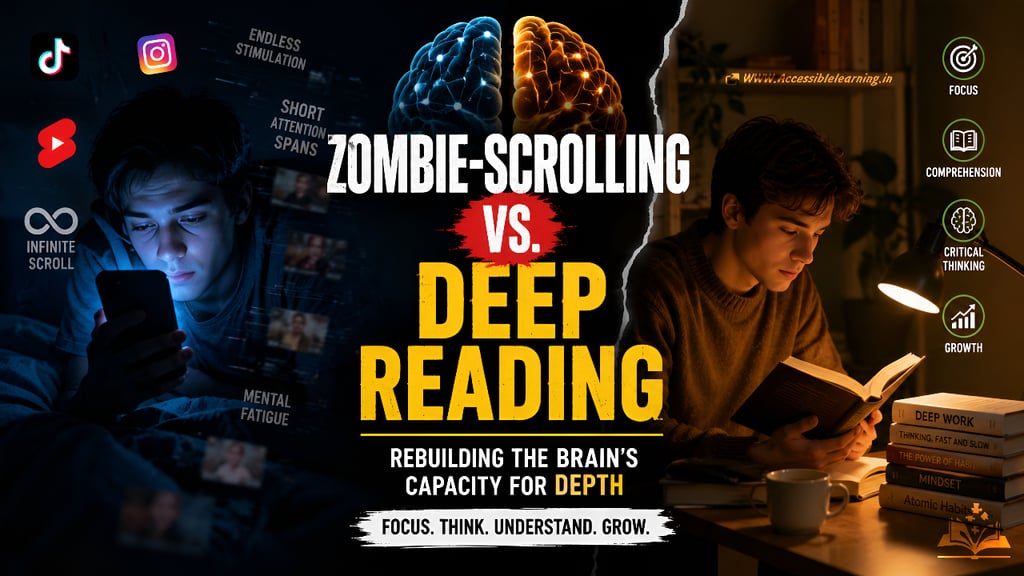
Why You Feel Exhausted but Unfulfilled After an Hour on TikTok
You open TikTok, Instagram Reels, or YouTube Shorts intending to spend five minutes catching up on content. An hour later, you feel mentally drained, strangely dissatisfied, and unable to remember most of what you watched.
The experience is so common that it has become a defining characteristic of modern digital life.
Many people assume this exhaustion comes from information overload. In reality, the problem is often deeper. Infinite-scroll platforms are not designed to help you reach a satisfying conclusion. They are designed to keep you moving endlessly from one stimulus to the next.
As a result, many users are discovering an uncomfortable truth: despite consuming more content than ever before, they are struggling to focus on books, long articles, research papers, and complex ideas.
This is the growing conflict between zombie-scrolling and deep reading.
One rewards rapid consumption. The other develops understanding.
One trains the brain to chase novelty. The other trains it to build knowledge.
And increasingly, our digital environment favors the first while quietly eroding the second.
Understanding Zombie-Scrolling
Zombie-scrolling describes the state in which a person consumes content almost automatically, with little conscious intention or reflection. Unlike purposeful browsing, zombie-scrolling feels passive.
The user is not actively choosing what to watch. Instead, algorithms continuously deliver content designed to maximize engagement. The experience resembles being carried by a current.
You swipe.
A new video appears.
You swipe again.
Another appears.
Hours pass.
The process continues without requiring significant effort, planning, or decision-making.
This design is not accidental.
Modern social media platforms employ sophisticated recommendation systems that learn what captures attention and then provide an endless stream of similar content. The result is an environment where stopping requires more effort than continuing.
The Disappearance of Natural Stopping Cues
Before the digital age, most forms of media included natural endpoints.
A newspaper article ended.
A television program finished.
A magazine had a final page.
A book chapter concluded.
These endpoints acted as psychological stopping cues.
They gave the brain opportunities to pause, evaluate, and decide what to do next.
Infinite-scroll platforms remove these cues.
The feed never ends. The next video begins automatically.
Recommendations appear before attention can disengage.
Without stopping points, the brain remains trapped in a continuous cycle of consumption.
Researchers studying behavioral design have repeatedly found that removing stopping cues increases engagement time dramatically because users no longer receive natural moments to reassess their behavior.
The result is not necessarily satisfaction. It is simply continuation.
The Dopamine Trap Nobody Talks About
Dopamine is often misunderstood. It is not merely the brain's pleasure chemical.
More accurately, dopamine is associated with anticipation, motivation, and reward prediction.
Every swipe on a social media feed contains uncertainty.
The next piece of content might be boring. Or it might be fascinating.
This unpredictability creates what psychologists call a variable reward system.
The same mechanism helps explain why slot machines can become so compelling.
Most outcomes are average. Occasionally, one is highly rewarding.
The possibility of discovering something exciting encourages repeated behavior.
Each swipe becomes a tiny gamble. The reward is not necessarily the content itself.
The reward is the anticipation of what might come next. Over time, this constant cycle trains the brain to seek novelty instead of depth.

Why Deep Reading Feels Harder Than It Used To
Many adults report a surprising experience. They once enjoyed reading books for hours.
Today, after only a few pages, they feel restless and distracted.
This does not necessarily indicate laziness or declining intelligence.
It often reflects a shift in cognitive conditioning.
Deep reading requires several mental skills:
Sustained attention
Working memory
Reflection
Pattern recognition
Concept integration
Delayed gratification
When reading a complex argument, the brain must hold multiple ideas simultaneously.
It must connect concepts across paragraphs and chapters. It must tolerate temporary confusion while constructing understanding.
Infinite-scroll environments train the opposite habits. They reward immediate stimulation. They encourage constant novelty. They minimize cognitive effort.
As these habits become dominant, deep reading begins to feel unusually demanding.
What Happens Inside the Brain During Deep Reading
Deep reading is one of humanity's most remarkable cognitive achievements. Unlike spoken language, reading is not something humans evolved to do naturally. The brain creates reading ability by connecting multiple neural systems.
During deep reading, regions associated with language, memory, imagination, reasoning, and emotional processing work together.
This integration allows readers to:
Understand complex arguments
Analyze information critically
Build long-term knowledge
Develop empathy
Recognize nuance
Generate original insights
In essence, deep reading transforms information into understanding.
The process requires time. It requires focus. And it requires uninterrupted mental space.
When these conditions disappear, comprehension suffers.
The Cost of Constant Cognitive Fragmentation
One of the most significant consequences of endless scrolling is cognitive fragmentation. Attention becomes divided into tiny units.
Instead of remaining engaged with one idea for twenty minutes, the brain jumps between dozens or hundreds of unrelated stimuli.
A news headline.
A comedy clip.
A motivational quote.
A product review.
A political argument.
A travel video.
A meme.
A dance trend.
Each switch carries a cognitive cost. The brain must repeatedly reset context.
Over time, this reduces the capacity to maintain sustained concentration.
The result is a growing preference for content that can be consumed quickly and effortlessly.
Complex ideas begin to feel exhausting. Simple stimulation becomes increasingly attractive.
The Knowledge Illusion of Modern Content Consumption
One of the most deceptive aspects of social media is that it creates the feeling of learning. After consuming hundreds of educational clips, many users believe they have acquired substantial knowledge.
In reality, information exposure is not the same as understanding. Knowing a fact differs from understanding a system. Recognizing a concept differs from mastering it.
Deep knowledge emerges through:
Reflection
Repetition
Context
Synthesis
Application
Short-form content excels at introducing ideas. It is far less effective at helping people fully develop them. This creates what might be called the knowledge illusion. People feel informed while retaining surprisingly little.

Why Reading Builds Mental Endurance
Reading is often compared to exercise for the mind. The comparison is more accurate than many realize.
Just as physical endurance develops through consistent training, cognitive endurance develops through sustained mental effort.
Every time a reader follows a long argument, maintains concentration, and integrates information across pages, neural pathways associated with focus become stronger.
Deep reading improves:
Attention span
Memory formation
Critical thinking
Analytical reasoning
Emotional intelligence
Intellectual patience
These abilities are increasingly valuable in a world saturated with distractions. Ironically, the rarer sustained focus becomes, the more valuable it becomes.
How to Rebuild Your Capacity for Deep Reading
The good news is that attention is trainable.
The brain remains adaptable throughout life.
Even individuals who feel trapped in scrolling habits can rebuild reading endurance.
The process requires consistency rather than perfection.
1. Start Smaller Than You Think
Many people fail because they attempt to jump directly from hours of scrolling to reading entire books. Instead:
Read for 10 minutes daily
Focus on consistency
Increase gradually
Small wins create sustainable habits.
2. Create Friction Around Infinite Scroll
Convenience fuels compulsive behavior. Add barriers between yourself and distraction.
Examples include:
Removing social media apps
Disabling notifications
Logging out after each session
Using website blockers
Even minor obstacles can significantly reduce impulsive scrolling.
3. Schedule Reading Before Entertainment
Willpower weakens throughout the day.
Read first.
Scroll later.
Protect your highest-quality attention for activities that require depth.
4. Practice Single-Tasking
Modern culture celebrates multitasking. The brain performs best when focused on one task.
While reading:
Close extra tabs
Silence notifications
Put away other devices
Attention grows where it is consistently directed.
5. Read Challenging Material
Comfortable reading maintains ability.
Challenging reading expands it.
Choose books and articles that require effort.
The goal is not speed.
The goal is engagement.
Struggle is often a sign that the brain is growing.
6. Embrace Boredom Again
Scrolling trains people to escape every moment of boredom.
Deep reading requires the opposite.
Learning to sit quietly with a single idea is a powerful cognitive skill.
Moments of boredom often become gateways to reflection, creativity, and insight.
The Future Belongs to People Who Can Focus
Artificial intelligence can summarize articles.
Algorithms can recommend content.
Information has become abundant.
Attention has become scarce.
The ability to think deeply, read carefully, and sustain focus is becoming a competitive advantage.
In education, business, creativity, research, and leadership, individuals who can engage with complexity will increasingly outperform those trapped in cycles of endless distraction.
The challenge is not access to information. The challenge is developing the mental capacity to process it meaningfully.


Zombie-scrolling and deep reading represent two very different relationships with information.
One encourages passive consumption.
The other develops understanding.
One offers endless stimulation.
The other builds lasting knowledge.
Infinite-scroll platforms are designed to capture attention, often by bypassing the natural stopping cues that once helped us regulate media consumption. The consequence is a gradual weakening of the cognitive habits required for deep thinking.
Yet this trend is not irreversible.
Every page read, every uninterrupted reading session, and every moment spent resisting the pull of infinite scrolling strengthens the brain's capacity for depth.
In a culture optimized for distraction, choosing to read deeply is more than a habit. It is an act of cognitive self-defense. And perhaps one of the most important skills of the twenty-first century.
FAQ's
Q: What is zombie scrolling?
Zombie-scrolling refers to the habit of mindlessly consuming endless streams of content on platforms like TikTok, Instagram Reels, YouTube Shorts, and social media feeds without a clear purpose. Users often continue scrolling automatically, even when they no longer enjoy the experience.
Q: Why do I feel exhausted after scrolling social media for a long time?
Long periods of scrolling expose the brain to constant novelty, rapid information switching, and continuous stimulation. This can create mental fatigue without delivering a sense of accomplishment, leaving users feeling tired, distracted, and unfulfilled.
Q: How does infinite scrolling affect attention span?
Infinite scrolling trains the brain to expect frequent rewards and constant new stimuli. Over time, this can reduce the ability to maintain focus on a single task, making activities such as reading books, studying, or working on complex projects feel more difficult.
Q: What is deep reading?
Deep reading is the process of engaging with long-form content in a focused and reflective way. It involves understanding arguments, analyzing ideas, connecting concepts, and retaining information rather than simply skimming or scanning text.
Q: Can social media reduce my ability to read books?
Excessive consumption of short-form content can make deep reading feel more challenging by conditioning the brain for rapid attention shifts. However, the ability to read deeply is not permanently lost and can be rebuilt through regular reading practice.
Q: What happens in the brain during deep reading?
Deep reading activates multiple brain regions associated with language processing, memory, critical thinking, imagination, and emotional understanding. This integration helps readers comprehend complex ideas and develop deeper knowledge.
Q: How can I rebuild my focus and concentration?
You can improve focus by:
Reading daily without interruptions
Limiting social media usage
Turning off notifications
Practicing single-tasking
Scheduling dedicated reading sessions
Gradually increasing reading time
Q: Why is deep reading important in the digital age?
Deep reading helps develop critical thinking, problem-solving abilities, knowledge retention, and analytical skills. As information becomes increasingly abundant, the ability to process and understand complex information becomes more valuable.
Q: How long does it take to regain reading endurance?
The timeline varies by individual, but many people notice improvements within a few weeks of consistent reading. Regular practice helps retrain attention and strengthens the neural pathways associated with sustained focus.
Q: Are short-form videos harmful to the brain?
Short-form videos are not inherently harmful. The issue arises when excessive consumption replaces activities that require deeper engagement, such as reading, studying, reflection, or meaningful conversations. Balance is key.
Q: What are the signs that zombie scrolling is affecting me?
Common signs include:
Difficulty concentrating on books or articles
Constant urge to check social media
Reduced patience for long-form content
Feeling mentally drained after scrolling
Trouble completing tasks without distraction
Q: Can deep reading improve memory and learning?
Yes. Deep reading strengthens comprehension, improves long-term memory formation, enhances critical thinking, and helps readers connect ideas more effectively, leading to better learning outcomes.
Q: Why do social media platforms use infinite scroll?
Infinite scroll keeps users engaged by removing natural stopping points. This design encourages longer sessions, increases content consumption, and maximizes user engagement on the platform.
Q: Is deep reading better than skimming?
Both have their place. Skimming is useful for quickly finding information, while deep reading is essential for understanding complex topics, evaluating arguments, and developing expertise. Deep reading provides greater comprehension and retention.
Q: How can parents encourage deep reading habits in children?
Parents can:
Model reading behavior
Create screen-free reading times
Provide access to engaging books
Limit excessive screen exposure
Encourage discussion about what children read
Establish daily reading routines
Q: What is the difference between information consumption and knowledge building?
Information consumption involves exposure to facts and content. Knowledge building requires understanding, reflection, synthesis, and application of information. Deep reading supports knowledge building, while passive scrolling often emphasizes consumption alone.
Subscribe to Frontier Intelligence
All © Copyright reserved by Accessible-Learning Hub
| Terms & Conditions
Accessible Learning Hub — Actionable clarity for high-agency minds.
Weekly breakdowns on AI breakthroughs, capital flow, and human performance systems. Zero fluff.