

Yadnya Kasada Festival: The Truth Behind Mount Bromo's Sacred Volcano Offerings
Discover the real story behind Indonesia's Yadnya Kasada Festival, where the Tenggerese honor Mount Bromo with sacred volcano offerings. Explore its history, traditions, tourism impact, and cultural significance.
CULTURE/TRADITIONINDONESIACELEBRATION/FESTIVALS
Sachin K Chaurasiya
7/9/20265 min read
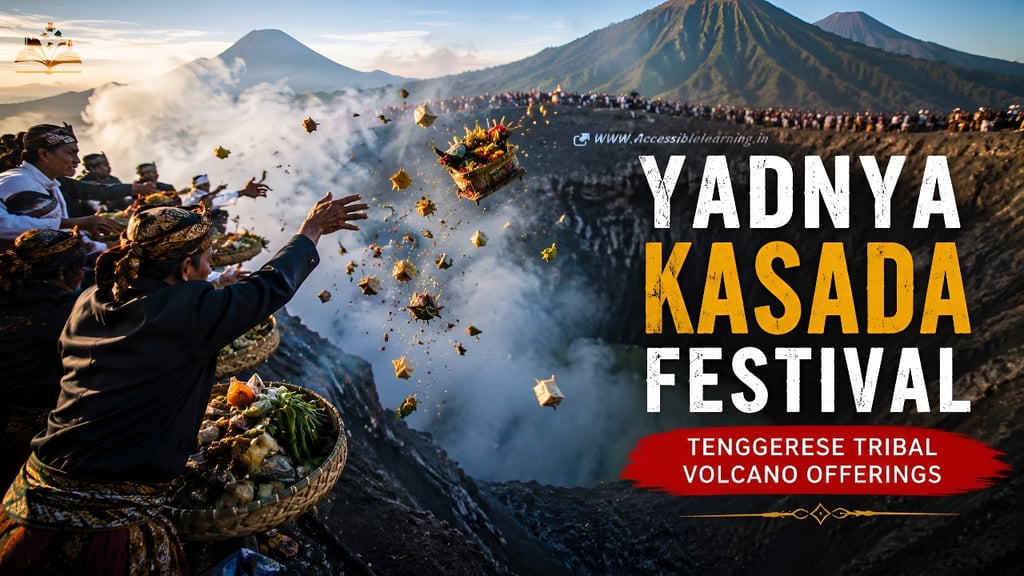
Every year, before sunrise, thousands of Tenggerese Hindus climb the rim of Mount Bromo in East Java and throw fruits, vegetables, livestock, flowers, and money into the smoking crater. To outsiders, the ritual looks irrational. To the Tenggerese, it is a sacred obligation that has survived for centuries despite modernization, mass tourism, and Indonesia's rapidly changing cultural landscape.
Yadnya Kasada Is Far More Than a Festival
Forget the word "festival" if you imagine music, food stalls, and entertainment. Yadnya Kasada is a deeply spiritual ceremony rooted in faith, ancestry, and community identity. The annual ritual takes place during the Kasada month of the traditional Tenggerese calendar and serves as the most important religious event for the Hindu Tenggerese people who live around Mount Bromo.
For one night, the volcano becomes both a place of worship and a symbol of an ancient promise. Families gather to pray, seek blessings, express gratitude, and ask for protection over their homes, crops, and livestock. The offerings they carry represent both devotion and sacrifice. Giving away valuable harvests is not a performance for visitors. It is an act of faith.
The Legend That Still Shapes the Ceremony
Every religious tradition has a story that defines its identity. For the Tenggerese, that story centers on Roro Anteng and Joko Seger, a legendary couple who longed for children.
According to local tradition, the gods granted them twenty-five children on one condition. They had to offer their youngest child, Kesuma, back to the mountain. When they refused to fulfill their promise, Mount Bromo erupted. Kesuma willingly sacrificed himself to save his family and the surrounding community. Before disappearing into the crater, he instructed his people to continue making annual offerings as a sign of gratitude and respect.
Whether people interpret the legend as history or symbolism, its influence remains undeniable. It continues to shape the spiritual identity of the Tenggerese community and explains why Yadnya Kasada remains one of Indonesia's most distinctive religious traditions.
Mount Bromo Is Both Provider and Threat
Life around Mount Bromo has always depended on a delicate balance.
The volcano creates fertile volcanic soil that supports agriculture across the region. Farmers rely on those rich lands to grow potatoes, onions, cabbage, corn, and other crops that sustain local livelihoods. At the same time, the same volcano can erupt without warning, covering villages with ash and disrupting everyday life.
That contradiction defines the relationship between the Tenggerese and Mount Bromo. They do not see the volcano as something to conquer or exploit. They respect it as a powerful force of nature capable of both giving and taking away.
This perspective explains why Yadnya Kasada continues to hold such profound meaning in an era dominated by science and tourism.
The Ceremony Begins Long Before the Offerings Reach the Crater
Most visitors focus on the dramatic moment when offerings disappear into the volcano. In reality, that moment marks the end of a much longer spiritual journey.
Families spend days preparing baskets filled with fruits, vegetables, rice, flowers, traditional cakes, and livestock. Community members gather at Pura Luhur Poten, the sacred Hindu temple located on Mount Bromo's Sea of Sand, where priests lead prayers and purification rituals.
After the ceremonies conclude, worshippers begin the challenging climb toward the crater rim. Carrying heavy offerings through cold mountain air requires both physical endurance and spiritual commitment. Every step reflects preparation, discipline, and devotion rather than spectacle.
The Hidden Reality Most Travel Guides Ignore
One of the most controversial aspects of Yadnya Kasada unfolds after the offerings leave the hands of worshippers.
As baskets fall toward the crater, groups of local residents position themselves along the steep inner slopes with nets and makeshift poles, hoping to catch fruits, vegetables, livestock, and even cash before the offerings disappear into the volcano.
Photographs of these risky attempts often circulate online without context, creating misleading headlines. The reality is more complex.
Some community members consider retrieving the offerings acceptable because the gifts have already fulfilled their religious purpose once presented to the mountain. Others disagree with the practice. Economic hardship also plays a significant role, as recovering valuable food or livestock can provide meaningful support for local families.
Reducing the practice to sensational headlines ignores the cultural, religious, and economic realities that coexist within the ceremony.


Tourism Has Changed the Festival, but Not Its Purpose
Yadnya Kasada has become one of Indonesia's most photographed cultural events. Every year, thousands of domestic and international visitors arrive to witness the ceremony alongside photographers, filmmakers, bloggers, and social media creators.
Tourism has created important economic opportunities for nearby communities. Hotels reach full capacity, jeep operators work around the clock, restaurants experience record business, and local guides earn valuable income.
However, increased popularity has introduced new challenges.
Some visitors treat sacred ceremonies as photo opportunities rather than religious events. Crowded viewpoints interrupt traditional processions, drones invade moments of prayer, and social media often values dramatic visuals over cultural understanding.
The Tenggerese continue to welcome respectful visitors, but preserving the spiritual integrity of Yadnya Kasada requires more than attracting tourists. It demands genuine respect for the beliefs that sustain the tradition.
Why the Festival Still Matters Today
Indonesia is home to extraordinary cultural diversity, yet many ancient traditions struggle against modernization, migration, and commercial tourism.
Yadnya Kasada has survived because the Tenggerese refuse to let it become a museum exhibit or a staged cultural performance.
The ceremony preserves religious beliefs, oral traditions, ancestral stories, traditional clothing, local leadership, and a shared sense of identity that connects generations. Every year, parents teach their children not only how to participate in the ritual but also why it matters.
That continuity gives the ceremony lasting cultural significance far beyond the volcanic landscape where it takes place.
What Visitors Should Remember
Anyone attending Yadnya Kasada should remember that they are witnessing an active religious ceremony rather than a tourist attraction.
Dress respectfully, stay behind designated safety barriers, avoid interrupting prayers, ask permission before photographing worshippers, and follow all safety instructions issued by local authorities. Mount Bromo remains an active volcano, and conditions can change rapidly.
Respecting both the people and the mountain creates a far more meaningful experience than chasing the perfect photograph.
Yadnya Kasada is often reduced to a simple headline: people throw offerings into a volcano. That description captures the spectacle but completely misses the deeper story.
The ceremony reflects a centuries-old relationship between people, nature, faith, and survival. It reminds the world that cultural traditions endure not because they entertain tourists, but because communities continue to believe in them.
Mount Bromo may dominate the landscape, but the true strength of Yadnya Kasada lies in the resilience of the Tenggerese people. Their commitment has preserved one of Indonesia's most remarkable living traditions through generations of political change, economic pressure, and modern tourism.
That enduring faith deserves far more attention than the dramatic images that dominate social media.
Subscribe To Our Newsletter
All © Copyright reserved by Accessible-Learning Hub
| Terms & Conditions
Knowledge is power. Learn with Us. 📚

