

Why AI Should Support Learning, Not Replace Thinking
Learn how to use AI tools for smarter learning without weakening critical thinking skills. This in-depth guide explains practical strategies, common mistakes, and ethical approaches to balance AI-assisted learning with human reasoning, creativity, and independent thought.
A LEARNINGAI/FUTUREEDUCATION/KNOWLEDGE
Shiv Singh Rajput
1/27/20268 min read
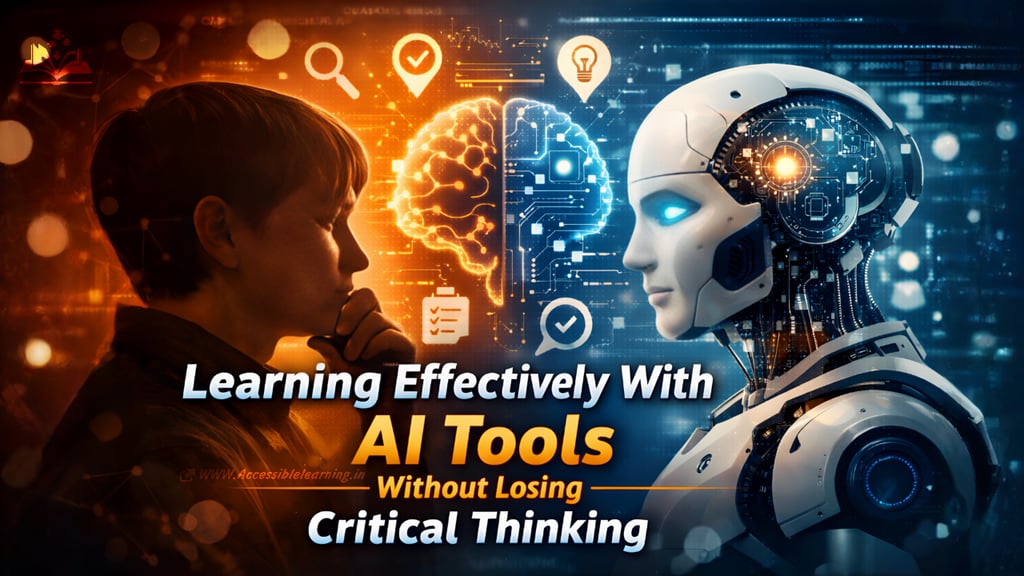
Artificial intelligence has quietly become part of everyday learning. From students using chatbots to understand complex topics to professionals relying on AI for quick research, summaries, and problem-solving, these tools are now everywhere. The real question is not whether AI should be used for learning, but how to use it without weakening one of the most important human skills: critical thinking.
Learning effectively with AI is possible. In fact, when used correctly, AI can strengthen reasoning, curiosity, and independent thought rather than replace them. The key lies in how you approach it.
Understanding the Role of AI in Learning
AI tools are best seen as learning assistants, not teachers and not replacements for your thinking. They are extremely good at pattern recognition, summarizing information, generating examples, and explaining concepts in multiple ways. What they do not have is genuine understanding, judgment, or context awareness in the human sense.
When learners treat AI as an authority instead of a support system, critical thinking begins to fade. When they treat it as a collaborator, learning improves.
A healthy mindset is simple:
AI provides inputs. You provide judgment.
Why Critical Thinking Is at Risk With AI
Before discussing solutions, it is important to understand the risk.
AI tools can:
Deliver instant answers
Write complete explanations
Solve problems step by step
Sound confident even when wrong
This convenience can create passive learning. When answers arrive too quickly, the brain skips effort. Over time, learners may stop questioning sources, stop verifying logic, and stop forming independent opinions.
Critical thinking declines not because AI is powerful, but because the learner becomes lazy.
The goal is not to avoid AI, but to avoid mental autopilot.
Using AI as a Question Generator, Not Just an Answer Machine
One of the most effective ways to preserve critical thinking is to flip how you use AI.
Instead of asking:
“Explain this topic to me.”
“Give me the answer.”
Try asking:
“What questions should I ask about this topic?”
“What are common misconceptions here?”
“What assumptions does this explanation rely on?”
When AI generates questions, you remain the one doing the thinking. This approach trains curiosity, not dependency.
For example, while studying history or science, ask AI to challenge you with counterarguments or edge cases. This keeps your analytical muscles active.
Always Demand Reasoning, Not Just Results
AI can give results fast. Your job is to demand the reasoning behind them.
If you are learning math, coding, philosophy, or even writing, never accept an output without understanding how it was formed. Ask follow-up prompts like
“Why does this step work?”
“What happens if this assumption changes?”
“Is there an alternative method?”
Then pause and try to answer those questions yourself before reading the AI’s response.
Learning happens in the pause, not the output.
Cross-Check Instead of Copy-Paste Learning
One of the biggest threats to critical thinking is blind trust. AI can be wrong, outdated, or biased depending on the data and prompt.
To avoid this:
Compare AI explanations with textbooks, research papers, or trusted websites
Ask the same question in different ways and look for inconsistencies
Use multiple AI tools and compare their responses
When you cross-check, you turn AI into a debate partner rather than a final authority.
Use AI to Break Complexity, Not Replace Struggle
Struggle is not a flaw in learning. It is the engine of understanding.
AI should be used to:
Break complex ideas into simpler parts
Provide analogies and examples
Clarify confusing sections after you attempt them
AI should not be used to:
Skip practice
Avoid problem-solving
Replace reading or thinking
A simple rule helps:
Try first. Ask AI second.
This ensures the brain stays engaged before assistance arrives.
Active Learning With AI Prompts
To stay human-centered in your learning, your prompts matter.
Instead of passive prompts like
“Write an essay on this topic.”
Use active prompts such as
“Critique my argument and point out logical gaps.”
“Suggest improvements but keep my original structure.”
“Ask me five questions to test my understanding.”
These prompts force interaction and reflection rather than consumption.
AI becomes a coach, not a ghostwriter.

Avoid Over-Automation in Creative and Analytical Tasks
AI can write essays, generate designs, and create code. While impressive, over-automation can weaken original thinking.
For writing and creativity:
Draft your ideas first, even if rough
Use AI to refine clarity, structure, or grammar
Keep your voice intact
For analytical tasks:
Solve the problem manually once
Use AI to verify or optimize your solution
Understand differences between your approach and AI’s approach
This preserves ownership of learning and thought.
Build a Habit of Reflection After Using AI
Reflection is where critical thinking matures.
After using AI, ask yourself:
What did I learn that I did not know before?
What part still feels unclear?
Do I agree with this explanation, and why?
Writing short reflections or summaries in your own words strengthens retention and reasoning. If you cannot explain it without AI, you have not learned it yet.
Teaching With AI: The Ultimate Test of Understanding
One of the strongest learning techniques is teaching.
Use AI as a simulated student:
Ask it to pretend it does not understand
Let it question your explanation
Defend your reasoning
If you can teach a concept clearly, your understanding is solid. If you struggle, AI has revealed a gap worth fixing.
Ethical and Cognitive Awareness While Using AI
Responsible AI learning also means awareness of ethical and cognitive limits.
Remember:
AI does not have values or intent
It reflects patterns from data, not truth
Confidence does not equal correctness
Maintaining skepticism, empathy, and context awareness ensures learning stays human-centered and responsible.
Balancing Speed and Depth in the AI Age
AI accelerates learning speed, but speed without depth creates fragile knowledge.
Effective learners balance both:
Use AI for quick overviews and exploration
Slow down for deep reading and thinking
Accept that some concepts require time
Depth builds mastery. AI should shorten confusion, not thinking.
The Future of Learning Is Hybrid, Not Automated
The most successful learners in the AI era will not be those who avoid AI or those who rely on it completely. They will be the ones who combine:
Human curiosity
Critical reasoning
Ethical judgment
AI-assisted efficiency
Learning effectively with AI is about partnership, not surrender.
When you stay intentional, question outputs, and keep thinking first, AI becomes a powerful ally rather than a mental crutch.
Calibrate AI Output to Your Learning Level
Most learners forget that AI can adapt to how you learn. Instead of generic explanations, you can instruct AI to respond at a specific cognitive level.
Examples:
“Explain this as if I am a beginner, and then again at an advanced level.”
“Explain this using first principles only.”
“Avoid metaphors and focus on logic.”
Switching levels forces you to compare explanations and identify gaps in understanding. This comparison itself is a critical thinking exercise.
Separate Knowledge Consumption From Knowledge Construction
AI is excellent at delivering information, but learning happens when you build something with it.
Use AI to:
Collect raw material
Organize scattered ideas
Surface connections
Then turn AI off and:
Create mind maps
Write summaries from memory
Design frameworks or models in your own words
This separation prevents cognitive outsourcing and strengthens long-term recall.

Use AI to Expose Cognitive Biases in Your Thinking
AI can help identify blind spots if used correctly.
Ask prompts like:
“What biases might influence this conclusion?”
“What perspectives are missing from this explanation?”
“How might someone strongly disagree with this view?”
This trains meta-thinking: thinking about how you think, which is a core pillar of advanced critical reasoning.
Track When AI Helps vs When It Hurts Learning
Not all AI use is beneficial. High-performing learners actively monitor impact.
Create a simple mental rule:
If AI saves time without reducing understanding, keep using it
If AI replaces effort, pause and switch methods
Awareness of dependency is more important than limiting usage itself.
Leverage AI for Error Analysis, Not Just Correct Answers
Mistakes are valuable learning signals.
Instead of asking AI to fix errors, ask it to:
Explain why an answer is wrong
Rank mistakes by severity
Show how a small error changes the final outcome
This builds diagnostic thinking, a skill often ignored but critical in science, math, coding, and decision-making.
Simulate Real-World Constraints Using AI
Real learning requires context, trade-offs, and limitations.
Ask AI to introduce constraints:
Time pressure
Budget limits
Ethical conflicts
Incomplete information
This transforms abstract knowledge into applied thinking and mirrors real-world problem solving.
Use AI to Train Long-Form Attention
Ironically, AI can help rebuild focus instead of destroying it.
Examples:
Ask AI to convert long texts into structured reading plans
Break large topics into staged learning paths
Generate reflection questions after each section
This supports deep learning without fragmenting attention.
Maintain a “No-AI Zone” in Your Learning Routine
Intentional restriction strengthens thinking.
Designate tasks where AI is not allowed:
First draft writing
Initial problem-solving
Concept explanation from memory
AI then becomes a review and refinement tool, not a cognitive substitute.
Develop Prompt Literacy as a Thinking Skill
Prompting is not just a technical skill. It reflects clarity of thought.
Good prompts require:
Clear intent
Logical structure
Awareness of what you don’t know
Improving prompt quality directly improves reasoning, articulation, and analytical depth.
Prepare for an AI-Rich Evaluation World
Exams, jobs, and assessments are evolving.
To stay ahead:
Practice explaining decisions, not just answers
Learn to justify logic under questioning
Focus on synthesis rather than recall
Critical thinking will be measured by how you think, not how fast you generate outputs.


The Future of Learning Is Hybrid, Not Automated
The most successful learners in the AI era will not be those who avoid AI or those who rely on it completely. They will be the ones who combine:
Human curiosity
Critical reasoning
Ethical judgment
AI-assisted efficiency
Learning effectively with AI is about partnership, not surrender. When you stay intentional, question outputs, and keep thinking first, AI becomes a powerful ally rather than a mental crutch.
AI tools are reshaping education and self-learning at every level. Used carelessly, they can weaken independent thought. Used wisely, they can sharpen it. The difference lies in how you engage.
Think first. Ask better questions. Reflect deeply. Use AI to expand your thinking, not replace it. That balance is what keeps learning effective, human, and future-ready.
FAQ's
Q: Can using AI tools reduce critical thinking skills?
Yes, if AI is used to replace thinking instead of supporting it. When learners rely on AI for instant answers without questioning or reflection, analytical skills can weaken. Used correctly, AI can strengthen critical thinking by encouraging deeper exploration and comparison.
Q: How can students use AI for studying without becoming dependent?
Students should attempt problems first, then use AI to review reasoning, clarify doubts, or test understanding. Setting boundaries, such as no AI first drafts or manual problem-solving, helps prevent dependency.
Q: Is learning with AI better than traditional learning methods?
AI-assisted learning is not better or worse by default. It is most effective when combined with traditional methods like reading, note-taking, and practice. AI enhances speed and clarity, while traditional learning builds depth and retention.
Q: What are the best AI tools for learning while maintaining critical thinking?
The best tools are those that allow interaction, questioning, and explanation rather than just output generation. Chat-based AI, research assistants, and concept-mapping tools are effective when used for exploration and reasoning, not shortcuts.
Q: How do teachers and educators use AI without harming student thinking?
Educators can use AI to design questions, generate practice problems, personalize explanations, and analyze learning gaps. Students should still be assessed on reasoning, explanation, and application, not just final answers.
Q: Should AI be allowed in exams or assessments?
In most cases, AI should not replace individual reasoning in exams. However, AI can be used in open-resource or project-based assessments where evaluation focuses on decision-making, justification, and problem-solving processes.
Q: How can professionals use AI for learning new skills without losing expertise?
Professionals should use AI to accelerate research, explore alternatives, and validate ideas while maintaining responsibility for final decisions. Explaining outcomes in their own words ensures knowledge stays internal, not outsourced.
Q: Can AI help improve critical thinking instead of weakening it?
Yes. When used to challenge assumptions, present counterarguments, and simulate real-world constraints, AI can actively train critical thinking rather than reduce it.
Q: What is the biggest mistake people make when learning with AI?
The biggest mistake is treating AI as an authority instead of a tool. Accepting outputs without questioning logic, sources, or context leads to shallow learning and false confidence.
Q: What is the future of learning with AI tools?
The future is hybrid learning, where AI handles support tasks and humans focus on reasoning, creativity, and judgment. Critical thinking will become more valuable, not less, in an AI-driven world.
Subscribe to Frontier Intelligence
All © Copyright reserved by Accessible-Learning Hub
| Terms & Conditions
Accessible Learning Hub — Actionable clarity for high-agency minds.
Weekly breakdowns on AI breakthroughs, capital flow, and human performance systems. Zero fluff.