

When the World Wears Color: International Women's Day & Rang Panchami
March carries two celebrations the world has never truly seen together, one born from factory smoke and socialist fire, the other from cosmic color and five thousand years of devotion. This is the story beneath both.
EVENT/SPECIALCELEBRATION/FESTIVALS
Kim Shin | Jagdish Nishad
2/27/20268 min read
The Coincidence That Isn't One
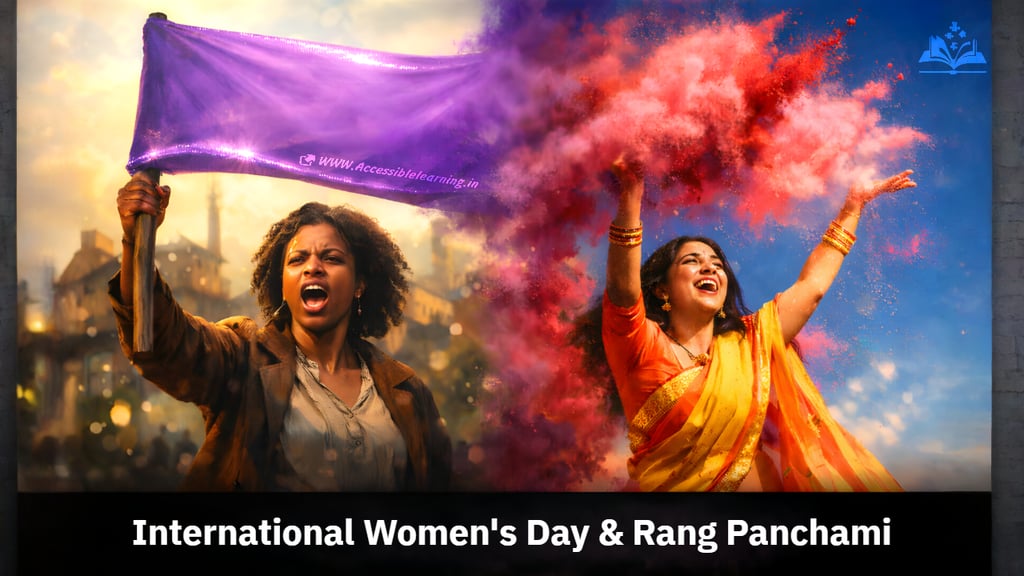
Every year in March, the world does something quietly extraordinary: it paints itself in the colors of resistance and devotion almost simultaneously. International Women's Day (IWD) on March 8 and Rang Panchami (typically falling in mid-to-late March) share more than a calendar proximity. Both are celebrations born from struggle, both are powered by communities rather than kings, and both use visible, vivid expression protest banners, gulal, and colored water to say something that words alone cannot.
But the stories behind them? Those are where it gets genuinely surprising.
International Women's Day: The Parts They Never Tell You
The Birth Certificate Is a Myth
Here's the uncomfortable truth hiding in plain sight: the famous story of IWD originating from a women's garment protest on March 8, 1857 in New York City is almost certainly a fabrication. Historians, including Temma Kaplan in the 1980s, traced this "founding myth" back to the Cold War era of the 1950s, when the story was likely invented to strip International Women's Day of its explicitly socialist roots and make it more palatable to Western audiences.
The real story is messier, more radical, and arguably more inspiring.
The Real Founder You've Never Heard Of
The actual woman who started all of this was Theresa Malkiel, a Ukrainian-born immigrant who came to New York City in 1891 as a teenager and went directly to work in the garment industry. She became the first woman to rise from factory floor worker to leadership of the Socialist Party of America. She proposed and organized the first official National Woman's Day on February 28, 1909 a Sunday, deliberately chosen so that working women who labored six days a week could actually attend.
Most IWD articles don't mention her name. Most people championed in history books are the Clara Zetkins of the world brilliant, yes, but already in positions of power. Malkiel is the seamstress who stitched the whole thing together first.
What Actually Happened at the Triangle Shirtwaist Factory
The Triangle Shirtwaist Factory fire of March 25, 1911 just six days after the first International Women's Day was celebrated across Europe, became the tragic fuel that made the movement unstoppable. 146 workers died, mostly young immigrant women, many of them Jewish and Italian teenagers, trapped behind locked exits while executives escaped safely.
The conditions these women endured were almost incomprehensible: 14-hour workdays, urine-covered floors (workers weren't permitted to leave their stations outside breaks), locked exit doors, and floors covered in flammable fabric scraps. No unions allowed. No recourse.
What emerged from the ashes was the International Ladies' Garment Workers' Union (ILGWU), one of the first predominantly female labor unions in American history, and labor laws that reshaped an entire nation's relationship with worker safety.
IWD didn't emerge from flowers and goodwill. It emerged from a building on fire.
The Russian Revolution Started on Women's Day
This part is astounding and under-told. On March 8, 1917 (February 23 by the then-used Julian calendar), female textile workers in Petrograd walked off their jobs demanding "Bread and Peace," an end to World War I food shortages, and the Tsarist regime. What began as a Women's Day demonstration spread from factory to factory and effectively became a mass insurrection.
Leon Trotsky himself wrote that the revolution was ignited not by party planning but by the spontaneous action of women who simply refused to wait anymore. Seven days later, Tsar Nicholas II abdicated. Russian women won the right to vote almost immediately after.
The first day of the Russian Revolution was International Women's Day. That fact alone should be written in every history book.
Why IWD Was Once Banned in the West
Because of its socialist origins, International Women's Day was treated with deep suspicion in Western Europe and the United States through much of the early-to-mid 20th century. It was actively celebrated in Communist countries like the Soviet Union, China (which declared it an official "half-day of work" for women in 1949), Cuba, and Vietnam while largely dismissed or ignored in the capitalist West.
The United Nations only officially recognized IWD in 1977, making it genuinely "international" in the mainstream sense relatively late. For decades before that, celebrating March 8 in the wrong country carried real political risk.
The Color Purple and What It Actually Means
IWD's signature colors are purple, green, and white, drawn from the British suffrage movement. Purple symbolizes dignity and loyalty. Green represents hope. White stands for purity (though modern activists have critiqued the latter).
But what's rarely mentioned is that these colors were chosen partly as a coded visual language, a way for women to signal solidarity to each other in public spaces without speaking. At a time when women couldn't openly organize in many settings, wearing the right color combinations became a form of silent protest.
Color has always been political. Always.

Rang Panchami: The Festival Behind the Festival
The One That Holi Overshadowed
Ask most people about Indian color festivals, and they'll say "Holi." Far fewer can tell you about Rang Panchami, and yet for much of Indian history, this was the more spiritually significant of the two. Holi was the social eruption; Rang Panchami was the sacred culmination.
Rang Panchami falls on the fifth day (Panchami) of the Krishna Paksha (waning moon phase) in the Hindu month of Phalguna, exactly five days after Holi. Bollywood's cultural dominance since the 20th century has pushed Holi into the global spotlight, but rural India, Maharashtra, Madhya Pradesh, and Vrindavan still know which day carries the deeper weight.
The Pancha Tattva Connection Nobody Talks About Enough
The "Panch" in Panchami doesn't just mean "fifth day." At its cosmological core, Rang Panchami is a celebration of the five primal elements Prithvi (Earth), Jal (Water), Agni (Fire), Vayu (Air), and Akasha (Space/Sky) and a ritual attempt to purify and re-harmonize them.
Each color used during Rang Panchami carries elemental correspondence. The act of throwing gulal into the air isn't random joy; it's a symbolic gesture of returning purified energy to all five dimensions of existence simultaneously. When you're watching someone throw a cloud of red and yellow powder against a blue sky, you're watching a 5,000-year-old cosmological ritual in action.
This is what distinguishes it from Holi. Holi is social and mythological. Rang Panchami is cosmological and spiritual.
The Sattva Victory Hidden in the Celebration
Hindu philosophy divides existence into three qualities: Tamas (inertia, darkness, ignorance), Rajas (passion, aggression, restlessness), and Sattva (purity, clarity, harmony). According to ancient texts, Rang Panchami specifically marks the moment in the lunar calendar when Sattva overcomes Tamas and Rajas when the universe itself tips toward clarity.
The bonfire of Holika Dahan, five days earlier, was believed to burn away the Tamasic energies from the environment. The smoke carried negativity out. By the time Rang Panchami arrives, the air has completed a cycle of purification. Playing with colors on this day is therefore not a celebration of something past; it's an invocation of something incoming.
You're not celebrating a victory. You're calling the new energy in.
The Kamadeva Story From the South
While Northern India associates Rang Panchami with Krishna and Radha, South India particularly Tamil Nadu, Andhra Pradesh, Telangana, and Karnataka, observes the day under an entirely different mythological lens: Kama Dahanam, the burning of Kamadeva, the god of love.
According to this narrative, Kamadeva (the Hindu equivalent of Cupid) shot an arrow of desire at Lord Shiva during his deep meditation to help awaken him after Sati's death, hoping to hasten his reunion with Parvati. An enraged Shiva opened his third eye and reduced Kamadeva to ash. The color rituals around this version of Rang Panchami carry a profoundly different emotional register: grief, sacrifice, love that destroys its bearer, and eventual resurrection (Kamadeva was later restored to life by Shiva, out of love for Parvati and Rati).
It's the same festival wearing completely different emotional clothes depending on where you stand in India.
Dev Holi: When the Gods Come Down
One of the most beautiful beliefs around Rang Panchami is the concept of Dev Holi, a belief that the Devas (celestial beings) descend to Earth specifically on this day to participate in the color celebrations. Rang Panchami is sometimes called Dev Panchami and Shri Panchami because the divine is understood to be physically present, playing alongside mortals.
The gulal you're throwing into the air? According to this belief, it's landing on divine hands.
This shifts the festival from human revelry to something like a threshold moment, a brief tear in the veil between the earthly and the cosmic where both sides are celebrating the same thing together.
The Indore Ger: India's Most Underrated Festival Spectacle
If you've never heard of Indore's Ger procession, you've been missing one of the most extraordinary public celebrations in the world.
Every year on Rang Panchami, the city of Indore in Madhya Pradesh hosts a massive processional event where municipal water tankers fitted with high-pressure water cannons spray rivers of colored water across entire city streets. Thousands of people of every religion and caste join in. The procession winds through the historic old city, with folk music, dance, and a wall-to-wall chromatic storm that turns Indore briefly into something between a street party and a spiritual pilgrimage.
This isn't a ticketed event. It's not organized by a tourism board. It is simply what Indore does every year because it always has.
The Koli Community's Shimgo
In Maharashtra's coastal fishing communities, particularly among the Koli people, considered the original inhabitants of the land on which Mumbai was built, Rang Panchami is celebrated as Shimgo. This is a tradition that predates the Mughal period, rooted in pre-colonial Maharashtrian folk culture.
Shimgo celebrations include specific folk dances, songs from the Koli repertoire, and color rituals connected to maritime traditions and prayers for safe returns from sea. It's a reminder that beneath the pan-Indian narrative of "Krishna's Holi," there are dozens of indigenous communities with their own layered relationships to this festival that predate the dominant mythology.
Prahlad's Coronation and the Color of Justice
Historical texts suggest that Rang Panchami also commemorates the day Prahlad, the young devotee of Vishnu Ji who survived his tyrant father Hiranyakashipu's repeated attempts to kill him, ascended the throne after Hiranyakashipu's death at the hands of Narasimha (Vishnu's half-lion avatar). The kingdom, freed from an oppressor, celebrated with color.
The parallel to International Women's Day is almost uncomfortably poetic: both festivals, at their deepest roots, are about communities celebrating liberation from systemic oppression by making themselves wildly, visibly, unmistakably visible.
The Thread That Connects Them
A century of activist women in New York, throwing off the machinery of exploitation. Five thousand years of devotees in India throwing gulal at the sky as a cosmic reset. The forms are different. The spiritual grammar underneath is identical.
Both International Women's Day and Rang Panchami insist on the same truth: transformation is public work, and joy is a form of resistance. You don't quietly change things in private. You march. You throw color. You make the change visible until the world can't pretend it didn't happen.
In 2026, March 8 is International Women's Day, and Rang Panchami falls on March 8, 2026 as well. Not a coincidence. A reminder.


Quick Reference: Key Facts at a Glance
International Women's Day
Date: March 8 every year
Founded: February 28, 1909 (first National Woman's Day, USA); officially international by 1911
Real founder: Theresa Malkiel (not Clara Zetkin, as commonly credited for the international expansion)
Officially recognized by the UN: 1977
Colors: Purple (dignity), Green (hope), White (purity)
2025 theme: "Accelerate Action"
Originally a socialist movement, the 1857 founding myth was debunked in the 1980s
Rang Panchami
Date: Fifth day after Holi (Krishna Panchami, Phalguna month); March 19 in 2025, March 8 in 2026
Also known as Dev Holi, Dev Panchami, Shri Panchami, Shimgo (Maharashtra), Kama Dahanam (South India), Yoshang/Pichkari/Deol (Northeast India)
Core symbolism: Pancha Tattva (five elements), Sattva over Tamas/Rajas
Most spectacular celebration: Indore's Ger procession (Madhya Pradesh)
Spiritually distinct from Holi: cosmic purification vs. social celebration
The Colors We Carry Forward
The women who walked off a factory floor in 1909 wore work clothes, not protest gear. They were cold, exhausted, and legally unprotected. The devotees throwing gulal in Vrindavan or marching through Indore's streets aren't performing a tourist attraction; they're enacting a ritual their ancestors felt in their bones. Both acts carry color as their most essential vocabulary. Not because it's pretty. Because it's undeniable.
You can ignore a quiet argument. You cannot ignore a sky turned red and gold. You cannot ignore a million women in the street. Color, it turns out, is how the world announces it is changing has changed, and will keep changing whether you agree or not. March arrives every year wearing both of these truths. The question is whether we're paying close enough attention to notice.
Subscribe To Our Newsletter
All © Copyright reserved by Accessible-Learning Hub
| Terms & Conditions
Knowledge is power. Learn with Us. 📚

