

What Is Answer Engine Optimization (AEO) and Why It Matters for Learners
Answer Engine Optimization (AEO) explains how modern learners find answers through AI, voice search, and smart assistants. This article breaks down what AEO is, how it differs from SEO, and why it matters for faster, clearer, and more reliable learning in the AI-driven search era.
A LEARNINGEDUCATION/KNOWLEDGEDIGITAL MARKETING
Shiv Singh Rajput
1/13/20266 min read
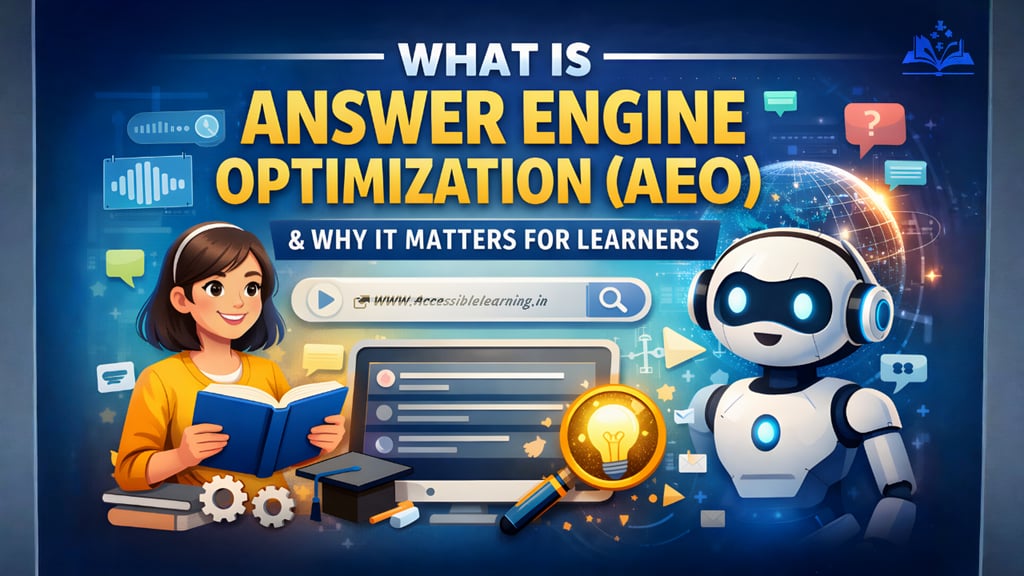
Learning no longer begins with opening a book or even visiting a website. It begins with a question. Learners today ask search engines, AI tools, and voice assistants for instant answers. This shift has transformed how knowledge is discovered and delivered, leading to the rise of Answer Engine Optimization, commonly known as AEO.
AEO is changing not just digital marketing but the entire learning experience.
What Is Answer Engine Optimization (AEO)?
Answer Engine Optimization is the process of structuring and presenting content so AI-powered systems can extract and deliver clear, accurate answers directly to users.
Instead of ranking a full page, answer engines aim to provide the best possible response to a specific question. For learners, this means skipping unnecessary steps and getting straight to understanding.
Answer engines include:
AI chatbots and AI tutors
Search engine featured snippets
Voice assistants and smart speakers
Educational AI tools and platforms
Knowledge graphs and instant answer boxes
AEO ensures that learning content becomes the answer, not just a link.
Why Search Is Becoming Answer-Based
Traditional search was designed for exploration. Modern search is designed for resolution.
Several factors drive this change:
Voice search encourages conversational questions
Mobile users prefer fast, concise answers
AI models summarize information instantly
Learners expect clarity, not complexity
Time-limited attention demands efficiency
AEO aligns content with how learners naturally think and ask questions.
AEO vs SEO: A Learner-Centered Comparison
While SEO focuses on visibility, AEO focuses on usefulness.
SEO helps learners find resources.
AEO helps learners understand concepts.
Key differences include:
SEO prioritizes keywords; AEO prioritizes intent
SEO measures success by traffic; AEO measures success by clarity
SEO supports browsing; AEO supports problem-solving
SEO works well for discovery; AEO works best for learning
For educational content, AEO is a natural evolution of SEO rather than a replacement.
Why AEO Is Critical for Modern Learners
Learners today face information overload. Thousands of articles may exist on one topic, but few explain it clearly.
AEO benefits learners by:
Reducing time spent searching
Providing structured explanations
Offering immediate conceptual clarity
Supporting self-paced learning
Improving focus and retention
When answers are clear, learning becomes less frustrating and more engaging.
AEO and the Rise of AI Tutors
AI-powered tutors and study assistants rely heavily on AEO-friendly content. These systems pull information from trusted sources and present it conversationally. Content that is well-structured, accurate, and learner-focused is more likely to be referenced and reused by AI tutors.
This means AEO directly influences:
How AI explains concepts
Which sources AI trusts
The quality of automated learning support
For learners, this shapes how knowledge is taught by machines.
How Answer Engines Understand Educational Content
Answer engines evaluate more than keywords. They look for meaning.
Important signals include
Clear definitions and explanations
Logical progression of ideas
Contextual relevance
Factual reliability
Consistent terminology
Readable sentence structure
Content that mimics how a teacher explains a concept performs better than content written only for ranking.
Question-Based Learning and AEO
Learners naturally think in questions.
Good AEO content mirrors this behavior by addressing:
What is this concept?
Why does it matter?
How does it work?
Where is it used?
What are common mistakes?
How does it compare to related ideas?
This approach turns an article into a guided learning session rather than a static page.

AEO and Microlearning
Microlearning focuses on short, focused learning units. AEO fits perfectly into this model.
Benefits include:
Bite-sized explanations
Fast comprehension
Easier revision and recall
Better mobile learning experience
Support for exam preparation
For learners with limited time, AEO makes learning manageable and effective.
Accessibility and Inclusive Learning Through AEO
AEO improves accessibility by design.
Well-structured answers help:
Voice assistant users
Learners with reading difficulties
Non-native language learners
Users with limited bandwidth
People relying on screen readers
Clear answers are easier to understand across different learning abilities and environments.
Trust and Accuracy in the AEO Era
Because answer engines often provide a single response, trust becomes critical.
High-quality AEO content:
Avoids misleading simplifications
Clearly explains limitations
Uses neutral, educational language
Maintains consistency across explanations
For learners, trustworthy answers build confidence and reduce confusion.
AEO’s Role in Skill-Based and Career Learning
Many learners search with practical goals in mind.
Examples include:
How to learn a new skill fast
What tools are required for a career
How to solve a specific problem
Which option is better and why
AEO helps deliver actionable, structured answers that support real-world learning and decision-making.
The Future of Learning Content with AEO
As AI systems become more integrated into education, AEO will define which content survives and thrives.
Future learning experiences will depend on:
Conversational search
Personalized AI explanations
Voice-driven learning environments
Real-time answer delivery
Adaptive learning systems
Content not optimized for answers may never reach learners at all.
How Learners Can Identify High-Quality AEO Content
Learners benefit by recognizing good AEO-driven resources.
Signs include:
Direct answers without filler
Clear structure and headings
Simple language with depth
Real-world examples
Logical flow of ideas
Such content saves time and improves understanding.


AEO and Cognitive Load Reduction
One hidden benefit of AEO is how it reduces cognitive load for learners. When information is presented as a direct, well-scoped answer, the brain processes it faster and retains it longer. Learners are not forced to filter noise, compare multiple sources, or resolve contradictions on their own. This is especially important for complex subjects where confusion can block progress early.
AEO as a Learning Quality Filter
Answer engines act as a gatekeeper. Content that is unclear, poorly structured, or conceptually weak is less likely to be selected as an answer. Over time, this pushes the learning ecosystem toward higher-quality explanations. For learners, this creates a natural filter where clearer thinking rises and shallow content fades.
The Role of Context Windows in AI Answers
Modern AI systems work within limited context windows. AEO-optimized content fits cleanly into these windows by focusing on essential explanations rather than long, unfocused paragraphs. This increases the chance that the full meaning of a concept survives when AI summarizes or rephrases it for learners.
AEO and Knowledge Consistency Across Platforms
Learners often switch between devices and platforms. AEO encourages consistency by structuring explanations in a way that remains stable whether delivered via text, voice, or AI chat. This reduces conflicting explanations and helps learners build a coherent mental model of a topic.
Concept Chunking and Mental Models
AEO naturally supports concept chunking. Instead of presenting large blocks of information, it breaks ideas into meaningful units that align with how the brain forms mental models. This improves understanding, recall, and the ability to apply knowledge in new situations.
AEO and Learning Intent Classification
Answer engines classify learner intent more precisely than traditional search. AEO-friendly content aligns with these intent types, such as
Definition-based learning
Process-based learning
Comparison-based learning
Problem-solving learning
Decision-making learning
This ensures learners receive the right type of explanation at the right moment.
The Risk of Over-Simplification and How Good AEO Avoids It
Poor AEO can oversimplify concepts and strip away nuance. High-quality AEO balances clarity with accuracy. It delivers a clean core answer first, then layers depth progressively. This protects learners from misunderstanding while still saving time.
AEO as a Foundation for Personalized Learning
Personalized learning systems rely on modular, answer-ready content. AEO makes content reusable, allowing AI systems to adapt explanations based on a learner’s level, background, or goals. This is a critical building block for adaptive education.
Long-Term Knowledge Retention Benefits
Clear answers improve long-term retention. When learners understand a concept quickly and correctly, they are more likely to integrate it into existing knowledge. AEO indirectly improves learning efficiency by reducing early misconceptions that are hard to unlearn later.
AEO and Ethical Knowledge Distribution
Because answer engines influence what millions of learners see, AEO carries ethical responsibility. Accurate, unbiased, and learner-first content ensures that AI-delivered education supports understanding rather than manipulation or misinformation.
Why AEO Is Not Optional Anymore
AEO is becoming infrastructure, not a tactic. As AI answers replace traditional search paths, learners will increasingly depend on what answer engines choose to explain. Content that cannot be understood, extracted, and trusted by these systems will simply disappear from the learning journey.
For learners, AEO defines not just how fast they learn, but what they get to learn at all.

FAQ's
Q: What is Answer Engine Optimization (AEO) in simple terms?
Answer Engine Optimization is the practice of creating content that gives clear, direct answers to questions so AI systems, voice assistants, and search engines can deliver those answers instantly to learners.
Q: How is AEO different from traditional SEO?
SEO focuses on ranking pages in search results, while AEO focuses on providing the best possible answer to a specific question. AEO prioritizes clarity, intent, and understanding over clicks.
Q: Why is AEO important for students and self-learners?
AEO helps learners find accurate explanations faster, reduces confusion, and saves time by delivering direct answers instead of forcing them to search through multiple sources.
Q: Does AEO help with voice search and AI tools?
Yes. AEO is essential for voice assistants, AI chatbots, and AI tutors because these systems rely on well-structured, answer-ready content to respond to spoken or conversational questions.
Q: Can AEO improve understanding, not just visibility?
Yes. AEO improves learning quality by reducing cognitive load, presenting concepts in clear chunks, and aligning explanations with how people naturally ask and learn.
Q: Is AEO useful only for websites and blogs?
No. AEO benefits any learning content, including online courses, documentation, study guides, FAQs, and educational platforms used by AI systems.
Q: Will AEO replace SEO in the future?
AEO will not replace SEO, but it will become more important for learning-focused content. SEO helps content get discovered, while AEO ensures it gets understood and used.
Q: How can learners identify AEO-optimized content?
AEO-optimized content provides direct answers, uses clear headings, avoids unnecessary filler, explains why a concept matters, and feels easy to understand without oversimplifying.
Q: Does AEO affect how AI explains concepts?
Yes. AI systems learn from and reuse AEO-friendly content, which directly influences how concepts are explained to learners across different platforms.
Q: Why will AEO matter even more in the future?
As AI-driven answers replace traditional searching, learners will rely on answer engines for knowledge. AEO ensures high-quality educational content remains visible, trusted, and accessible in that future.
Subscribe to Frontier Intelligence
All © Copyright reserved by Accessible-Learning Hub
| Terms & Conditions
Accessible Learning Hub — Actionable clarity for high-agency minds.
Weekly breakdowns on AI breakthroughs, capital flow, and human performance systems. Zero fluff.