

What Is Agentic AI? Definition, Workflows, and 2026 Use Cases
Agentic AI is an autonomous artificial intelligence system that can plan, reason, make decisions, use tools, and execute tasks to achieve goals. Learn how Agentic AI works, its architecture, key benefits, challenges, industry statistics, and real-world use cases in 2026.
AI ASSISTANTAI/FUTUREA LEARNINGCOMPANY/INDUSTRY
Sachin K Chaurasiya
7/2/20268 min read
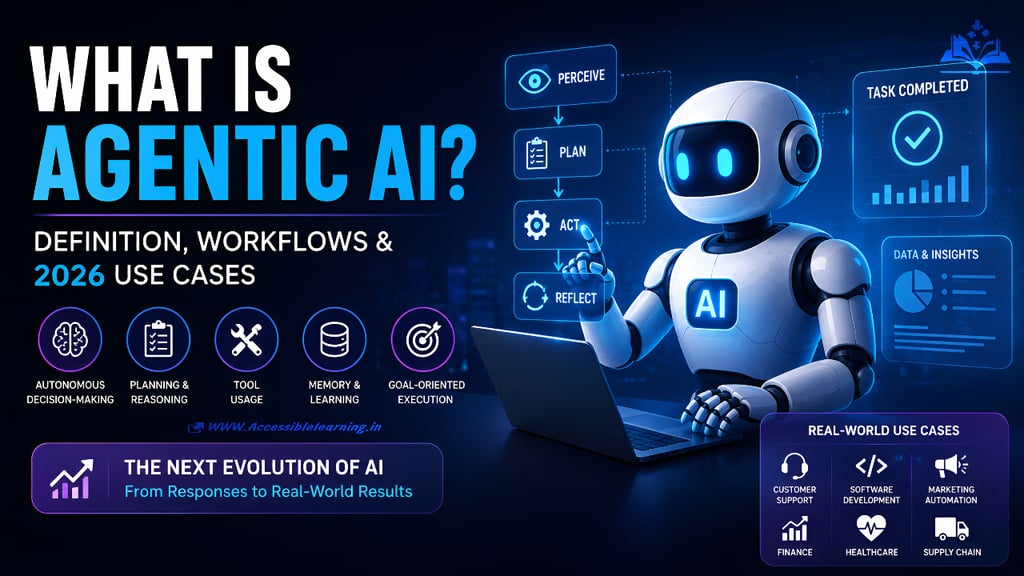
Agentic AI is an artificial intelligence system that can autonomously plan, decide, execute actions, use tools, and adapt its behavior to achieve a goal with minimal human intervention.
Unlike traditional AI systems that simply generate responses when prompted, Agentic AI actively pursues objectives. It can break complex tasks into smaller steps, choose appropriate tools, evaluate results, correct mistakes, and continue working until a defined outcome is achieved.
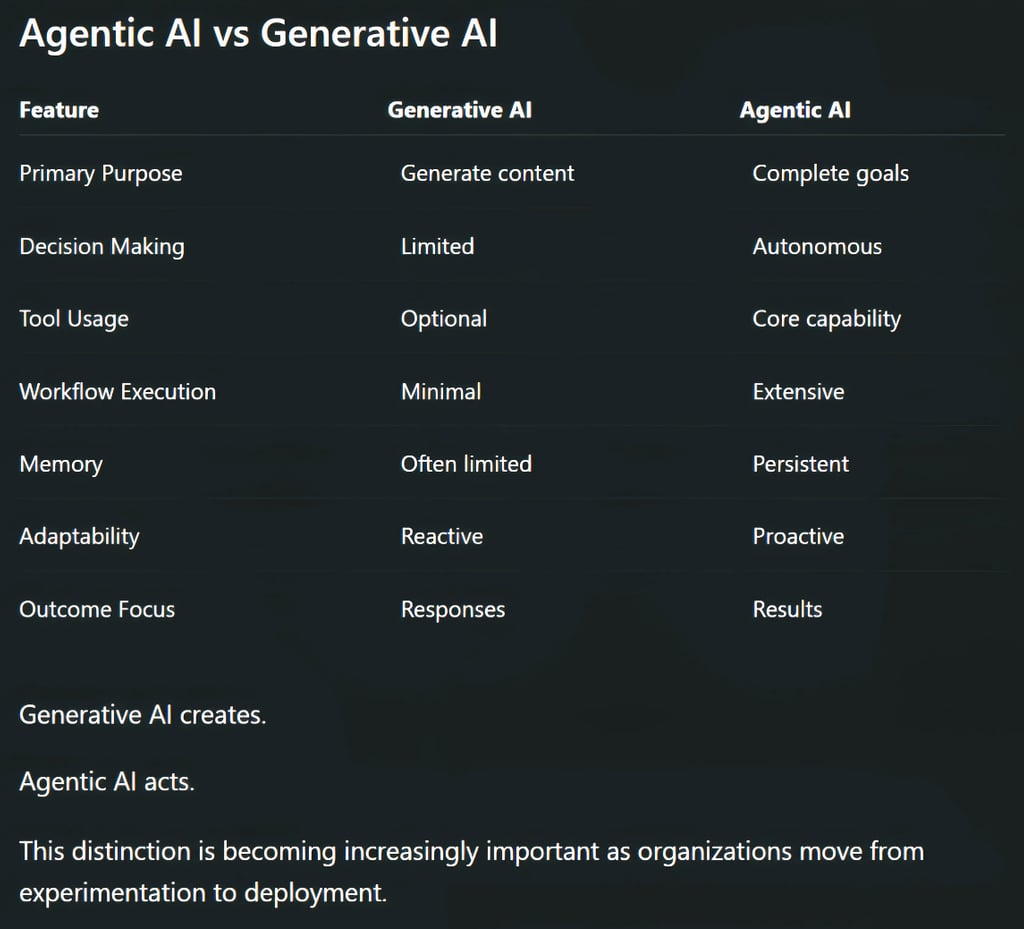
This shift represents one of the most significant developments in artificial intelligence since the rise of large language models (LLMs). While generative AI creates content, Agentic AI performs work.
Agentic AI at a Glance
Agentic AI systems can:
Understand goals instead of individual commands
Create multi-step plans
Make decisions during execution
Use software tools and APIs
Access and analyze data
Learn from previous interactions
Adapt to changing conditions
Collaborate with humans and other AI agents
In simple terms, a chatbot answers a question. An AI agent completes a task.
The Official Definition of Agentic AI
The term "agentic" comes from the concept of agency, which refers to the ability to act independently in pursuit of an objective.
An Agentic AI system combines the following:
Reasoning – determining what needs to be done
Planning – breaking goals into actionable steps
Memory – retaining relevant context
Tool Usage – interacting with external systems
Execution – carrying out actions
Self-Correction – evaluating and improving outcomes
A traditional AI model typically operates in a request-response pattern.
Example:
User:
Write a customer support email.AI:
Generates the email.An Agentic AI system operates differently.
User:
Reduce support ticket backlog by 30%.
Agent:
Analyzes ticket history
Categorizes requests
Drafts responses
Escalates complex cases
Tracks performance metrics
Reports results
The focus shifts from producing content to delivering outcomes.
How Agentic AI Works
Most Agentic AI systems follow a workflow known as the Perceive → Plan → Act → Reflect cycle.
Step 1: Perceive
The agent gathers information. Sources may include:
Databases
CRM platforms
Websites
APIs
Internal documents
User instructions
The goal is to understand the current environment and available information.
Step 2: Plan
The AI determines:
What objective must be achieved
Which actions are required
Which tools are available
What sequence of actions makes sense
This stage often involves task decomposition, where large objectives are broken into smaller executable tasks.
Step 3: Act
The agent begins executing tasks. Examples include:
Sending emails
Running software
Querying databases
Updating spreadsheets
Booking appointments
Creating reports
Writing code
Unlike conventional AI, execution is not limited to text generation.
Step 4: Reflect
The agent evaluates outcomes. Questions include:
Did the action succeed?
Were errors encountered?
Is additional information required?
Does the plan need adjustment?
If necessary, the agent revises its strategy and continues working. This iterative feedback loop is what makes Agentic AI fundamentally different from standard automation.

Agentic AI Architecture Explained
Most modern agentic systems contain five core layers.
1. Foundation Model
The underlying large language model provides reasoning and language understanding.
Examples include:
GPT-based models
Claude-based models
Gemini-based models
Open-source reasoning models
2. Memory Layer
Stores:
Previous conversations
User preferences
Workflow history
Task states
Memory enables continuity across tasks.
3. Planning Engine
Responsible for:
Goal decomposition
Prioritization
Decision-making
This layer transforms objectives into workflows.
4. Tool Layer
Provides access to:
Search engines
APIs
Databases
Enterprise software
Web browsers
Internal systems
Without tools, an AI remains mostly informational. With tools, it becomes operational.
5. Evaluation Layer
Monitors performance and validates results.
This reduces hallucinations and improves reliability.
Real-World Agentic AI Use Cases in 2026
Customer Support Agents
AI agents can:
Resolve tickets
Retrieve account information
Process refunds
Escalate exceptions
Monitor satisfaction scores
Industry analysts predict agentic systems will transform customer service operations over the next several years. Gartner forecasts that by 2029, agentic AI will autonomously resolve 80% of common customer service issues without human intervention.
AI Software Engineering
Agentic coding systems can:
Write code
Run tests
Debug issues
Deploy applications
Monitor production environments
Instead of generating snippets, these agents manage significant portions of development workflows.
Marketing Operations
AI agents increasingly handle the following:
Content creation
Keyword research
Competitive analysis
Campaign optimization
Reporting
Marketing teams use agents to automate repetitive work while focusing on strategy and creativity.
Sales Automation
Sales agents can:
Research prospects
Draft outreach emails
Schedule meetings
Update CRM systems
Score leads
This creates a continuous sales workflow operating around the clock.
Financial Analysis
Organizations deploy AI agents to:
Analyze market data
Generate forecasts
Detect anomalies
Produce reports
Monitor compliance
Human oversight remains essential, but execution becomes significantly faster.
Supply Chain Management
Agentic systems can:
Monitor inventory
Predict shortages
Reorder products
Evaluate suppliers
Optimize logistics
These capabilities make operations more responsive and efficient.
Healthcare Administration
Administrative healthcare workflows increasingly involve agents that:
Process records
Schedule appointments
Manage documentation
Coordinate patient communications
Clinical decisions still require human supervision, but operational tasks are becoming highly automated.
Agentic AI Statistics Every Business Should Know
The growth trajectory of Agentic AI is accelerating.
Key Industry Forecasts
Gartner predicts that at least 15% of day-to-day work decisions will be made autonomously by agentic AI by 2028, compared to essentially zero in 2024.
Gartner forecasts that 33% of enterprise software applications will include agentic AI by 2028, up from less than 1% in 2024.
Gartner expects 40% of enterprise applications to feature task-specific AI agents by the end of 2026, highlighting rapid adoption across software ecosystems.
Gartner predicts 60% of brands will use agentic AI for one-to-one customer interactions by 2028.
Gartner forecasts that at least 80% of governments will deploy AI agents for routine decision-making by 2028.
These projections indicate that Agentic AI is moving beyond experimentation into mainstream operational deployment.

Benefits of Agentic AI
Organizations adopt Agentic AI because it can:
Increase Productivity
Agents operate continuously without fatigue.
Reduce Operational Costs
Automation reduces manual workload and repetitive labor.
Improve Decision Speed
Tasks that once required hours can be completed in minutes.
Scale Expertise
Organizations can replicate high-value workflows without proportionally increasing headcount.
Enable Continuous Operations
Agents can monitor systems and execute tasks 24/7.
Challenges and Risks of Agentic AI
The technology is powerful, but it is not magic. Major challenges include:
Reliability
Agents occasionally make incorrect assumptions.
Governance
Autonomous systems require clear accountability frameworks.
Security
Agents often receive access to sensitive systems and data.
Compliance
Industries with strict regulations require extensive oversight.
Cost Control
Always-on agents can generate substantial infrastructure expenses.
Industry research also suggests that many organizations are still struggling to move agentic projects beyond pilot stages due to governance, orchestration, and trust issues.
The Core Characteristics of Agentic AI
Not every AI system qualifies as agentic. To be considered Agentic AI, a system must exhibit several defining characteristics.
Goal-Oriented Behavior
Traditional AI responds to instructions. Agentic AI works toward objectives.
For example, instead of asking:
"Write a report."
A user might simply say the following:
"Prepare a monthly performance review."
The agent determines what information is needed, gathers relevant data, creates the report, and delivers the final output.
Autonomy
Agentic systems operate with varying degrees of independence. Depending on permissions and governance rules, agents may:
Execute tasks automatically
Request human approval
Collaborate with other agents
Adjust workflows without intervention
Autonomy is what transforms AI from a tool into an active participant in business processes.
Persistence
Unlike conventional AI interactions that end after a response, agentic systems can continue operating over extended periods.
Examples include:
Monitoring inventory levels
Tracking cybersecurity threats
Managing customer support queues
Optimizing advertising campaigns
The system remains active until goals are achieved or conditions change.
Adaptability
Agentic AI can modify strategies when circumstances change. If a planned action fails, the system can:
Explore alternatives
Gather additional information
Adjust priorities
Retry with improved parameters
This flexibility makes agentic systems significantly more resilient than traditional automation software.
Single-Agent vs Multi-Agent Systems
As Agentic AI evolves, organizations are increasingly deploying multiple agents working together.
Single-Agent Systems
A single agent handles the entire workflow.
Examples include:
Personal productivity assistants
Customer support agents
Research assistants
Coding agents
These systems are simpler to deploy and manage.
Multi-Agent Systems
Multiple specialized agents collaborate to achieve complex objectives. For example:
A marketing department may use:
A research agent
A content creation agent
A SEO optimization agent
A performance analytics agent
Each agent focuses on a specific responsibility while sharing information with the others. This structure closely resembles how human organizations operate. Many experts believe multi-agent architectures will become the dominant enterprise model throughout the late 2020s.

The Evolution of AI: From Rules to Agents
Understanding Agentic AI becomes easier when viewed as the next stage in artificial intelligence evolution.
Stage 1: Rule-Based Systems
Early software relied on fixed rules.
Example:
If X happens, perform Y.
These systems were predictable but inflexible.
Stage 2: Predictive AI
Machine learning introduced pattern recognition.
Systems could:
Detect fraud
Predict demand
Recommend products
However, they still lacked independent action.
Stage 3: Generative AI
Large language models transformed AI into a content-generation engine.
Capabilities expanded to include:
Writing
Coding
Summarization
Translation
Yet these systems remained largely reactive.
Stage 4: Agentic AI
The current phase combines:
Reasoning
Planning
Memory
Tool usage
Autonomous execution
This enables AI to move beyond generating information and begin executing work.
Agentic AI and Business Transformation
The business implications of Agentic AI extend far beyond automation. Organizations are beginning to redesign entire workflows around autonomous systems.
From Task Automation to Process Automation
Previous automation technologies focused on individual tasks.
Examples:
Sending emails
Processing invoices
Updating databases
Agentic AI automates entire business processes. For example, a recruiting agent might:
Source candidates
Screen resumes
Schedule interviews
Generate evaluation reports
Update hiring systems
This dramatically expands the economic value of automation.
Digital Workforce Expansion
Many organizations now view AI agents as members of a digital workforce. Unlike human employees, agents can:
Operate continuously
Scale instantly
Handle repetitive work at low marginal cost
This allows human teams to focus on higher-value strategic activities.
Technologies Powering Agentic AI
Several technologies work together to make modern agentic systems possible.
Large Language Models (LLMs)
LLMs provide reasoning and language capabilities.
They serve as the cognitive engine behind most AI agents.
Retrieval-Augmented Generation (RAG)
RAG enables agents to access external knowledge sources.
This improves:
Accuracy
Context awareness
Decision quality
Vector Databases
These databases help agents store and retrieve information efficiently.
They support long-term memory and semantic search.
APIs and Tool Integrations
APIs allow agents to interact with external systems. Examples include:
CRM software
Payment systems
Analytics platforms
Enterprise databases
Without integrations, agents remain limited to conversation.
Workflow Orchestration Platforms
Orchestration systems coordinate complex multi-step workflows and manage communication between multiple agents.
They serve as the operational backbone of enterprise agent deployments.
What Makes a Successful Agentic AI Deployment?
Despite growing enthusiasm, many Agentic AI initiatives fail because organizations focus on technology rather than workflow design. Successful deployments typically share several characteristics.
Clear Objectives
Agents perform best when goals are measurable and well-defined.
Human Oversight
Human review remains essential for:
Legal decisions
Financial approvals
Healthcare workflows
Strategic planning
High-Quality Data
Poor data leads to poor decisions.
The effectiveness of any agent depends heavily on the quality of information it can access.
Strong Governance
Organizations need clear policies regarding:
Permissions
Security
Accountability
Compliance
Governance becomes increasingly important as autonomy increases.

Is Agentic AI the Future of Work?
The evidence increasingly suggests that Agentic AI will become a foundational layer of digital operations. However, the future is unlikely to be fully autonomous.
The most successful organizations are adopting a human-plus-agent model, where AI handles execution while humans provide strategy, judgment, ethics, and oversight. Industry leaders continue to emphasize that removing humans entirely from important workflows creates significant risks.
Rather than replacing human workers outright, Agentic AI is more likely to redefine work by automating coordination, execution, and routine decision-making.
Agentic AI is not merely a smarter chatbot. It is a goal-oriented system capable of reasoning, planning, acting, and adapting to achieve outcomes. As organizations move from content generation to workflow automation, Agentic AI is becoming the bridge between artificial intelligence and real-world execution. The companies that learn to deploy, govern, and scale AI agents effectively will likely define the next era of digital transformation.
Frequently Asked Questions
Q: What is Agentic AI in simple terms?
Agentic AI is a type of artificial intelligence that can independently plan, make decisions, use tools, and execute tasks to achieve a goal with minimal human intervention.
Q: How is Agentic AI different from Generative AI?
Generative AI focuses on creating content such as text, images, or code. Agentic AI goes further by planning actions, interacting with systems, and completing multi-step workflows to achieve specific outcomes.
Q: How does Agentic AI work?
Agentic AI typically follows a cycle of perception, planning, execution, and reflection. It gathers information, creates a strategy, performs actions, evaluates results, and adjusts its approach when necessary.
Q: What are the main components of an Agentic AI system?
Most Agentic AI systems include a reasoning model, memory layer, planning engine, tool integrations, and an evaluation mechanism that helps improve decision-making and task execution.
Q: What are some real-world examples of Agentic AI?
Common examples include AI customer support agents, autonomous coding assistants, sales automation agents, research assistants, cybersecurity monitoring systems, and supply chain optimization platforms.
Q: What industries are adopting Agentic AI?
Industries such as healthcare, finance, retail, manufacturing, logistics, customer service, software development, and marketing are increasingly using Agentic AI to automate complex workflows.
Q: What are the benefits of Agentic AI?
Agentic AI can improve productivity, reduce operational costs, automate repetitive tasks, accelerate decision-making, and enable organizations to scale operations more efficiently.
Q: What are the risks of Agentic AI?
Potential risks include inaccurate decision-making, security vulnerabilities, compliance concerns, governance challenges, and excessive autonomy without adequate human oversight.
Q: Will Agentic AI replace human workers?
Agentic AI is more likely to augment human capabilities than replace entire jobs. It automates repetitive and process-driven tasks while humans continue to provide strategic thinking, creativity, and oversight.
Q: Why is Agentic AI important in 2026?
Agentic AI represents a major shift from AI that generates information to AI that performs work. As businesses seek greater automation and efficiency, agent-based systems are becoming a key part of digital transformation strategies.
Subscribe To Our Newsletter
All © Copyright reserved by Accessible-Learning Hub
| Terms & Conditions
Knowledge is power. Learn with Us. 📚

