

What Global Certifications Mean for USA Students
Global certifications help USA students turn academic learning into real-world skills. This article explains what global certifications mean, why employers value them, how students can choose the right credentials, and how these certifications improve career opportunities, salary potential, and global employability.
USAA LEARNINGEDUCATION/KNOWLEDGENEW YOUTH ISSUES
Kim Shin | Shiv Singh Rajput
2/20/20265 min read
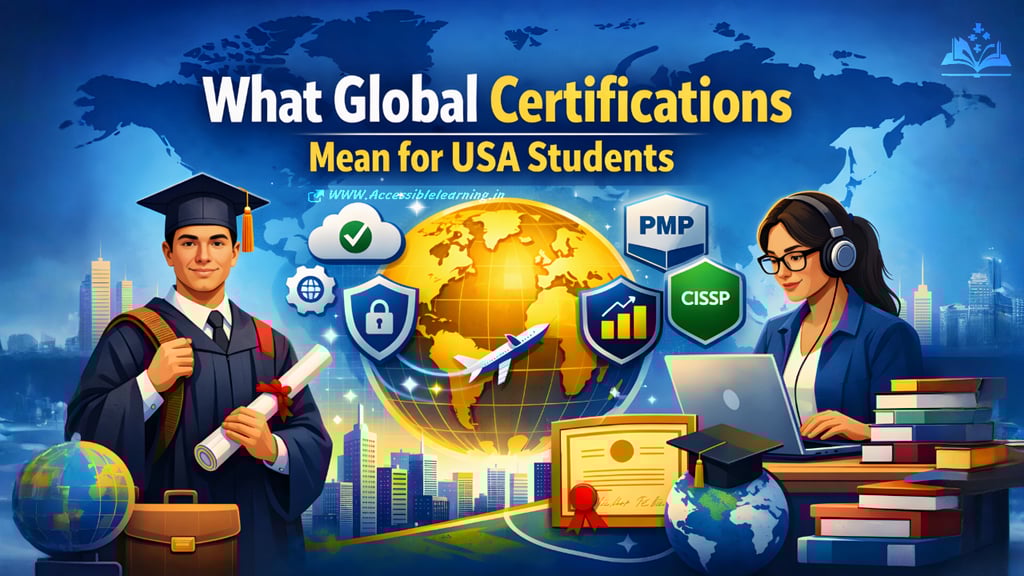
In today’s competitive education and job market, a college degree alone is often not enough to stand out. Employers in the United States are increasingly focused on practical skills, real-world readiness, and proof of competence. This is where global certifications come in. For U.S. students, global certifications act as a bridge between academic learning and industry expectations, helping them build credibility, confidence, and career momentum.
This article explains what global certifications really mean for USA students, why they matter, and how to use them wisely for long-term growth.
Understanding Global Certifications
Global certifications are professional credentials awarded by internationally recognized organizations, technology providers, or industry bodies. They validate specific skills such as cloud computing, cybersecurity, data analysis, project management, finance, design, or digital marketing. Unlike traditional degrees, these certifications focus on applied knowledge and measurable outcomes.
What makes them “global” is their acceptance across countries and industries. A certification earned in the United States can be recognized by employers in Europe, Asia, or remote-first global companies. This portability is a major advantage in an increasingly international job market.
Why Global Certifications Matter for U.S. Students
For American students, global certifications provide several practical benefits that complement formal education.
First, they improve job readiness. Many university programs focus on theory, while employers expect hands-on skills from day one. Certifications are designed around real tools, workflows, and scenarios used in the workplace. This helps students transition smoothly from classroom learning to professional roles.
Second, they act as strong hiring signals. Recruiters often scan resumes quickly, and recognized certifications immediately communicate skill level and seriousness. In technical and professional roles, certifications can be the difference between getting shortlisted or overlooked.
Third, they can increase earning potential. In fields like IT, cloud computing, cybersecurity, and project management, certified professionals often earn higher starting salaries or qualify for faster promotions. Employers are willing to pay more for candidates who reduce training time and risk.
Fourth, certifications support career flexibility. Many U.S. students change majors, industries, or job roles over time. Global certifications make it easier to pivot careers without starting from scratch, especially when moving from non-technical to technical or hybrid roles.
Finally, they help students compete globally. With remote work and international hiring on the rise, U.S. students are no longer competing only with local graduates. Global certifications level the playing field by providing universally understood proof of skill.
Popular Certification Areas for USA Students
Different fields value different certifications, and students should choose based on career goals rather than popularity.
In technology and cloud computing, certifications related to cloud platforms, IT support, networking, and systems administration are highly valued. These are especially useful for computer science, IT, and engineering students.
In cybersecurity, certifications that validate knowledge of network security, ethical hacking, and risk management are in high demand due to growing security concerns across industries.
For data, AI, and analytics, certifications focusing on data analysis, machine learning fundamentals, and business intelligence tools are popular among students pursuing data science, economics, and analytics-driven careers.
In project and product management, certifications that demonstrate understanding of project lifecycles, agile methods, and team coordination are useful for business, management, and engineering students.
In finance, marketing, and business, professional credentials and industry-backed certificates help students demonstrate practical expertise beyond textbooks, especially in analytics, financial modeling, and digital marketing.
Creative fields such as design, video, and UX also benefit from tool-based certifications that validate proficiency in widely used software and workflows.
How Employers in the U.S. View Global Certifications
Most U.S. employers do not see certifications as replacements for degrees. Instead, they view them as strong supplements. A degree shows academic foundation, while certifications prove that a candidate can apply knowledge in real-world situations.
In technical roles, certifications are often used as screening criteria. In non-technical roles, they signal initiative, continuous learning, and adaptability. When paired with internships, projects, or portfolios, certifications significantly strengthen a candidate’s profile.
Choosing the Right Certification
Selecting the right certification is more important than collecting many of them.
Students should start by identifying their target job roles and reviewing real job descriptions. Repeatedly mentioned tools and skills are good indicators of what certifications matter. Next, they should check whether employers actually recognize and request those certifications.
Time, cost, and difficulty should also be considered. Some entry-level certifications can be completed in weeks, while advanced credentials require months of preparation and prior experience. A good certification should match the student’s current level and career stage.
Most importantly, students should plan how they will apply the skill. Certifications are far more powerful when supported by projects, internships, or case studies that show real usage.

Return on Investment and Long-Term Value
The return on investment of global certifications varies by field and level. Entry-level certifications often provide quick benefits by improving employability. Advanced certifications tend to deliver higher salary growth but require more commitment.
For U.S. students, the long-term value lies not just in passing an exam but in developing a habit of continuous learning. Certifications help students stay relevant in fast-changing industries and demonstrate adaptability throughout their careers.
Common Mistakes to Avoid
One common mistake is choosing certifications only because they are trending. A credential that does not align with career goals offers limited value. Another mistake is relying on certifications without gaining practical experience. Employers still prioritize applied skills and results.
Students should also avoid outdated or poorly recognized certifications and should be mindful of renewal requirements, especially in technology fields.
A Practical Approach for U.S. Students
A smart approach is to start with one foundational certification aligned with your major or intended role. Combine it with a small project or internship experience. As you progress through college or early career stages, add intermediate certifications that deepen your expertise. This step-by-step approach keeps learning manageable, affordable, and clearly connected to career outcomes.
For USA students, global certifications are not shortcuts but strategic tools. They strengthen resumes, improve confidence, and open doors in both domestic and international job markets. When chosen thoughtfully and supported by real-world application, global certifications can significantly enhance a student’s academic journey and professional future. If used wisely, they turn education into opportunity and skills into measurable career progress.
FAQ's
Q: Are global certifications necessary for U.S. students?
Global certifications are not mandatory, but they are highly valuable. They help U.S. students prove practical skills, stand out in competitive hiring processes, and become job-ready faster, especially in technical and professional fields.
Q: Can global certifications replace a college degree in the United States?
No. In most cases, certifications do not replace a degree. Employers typically view them as a strong supplement that validates hands-on skills alongside academic knowledge.
Q: Which stage of education is best for pursuing global certifications?
Students can start during college, ideally after gaining some foundational knowledge. Entry-level certifications are suitable for early years, while advanced certifications are better pursued in the final years or early career.
Q: Do U.S. employers trust online and international certifications?
Yes, as long as the certification is issued by a well-known, industry-recognized organization. Employer-backed and vendor-specific certifications are generally well trusted.
Q: How many certifications should a U.S. student have?
Quality matters more than quantity. One or two relevant certifications aligned with career goals and supported by projects or internships are often more effective than multiple unrelated credentials.
Q: Are global certifications useful for remote or international jobs?
Absolutely. Global certifications are especially helpful for remote roles and international companies, as they provide standardized proof of skills that employers worldwide understand.
Q: Do global certifications expire?
Many do, particularly in technology-related fields. Students should check renewal requirements and stay updated to ensure their certifications remain valid and relevant.
Subscribe To Our Newsletter
All © Copyright reserved by Accessible-Learning Hub
| Terms & Conditions
Knowledge is power. Learn with Us. 📚

