

What Global Certifications Mean for Indian Students
Global certifications are becoming essential for Indian students aiming for international education, better career opportunities, and remote work. This article explains what global certifications mean, why they matter, how they impact study abroad and jobs, and how Indian students can choose the right ones for long-term success.
INDIA/BHARATA LEARNINGNEW YOUTH ISSUESEDUCATION/KNOWLEDGE
Shiv Singh Rajput
2/19/20267 min read
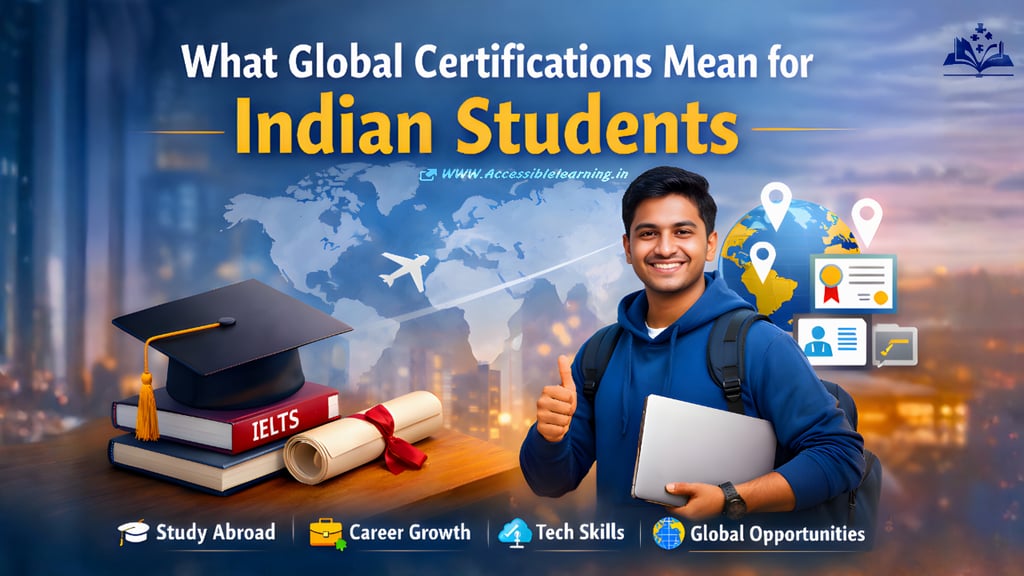
For Indian students, education and careers are no longer confined to local universities or domestic job markets. Global exposure has become a realistic goal, whether through higher studies abroad, international employment, or remote work with global companies. In this changing landscape, global certifications play a critical role. They act as standardized proof of knowledge, skills, and readiness that can be understood and trusted worldwide.
Global certifications are not just additional qualifications. When used correctly, they become strategic tools that help Indian students overcome geographic, academic, and professional barriers.
What Are Global Certifications?
Global certifications are credentials issued by internationally recognized universities, professional institutions, or global technology companies. These certifications follow standardized evaluation systems and are accepted across multiple countries and industries.
Unlike local certificates or short-term training programs, global certifications are designed to meet international benchmarks. This means the syllabus, assessment method, and grading criteria are consistent regardless of where the student takes the exam.
They generally fall into these categories:
Language proficiency and admission certifications for studying abroad
Professional and industry certifications for specific career paths
Technology and digital skill certifications focused on practical, job-ready expertise
Academic and skill-based micro-credentials from globally reputed platforms
Each category serves a different purpose, but all share one key feature: global credibility.
Why Global Certifications Are Especially Important for Indian Students
Indian students often face a unique challenge. While many have strong academic foundations, international universities and employers may not be fully familiar with Indian grading systems, institutions, or curricula. This can make evaluation difficult.
Global certifications solve this problem by acting as a common reference point. They provide measurable proof of competence that is easy to understand across borders.
Additionally, these certifications demonstrate qualities that go beyond academic knowledge. They reflect discipline, time management, self-motivation, and the ability to meet international standards, all of which are highly valued globally.
Role in Study Abroad and Higher Education
For Indian students planning to study overseas, global certifications are often unavoidable.
Language proficiency certifications prove that a student can participate in academic discussions, write research papers, and adapt to an English-speaking academic environment. Many universities and visa authorities treat these scores as non-negotiable requirements.
Standardized admission tests help universities compare applicants from different educational systems fairly. A strong score can strengthen an application, especially when institutions are unfamiliar with a student’s college or board.
In highly competitive programs, certifications can also add depth to a student’s profile by demonstrating academic seriousness, preparedness, and global orientation.
Enhancing Career Opportunities and Job Readiness
In the professional world, global certifications function as trust indicators. Recruiters often receive applications from candidates across countries and backgrounds. Recognized certifications make it easier for them to assess skills quickly.
For Indian students, this is particularly useful when applying to multinational corporations, international startups, or overseas roles. Even if an employer does not recognize a student’s college, they are likely to recognize a global certification.
In technical fields, certifications often align closely with job roles. Cloud, data, cybersecurity, and networking certifications validate hands-on abilities and reduce the employer’s training burden. In business and finance, professional certifications signal long-term commitment and industry competence.
Over time, certified professionals may also experience faster career progression and better salary growth due to their verified expertise.
Supporting Career Changes and Skill Transitions
Many Indian students change career paths due to market demand, personal interest, or limited opportunities in their original field. Global certifications provide a structured way to make such transitions credible.
When a student earns a relevant certification, it signals intentional learning rather than experimentation. It shows employers that the candidate has invested time and effort into acquiring industry-aligned skills.
This is particularly effective in fields such as data analytics, digital marketing, product management, UX design, cloud computing, and artificial intelligence, where practical knowledge often outweighs formal degrees.
Opening Doors to Global and Remote Work
The rise of remote work has changed hiring patterns worldwide. Companies now recruit talent based on skill rather than location, but they also need reliable ways to assess that talent.
Global certifications reduce uncertainty in remote hiring. They reassure employers that a candidate meets recognized standards and can work independently in distributed teams.
For Indian students, this creates access to global income opportunities, international clients, and cross-border collaborations without the immediate need to relocate.
Academic Credibility and Research Opportunities
Global certifications can also support academic and research ambitions. Certain certifications enhance eligibility for research assistantships, fellowships, and funded programs.
They demonstrate analytical ability, subject knowledge, and readiness for advanced academic work. For students aiming at research-intensive universities, certifications can strengthen applications alongside publications and projects.

Financial Considerations and Long-Term Return
Global certifications often involve significant investment, including exam fees, preparation materials, and time commitment. For Indian students, cost is an important factor.
However, when evaluated over the long term, the return on investment can be substantial. Certifications can lead to higher-paying roles, international exposure, and faster career mobility.
That said, indiscriminate certification collection is risky. Each certification should be chosen with a clear purpose and expected outcome.
Limitations and Common Misunderstandings
Global certifications are powerful, but they are not substitutes for real experience. A certification without application rarely creates impact.
Employers and universities increasingly look for proof of learning through projects, internships, case studies, or research work. Certifications work best when they complement practical exposure.
Another common misconception is that all global certifications are equally valuable. Recognition varies by country, industry, and employer. Proper research is essential before enrolling.
How Indian Students Should Choose the Right Certification
The effectiveness of a certification depends on alignment. Students should begin by identifying their primary goal, whether it is studying abroad, securing a specific job role, switching careers, or increasing salary potential.
Next, they should analyze market demand by reviewing university requirements, job listings, and industry trends. Certifications that repeatedly appear in these contexts usually carry real value.
Practical relevance matters. Certifications with hands-on components, labs, or real-world projects tend to offer stronger career outcomes.
Finally, students should consider sustainability. Some certifications require renewals or continuous learning, which should align with long-term career plans.
Using Certifications Strategically
Global certifications should never stand alone. Their impact multiplies when combined with:
Real-world projects and portfolios
Internships, apprenticeships, or freelance work
Strong communication and problem-solving skills
On resumes and professional profiles, certifications should be clearly presented with issuing bodies and completion dates. Wherever possible, they should be connected to outcomes, tools used, or problems solved.
This approach transforms certifications from static credentials into evidence of capability.
Long-Term Value for Indian Students
Over time, global certifications help Indian students compete on equal footing with international peers. They reduce dependence on institutional reputation and shift focus toward skills, standards, and adaptability.
They encourage continuous learning and global awareness, which are essential in fast-changing industries. Most importantly, they give students control over their growth, allowing them to shape careers that are not limited by geography.
Global certifications are not about collecting titles or impressing others. They are about building credibility, clarity, and confidence in a global system.
For Indian students navigating international education and careers, these certifications serve as bridges. When chosen thoughtfully and supported by real effort, they open doors to global opportunities and long-term professional success.


FAQ's
Q: Are global certifications necessary for Indian students?
Global certifications are not mandatory for every student, but they are increasingly important for those planning to study abroad, work with multinational companies, or apply for remote international roles. They help standardize skill evaluation and make profiles easier to assess globally.
Q: Do global certifications guarantee admission to foreign universities?
No. Global certifications strengthen an application but do not guarantee admission. Universities consider multiple factors such as academic records, statements of purpose, letters of recommendation, and overall profile fit along with certifications.
Q: Which global certifications are most useful for Indian students?
The usefulness of a certification depends on the student’s goal. Language proficiency certifications help with overseas education, professional certifications support career growth, and technology certifications are valuable for skill-based jobs. The best certification is one that aligns directly with career or academic objectives.
Q: Are online global certifications trusted by employers and universities?
Yes, provided they are issued by reputable international institutions or globally recognized platforms. Employers and universities typically verify the issuing body rather than the mode of learning. Practical application and projects increase credibility further.
Q: Can global certifications replace a university degree?
Global certifications cannot fully replace a formal degree, especially for academic roles or regulated professions. However, in skill-driven industries such as technology, analytics, and digital fields, certifications combined with strong portfolios can sometimes compensate for traditional degrees.
Q: How do global certifications help with career switching?
Global certifications provide structured learning and recognized proof of competence in a new field. For Indian students transitioning careers, they help build credibility and demonstrate intentional skill development to employers.
Q: Are global certifications useful for jobs in India?
Yes. Many Indian companies, especially multinational firms and startups, value global certifications. They signal global exposure, updated knowledge, and readiness to work in international environments, even within India.
Q: How long are global certifications valid?
Validity varies by certification. Some have fixed expiration periods and require renewal, while others remain valid for life. Students should always check validity rules and recertification requirements before enrolling.
Q: Are global certifications expensive for Indian students?
Costs vary widely. Some certifications are affordable, while others require significant investment. Indian students should evaluate return on investment by considering career impact, salary potential, and long-term relevance before committing.
Q: Do recruiters verify global certifications?
Yes. Many recruiters verify certifications using official credential IDs or digital verification links. Providing accurate and verifiable details is essential, as false claims can lead to disqualification.
Q: Should students pursue multiple global certifications?
Only if each certification adds clear value. Multiple unrelated certifications can dilute a profile. Focused certifications aligned with a specific goal are more effective than collecting many credentials.
Q: When is the right time to pursue a global certification?
The ideal time depends on individual goals. Some students pursue certifications during college to strengthen placements, while others do so after graduation for career advancement or international opportunities. Planning around academic and professional timelines is key.
Q: Do global certifications help in getting scholarships?
Yes, in many cases. Certifications can strengthen scholarship applications by demonstrating academic preparedness, skill proficiency, and global competitiveness, especially for merit-based funding.
Q: What matters more: certifications or practical experience?
Practical experience generally has a stronger impact. Certifications are most effective when they support and validate real-world projects, internships, or work experience.
Q: How should global certifications be presented on a resume?
Certifications should be listed clearly with the issuing authority, completion date, and verification details if available. Linking certifications to projects or outcomes improves their impact significantly.
Subscribe to Frontier Intelligence
All © Copyright reserved by Accessible-Learning Hub
| Terms & Conditions
Accessible Learning Hub — Actionable clarity for high-agency minds.
Weekly breakdowns on AI breakthroughs, capital flow, and human performance systems. Zero fluff.