

What Global Certifications Mean for Chinese Students
Global certifications play a key role in helping Chinese students access international education and careers. This article explains what global certifications mean, why they matter, how they support study abroad and employment goals, and how Chinese students can choose the right certifications for long-term success.
CHINAA LEARNINGNEW YOUTH ISSUESEDUCATION/KNOWLEDGE
Kim Shin | Shiv Singh Rajput
2/18/20265 min read
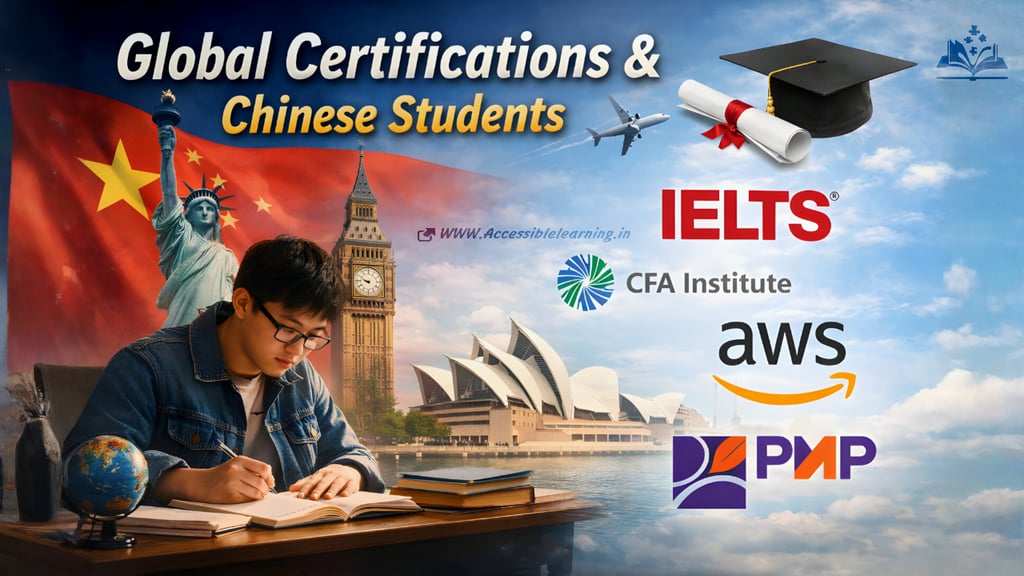
In today’s interconnected education and job market, global certifications play a powerful role in shaping opportunities for Chinese students. Whether the goal is studying abroad, working with multinational companies, or building an internationally competitive career, these certifications act as trusted proof of skills, knowledge, and readiness. They help bridge differences between education systems and make a student’s profile easier to understand and trust across borders.
This article explains what global certifications really mean for Chinese students, why they matter, which types are most relevant, and how to choose them wisely.
Understanding global certifications
Global certifications are qualifications recognized across multiple countries. They are issued by international testing bodies, universities, professional organizations, or technology companies. Unlike local diplomas, these certifications follow standardized evaluation systems, which makes them easier for foreign universities and employers to assess.
For Chinese students, this standardization is crucial. Grading systems, teaching styles, and curricula in China can differ significantly from those in Europe, North America, or Australia. Global certifications provide a common language of evaluation that reduces uncertainty and builds credibility.
Why global certifications are important for Chinese students
One of the biggest challenges Chinese students face internationally is proving equivalency. A strong academic background alone may not clearly communicate language ability, practical skills, or professional readiness to foreign institutions. Global certifications solve this problem in several ways.
They offer objective proof of ability. Test scores and credentials are measurable and comparable, which helps admissions officers and recruiters make decisions with confidence.
They improve access to overseas education. Many universities require specific language or aptitude tests as part of the application and visa process. Without these certifications, applications may not even be considered.
They enhance employability. Multinational companies often use certifications as screening tools, especially for technical, financial, or managerial roles.
They support career mobility. Certifications recognized worldwide make it easier to move between countries, industries, or international teams.
They signal commitment and discipline. Preparing for a global certification demonstrates focus, long-term planning, and the ability to meet international standards.
Key categories of global certifications
Global certifications are not one-size-fits-all. Their value depends on a student’s academic goals and career direction. The most common categories include the following.
Language proficiency certifications
Language tests are often the first and most essential requirement for Chinese students planning to study or work abroad. They demonstrate the ability to study, communicate, and work in an English-speaking or international environment.
These certifications are commonly required for university admissions, scholarships, internships, and visas. Choosing the right test depends on the target country and institution, as acceptance policies can vary.
Academic admissions and aptitude tests
These tests assess academic readiness rather than subject-specific knowledge. They are widely used by universities to compare applicants from different education systems.
For Chinese students, strong performance in these exams can offset concerns about curriculum differences or grading scales and significantly improve chances of admission to competitive programs.
Professional and finance certifications
Certifications in finance, accounting, and management are especially valuable for students aiming for international corporate careers. They are often respected globally and recognized by employers as indicators of strong technical knowledge and ethical standards.
These certifications typically require a long-term commitment and may include multiple exam levels, work experience, or continuing education.
Technology and IT certifications
Technology certifications are among the most practical global credentials. They focus on real-world skills and are closely aligned with industry needs.
For Chinese students entering fields like software development, cloud computing, cybersecurity, or networking, these certifications can quickly improve job readiness and make resumes more attractive to international employers.
Project management and operations certifications
Project management certifications are useful across industries, including construction, IT, healthcare, and business services. They emphasize planning, execution, communication, and leadership.
For students who aim to move into supervisory or managerial roles, these certifications help demonstrate structured thinking and global best practices.
Unique advantages for Chinese students
Global certifications provide specific advantages for students from China that go beyond general career benefits. They help translate academic achievements into internationally understandable credentials. This reduces misunderstandings during admissions or hiring processes.
They help students stand out in competitive applicant pools, especially when many candidates have similar degrees. They align Chinese students with global workplace expectations, including communication style, problem-solving methods, and professional ethics.
They add value both inside China and abroad. Many international certifications are increasingly respected by domestic employers, particularly in technology, finance, and multinational firms.

How to choose the right certification
Choosing the right certification is more important than collecting many certificates. A strategic approach is essential. Start by defining the goal clearly. The best certification for studying abroad may not be the best one for employment.
Research acceptance and recognition carefully. Always check official university websites or job descriptions rather than relying on general advice. Evaluate the investment required. Consider exam fees, preparation costs, time commitment, and renewal requirements.
Assess personal strengths. Some students perform better in computer-based exams, while others prefer written formats. Think about long-term value. Certifications with global recognition and clear career pathways usually offer better returns.
Preparation strategies that work
Effective preparation goes beyond memorization. Successful Chinese students usually combine several approaches.
They begin with diagnostic tests to identify weaknesses early.
They prioritize official study materials, as these best reflect real exam standards.
They follow a structured study plan with clear weekly targets.
They practice under real exam conditions to improve time management and confidence.
They integrate real-world practice, such as projects, internships, or case studies, especially for professional and technical certifications.
Recognition and documentation considerations
After earning a global certification, students may need to use it for applications, employment, or official procedures in China.
In some cases, certified translations or notarization may be required. Certain employers or institutions may ask for verification directly from the issuing body.
Students should keep digital and physical copies of certificates, score reports, and registration details to avoid delays later.
Challenges and realistic expectations
While global certifications offer strong benefits, they also come with challenges.
They can be expensive, especially professional-level certifications.
Preparation requires consistent effort over months or even years.
Some certifications expire and require renewal or continuing education.
Not all certificates carry equal weight in every country or industry.
Understanding these limitations helps students make informed and realistic decisions.
For Chinese students, global certifications are not just exam results. They are strategic tools that connect local education with global opportunity. When chosen carefully and supported by real skills, academic performance, and practical experience, these certifications can significantly expand access to international education and careers.
The key is clarity of purpose. One well-chosen, well-prepared global certification can often be more valuable than several unrelated ones. With the right plan, global certifications become a bridge from ambition to achievement on the international stage.
FAQ's
Q: Are global certifications mandatory for Chinese students who want to study abroad?
Not always, but in many cases they are essential. Most overseas universities require at least a language proficiency certification, and some programs also ask for academic aptitude tests. Without these certifications, applications may be incomplete or less competitive.
Q: Which global certification is most important for Chinese students?
There is no single most important certification. The value depends on the student’s goal. Language certifications are critical for study abroad, while professional or technical certifications are more useful for employment and career growth.
Q: Do global certifications really improve job opportunities for Chinese students?
Yes, especially for international companies and roles that follow global standards. Certifications help employers quickly understand a candidate’s skill level and reduce uncertainty when hiring across borders.
Q: Can Chinese students prepare for global certifications while staying in China?
Yes. Most global certifications can be prepared for entirely within China through official online resources, authorized test centers, and local training institutes. Many exams are now computer-based and widely accessible.
Q: How long does it usually take to prepare for a global certification?
Preparation time varies. Language tests may require a few months, while professional or technical certifications can take several months to over a year, depending on prior knowledge and experience.
Q: Are global certifications recognized by employers inside China?
Many are. International certifications are increasingly valued by multinational companies and large domestic firms in China, especially in the technology, finance, and consulting sectors.
Q: Do global certifications expire?
Some do. Language test scores often have a validity period, and many professional certifications require renewal or continuing education. Students should always check the official validity rules before planning long-term use.
Q: Is it better to have multiple certifications or one strong certification?
One well-chosen and relevant certification is usually more valuable than several unrelated ones. Quality, relevance, and real skills matter more than the number of certificates.
Subscribe to Frontier Intelligence
All © Copyright reserved by Accessible-Learning Hub
| Terms & Conditions
Accessible Learning Hub — Actionable clarity for high-agency minds.
Weekly breakdowns on AI breakthroughs, capital flow, and human performance systems. Zero fluff.