

Web3 Explained Simply: How the Next Internet Will Impact Learning and Your Data
Web3 is shaping the next version of the internet where users own their data, identity, and digital learning records. This article explains Web3 in simple terms and explores how it will transform education, online learning, and personal data privacy in a more open, secure, and learner-focused digital world.
A LEARNINGAI/FUTURECOMPANY/INDUSTRY
Sachin K Chaurasiya | Shiv Singh Rajput
1/29/20267 min read
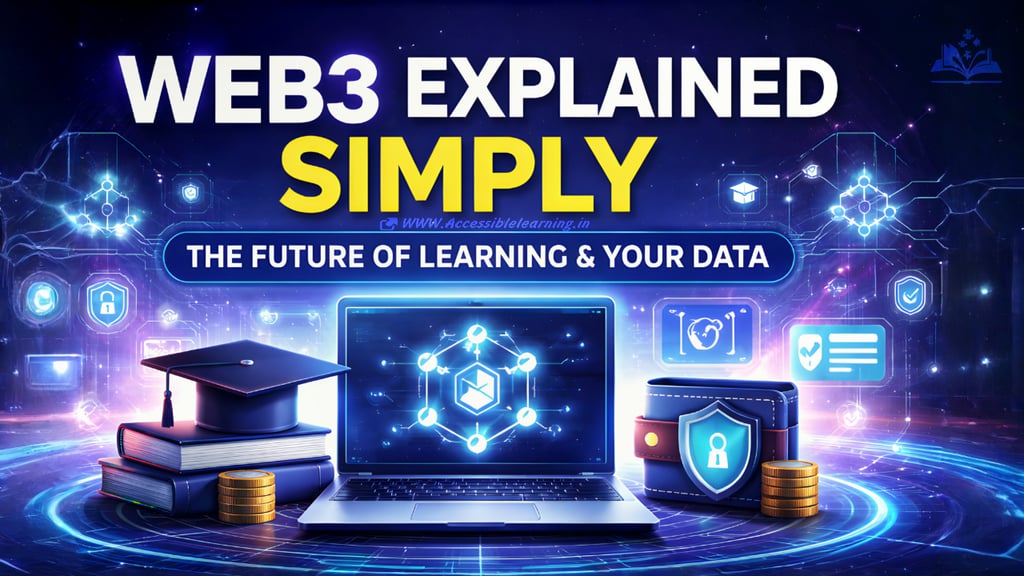
The internet is changing again. After static websites (Web1) and social media-driven platforms (Web2), we are moving toward something called Web3. You may hear it linked with blockchain, crypto, or NFTs, but Web3 is much bigger than those buzzwords. At its core, Web3 is about ownership, control, and trust. Especially for learning and personal data, this shift can be meaningful if understood properly.
This article explains Web3 in simple terms and explores how it may reshape education, digital identity, and the way your data is used.
What Is Web3 in Simple Words?
Web3 is the idea of a decentralized internet. Instead of big companies owning platforms and controlling data, Web3 aims to give users more power and ownership.
To understand it clearly, look at how the web evolved:
Web1 was read-only. People consumed information from static websites.
Web2 is read-write. Users create content, but platforms like Google, Meta, and Amazon control data.
Web3 is read-write-own. Users interact, create, and also own their digital assets and data.
Web3 uses technologies like blockchain, smart contracts, and decentralized networks to remove the need for central authorities.
Why Web3 Exists in the First Place
The current internet has some serious problems:
Your personal data is collected, sold, and monetized without real control.
Educational platforms lock certificates, progress, and content inside their systems.
Trust depends on intermediaries like companies, institutions, or platforms.
Data breaches and privacy violations are common.
Web3 tries to fix this by designing systems where trust is built into technology rather than controlled by corporations.
Key Technologies Behind Web3 (Explained Simply)
You do not need to be technical to understand Web3. These concepts matter most:
Blockchain: A blockchain is a shared digital record that cannot be easily changed. Once information is stored, it becomes transparent and verifiable.
Smart Contracts: These are self-executing rules written into code. If conditions are met, actions happen automatically without middlemen.
Decentralized Applications (dApps): Apps that run on decentralized networks rather than a single company’s server.
Digital Wallets: Instead of logging in with email and password, Web3 often uses wallets that represent your identity and assets.
How Web3 Changes Learning and Education
Web3 has the potential to transform how people learn, prove skills, and access education.
Ownership of Learning Records
In Web3, certificates, degrees, and course completions can be stored on a blockchain. This means:
You own your credentials, not the platform or institution.
Records cannot be altered or lost.
Skills are verifiable anywhere in the world.
This is especially useful for freelancers, self-learners, and students outside traditional education systems.
Borderless and Open Education
Web3 enables global learning communities without centralized control. Anyone can access courses, contribute knowledge, or teach without depending on a single platform.
This supports:
Peer-to-peer learning
Community-driven courses
Open knowledge sharing
Learn-to-Earn Models
Some Web3 platforms reward learners with tokens for completing tasks or courses or contributing value. While not perfect, this model introduces new incentives for continuous learning.
Transparent Skill Verification
Instead of trusting resumes or PDFs, employers can verify skills directly through blockchain-based credentials.
How Web3 Impacts Your Personal Data
Data is one of the most valuable resources in the digital world. Web3 changes how data ownership works.
Data Ownership Shifts to Users
In Web3, you control access to your data. Platforms request permission instead of taking it by default.
This means:
Less data exploitation
More privacy by design
Clear consent mechanisms
Reduced Dependence on Central Platforms
Web3 reduces reliance on companies that act as data gatekeepers. Your identity is portable and not tied to a single service.
Better Security, But New Responsibilities
Blockchain systems are harder to hack at a systemic level, but users must protect their private keys. With more control comes more responsibility.


Web3 vs Web2: A Quick Comparison
Web2 stores data on company servers. Web3 stores data across decentralized networks.
Web2 platforms monetize users. Web3 focuses on user ownership.
Web2 identity is account-based. Web3 identity is wallet-based.
Web2 learning credentials are platform-controlled. Web3 credentials are learner-owned.
Challenges and Reality Check
Web3 is promising, but it is not perfect or fully ready.
User experience is still complex for beginners.
Scams and low-quality projects exist.
Regulation and legal clarity are evolving.
Not every problem needs blockchain.
Web3 should be approached as a long-term shift, not a quick replacement for everything online.
What Web3 Means for Students, Creators, and Educators
For learners, Web3 offers freedom, ownership, and global recognition of skills.
For educators, it enables new ways to distribute knowledge and earn directly.
For creators, it opens paths to monetize work without platform dependency.
The biggest change is mindset. Web3 moves learning from platforms to people.
The Role of Digital Identity in Web3 Learning
In Web2, your identity exists as multiple accounts across platforms. In Web3, identity becomes unified and user-owned.
A decentralized digital identity allows learners to:
Maintain one verifiable identity across platforms
Share only required information, not full profiles
Prove skills without exposing personal details
For example, you could prove you completed a cybersecurity course without revealing your name, age, or location. This concept is called selective disclosure, and it is a major shift toward privacy-first learning systems.
Web3 and Lifelong Learning Portfolios
Traditional education focuses on degrees. Web3 supports skill-based learning portfolios.
Instead of one final certificate, learners can build:
A timeline of skills
Micro-credentials for specific abilities
Proof of real-world projects
These portfolios live independently of platforms and institutions. Even if a company shuts down, your learning history remains accessible and verifiable. This aligns better with how people actually learn today: continuously, informally, and across multiple sources.
How DAOs Can Redefine Education Governance
DAOs (Decentralized Autonomous Organizations) introduce a new way to manage learning communities.
In education, DAOs can:
Let learners vote on course topics
Fund new educational content collectively
Reward mentors transparently
Remove centralized decision-making
This creates community-owned learning ecosystems rather than top-down institutions. It also encourages accountability, as decisions and funding are publicly visible.
Web3 and Open Research Collaboration
Web3 can improve how research and academic knowledge are shared.
Current problems include:
Paywalled research
Limited access in developing regions
Centralized academic publishers
With Web3:
Research papers can be stored on decentralized networks
Contributors can be credited transparently
Knowledge becomes globally accessible
This is especially powerful for independent researchers and students without institutional access.

Interoperability: Learning Without Platform Lock-In
One hidden issue in Web2 education is platform lock-in. Your progress, notes, and achievements often cannot move with you.
Web3 supports interoperability, meaning:
Credentials work across platforms
Learning data is reusable
Students are not trapped inside one system
This creates a more open learning economy where tools compete on quality, not data ownership.
Economic Inclusion Through Web3 Learning
Web3 can lower barriers to education by:
Removing costly intermediaries
Supporting micro-payments instead of subscriptions
Enabling community-funded education
Students from underserved regions can access global learning opportunities and even earn while contributing value.
This shifts education from a privilege model to a participation model.
Environmental and Ethical Considerations
Early blockchain systems were criticized for energy usage. Modern Web3 is evolving toward:
Energy-efficient blockchains
Proof-of-stake systems
Sustainable infrastructure
Ethics also matter. Transparent systems can reduce corruption, fake credentials, and biased gatekeeping in education if designed responsibly.
The Role of AI in a Web3 Learning Future
AI and Web3 complement each other.
AI helps with:
Personalized learning paths
Skill recommendations
Intelligent tutoring
Web3 ensures:
Learners own AI-generated insights
Training data is not exploited
Algorithms are more transparent
Together, they create systems that are both intelligent and user-respecting.
Skills Needed to Thrive in a Web3-Driven Learning World
You do not need deep technical skills, but some awareness helps:
Understanding digital ownership
Basic wallet and security knowledge
Critical thinking about decentralization
Ability to evaluate credible Web3 projects
These skills are becoming part of digital literacy, just like email and search engines once were.
A Balanced Perspective on the Web3 Future
Web3 is not a magic solution. It will likely coexist with Web2 for a long time.
The real value lies in:
Giving users choices
Reducing dependency on centralized systems
Encouraging transparent, learner-first design
Education does not need hype. It needs systems that respect learners, protect data, and support real growth. Web3, when used wisely, can help move in that direction.
Should You Care About Web3 Right Now?
You do not need to invest money or become an expert. What matters is understanding the direction of the internet.
Learning the basics of Web3 helps you:
Protect your digital identity
Understand data ownership
Prepare for future learning models
Make informed decisions, not hype-driven ones
Web3 is not just about crypto or technology trends. It is about redefining trust, ownership, and participation on the internet. For education and personal data, this shift can be empowering if adopted thoughtfully.
The next internet is not about replacing humans with machines. It is about giving people more control over their knowledge, identity, and digital life. Understanding Web3 today helps you stay ready for how learning and the web will evolve tomorrow.

FAQ's
Q: What is Web3 in simple terms?
Web3 is the next stage of the internet, where users own their data, identity, and digital assets instead of platforms controlling them. It uses decentralized technologies like blockchain to reduce reliance on central authorities.
Q: How is Web3 different from the current internet (Web2)?
Web2 platforms store and control user data on their own servers. Web3 distributes data across decentralized networks, giving users more control, transparency, and ownership.
Q: How will Web3 affect online learning and education?
Web3 allows learners to own their certificates, skills, and learning records. These credentials are portable, verifiable, and not locked to a single platform or institution.
Q: Can Web3 credentials replace traditional degrees?
Not immediately. Web3 credentials currently complement traditional education by validating skills and micro-learning. Over time, they may gain wider recognition, especially in skill-based industries.
Q: Is Web3 only about cryptocurrency and NFTs?
No. Crypto and NFTs are tools within Web3, but the core idea is decentralization, user ownership, and trust without intermediaries. Education, identity, and data privacy are major use cases.
Q: How does Web3 improve data privacy?
Web3 gives users control over who can access their data. Instead of platforms collecting everything by default, users grant specific permissions when needed.
Q: Is Web3 safe for students and beginners?
Web3 systems are secure by design, but users must protect their wallets and private keys. Learning basic digital security is essential before using Web3 tools.
Q: Do I need technical knowledge to use Web3 learning platforms?
No advanced technical skills are required. Many platforms are improving usability, and basic awareness of wallets and digital identity is usually enough.
Q: How does Web3 support global and inclusive education?
Web3 removes geographical and institutional barriers. Anyone with internet access can learn, teach, or verify skills without relying on centralized gatekeepers.
Q: Is Web3 the future of education?
Web3 is likely to be part of the future, not the entire solution. It will coexist with traditional systems while offering more flexible, learner-owned alternatives.
Subscribe To Our Newsletter
All © Copyright reserved by Accessible-Learning Hub
| Terms & Conditions
Knowledge is power. Learn with Us. 📚

