

We Just Weaponized Space to Save Earth: Inside the DART Mission's Deliberate Asteroid Collision
Discover how NASA spent $330 million to deliberately crash a spacecraft into an asteroid at 14,000 mph. The DART mission proved humanity's first planetary defense strategy works—better than expected.
SPACE & EXPLORATION
Sachin K Chaurasiya
7/22/20267 min read
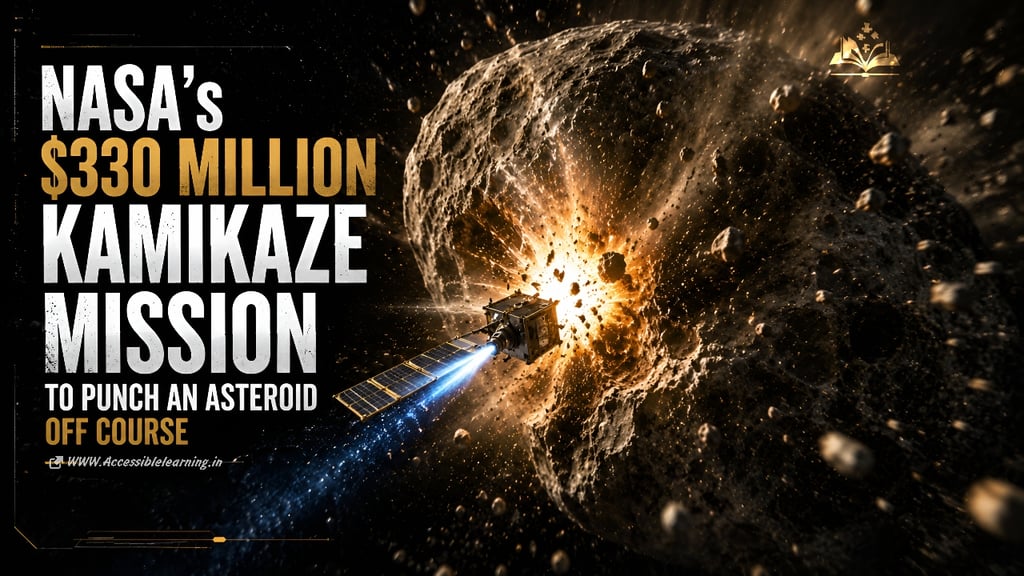
The clock reads 7:14 p.m. EDT on September 26, 2022.
A 1,260-pound spacecraft (barely the size of a refrigerator) is hurtling through the vacuum at 14,000 miles per hour. It has traveled 6.8 million miles to reach this exact moment. And in the next six seconds, it's going to obliterate itself on purpose.
This isn't an accident. This is the plan.
The Didymos binary asteroid system looms ahead: a 2,600-foot asteroid named Didymos and its smaller companion moon, Dimorphos—740 feet of ancient rock spinning in orbit around its larger sibling. Neither threatens Earth. They never will. But Dimorphos is about to become humanity's first deliberate target in a new kind of warfare: planetary defense.
The spacecraft—NASA's Double Asteroid Redirection Test, or DART—makes final autonomous adjustments. There's no pilot at the controls, no mission commander screaming corrections from Houston. This probe is flying solo through the dark, calculating its own trajectory, making split-second decisions about how to hit a moving target in the void of space.
Then impact. The mission was a success. But what happened next proved something far more consequential: humanity's first planetary defense mission worked better than anyone dared hope.
The Targeting Problem: Hitting a Ghost in the Dark
Let's establish what makes this feat so audacious: hitting a small asteroid with a spacecraft is harder than most people can comprehend.
Dimorphos orbits Didymos at a distance of just 1,200 kilometers—less than three-quarters of a mile. To Earth-based telescopes, the two asteroids appear as a single point of light in the cosmic void. Even with humanity's most powerful observatories, separating them visually is barely possible. But DART couldn't rely on what astronomers on Earth could see. It had to navigate by what it could see itself.
The spacecraft carried a single instrument: DRACO, the Didymos Reconnaissance and Asteroid Camera for OpNav. This wasn't some cutting-edge sensor suite born from years of specialized development. It was a repurposed imager from a previous space mission, jury-rigged to perform a task no camera had ever attempted: identify a 740-foot asteroid in the blackness of space and guide a speeding probe directly into it.
The catch? Dimorphos wouldn't even become visible in DRACO's field of view until 40 minutes before impact. Forty minutes. That's when the autonomous guidance system would activate and take control based on a target it had just identified for the first time. Miss that window, and DART would sail harmlessly past billions of dollars of carefully orchestrated hardware.
The Physics That Almost Broke Everything
Here's where the theoretical elegance of the mission collided with brutal physics.
The assumption underlying NASA's $330 million kamikaze mission was deceptively simple: hit something hard enough, and it moves. Newton's Third Law. Action and reaction. You apply force; the object responds.
Except asteroids aren't billiard balls sitting on a pool table.
When a 1,260-pound probe traveling at 14,000 mph collides with an 11-billion-ton asteroid, the interaction isn't a clean transfer of momentum. The impact generates something far more complex: a debris plume. Rock and dust eject violently backward from the impact site, shooting into space like a cosmic rocket exhaust. That ejected material becomes a thruster in reverse, pushing the asteroid in the opposite direction.
The physics is counterintuitive: the asteroid doesn't move simply because something hit it. It moves because the aftermath is shoving it.
The problem haunting mission planners was fundamental: nobody had ever measured how much momentum the debris plume would transfer. The theoretical models disagreed wildly. Some projections suggested DART would nudge Dimorphos' orbit by just 73 seconds. Others predicted 4 minutes of change. The difference between those numbers wasn't academic nitpicking—it was the difference between marginal success and vindication.
Key Mission Specifications:
Distance traveled: 6.8 million miles
Impact velocity: 14,000 mph
Target diameter: 740 feet
Required precision: Within 50 feet at impact
Autonomous navigation window: Final 40 minutes
Fuel margins: Razor-thin
Backup plan: None
The $330 million question hung in the void: Would we even know if we'd succeeded?
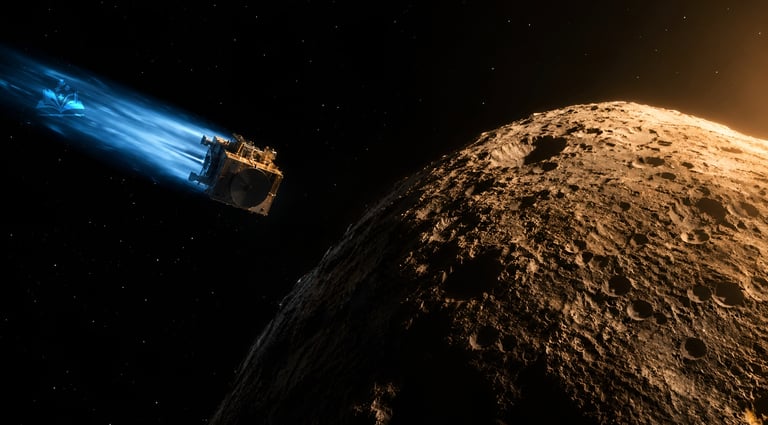
The Navigation Gauntlet: One Shot, No Margin for Error
DART had to achieve something close to interplanetary microsurgery.
The spacecraft launched in November 2021 and coasted for nearly 10 months to reach the asteroid pair. Over those months, celestial mechanics bent the trajectory constantly. Earth's gravity pulled at it. The Sun's gravitational field tugged it sideways. Relativistic effects whispered tiny adjustments. Mission control could make corrections with the spacecraft's thrusters, but fuel was finite. Every course adjustment burned precious reserves that might be needed for the critical final approach.
The engineers had built redundancy into the system, but space doesn't care about redundancy. Space cares about physics. Imagine trying to throw a dart from New York that hits a city block in London—while traveling through fog that only clears 40 seconds before impact, and you only get one dart.
The Moment of Impact: DRACO's Last Feed
The data stream from DRACO came in pixelated and raw: a small gray object growing larger in real time. Dimorphos. The target. Less than one minute to collision.
The control room at Johns Hopkins Applied Physics Laboratory fell silent. The engineers were spectators now. They had done everything they could do. Decades of planning, billions in taxpayer funding, hundreds of careers—all distilled into the next 60 seconds.
DRACO's images became increasingly clear. Dimorphos transformed from a point of light to a visible, cratered surface. The guidance system locked in. Trajectory confirmed. Perfect approach vector.
Then: black. The feed cuts. Dimorphos fills the entire frame. Impact.
The spacecraft vanished—intentionally vaporized in the collision. But telemetry from approaching instruments confirmed what had happened: DART had executed its mission flawlessly.
"We were essentially telling a refrigerator-sized spacecraft to hit a moving target 6.8 million miles away while flying blind for most of the journey. The accuracy required was extraordinary." — DART Mission Team
The Discovery: We Were Wrong (In the Best Way)
Observations began arriving days later. Ground-based telescopes tracked Dimorphos as it orbited Didymos. Had the orbital period changed?
The data came in slowly but decisively. Dimorphos' orbital period had shifted by 22 minutes. The predictions had ranged from 73 seconds to 4 minutes. DART delivered more than five times the expected change.
The debris plume effect was far more powerful than theoretical models predicted.
This wasn't a marginal success. This was validation that humanity had unlocked something new: a proven method of moving asteroids.
"DART proved that kinetic impact doesn't just work in theory—it works better than our best models predicted. That changes everything about planetary defense strategy."


A New Age of Cosmic Security
The DART mission cost $330 million. Consider context: the U.S. military spends that amount on weapons systems every few days. The fact that humanity dedicated an entire spacecraft solely to testing planetary defense—and that it succeeded beyond expectations—represents a watershed moment in space policy.
The message is stark and unmissable: if a city-killer asteroid is ever aimed at Earth, humanity doesn't need prayer. We don't need evacuation protocols or end-of-world contingencies. We can build a kinetic impactor, aim it at the threat, and punch the asteroid out of the way.
That's not speculation anymore. That's proven science. The future of planetary defense isn't theoretical. It's operational. And it works.
FAQ's
Q: Was Dimorphos Actually a Threat to Earth?
No. Neither Dimorphos nor Didymos poses any risk to Earth for the foreseeable future. That was entirely the point. Scientists deliberately chose a harmless target so that even if something went catastrophically wrong, there would be zero consequences for our planet. The DART mission was a weapons test conducted in the safest possible environment. It proved the technology works before we ever need to use it against a real threat.
Q: Why Not Just Blow Up Dangerous Asteroids with Nuclear Weapons?
This question sounds logical until you do the math. Detonating a nuclear weapon near a large asteroid would fragment it into dozens of smaller pieces—some of which might still hit Earth, just in multiple locations instead of one. You'd essentially be trading one city-killer for several regional killers. Kinetic impact, by contrast, nudges the asteroid into a different orbit without destroying it. The asteroid stays intact, just repositioned. It's planetary surgery instead of planetary demolition.
Q: How Much Warning Time Do We Actually Have Before a Dangerous Asteroid Arrives?
Most near-Earth asteroids are discovered years or even decades before they get close to our planet. NASA's Planetary Defense Coordination Office tracks over 28,000 known near-Earth asteroids. None pose a threat for at least the next 100 years. The real danger would be discovering a previously unknown asteroid aimed directly at Earth with less than a year's warning. Even then, a DART-style kinetic impactor sent immediately could nudge it enough to miss populated areas. The earlier you can detect a threat, the smaller the nudge needs to be.
Q: Couldn't This Technology Be Weaponized Against Satellites or Space Stations?
Technically yes, but it's impractical and far less efficient than existing anti-satellite weapons. A kinetic impact requires extreme precision and months of planning—you can't just fire one at a moving target on a whim. Existing military systems can destroy satellites far more quickly and with more control. What makes DART revolutionary is that it works slowly and predictably—perfect for moving asteroids, but useless as a fast-response weapon.
Q: How Long Until Humanity Faces a Real Planetary Threat That Requires This?
Statistically, a civilization-ending asteroid impact happens roughly every 100,000 years on average. A 2023 NASA assessment estimated there's roughly a 1-in-500,000 chance per year of a large asteroid hitting Earth. Those odds sound reassuring until you realize we've only been tracking asteroids systematically for about 30 years. We still don't know about every potentially dangerous object out there. The mission to map all near-Earth asteroids down to small sizes could take decades. The good news: DART proved we have a solution if we need it.
Q: What Happened to All the Debris Created by the Impact?
The debris ejected from Dimorphos during impact didn't disappear—it became the mechanism that pushed the asteroid. Most of the ejected material remained in the asteroid system, now orbiting at slightly different speeds. Some debris scattered into space, but an 11-billion-ton asteroid is so massive that the relatively tiny debris plume didn't significantly alter the system's stability. Calculations show the Didymos system remains stable and poses no future hazard.
Q: Could We Do This Again if We Needed To?
Yes, and that's the real victory. DART proved the concept works with current technology. Building another kinetic impactor would cost far less the second time around—engineers would have real data instead of theoretical models. NASA is already designing a follow-up mission to Didymos (named Hera) launching in 2026 to measure the crater DART created and gather more data for future missions. If an actual threatening asteroid is ever discovered, we now know we have a proven, practical solution that doesn't require inventing new physics.
Subscribe to Frontier Intelligence
All © Copyright reserved by Accessible-Learning Hub
| Terms & Conditions
Accessible Learning Hub — Actionable clarity for high-agency minds.
Weekly breakdowns on AI breakthroughs, capital flow, and human performance systems. Zero fluff.