

Vidu AI vs Veo 3 vs Sora AI: Which AI Video Generator Is the Most Powerful?
Explore the detailed comparison of Vidu AI, Veo 3, and Sora AI. Learn how these advanced AI video generators differ in cinematic quality, storytelling ability, realism, and creative capabilities, shaping the future of video production.
ARTIFICIAL INTELLIGENCE & FUTURE TECH
Sachin K Chaurasiya
4/12/20266 min read
Artificial intelligence is transforming video production at a pace few expected. Traditionally, creating high-quality video required expensive equipment, editing software, actors, lighting setups, and production teams. Today, AI models can generate cinematic videos from simple text prompts.
A new generation of text-to-video AI systems is making it possible to produce complex visual scenes in seconds. Among the most discussed platforms are Vidu AI, Veo 3, and Sora AI. These systems represent some of the most advanced attempts to automate video creation using artificial intelligence.
Each model focuses on different strengths. Some emphasize cinematic realism; others prioritize storytelling or fast content generation. Understanding how they differ helps creators, marketers, and developers choose the right tool for their projects.
Understanding AI Video Generation
Before comparing the platforms, it is important to understand how AI video generation works. AI video models are trained using massive datasets containing images, videos, and text descriptions. These models learn how objects move, how lighting behaves, how environments interact, and how camera angles affect perception.
When a user provides a prompt such as:
"A cinematic slow-motion shot of a surfer riding a giant wave at sunset."
The AI model generates multiple frames that simulate motion, lighting, physics, and camera perspective. Modern AI video systems focus on several critical capabilities:
prompt interpretation and contextual understanding
consistent motion between frames
realistic lighting and shadows
stable characters and objects
camera movement simulation
cinematic composition
The better a model performs in these areas, the more realistic and useful the generated videos become.

Vidu AI
What is Vidu AI?
Vidu AI is a modern AI video generation platform designed to create animated and stylized video clips from text prompts or images. It focuses on speed, creative flexibility, and accessibility for everyday creators.
The platform is particularly known for producing visually appealing animations, short cinematic clips, and stylized content that works well for social media and digital storytelling.
Unlike some models that aim purely for realism, Vidu often performs best when generating artistic visuals.
Core Capabilities
Text-to-Video Generation
Users can write prompts describing scenes, characters, or environments, and Vidu generates animated video sequences based on the instructions.
Image-to-Video Animation
Creators can upload images and convert them into animated sequences, adding movement and camera motion.
Style Control
Vidu supports multiple artistic styles, including
anime
illustration
cinematic animation
stylized advertising visuals
Rapid Rendering
The system is optimized for speed, allowing creators to produce short clips quickly for testing ideas or creating content.
Reference-Based Generation
Users can provide reference frames to maintain consistency in characters or environments.
Advantages
fast generation speeds
strong stylized visuals
easy entry for beginners
flexible animation capabilities
Limitations
less photorealistic than cinematic models
limited advanced physics simulation
shorter video length compared to future models
Ideal Users
Vidu AI works well for:
content creators
social media marketers
designers experimenting with animation
short creative storytelling projects

VEO 3
What is Veo 3?
Veo 3 is an advanced AI video generation system developed by Google. The model focuses heavily on cinematic realism and professional filmmaking techniques.
It aims to produce video clips that look similar to real camera footage, including natural lighting, complex environments, and realistic human movement. Because of this focus, Veo is often viewed as one of the most powerful AI tools for cinematic video creation.
Key Technologies Behind Veo
Veo combines several advanced technologies:
large multimodal training models
motion prediction systems
scene consistency algorithms
camera simulation techniques
These technologies help the model generate coherent scenes that look like real filmed footage.
Major Features
Cinematic Camera Control
Users can specify camera movements such as:
tracking shots
crane shots
drone perspectives
slow-motion footage
Realistic Environmental Rendering
Veo produces detailed environments, including weather effects, reflections, and natural lighting.
High-Resolution Output
The model supports high-resolution video generation suitable for professional visual content.
Audio Integration
Some implementations of Veo can generate synchronized audio elements like music, dialogue, and environmental sounds.
Advanced Motion Consistency
Objects and characters maintain consistent movement across frames, reducing visual glitches.
Advantages
cinematic visual quality
realistic lighting and textures
advanced camera simulation
high-resolution video capability
Limitations
access may be limited
clip length can be short
heavy computational requirements
Ideal Users
Veo 3 is suitable for:
filmmakers and studios
advertising agencies
visual effects teams
concept artists

Sora AI
What is Sora AI?
Sora AI is a text-to-video model developed by OpenAI designed to generate realistic and story-driven video scenes from detailed prompts. It became widely recognized for its ability to generate complex environments, characters, and actions within a single coherent scene. Sora is particularly strong at interpreting narrative descriptions and translating them into dynamic visuals.
Key Capabilities
Narrative Scene Generation
Sora can interpret detailed prompts describing multiple characters, environments, and events happening simultaneously.
Complex Motion Simulation
The model simulates realistic movement such as:
walking characters
environmental motion
object interaction
water and particle effects
Story-Based Video Creation
Sora excels at producing clips that feel like parts of a story rather than isolated scenes.
Environmental Awareness
The system generates detailed backgrounds with natural depth, lighting, and spatial relationships.
Creative Interpretation
It performs well with imaginative prompts, including fantasy worlds and futuristic concepts.
Advantages
strong narrative understanding
impressive scene complexity
detailed environments
natural motion simulation
Limitations
still limited availability
high computational demands
complex prompts may require refinement
Ideal Users
Sora AI is useful for:
storytellers
filmmakers
creative designers
concept visualization
Factors to Consider
Prompt Engineering Importance
AI video generation depends heavily on prompt quality. Detailed prompts with camera angles, lighting descriptions, and motion instructions often produce better results.
Example prompt:
"Wide cinematic drone shot of a snowy mountain village at sunrise with soft golden light and drifting fog."
More specific prompts typically lead to better-generated videos.
Ethical and Safety Considerations
AI video generation raises important concerns such as:
deepfake misuse
misinformation through synthetic media
copyright and ownership issues
Developers are implementing safety systems to prevent misuse and improve transparency.
Impact on the Creative Industry
AI video tools could reshape many industries, including:
filmmaking
advertising
digital marketing
gaming
education
social media content creation
Instead of replacing creators, these tools are likely to become powerful assistants that accelerate the creative process.
The Future of AI Video Technology
AI video models are evolving rapidly. Current systems generate short clips lasting a few seconds, but future models may generate full scenes or even entire films.
Expected future improvements include:
multi-minute video generation
consistent characters across scenes
AI voice acting and dialogue generation
interactive scene editing
real-time video creation
These developments could eventually transform how visual media is produced.
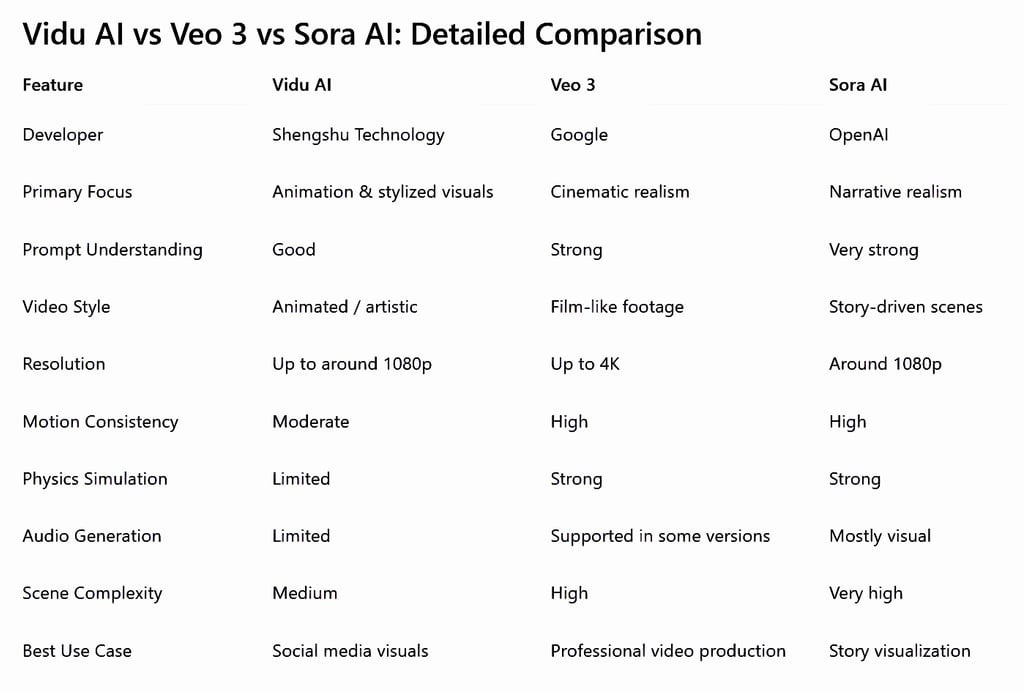
Vidu AI, Veo 3, and Sora AI represent three different approaches to AI video generation.
Vidu AI prioritizes speed and creative animation.
Veo 3 pushes cinematic realism and professional filmmaking capabilities.
Sora AI focuses on storytelling and complex scene generation.
Each platform excels in different areas, and their continued development will likely push AI video technology even further.
As these systems evolve, the boundary between traditional filmmaking and AI-generated video will continue to blur, opening new possibilities for creators worldwide.

FAQ's
Q: What is the difference between Vidu AI, Veo 3, and Sora AI?
Vidu AI, Veo 3, and Sora AI are all AI video generation models, but they focus on different strengths. Vidu AI is known for fast generation and stylized visuals such as animation and creative social media content. Veo 3 focuses on cinematic realism with advanced camera control and high-quality visuals. Sora AI stands out for narrative understanding, allowing it to generate complex scenes with multiple actions and detailed environments.
Q: Which AI video generator is the most realistic?
Among the three platforms, Veo 3 is generally considered the most cinematic and realistic. It emphasizes professional filmmaking techniques such as realistic lighting, natural motion, camera movement, and high-resolution visuals. Sora AI is also highly realistic but is particularly strong in storytelling and scene complexity.
Q: Is Sora AI better than Veo 3 for storytelling?
Yes, Sora AI is often stronger for storytelling. It can interpret complex prompts involving multiple characters, actions, and environments. This allows it to generate scenes that feel like parts of a narrative rather than isolated video clips.
Q: What is Vidu AI mainly used for?
Vidu AI is widely used for creative content such as animated clips, stylized visuals, marketing videos, and social media content. Because it generates videos quickly and supports artistic styles, it is popular among designers, creators, and digital marketers.
Q: Can AI video generators replace traditional video production?
AI video generators are unlikely to fully replace traditional filmmaking, but they can significantly speed up the creative process. They are useful for concept visualization, rapid prototyping, marketing content, and experimental storytelling. Many filmmakers are expected to combine AI tools with traditional production techniques.
Q: How long can AI video generators create videos?
Most current AI video models generate short clips ranging from a few seconds to around 10–20 seconds. However, future versions are expected to support longer video generation with improved scene consistency and character continuity.
Q: Do AI video generators support audio and dialogue?
Some advanced models are beginning to integrate audio generation. For example, Veo has experimented with generating synchronized sound effects and dialogue. Many other models currently focus primarily on visual generation, with audio added later during editing.
Q: Are AI video generators available for public use?
Access depends on the platform. Some AI video tools are available through limited beta programs or creative platforms, while others are gradually expanding access. As AI technology evolves, more video generation tools are expected to become publicly accessible.
Q: What industries can benefit from AI video generation?
AI video technology can impact many industries, including:
filmmaking and entertainment
digital marketing and advertising
gaming and virtual worlds
education and training
social media content creation
product visualization and design
These tools can help creators produce visual content faster and explore new creative possibilities.
Q: What is the future of AI video generation?
The future of AI video generation will likely include longer videos, consistent characters across scenes, realistic voice generation, and real-time editing through prompts. As models improve, AI could become a central tool in filmmaking, advertising, and digital storytelling.
Subscribe to Frontier Intelligence
All © Copyright reserved by Accessible-Learning Hub
| Terms & Conditions
Accessible Learning Hub — Actionable clarity for high-agency minds.
Weekly breakdowns on AI breakthroughs, capital flow, and human performance systems. Zero fluff.