

Veer Savarkar: Revolutionary, Ideologue, and Controversial Figure in Indian History
Explore Veer Savarkar's life as a revolutionary, ideologue, and controversial figure. From Cellular Jail to Hindutva philosophy—discover his complex legacy in Indian history.
INDIAN HISTORYTHE GREAT LEADERBIOGRAPHY/HISTORY
Keshav Jha
12/21/202510 min read
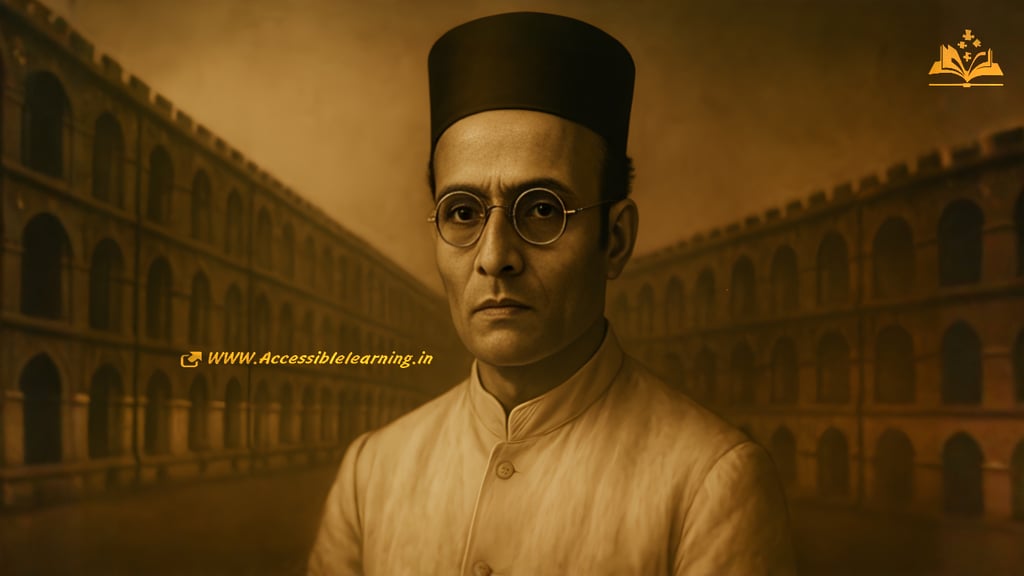
Who Was Veer Savarkar?
Vinayak Damodar Savarkar, popularly known as Veer Savarkar (translating to "Brave Savarkar"), remains one of India's most debated historical figures. Born on May 28, 1883, in Bhagur, Maharashtra, Savarkar was a freedom fighter, political activist, lawyer, writer, and social reformer whose legacy continues to spark intense discussions across India's political spectrum.
What makes Savarkar's story compelling is the stark contrast between his early revolutionary activities against British colonial rule and his later ideological positions that shaped Hindu nationalist thought. His life journey—from organizing armed resistance to spending years in the infamous Cellular Jail in the Andaman Islands—offers crucial insights into India's independence movement and the formation of modern Indian political identity.
Early Life and Revolutionary Beginnings
Formative Years in Maharashtra
Savarkar grew up in a middle-class Chitpavan Brahmin family in Maharashtra during British colonial rule. His early exposure to nationalist ideas came through his elder brother Ganesh Damodar Savarkar, who was already involved in anti-British activities. The young Vinayak showed exceptional intelligence and developed strong nationalist sentiments from his teenage years.
By age 16, Savarkar had already formed a youth organization called "Mitra Mela" (Friends' Club) in 1899, which later transformed into the more militant "Abhinav Bharat Society" (Young India Society) in 1904. This organization aimed to achieve complete independence through revolutionary means, marking Savarkar's early commitment to armed resistance.
Education and Revolutionary Activities in London
In 1906, Savarkar traveled to London on a scholarship to study law at Gray's Inn. However, his time in London became less about legal studies and more about revolutionary networking. He established connections with various international revolutionary groups and Indian freedom fighters abroad.
During this period, Savarkar wrote extensively, producing works that would later be banned by the British authorities. His most significant early work, "The Indian War of Independence of 1857," reframed what the British called the "Sepoy Mutiny" as India's first organized war of independence. The book was banned before publication in Britain and India but circulated secretly among revolutionists.
The Cellular Jail: Kala Pani Imprisonment
Arrest and Transportation to Andaman Islands
Savarkar's revolutionary activities caught up with him in 1910 when he was arrested in London for his connections to revolutionary groups. During his transportation back to India by ship, Savarkar made a dramatic escape attempt in Marseilles, France, which failed. This incident became internationally significant, with France eventually returning him to British custody despite initial asylum claims.
In 1911, Savarkar was sentenced to two life terms of imprisonment totaling 50 years—a reflection of how seriously the British viewed his threat to colonial rule. He was sent to the Cellular Jail in the Andaman and Nicobar Islands, infamously known as "Kala Pani" (Black Waters), considered one of the harshest penal settlements.
Life in Cellular Jail: Hardship and Transformation
The Cellular Jail experience profoundly shaped Savarkar's later life and thinking. Prisoners faced brutal conditions: solitary confinement in individual cells, forced labor extracting oil from coconuts, limited food, and physical torture. Savarkar spent years in this isolation, which tested his physical and mental endurance.
During his imprisonment spanning over a decade (1911-1921 in the Andamans, followed by mainland prisons), Savarkar wrote extensively, scratching words on prison walls with thorns and memorizing thousands of lines of poetry. He also began submitting mercy petitions to British authorities—a controversial aspect of his legacy that critics point to as evidence of capitulation.


Ideological Contributions: Hindutva and Political Philosophy
Defining Hindutva: Beyond Religion
Savarkar's most enduring intellectual contribution came through his 1923 book "Hindutva: Who is a Hindu?" Written during his imprisonment, this work laid the philosophical foundation for Hindu nationalism in India. Savarkar defined "Hindutva" not merely as a religion but as a cultural and political identity.
His definition encompassed three key elements:
Rashtra (nation): India as the homeland
Jati (race): A common ancestry or bloodline
Sanskriti (culture): Shared civilization and cultural heritage
According to Savarkar's formulation, a Hindu is anyone for whom India is both "Pitribhu" (fatherland) and "Punyabhu" (holy land). This definition included Hindus, Buddhists, Jains, and Sikhs but implicitly excluded Muslims and Christians, whose holy lands lay outside India—a distinction that remains controversial.
Social Reform Advocacy
Despite his Hindu nationalist ideology, Savarkar advocated for several progressive social reforms that challenged orthodox Hindu practices:
Opposition to caste discrimination: He actively campaigned against untouchability and supported temple entry for all castes
Inter-caste dining and marriages: Organized events promoting social mixing across caste lines
Women's rights: Supported women's education and opposed child marriage
Rationalist approach: Criticized blind faith and superstitious practices within Hindu society
This combination of Hindu cultural nationalism with social reform created a unique ideological position that defied simple categorization.
Controversies and Criticism
The Mercy Petition Debate
One of the most contentious aspects of Savarkar's legacy involves his submission of multiple mercy petitions to British authorities during his imprisonment. Critics argue these petitions showed weakness and a willingness to compromise with colonial powers in exchange for personal freedom. His petitions expressed willingness to serve the British government if released.
Supporters counter that these were tactical moves by a practical revolutionary who recognized the futility of suffering in isolation when he could contribute to the freedom struggle outside prison. They point to his continued nationalist activities after release as evidence of unchanged commitment.
Allegations Surrounding Mahatma Gandhi's Assassination
Savarkar faced one of his most serious challenges when he was arrested and tried for conspiracy in the assassination of Mahatma Gandhi on January 30, 1948. Nathuram Godse, Gandhi's assassin, was a former member of organizations influenced by Savarkar's ideology.
The trial court acquitted Savarkar due to a lack of evidence linking him directly to the conspiracy. However, subsequent investigations and historical analyses have kept this question alive. The Kapur Commission in 1969 expressed doubt about the acquittal, though this had no legal consequences. This association with Gandhi's assassination remains perhaps the darkest shadow over Savarkar's legacy.
Stance During the Quit India Movement
Another criticism focuses on Savarkar's position during the 1942 Quit India Movement. While the Congress launched this mass civil disobedience campaign against British rule, Savarkar and the Hindu Mahasabha (which he led) did not support the movement. Instead, they encouraged Hindus to join the British armed forces and gain military training.
Critics view this as collaboration with colonial powers during a crucial phase of the independence struggle. Supporters argue Savarkar was being pragmatic, recognizing the geopolitical context of World War II and prioritizing Hindu interests in anticipation of partition.
Political Career and Hindu Mahasabha Leadership
Hindu Mahasabha Presidency
Savarkar served as the president of the Hindu Mahasabha from 1937 to 1943, transforming it into a significant political force. Under his leadership, the organization articulated a clear Hindu nationalist vision that competed with the Congress's secular nationalism and the Muslim League's demand for Pakistan.
His political philosophy emphasized:
Hindu unity across caste and sect lines
Opposition to the partition of India along religious lines
Preparation of Hindus for potential conflicts with other communities
Military training and "Hinduization of politics and militarization of Hindudom"
Relationship with Other Freedom Fighters
Savarkar's relationships with other independence movement leaders were complex and often strained. While he shared the goal of Indian independence with leaders like Gandhi, Nehru, and Subhas Chandra Bose, his methods and underlying philosophy differed significantly.
He criticized Gandhi's non-violence as ineffective and his approach to Hindu-Muslim unity as appeasement. Similarly, he found himself at odds with Nehru's secular socialist vision for independent India. These ideological divides reflected deeper questions about what independent India should become.
Literary and Intellectual Contributions
Written Works and Poetry
Beyond political activism, Savarkar was a prolific writer and poet. His works span multiple genres and languages, primarily Marathi, Hindi, and English. Key literary contributions include:
"The Indian War of Independence of 1857": Reinterpreted 1857 as a coordinated independence struggle
"Hindutva: Who is a Hindu?": Defined Hindu identity in cultural-political terms
"Six Glorious Epochs of Indian History": Presented Hindu-centric historical narrative
Poetry collections: Wrote patriotic poems and verses during imprisonment
His writing style combined historical analysis, political philosophy, and emotional appeal, making complex ideas accessible to broader audiences.
Historical Methodology and Narrative
Savarkar approached Indian history with a particular lens that emphasized Hindu valor, resistance to invasions, and civilizational continuity. His historical narratives focused on:
Hindu resistance to Islamic invasions from the 8th century onward
Stories of Hindu kings and warriors who fought foreign rule
Cultural and religious preservation during periods of Muslim dominance
Reinterpretation of historical events through a Hindu nationalist perspective
While this approach resonated with many who felt Indian history had been written primarily by colonial historians, critics argued it selectively presented evidence and fostered communal divisions.
Later Life and Death
Post-Independence Years
After India's independence in 1947 and his acquittal in the Gandhi assassination case in 1949, Savarkar lived a relatively quiet life. He withdrew from active politics and spent his time writing and reflecting on the direction of independent India.
Disappointed with developments such as the secular Constitution, Nehruvian socialism, and what he perceived as appeasement of minorities, Savarkar watched from the sidelines as India took shape differently from his vision.
Final Years and Atmaarpan (Self-Sacrifice)
In his final years, Savarkar's health declined. In 1966, he announced he would undertake "Atmaarpan" (self-sacrifice), refusing food and medicine. On February 26, 1966, Veer Savarkar died at his residence in Bombay (now Mumbai), bringing to an end a life spanning eight decades and some of India's most tumultuous historical periods.

Contemporary Relevance and Modern Debates
Political Appropriation and Symbolism
In contemporary Indian politics, Savarkar has become a highly symbolic figure. The Bharatiya Janata Party (BJP) and associated organizations celebrate him as a fearless freedom fighter and nationalist icon. Government initiatives have included:
Naming airports, public institutions, and roads after Savarkar
Installing portraits in Parliament and other government buildings
Promoting his works through educational curricula
Commemorating anniversaries of his birth and death
Opposition parties and critics resist this glorification, arguing it overlooks his controversial positions and alleged connections to Gandhi's assassination. These debates reflect broader tensions about India's national identity and the role of Hindu nationalism in a secular democracy.
Academic Reassessment
Historical scholarship on Savarkar has expanded significantly in recent decades. Academic works attempt to contextualize his actions within the colonial period, analyze his ideological contributions objectively, and separate hagiography from historical fact.
Recent biographies and studies examine:
The evolution of his thought from revolutionary socialism to Hindu nationalism
His influence on contemporary right-wing movements
Comparative analysis with other nationalist leaders
The lasting impact of Hindutva philosophy on Indian politics
Global Hindu Diaspora Perspective
Among the global Hindu diaspora, Savarkar's legacy generates varied responses. Some diaspora organizations celebrate him as a champion of Hindu identity and cultural pride. Others, particularly in Western academic contexts, scrutinize his ideology's relationship with concepts of majority nationalism and minority rights.
The transnational discussion about Savarkar reflects broader conversations about identity, nationalism, and pluralism in increasingly diverse societies worldwide.
Frequently Asked Questions
Q: What does "Veer" in Veer Savarkar mean?
"Veer" means "brave" or "courageous" in Sanskrit and Hindi. This honorific was added to Vinayak Damodar Savarkar's name by his followers and supporters, recognizing his revolutionary activities against British colonial rule and his endurance during harsh imprisonment in the Cellular Jail.
Q: Why was Savarkar sent to Kala Pani?
Savarkar was sentenced to transportation for life ("Kala Pani") in the Andaman Islands' Cellular Jail due to his involvement in revolutionary activities against British rule. He was convicted of waging war against the King-Emperor, abetting murder, and involvement with the Abhinav Bharat Society, which planned armed resistance and assassinations of British officials.
Q: What is the difference between Hinduism and Hindutva according to Savarkar?
According to Savarkar, Hinduism is a religion with specific beliefs, practices, and rituals, while Hindutva is a broader cultural, political, and national identity. Hindutva encompasses anyone who considers India their fatherland (Pitribhu) and holy land (Punyabhu), regardless of their specific religious practices. This definition aimed to create a unifying national identity based on shared civilization rather than just religious belief.
Q: Did Savarkar support or oppose Indian independence?
Savarkar consistently supported Indian independence throughout his life. However, his methods and approach evolved. Initially, he advocated armed revolutionary resistance. Later, particularly during World War II, he adopted more pragmatic positions, including encouraging military service in British forces to gain training for future conflicts. His non-participation in movements like Quit India reflected strategic disagreements, not opposition to independence itself.
Q: Was Savarkar involved in Gandhi's assassination?
Savarkar was arrested and tried for conspiracy in Mahatma Gandhi's assassination in 1948, as the assassin Nathuram Godse had connections to Savarkar's ideological circle. The trial court acquitted Savarkar due to insufficient evidence linking him directly to the conspiracy. However, the 1969 Kapur Commission expressed doubts about this acquittal. The question remains controversial, with no definitive legal conclusion beyond the original acquittal.
Q: What social reforms did Savarkar advocate?
Despite his Hindu nationalist ideology, Savarkar supported progressive social reforms, including the abolition of untouchability and caste discrimination, temple entry for all castes, inter-caste dining and marriages, women's education and rights, widow remarriage, opposition to child marriage, and rationalist approaches that challenged superstitious practices. He organized public events demonstrating these values, earning both praise and criticism from different segments of Hindu society.
Q: How do historians view Savarkar's mercy petitions?
Historians remain divided on Savarkar's multiple mercy petitions to British authorities during his imprisonment. Critics argue they demonstrated weakness and willingness to compromise principles for personal freedom, as he expressed readiness to serve the British government. Supporters contend these were pragmatic tactical moves by someone who recognized he could contribute more to the independence struggle outside prison. The debate reflects broader questions about revolutionary purity versus practical effectiveness.
Q: What is Savarkar's legacy in modern India?
Savarkar's legacy remains deeply contested in contemporary India. Right-wing Hindu nationalist organizations celebrate him as a freedom fighter, social reformer, and intellectual founder of Hindu nationalism. Left-wing and secular groups criticize his ideology's divisive potential and his alleged connections to Gandhi's assassination. Government recognition of Savarkar has increased under BJP-led administrations, while opposition parties resist this glorification. His legacy thus serves as a focal point for larger debates about Indian national identity, secularism, and Hindu nationalism.
Veer Savarkar defies simple categorization. He was simultaneously a revolutionary who suffered brutal imprisonment for opposing British rule and an ideologue whose vision of Hindu nationalism conflicts with secular democratic principles. He advocated for progressive social reforms while articulating an exclusionary definition of national identity. He inspired generations of Hindu nationalists while alienating Muslims, Christians, and secular Indians.
Understanding Savarkar requires acknowledging these contradictions without reducing him to a one-dimensional hero or villain. His life and work pose challenging questions that remain relevant: How should diverse nations balance majority and minority identities? What relationship should exist between religion and politics? How do we evaluate historical figures whose actions we may admire while rejecting aspects of their ideology?
As India continues evolving as the world's largest democracy, debates around Savarkar's legacy will likely persist, serving as a lens through which Indians negotiate their past, present, and future national identity. Whether one views him as a visionary patriot or a divisive ideologue, his impact on Indian political thought and practice remains undeniable and continues shaping contemporary discourse.
The story of Veer Savarkar ultimately reflects the complexity of India's independence movement and the ongoing challenge of building an inclusive nation from diverse religious, cultural, and ideological traditions.
Subscribe to Frontier Intelligence
All © Copyright reserved by Accessible-Learning Hub
| Terms & Conditions
Accessible Learning Hub — Actionable clarity for high-agency minds.
Weekly breakdowns on AI breakthroughs, capital flow, and human performance systems. Zero fluff.