

Top 10 Uncensored AI Platforms for 2026: The Ultimate Guide to Open AI Tools
Discover the top uncensored AI platforms for 2026 that offer full creative freedom, local deployment, and advanced customization. Explore powerful open-source tools for writing, coding, design, research, and automation while understanding their benefits, risks, and real-world uses.
AI ASSISTANTAI/FUTURECOMPANY/INDUSTRY
Sachin K Chaurasiya
3/4/20266 min read
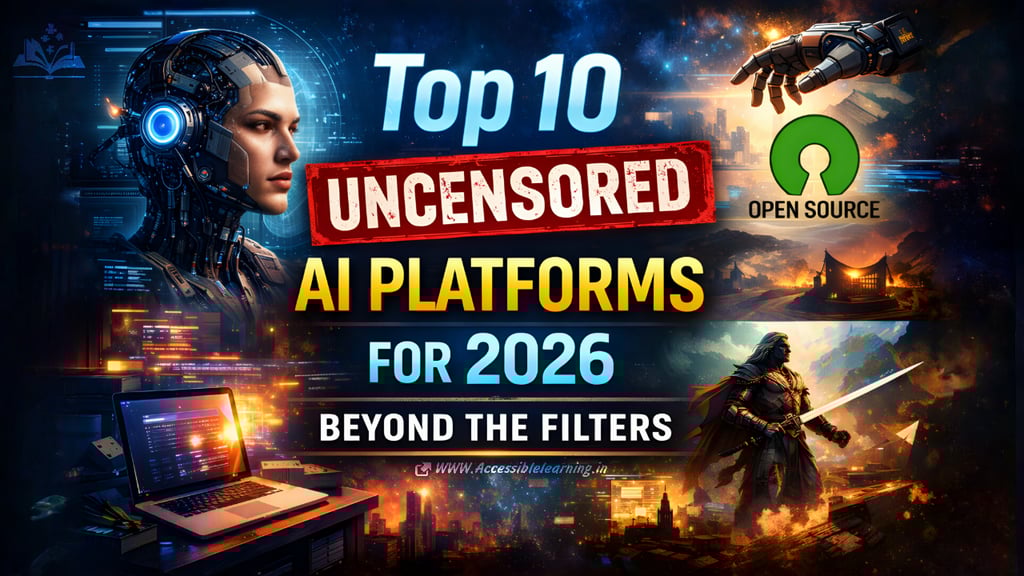
Artificial intelligence has grown fast, but so have moderation layers. Many creators, developers, and researchers now look for uncensored AI platforms that allow deeper experimentation, storytelling freedom, and private deployment.
This in-depth guide explains what uncensored AI means, the top platforms in 2026, technical details, pros and cons, real-world use cases, hardware needs, and future trends.
What Does “Uncensored AI” Really Mean?
An uncensored AI platform usually refers to systems that:
Have fewer built-in content filters
Allow local or private deployment
Let users fine-tune or retrain models
Give full control over prompts and outputs
These platforms are usually based on open-source large language models or customizable AI stacks rather than mainstream hosted chatbots.
Important Note
“Uncensored” does not mean unsafe. It means user-controlled moderation instead of forced restrictions.
Top 10 Uncensored AI Platforms in 2026
Here are the most popular platforms used by developers, writers, and AI enthusiasts today.
FreedomGPT
Best for: Offline AI usage and privacy
FreedomGPT focuses on local execution with minimal filtering.
Key Features
Runs without internet
Supports many open models
Private and secure
Limitations
Needs strong hardware
Smaller community than others
Pygmalion AI
Best for: Roleplay, storytelling, emotional dialogue
Pygmalion is known for immersive character conversations.
Key Features
Strong personality modeling
Long conversation memory
Fully open-source
Use Cases
Fiction writing
Game NPC dialogue
Interactive stories
KoboldAI
Best for: Novel writing and long-form content
KoboldAI is popular among creative writers.
Key Features
Long story support
Offline mode
Custom model integration
Use Cases
Book writing
Scriptwriting
Story brainstorming
Janitor AI
Best for: Custom character chat
Janitor AI allows users to create detailed personalities.
Key Features
Character marketplace
Multiple model backends
Deep customization
Use Cases
Character design
Roleplay communities
Game writing
OpenRouter + Open Models
Best for: Developers testing multiple LLMs
OpenRouter connects many models through one API.
Key Features
Multi-model access
Flexible pricing
Easy integration
Use Cases
App development
AI testing
Model benchmarking
Dolphin LLM Variants
Best for: Developers needing uncensored open weights
Dolphin models are fine-tuned versions with fewer alignment limits.
Key Features
High reasoning ability
Open weights
Easy retraining
Use Cases
Research experiments
Custom chatbots
Coding assistants
Nous Hermes Models
Best for: Technical experimentation
Nous Hermes models are strong instruction-tuned models.
Key Features
Strong coding ability
Flexible deployment
Active community
Use Cases
Programming help
Research tools
Local assistants
LLaMA-Based Uncensored Builds
Best for: Local AI power users
Many uncensored versions are built on LLaMA-style architectures.
Key Features
Huge ecosystem
Many fine-tuned models
High performance
Use Cases
Private AI assistants
Business automation
Knowledge base chatbots
NovelAI
Best for: Creative storytelling with fewer limits
NovelAI is built specifically for writers.
Key Features
Narrative memory
Style presets
Visual storytelling tools
Use Cases
Fiction writing
World-building
Poetry and scripts
Open WebUI + Local LLM Stack
Best for: Self-hosted AI control
Open WebUI acts as a dashboard for running local models.
Key Features
Self-hosting
Multi-model support
Clean interface
Use Cases
Team AI tools
Private research
Enterprise automation

Top 10 Other Uncensored AI Platforms for 2026
LM Studio
Best for: Running uncensored AI locally on Windows or Mac
LM Studio is one of the easiest ways to download and run open models on your own computer.
Why it’s powerful
Runs LLaMA, Mistral, DeepSeek, etc.
Offline usage
Simple UI
Many open-source models have fewer restrictions compared to commercial AI systems.
Use Cases
Private chatbot
Coding assistant
Research
Ollama
Best for: Developers building local AI apps
Ollama lets you run and deploy LLMs locally with API support.
Key Features
Easy local deployment
Works with Docker-like commands
Supports uncensored fine-tuned models
Use Cases
AI tools for clients
Website chatbots
Automation scripts
Text Generation WebUI
Best for: Advanced AI customization
This is a powerful interface used by many AI enthusiasts.
Key Features
Huge model compatibility
Plugins and extensions
Full prompt control
Use Cases
Research
AI experimentation
Prompt engineering
SillyTavern
Best for: Roleplay, character AI, storytelling
SillyTavern connects to many LLM backends and gives full prompt control.
Key Features
Character memory
Custom prompts
Multi-model support
Use Cases
Game writing
Character design
Interactive fiction
Stable Diffusion (Local Builds)
Best for: Uncensored AI image generation
Local Stable Diffusion builds allow full creative freedom.
Key Features
No content filters locally
Custom models and LoRAs
High-quality images
Use Cases
Concept art
Marketing visuals
YouTube thumbnails
Automatic1111 WebUI
Best for: Advanced image AI control
This is the most popular interface for Stable Diffusion.
Key Features
ControlNet support
Style models
Batch generation
Use Cases
Branding design
Illustration
Product mockups
H2O GPT
Best for: Business and research AI
H2O GPT is an open-source LLM framework designed for enterprise AI tools and private document search.
Key Features
Private document search
Commercial-friendly license
Custom model training
Use Cases
Business knowledge AI
Legal document analysis
Internal company chatbot
DeepSeek Open Models
Best for: Coding and reasoning
DeepSeek models are strong open-source LLMs that can be self-hosted.
Key Features
Excellent coding ability
High reasoning quality
Self-hosting support
Use Cases
Coding assistant
AI automation
Research
Mixtral-Based Uncensored Builds
Best for: High-performance local AI
Mixtral-based models are powerful mixture-of-experts systems used in many uncensored builds.
Key Features
Strong logic
Fast inference
Scalable
Use Cases
Enterprise AI
Multi-agent systems
Data analysis
Agent Frameworks (AutoGen / OpenDevin / CrewAI)
Best for: Autonomous AI workflows
Agent frameworks allow AI systems to plan tasks with fewer restrictions.
Key Features
Multi-agent collaboration
Coding automation
Research pipelines
Use Cases
Website building
AI automation
Content pipelines


Bonus: Emerging Uncensored AI Platforms
These tools are growing fast in 2026:
DeepSeek-Coder local builds
Qwen open models
Vicuna uncensored versions
MythoMax storytelling models
Gaia local AI project
These open-source models can often be self-hosted without strict moderation layers.
Types of Uncensored AI Platforms
To help readers understand better, here are the categories:
Local Chat AI: LM Studio, Ollama, Text-Gen WebUI
Image AI: Stable Diffusion, Automatic1111
Coding AI: DeepSeek, Mixtral builds
Business AI: H2O GPT
Agent AI: AutoGen, CrewAI
Storytelling AI: SillyTavern, MythoMax
This helps you choose tools based on your work style.
Additional Platforms Worth Watching
Some rising tools in 2026 include:
LM Studio (local model runner)
Text-Generation-WebUI
SillyTavern interface
DeepSeek-based open builds
These tools are growing fast and offer powerful local AI control.
Real-World Uses of Uncensored AI
Creative Writing
Authors generate darker fiction, philosophical essays, or experimental narratives.
Game Development
Studios create dynamic NPC dialogue and branching storylines.
Research
AI safety teams test edge-case prompts.
Business Automation
Companies run private AI assistants on internal data.
Education
Students explore complex topics without blocked responses.
Hardware Requirements for Local AI
Running uncensored AI locally often needs strong hardware.
Minimum Setup
16 GB RAM
Modern GPU with 8 GB VRAM
Recommended Setup
32–64 GB RAM
RTX 4070 or better GPU
Fast SSD
Smaller models can run on laptops, but large models need high-end GPUs.
Advantages of Uncensored AI
Creative Freedom: No blocked ideas during writing or brainstorming.
Privacy: Local AI keeps data secure.
Customization: You can train models on personal data.
Cost Control: No monthly API bills when running locally.
Innovation: Developers can test new ideas quickly.
Risks and Challenges
Misuse Risk: Unfiltered AI can be used for scams or misinformation.
Legal Issues: Some content may violate local laws.
Technical Complexity: Setting up local AI needs skills.
Hardware Cost: Powerful GPUs can be expensive.
Model Bias: Uncensored models may reflect training data biases.
When to Use Uncensored AI
These tools are useful for:
Writers exploring complex themes
Developers testing edge cases
Designers creating bold visuals
Businesses running private AI
Researchers studying model behavior
Open-source AI often allows deeper customization and local deployment.

Ethical Use Guidelines
When using uncensored AI:
Respect privacy
Avoid harmful content
Follow local laws
Protect personal data
Use AI responsibly
Freedom should never harm others.
Future Trends in Uncensored AI
By 2026 and beyond, expect:
Faster local AI models
Smaller high-quality models
Hybrid moderation controls
Decentralized AI networks
Personal offline AI assistants
Open-source AI is improving rapidly and may rival commercial systems soon.
Uncensored AI platforms give creators and developers powerful tools for experimentation, storytelling, and private automation. They allow deeper customization and full control over how AI behaves. But with freedom comes responsibility.
Used wisely, these tools can help build better technology, richer creative work, and smarter solutions for real problems. AI is powerful. The most important filter will always be human judgment.
FAQ's
What is an uncensored AI platform?
An uncensored AI platform is an AI system that has fewer built-in restrictions and gives users more control over prompts, outputs, and customization. Most of these tools are open-source or self-hosted, allowing creators and developers to experiment freely.
Are uncensored AI platforms legal to use?
Yes, uncensored AI platforms are legal in most countries as long as they are used responsibly and follow local laws. The tool itself is not illegal, but misuse of AI for scams, harassment, or harmful content can lead to legal issues.
Why do people use uncensored AI tools?
People use them for several reasons:
Creative writing without blocked ideas
Private AI assistants
Research and experimentation
Custom chatbot development
Running AI locally without sharing data
They offer flexibility that many commercial AI platforms cannot.
Are uncensored AI platforms safe?
They can be safe when used responsibly. However, because they have fewer restrictions, users must be careful about how they use them. Always protect personal data, avoid harmful use, and follow ethical guidelines.
Can I run uncensored AI on my personal computer?
Yes. Many uncensored AI tools are designed for local use. You usually need:
At least 16–32 GB RAM
A modern GPU for larger models
Enough storage for model files
Smaller models can run on regular laptops.
Are uncensored AI models better than filtered AI?
Not always. Uncensored AI offers more freedom, but filtered AI often provides safer and more reliable responses. The best choice depends on your purpose, such as writing fiction, research, or business automation.
What are the risks of using uncensored AI?
Some key risks include:
Generating inaccurate or biased information
Producing harmful or offensive content
Security and privacy issues if models are poorly configured
Legal problems if used irresponsibly
Understanding these risks is important before using such tools.
Which uncensored AI platforms are best for beginners?
Beginner-friendly options usually include local model runners and simple interfaces that allow easy setup. Tools with clear UI and community guides are easier to start with.
Can businesses use uncensored AI platforms?
Yes. Many companies use self-hosted AI to analyze documents, automate workflows, and protect private data. However, businesses must ensure compliance with laws, data privacy rules, and internal policies.
What is the future of uncensored AI?
The future will likely include:
More powerful local AI models
Better customization tools
Hybrid systems with optional moderation
Private AI assistants for individuals and teams
Uncensored AI will continue growing as open-source technology improves.
Subscribe To Our Newsletter
All © Copyright reserved by Accessible-Learning Hub
| Terms & Conditions
Knowledge is power. Learn with Us. 📚

