

Tokenized Luxury: Investing in a Billionaire’s “Leftovers” (Expanded Edition)
Explore how tokenized luxury is transforming investing by allowing fractional ownership of high-value assets like art, real estate, and collectibles. Learn benefits, risks, and future potential.
BANKING/CASH-FLOWWEALTHY FAMILYSTOCK MARKET
Vishwajeet Chaurasiya
4/3/20265 min read
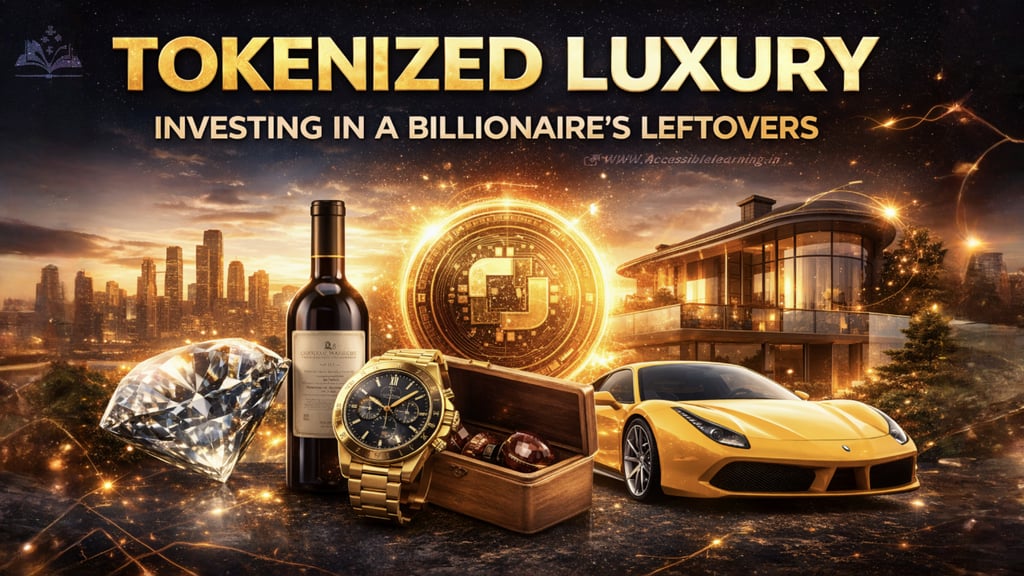
Luxury assets have always operated behind closed doors. Whether it’s blue-chip art, rare collectibles, or trophy real estate, access has been limited by capital, connections, and geography.
Tokenization changes that equation. It transforms these traditionally illiquid, exclusive assets into divisible digital units that can be owned by a broader pool of investors. This is not just a tech trend. It’s a structural shift in how ownership, wealth, and access are defined.
A Deeper Look at Tokenized Luxury
At its core, tokenized luxury combines blockchain infrastructure with real-world assets (RWAs).
Instead of a single owner holding 100% of an asset:
Ownership is split into thousands of tokens
Each token represents economic rights (and sometimes governance rights)
These tokens can be traded, held, or transferred digitally
This bridges two worlds:
Traditional finance (real assets)
Digital finance (blockchain-based ownership)
Types of Tokenized Luxury Assets (Expanded)
1. Blue-Chip Art
Works from globally recognized artists
Often held in secure vaults or galleries
Value driven by rarity, artist reputation, and historical demand
2. Trophy Real Estate
Prime locations (NYC, London, Dubai, Mumbai luxury segments)
Income from rent + long-term appreciation
Token holders may receive periodic payouts
3. Ultra-Rare Collectibles
Watches (e.g., limited Rolex/Patek pieces)
Vintage cars
Sports memorabilia
4. Luxury Lifestyle Assets
Private jets (fractional usage + investment)
Yachts
High-end hospitality investments
5. Alternative Prestige Assets
Fine wine and whiskey portfolios
Diamonds and precious stones
Fashion archives and rare designer pieces
New Layer: Token Utility Beyond Ownership
Modern tokenized luxury platforms are going beyond passive ownership.
Utility Features:
Access Rights: Token holders may get exclusive event invitations
Usage Privileges: Fractional usage of assets (e.g., vacation homes, yachts)
Governance Voting: Decisions on selling, leasing, or holding assets
VIP Ecosystems: Membership-like benefits tied to token ownership
This turns tokens into experience + investment hybrids, not just financial instruments.
Technology Stack Behind Tokenized Luxury
1. Blockchain Layer
Ensures immutable ownership records
Enables peer-to-peer transactions
2. Smart Contracts
Automate:
Profit distribution
Ownership transfers
Compliance rules
3. Custodianship Infrastructure
Physical assets are stored, insured, and maintained by third parties
4. Token Standards
Often built on standards like ERC-20 or ERC-721
Some platforms use hybrid models for compliance

Institutional Interest and Market Growth
Tokenization is no longer experimental. Major financial players are entering the space.
Why Institutions Are Paying Attention:
Unlocks trillions in illiquid assets
Creates new liquidity channels
Improves asset price discovery
Expands investor base globally
Market Projection Insight:
Tokenized assets market is expected to reach trillions in value over the next decade
Real estate and private equity are leading adoption sectors
Advanced Benefits (Beyond Basics)
1. Programmable Ownership
Ownership rules can be coded:
Lock-in periods
Automatic royalty splits
Tiered investor rights
2. Fractional Exit Flexibility
Investors can:
Sell partial holdings
Rebalance portfolios easily
3. Borderless Investing
No need for:
International brokers
Complex legal paperwork (handled by platforms)
4. Reduced Intermediaries
Blockchain reduces dependency on:
Brokers
Auction houses
Middlemen
Hidden Risks Most People Overlook
Beyond the obvious risks, there are deeper considerations:
1. Legal Ownership vs Token Ownership
Holding a token doesn’t always mean direct legal ownership of the asset. It often represents a share in an entity.
2. Illusion of Liquidity
Secondary markets exist, but:
Not all tokens have active buyers
Liquidity can dry up during downturns
3. Custodian Dependency
The physical asset still relies on:
Storage
Insurance
Maintenance
If mismanaged, value can drop.
4. Pricing Inefficiencies
Luxury markets are not always rational:
Hype cycles can inflate token prices
Valuation may lag behind real market demand
5. Regulatory Fragmentation
Different countries treat tokenized assets differently:
Securities laws
Tax implications
Investor protections
Taxation Considerations
Tax treatment depends on jurisdiction, but generally:
Gains may be taxed as capital gains
Rental income may be taxed as income
Cross-border investments may involve double taxation rules
Investors should always consider local tax regulations before entering.
Secondary Markets and Liquidity Evolution
Tokenized luxury is evolving toward more active marketplaces.
Current State:
Platform-specific marketplaces
Limited liquidity pools
Future Direction:
Cross-platform trading
Integration with DeFi (lending against tokens)
Token-backed collateral systems
This could turn luxury assets into financial primitives, not just collectibles.
Role of AI in Tokenized Luxury
AI is starting to play a major role:
Use Cases:
Asset valuation modeling
Market trend prediction
Risk assessment
Fraud detection
AI + blockchain together create a more data-driven luxury investment ecosystem.

Who Should Approach with Caution?
Tokenized luxury is not for everyone. Be cautious if:
You need high liquidity
You prefer regulated, traditional markets
You don’t understand blockchain fundamentals
You’re chasing short-term gains
Strategic Approach for Investors
Instead of jumping in blindly:
Smart Entry Strategy:
Start small
Diversify across asset types
Choose reputable platforms
Understand legal structure
Focus on long-term appreciation
Portfolio Positioning:
Tokenized luxury works best as:
A diversification layer, not a core portfolio
The Bigger Picture: Democratization of Wealth
Tokenized luxury is part of a broader movement:
Fractional ownership
Creator economy monetization
Decentralized finance (DeFi)
Global investor participation
It signals a shift from:
Ownership by the few → Access for the many
Calling it a billionaire’s “leftovers” misses the bigger point. These are not scraps. They are slices of high-value ecosystems that were previously inaccessible.
Tokenization doesn’t dilute luxury. It redistributes access to it. For investors who understand both the opportunity and the risks, this space offers a new way to participate in wealth creation—one fraction at a time.
FAQ's
Q: What is tokenized luxury investing?
Tokenized luxury investing is the process of buying fractional ownership in high-value assets like art, real estate, or collectibles through blockchain-based tokens. Each token represents a share of the asset, allowing investors to participate with smaller amounts of capital.
Q: How does tokenization make luxury assets more accessible?
Tokenization divides expensive assets into smaller units, reducing the entry barrier. Instead of needing millions to own an asset, investors can buy fractions, making luxury markets accessible to a broader audience globally.
Q: Is tokenized luxury a safe investment?
It depends on multiple factors such as platform credibility, asset quality, legal structure, and market demand. While blockchain adds transparency, risks like regulatory uncertainty and liquidity issues still exist.
Q: What types of assets can be tokenized?
Common tokenized luxury assets include:
Fine art
Luxury real estate
Rare watches and collectibles
Vintage cars
Fine wine and whiskey
High-end investment funds
Q: How do investors make money from tokenized luxury assets?
Returns typically come from:
Asset appreciation over time
Rental or usage income (for real estate or shared assets)
Profit when tokens are sold on secondary markets
Q: Are tokenized assets liquid?
They are generally more liquid than traditional luxury assets but not as liquid as stocks. Liquidity depends on the availability of active buyers and the platform’s marketplace.
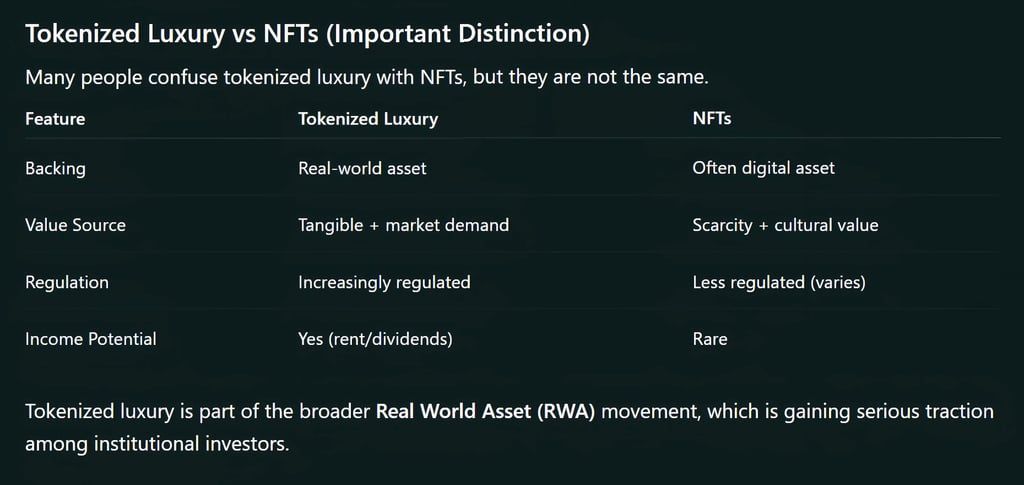
Q: What is the difference between tokenized assets and NFTs?
Tokenized assets are backed by real-world physical or financial assets and often generate income. NFTs are usually digital assets whose value is based on uniqueness and demand rather than underlying tangible value.
Q: Do token holders legally own the asset?
In most cases, investors own shares in a legal entity (like an SPV) that holds the asset, not the asset directly. The exact ownership rights depend on the platform and legal framework.
Q: What are the risks of investing in tokenized luxury?
Key risks include:
Regulatory uncertainty
Platform failure or mismanagement
Limited liquidity
Market volatility and subjective asset valuation
Q: Can beginners invest in tokenized luxury assets?
Yes, many platforms are designed for beginners with low minimum investment requirements. However, understanding blockchain basics and doing proper research is important before investing.
Q: Is tokenized luxury investing legal?
It is legal in many jurisdictions but regulated differently across countries. Some tokenized assets may be classified as securities and must comply with local financial laws.
Q: What is the future of tokenized luxury investments?
The market is expected to grow significantly as blockchain adoption increases. With institutional involvement and better regulations, tokenized luxury could become a mainstream investment category.
Q: How do I start investing in tokenized luxury?
To get started:
Choose a reputable tokenization platform
Complete identity verification (KYC)
Browse available assets
Invest based on your budget and strategy
Q: Are tokenized luxury assets suitable for long-term investment?
Yes, they are generally better suited for long-term holding, especially for assets like real estate or art that appreciate over time rather than offering quick returns.
Q: Can tokenized assets be used as collateral?
In emerging cases, yes. Some platforms and DeFi ecosystems are beginning to allow tokenized real-world assets to be used as collateral for loans, though this is still developing.
Subscribe to Frontier Intelligence
All © Copyright reserved by Accessible-Learning Hub
| Terms & Conditions
Accessible Learning Hub — Actionable clarity for high-agency minds.
Weekly breakdowns on AI breakthroughs, capital flow, and human performance systems. Zero fluff.