

The "Vibe Coder": How Solo Developers Are Building Entire Apps in Hours
Discover how Vibe Coding is transforming software development in 2026. Learn how solo developers use AI-powered tools like Lovable, Bolt.new, and Cursor to build, test, and deploy full-stack applications in hours instead of months. Explore the workflows, tools, and strategies behind the next generation of AI-native development.
PROGRAMMINGEDUCATION/KNOWLEDGEEDITOR/TOOLSENTREPRENEUR/BUSINESSMAN
Sachin K Chaurasiya
6/18/20267 min read
Why Writing Syntax Is Dead (And How to "Vibe Code" Instead)
For decades, software development followed the same formula.
A developer had an idea.
They opened an editor.
They wrote thousands of lines of code.
They debugged errors.
They configured servers.
They deployed applications.
They spent weeks or months transforming an idea into a working product.
That workflow is rapidly becoming obsolete. The most productive developers in 2026 are not spending their days manually typing JavaScript, React components, API routes, database schemas, and deployment configurations.
They're orchestrating.
They're directing.
They're designing systems.
And increasingly, artificial intelligence is doing the actual coding.
This shift has created an entirely new category of builder: the Vibe Coder.
A Vibe Coder doesn't focus on writing every line of code. Instead, they focus on communicating intent, defining architecture, validating outcomes, and steering AI systems that generate, test, refactor, and deploy applications autonomously.
The result?
Solo developers are launching products in hours that previously required entire engineering teams. This isn't a prediction about the future. It's already happening.
What Is Vibe Coding?
Vibe Coding is the practice of building software primarily through natural-language instructions, architectural guidance, and iterative feedback rather than manual code creation.
The developer becomes the strategist.
The AI becomes the implementation layer.
Instead of saying:
"I need to build this authentication system myself."
A Vibe Coder says:
"Build a secure authentication flow using email login, social sign-in, password reset, role-based permissions, and JWT sessions."
The AI writes the implementation.
The developer validates the result.
The workflow shifts from coding to orchestration.
Think of it as the difference between the following:
Writing every brick into a building
Designing the blueprint and directing construction
The architect still matters.
In fact, they matter more than ever.
But their value comes from decision-making rather than manual execution.
Why Traditional Coding Is Losing Its Dominance
Many developers resist this idea because they've spent years mastering syntax. But the market doesn't reward effort. It rewards outcomes. Clients don't care how many lines of code you write. Users don't care how many hours you spent debugging.
Businesses care about:
Faster launches
Lower costs
Better user experiences
Rapid iteration
Competitive advantage
AI dramatically compresses the time required to achieve those outcomes. The reality is uncomfortable:
Typing code is becoming one of the least valuable parts of software development.
The valuable skills are now the following:
Product thinking
System architecture
User experience design
Prompt engineering
AI workflow management
Quality assurance
Strategic decision-making
The developers who understand this shift are multiplying their output. The developers who ignore it are becoming bottlenecks.
The Rise of the One-Person Software Company
A decade ago, launching a SaaS product typically required the following:
Frontend developer
Backend developer
Designer
DevOps engineer
QA tester
Product manager
Today, a skilled Vibe Coder can perform all of these functions with AI assistance.
One individual can:
Design interfaces
Generate code
Create APIs
Configure databases
Produce marketing assets
Deploy infrastructure
Build documentation
The leverage is unprecedented.
A single person can now execute at a level that previously required an entire startup team.
This is why solo-founder businesses are growing faster than ever.
AI has fundamentally changed the economics of software creation.

The New Developer Stack in 2026
The modern development workflow looks dramatically different from traditional coding environments.
Instead of assembling dozens of tools manually, developers increasingly rely on AI-native platforms.
Three tools have emerged as clear leaders.
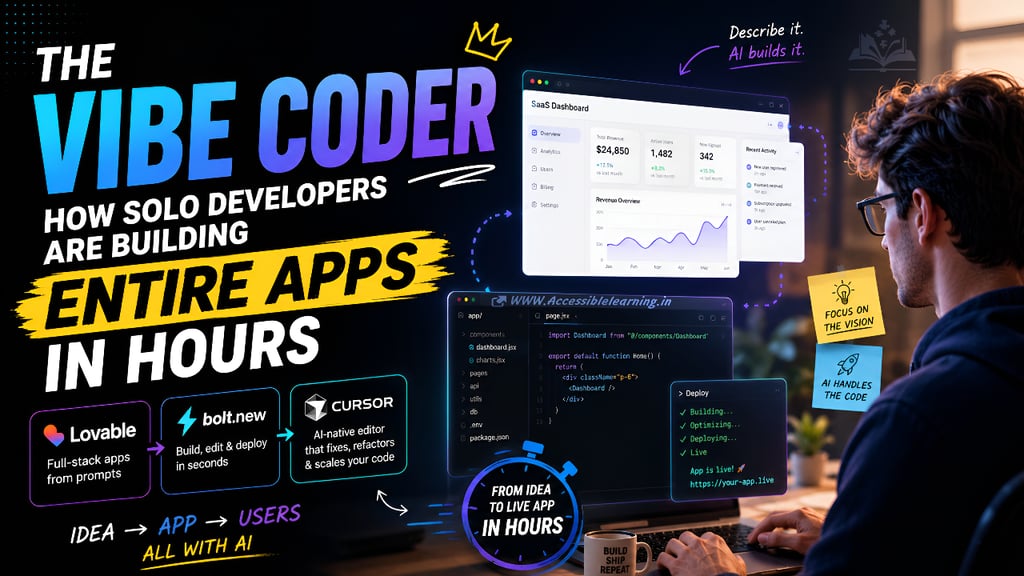
Lovable: From Idea to Full-Stack Application
Lovable has become one of the most disruptive products in software development. Instead of building applications manually, developers describe what they want in natural language.
For example:
Build a project management SaaS with team collaboration, user authentication, subscription billing, dashboard analytics, and responsive design.
Within minutes, Lovable generates:
Frontend interfaces
Backend logic
Database structures
Authentication systems
API integrations
Deployment-ready applications
The platform dramatically reduces the distance between concept and execution.
For freelancers, this means faster client delivery.
For founders, it means rapid validation.
For developers, it means focusing on product decisions rather than boilerplate code.
Bolt.new: The Instant Application Factory
Bolt.new takes AI-powered development even further. The platform allows developers to create, edit, test, and deploy applications directly through conversational interactions. What makes Bolt powerful is its speed.
You can:
Generate prototypes
Create MVPs
Build dashboards
Launch SaaS applications
Test new business ideas
Without spending days configuring environments. Many developers now use Bolt as their first step in application development because it dramatically accelerates the initial build phase. What once required weeks can often be achieved before lunch.
Cursor: The AI-Native Development Environment
If Lovable and Bolt create applications, Cursor perfects them. Cursor has become the preferred editor for serious AI-assisted development. Unlike traditional IDEs, Cursor understands the entire codebase. This enables capabilities that were previously impossible.
Examples include:
Cross-file refactoring
Automated debugging
Architecture-wide updates
Dependency analysis
Feature implementation
Security improvements
A developer can simply instruct the following:
Refactor this authentication system to support role-based permissions across the entire application.
Cursor analyzes the project and implements the changes across multiple files automatically.
This transforms development from file-level coding to system-level orchestration.
How Elite Developers Actually Work in 2026
Many people assume Vibe Coding means blindly accepting AI-generated output.
That's not how top developers operate.
The best builders follow a structured workflow.
Step 1: Define the Product Vision
They begin with clarity. Not code.
Questions include:
Who is the user?
What problem are we solving?
What is the business goal?
What should the experience feel like?
AI performs better when the objective is precise.
Step 2: Generate the Initial Application
Using platforms like Lovable or Bolt, developers generate a working foundation.
The goal is speed.
Perfection is irrelevant.
The first version simply needs to exist.
Step 3: Architect the System
Once the application exists, the developer becomes an architect. They refine:
Data structures
Security models
Scalability plans
User flows
Feature priorities
This stage separates professionals from amateurs. AI can generate code. Architecture still requires judgment.
Step 4: Use Cursor for Deep Optimization
After the core application is built, Cursor becomes the primary workspace. Developers use it to:
Refactor systems
Remove technical debt
Improve maintainability
Optimize performance
Strengthen security
The result is production-quality software rather than AI-generated prototypes.
Step 5: Deploy and Iterate
Modern deployment workflows are increasingly automated. Developers can:
Push updates rapidly
Gather feedback immediately
Ship improvements daily
The iteration cycle becomes dramatically shorter. Speed becomes a competitive advantage.

What This Means for Web Developers
Traditional frontend development is changing rapidly. Developers who only focus on writing components risk becoming interchangeable.
The market increasingly rewards those who understand the following:
Product strategy
User experience
AI orchestration
Business objectives
The future belongs to developers who can transform ideas into products quickly. Not necessarily those who type the fastest.
Why Three.js and WebGL Designers Have a Massive Opportunity
Three.js and WebGL specialists are uniquely positioned for the AI era. While AI excels at generating standard interfaces, immersive experiences still require creative direction.
Developers who combine:
AI-generated foundations
Three.js expertise
WebGL optimization
Interactive storytelling
Advanced visual experiences
Can create products that stand out in increasingly crowded markets.
AI can build dashboards.
It still struggles to replace exceptional creative execution.
That makes visual technologists more valuable, not less.
What Technical Freelancers Need to Understand
Freelancers face a choice.
They can sell hours.
Or they can sell outcomes.
Clients increasingly expect the following:
Faster delivery
Better quality
Lower costs
AI makes this possible.
A freelancer who learns Vibe Coding can:
Deliver projects faster
Handle more clients
Increase profit margins
Build internal products
Launch recurring revenue streams
The economics become dramatically more favorable. The freelancer evolves into a digital operator.
The Biggest Mistake Developers Are Making
Many developers are trying to compete with AI. That's a losing battle.
AI improves every month. The winning strategy is learning how to direct it.
Think about what happened to calculators. Mathematicians didn't disappear.
The role changed. The same transformation is happening in software development.
Developers who master orchestration become exponentially more productive.
Developers who cling to manual execution become slower relative to the market.
The Future Belongs to Application Architects
The highest-paid developers of the next decade will not be those who write the most code. They will be those who:
Understand systems
Design products
Manage AI workflows
Solve business problems
Coordinate multiple intelligent agents
Coding is becoming a commodity. Judgment is becoming a premium skill. This is the defining shift of modern software development.

Vibe Coding is not about replacing developers. It's about amplifying them. The elite builder in 2026 acts less like a programmer and more like a technology director.
Tools like Lovable, Bolt.new, and Cursor are eliminating much of the repetitive work that once consumed development teams. The developers who embrace this transition can build faster than ever before.
The ones who refuse may eventually discover that the market no longer rewards how much code you write. It rewards how quickly you can turn an idea into a working product. And in the age of AI-native development, that process is measured in hours, not months.
FAQ's
Q: What is Vibe Coding?
Vibe Coding is an AI-assisted software development approach where developers focus on product architecture, business logic, and user experience while AI tools generate, test, refactor, and deploy much of the code. The developer acts as an orchestrator rather than manually writing every line of code.
Q: How does Vibe Coding differ from traditional programming?
Traditional programming requires developers to manually write, debug, and maintain code. Vibe Coding uses AI-native tools to generate large portions of applications through natural language instructions, allowing developers to focus on strategy, architecture, and problem-solving.
Q: Can AI build a complete web application from a prompt?
Yes. Modern platforms such as Lovable and Bolt.new can generate full-stack applications, including frontend interfaces, backend logic, authentication systems, databases, and deployment configurations, from detailed prompts.
Q: Is Vibe Coding replacing software developers?
No. AI is automating code generation, but developers are still responsible for architecture, security, scalability, user experience, quality assurance, and business decisions. The role is evolving from coding implementation to application orchestration.
Q: Why are solo developers becoming more productive in 2026?
AI-powered development tools reduce the time spent on repetitive tasks such as boilerplate coding, debugging, and setup. This allows solo developers to build, test, and launch products significantly faster than traditional development workflows.
Q: What is the best AI coding tool for professional developers?
The answer depends on the workflow:
Cursor is ideal for AI-assisted coding, debugging, and large-scale refactoring.
Lovable excels at generating full-stack applications from prompts.
Bolt.new is designed for rapid prototyping and deployment.
Q: Can freelancers use Vibe Coding to increase revenue?
Yes. Freelancers can deliver projects faster, handle more clients simultaneously, reduce development time, and focus on higher-value consulting and product strategy services instead of charging purely for coding hours.
Q: Does Vibe Coding work for Three.js and WebGL projects?
Yes, but with limitations. AI can generate foundational code and project structures, while developers still provide creative direction, performance optimization, advanced shaders, 3D interactions, and immersive user experiences that require specialized expertise.
Q: What skills should developers learn instead of focusing only on coding?
Developers should strengthen:
System architecture
Product design thinking
AI workflow orchestration
Prompt engineering
User experience design
Security and scalability planning
Business problem-solving
Q: What is the future of software development with AI?
Software development is moving toward AI-assisted application creation where developers act as architects and orchestrators. The most valuable professionals will be those who can rapidly transform ideas into scalable products using a combination of AI tools, technical expertise, and strategic decision-making.
Subscribe To Our Newsletter
All © Copyright reserved by Accessible-Learning Hub
| Terms & Conditions
Knowledge is power. Learn with Us. 📚

