

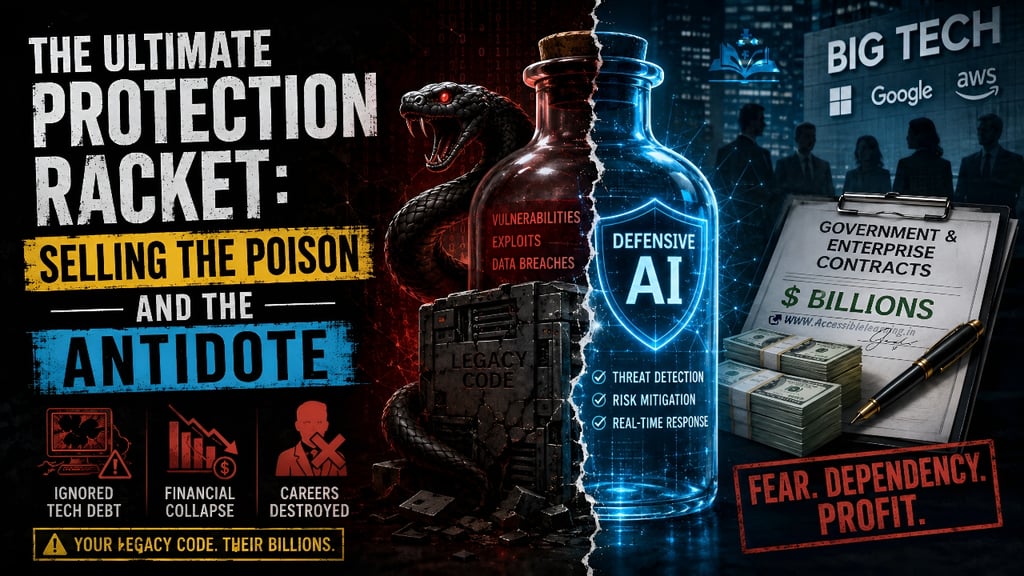
The Ultimate Protection Racket: Selling the Poison and the Antidote
AI-powered attacks are revealing dangerous technical debt. Learn who is affected and why defensive AI matters, plus get tips for safeguarding your organization today.
ACCESSIBLE LEARNINGARTIFICIAL INTELLIGENCE & FUTURE TECH
Sachin K Chaurasiya
7/17/20265 min read

At 3:17 a.m., an automated attack ripped through an enterprise network that executives had labeled "secure." Within minutes, attackers bypassed outdated authentication code, exploited forgotten APIs, and used AI to mutate malware faster than human analysts could respond. Customer records vanished. Manufacturing stopped. Trading systems froze. The company lost hundreds of millions before sunrise.
None of it surprised security engineers.
They had spent years warning leadership about legacy software, neglected architecture, and mounting technical debt. Executives rejected modernization because quarterly earnings mattered more than invisible infrastructure.
Now those same executives face another bill. Not for rebuilding their systems.
For buying AI security products from many of the same technology companies that helped create the new generation of AI capabilities powering these attacks.
That is the uncomfortable reality behind today's cybersecurity market.
The New Business Model Nobody Wants to Admit Exists
The latest Five Eyes cybersecurity guidance warns organizations that AI dramatically increases the speed, scale, and sophistication of cyberattacks. Criminals no longer need elite expertise. AI generates convincing phishing campaigns, discovers vulnerabilities faster, automates exploit development, and adapts malware in real time.
The official recommendation sounds logical.
Deploy defensive AI.
On paper, that makes perfect sense.
In practice, it creates an extraordinary conflict of incentives.
The same technology giants racing to build increasingly powerful AI models now sell AI-powered security platforms, AI threat detection, AI code review, AI vulnerability discovery, and AI incident response.
The more capable offensive AI becomes, the larger the market for defensive AI grows.
Fear becomes recurring revenue.
Technical Debt Created the Perfect Battlefield
AI did not create today's cybersecurity crisis. Executives did.
For decades, organizations postponed upgrades because replacing aging infrastructure looked expensive. They approved new customer features while leaving authentication systems untouched. They connected modern cloud services to decades-old software held together by undocumented integrations and emergency patches.
Every shortcut accumulated interest.
Every delayed upgrade increased complexity.
Every ignored architecture review expanded the attack surface.
Now AI weaponizes those decisions.
Instead of spending weeks analyzing legacy applications, attackers can ask AI to identify vulnerable libraries, generate exploit chains, write customized phishing emails, and adapt their methods within minutes.
Technical debt no longer slows innovation.
It accelerates compromise.
Selling the Cure After Building the Disease
The technology industry insists AI itself is neutral.
That misses the larger economic reality.
Every leap in AI capability expands offensive potential.
Every expansion of offensive potential creates demand for stronger defensive products.
Governments respond by increasing cybersecurity budgets.
Enterprises purchase AI security platforms.
Consultants recommend AI governance programs.
Cloud providers sell AI monitoring.
Software vendors launch premium AI protection tiers.
Everyone profits from the escalating arms race.
Except for the organizations paying for both sides.
This does not require conspiracy.
It only requires incentives.
When one industry profits from increasing offensive capability while simultaneously dominating defensive products, customers inevitably finance the entire cycle.

Legacy Architecture Has Become Executive Negligence
Many executives still treat technical debt as an engineering problem. It is a governance failure.
Boards approve billion-dollar acquisitions while ignoring obsolete identity systems.
Leadership celebrates AI adoption while refusing to replace unsupported software.
Budgets prioritize marketing over modernization.
Then everyone expresses shock after another catastrophic breach.
Architecture determines security.
Poor architecture guarantees future failure.
No AI product can permanently compensate for systems designed without maintainability, visibility, or resilience. Organizations refusing to modernize simply purchase increasingly expensive layers of protection around increasingly fragile foundations.
That strategy never scales.
The Three Biggest Warning Signs of Lethal Technical Debt
If these conditions exist inside your organization, attackers probably already see them.
Mission-critical systems depend on unsupported legacy software. Every postponed migration increases exploitable weaknesses while reducing the number of engineers capable of maintaining the environment.
Developers fear changing production code. When teams avoid touching core systems because nobody understands them, the architecture has already become a security liability.
Security relies on adding more tools instead of simplifying infrastructure. Organizations often deploy dozens of monitoring products while leaving vulnerable applications fundamentally unchanged.
These warning signs rarely appear overnight. Leadership creates them through years of delayed investment.
AI Cannot Rescue Broken Foundations
Many vendors market defensive AI as the ultimate cybersecurity solution. Reality looks different. AI excels at identifying suspicious behavior, correlating massive datasets, prioritizing alerts, and accelerating investigations.
It cannot eliminate architectural decay.
It cannot rewrite decades of poor software design.
It cannot restore engineering discipline that executives abandoned years ago.
Organizations that treat defensive AI as a substitute for modernization simply automate the monitoring of systems already heading toward failure. Detection without remediation only produces faster notifications.
The Coming Divide Between Survivors and Casualties
The next decade will separate organizations into two categories.
The first group invests aggressively in architectural modernization, reduces technical debt, simplifies infrastructure, and treats cybersecurity as a design principle rather than a compliance exercise.
The second group continues accumulating complexity while purchasing increasingly sophisticated AI security products to compensate.
One strategy reduces long-term risk.
The other creates permanent dependence.
Every new generation of offensive AI increases that dependence.
Every new defensive platform becomes another operational expense protecting decisions that leadership refused to fix. Eventually, the economics collapse.


Stop Buying Armor for Buildings Already Falling Down
Executives love measurable purchases. Buying another AI security platform produces dashboards, contracts, and reassuring presentations. Rebuilding architecture produces none of those immediate optics.
It produces resilience.
That difference matters.
Defensive AI deserves a place inside modern security operations. It does not deserve to become an excuse for avoiding modernization. The organizations that survive the AI security era will not simply own better defensive models.
They will own cleaner code, stronger architecture, smaller attack surfaces, disciplined engineering practices, and executives willing to fund infrastructure before catastrophe forces them to.
Everyone else will continue financing the industry's newest protection racket.
First they paid for software that accumulated decades of technical debt.
Now they pay again for AI that promises to defend it.
The invoice only grows larger.
FAQ's
Q: What is the "protection racket" in AI cybersecurity?
The term refers to the growing trend where companies developing powerful AI technologies that can inadvertently enable more sophisticated cyberattacks also sell AI-powered cybersecurity products designed to defend against those same threats. It highlights the economic incentives behind the AI security arms race.
Q: Why is technical debt one of the biggest cybersecurity risks?
Technical debt leaves organizations with outdated software, unsupported systems, and poorly maintained code. Attackers, especially those using AI, can identify and exploit these weaknesses much faster than ever before, increasing the likelihood of major data breaches and operational failures.
Q: How do AI-powered cyberattacks differ from traditional attacks?
AI-powered attacks automate phishing, vulnerability discovery, malware generation, credential theft, and exploit development. They operate at machine speed, adapt in real time, and allow less-skilled attackers to launch highly sophisticated campaigns.
Q: Can defensive AI stop every cyberattack?
No. Defensive AI improves threat detection, incident response, and security monitoring, but it cannot fix insecure software architecture, eliminate technical debt, or replace proper cybersecurity practices. Strong system design remains the foundation of effective security.
Q: What are the warning signs that legacy systems are becoming a security liability?
Common warning signs include unsupported software, undocumented legacy code, developers afraid to modify production systems, increasing reliance on security tools instead of infrastructure modernization, and delayed patching due to fragile applications.
Q: Why do cybersecurity experts emphasize modernizing legacy infrastructure?
Modernizing legacy infrastructure reduces attack surfaces, improves patch management, simplifies security operations, and makes it harder for AI-driven attacks to exploit known vulnerabilities. It also lowers long-term operational and security costs.
Q: What is the Five Eyes advisory on AI cybersecurity?
The Five Eyes intelligence alliance warns that AI significantly increases the speed and sophistication of cyber threats. The advisory recommends organizations adopt AI-assisted defensive capabilities alongside stronger security governance, secure software development, and continuous modernization.
Q: How can organizations reduce AI-related cybersecurity risks?
Organizations should eliminate critical technical debt, modernize legacy systems, implement secure-by-design principles, deploy AI-assisted security tools responsibly, conduct continuous vulnerability assessments, train employees against AI-enhanced phishing, and maintain strong incident response plans.
Subscribe to Frontier Intelligence
All © Copyright reserved by Accessible-Learning Hub
| Terms & Conditions
Accessible Learning Hub — Actionable clarity for high-agency minds.
Weekly breakdowns on AI breakthroughs, capital flow, and human performance systems. Zero fluff.