

The Trojan Horse of STEM and Business: Why a 15-Year-Old Knows More About Cellular Biology Than You Do
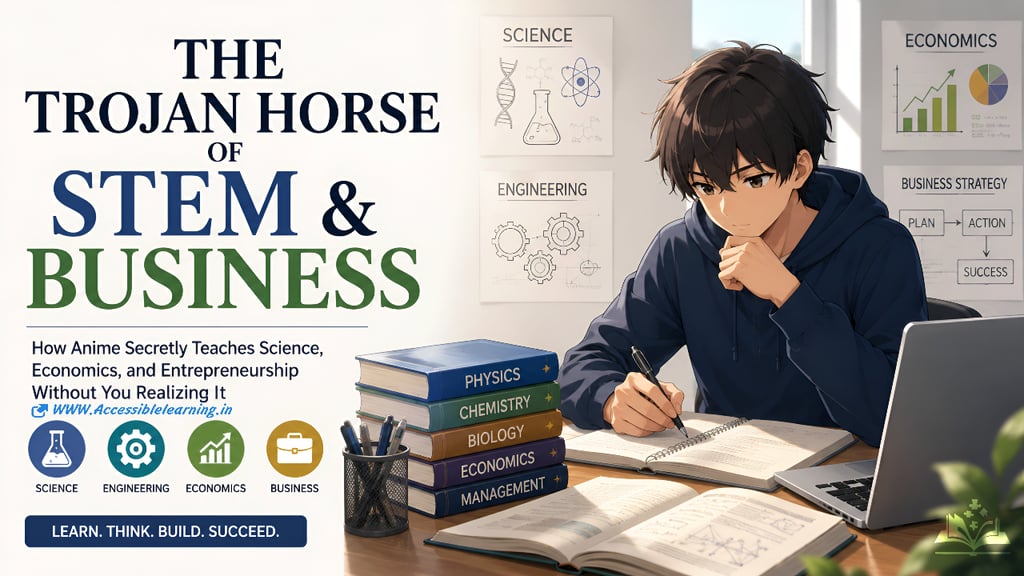
Most people see anime as entertainment, but many modern series secretly teach science, engineering, economics, business strategy, and systems thinking. Discover how shows like Dr. Stone, Amagi Brilliant Park, and Tsukimichi: Moonlit Fantasy are becoming powerful educational tools that help young audiences learn STEM and business concepts without realizing they're studying.
PSYCHOLOGY & COGNITIVE SCIENCEACCESSIBLE LEARNING
Hikari | Kim Shin
6/5/20266 min read
The Classroom Nobody Talks About
Most parents think anime is just screaming heroes firing energy blasts, impossible hairstyles, and over-the-top battles.
What many don't realize is that some of the most influential STEM and business education happening today is occurring through animated stories watched after school, late at night, or on a smartphone during a commute.
A surprising number of teenagers can explain concepts like fermentation, antibiotic production, mineral extraction, supply chains, negotiation tactics, economic incentives, public relations, resource allocation, and even cellular biology. Yet many of them have never taken a formal college course on these subjects.
How? Because they learned them through stories.
Anime has quietly become one of the most effective educational Trojan horses of the modern era. Instead of presenting science, economics, engineering, and management as dry academic subjects, it embeds them inside compelling narratives that make learning feel like entertainment.
The audience arrives for the adventure but leaves with knowledge. And often, they do not even realize they have been studying.
What Makes a Trojan Horse Educational?
Traditional education often starts with information and hopes students become interested. Stories work in the opposite direction. They create emotional investment first.
When viewers care about characters and outcomes, they naturally become curious about the systems those characters are navigating.
Instead of asking:
"Would you like to learn chemistry?"
The story asks:
"Can these characters survive without chemistry?"
That small difference changes everything. Human brains evolved to remember stories far more effectively than isolated facts. Information attached to emotion, conflict, and curiosity tends to remain in memory longer. Anime frequently leverages this principle with remarkable effectiveness.
Why Anime Is Particularly Effective at Teaching Complex Subjects
Unlike many forms of entertainment, anime often dedicates significant time to explaining systems.
These systems can include:
Scientific processes
Engineering principles
Economic structures
Political institutions
Supply chains
Agricultural production
Trade networks
Resource management
Corporate strategy
Public relations
Military logistics
Rather than treating these topics as background details, many anime make them central to the plot. The result is accidental education. Viewers absorb concepts because understanding them helps them follow the story.
Dr. Stone: Turning Science into an Adventure
Perhaps no anime demonstrates educational storytelling better than the acclaimed series Dr. Stone. The premise is simple but brilliant.
Human civilization has collapsed, and a young scientific genius named Senku must rebuild technology from scratch. What follows is effectively a STEM curriculum disguised as a survival adventure. Throughout the series, viewers encounter:
Chemistry
Characters explain:
Acid production
Chemical reactions
Soap creation
Sulfuric acid manufacturing
Metal extraction
Material purification
Physics
The story explores:
Electricity generation
Magnetism
Energy conversion
Mechanical systems
Biology
Viewers learn about:
Antibiotics
Disease prevention
Human anatomy
Cellular processes
Medical treatments
Engineering
The series demonstrates:
Tool development
Manufacturing methods
Infrastructure creation
Transportation technology
What makes these lessons memorable is context. The audience is not learning chemistry because a teacher assigned homework. They are learning chemistry because a character's life may depend on it. That emotional connection dramatically increases retention.

Why Young Viewers Remember Science Better Through Stories
Educational psychologists have long understood that context improves learning. Facts presented in isolation are easy to forget. Facts connected to meaningful situations become easier to retain.
When viewers watch a character use scientific reasoning to solve a crisis, they witness practical application rather than abstract theory.
This creates:
Stronger memory formation
Greater curiosity
Improved comprehension
Increased motivation to explore further
For many young people, anime becomes the gateway that leads to genuine interest in STEM fields.
Amagi Brilliant Park: A Hidden Business Management Course
At first glance, Amagi Brilliant Park appears to be a fantasy comedy about saving an amusement park.
Underneath the humor, however, lies a surprisingly detailed exploration of business management.
The protagonist is tasked with rescuing a failing organization facing closure.
To succeed, he must address challenges familiar to real-world executives.
Marketing and Branding
The series explores:
Customer attraction
Brand image
Promotional events
Audience engagement
Operations Management
Characters must manage:
Staffing shortages
Resource constraints
Operational inefficiencies
Service quality
Financial Survival
The story introduces concepts such as:
Revenue generation
Cost control
Performance metrics
Strategic decision-making
Public Relations
The anime highlights how perception influences organizational success.
A technically good product can still fail if public opinion turns negative.
This lesson mirrors challenges faced by modern companies every day.
Many viewers finish the series with a better understanding of management principles than they realize.
Tsukimichi: Moonlit Fantasy and the Economics of Empire Building
Fantasy worlds are often viewed as pure escapism.
Yet some of them function as sophisticated economic simulations.
Tsukimichi: Moonlit Fantasy is a strong example.
As the protagonist builds influence and develops territories, viewers are exposed to concepts that mirror real-world economics.
Trade Networks
The series demonstrates:
Supply and demand
Market expansion
Distribution systems
Commercial relationships
Resource Allocation
Success depends on managing:
Labor
Capital
Materials
Infrastructure
Economic Incentives
Characters repeatedly respond to incentives, illustrating one of the foundational principles of economics.
People change behavior when rewards and costs change.
Strategic Growth
The story showcases:
Investment decisions
Expansion planning
Risk management
Competitive positioning
Without using formal textbook language, the anime introduces many of the same concepts found in introductory economics courses.
The Hidden Business Curriculum Across Anime
The educational value extends beyond a few well-known examples.
Many anime expose audiences to real-world organizational thinking.
Common themes include:
Leadership
Characters learn:
Decision-making
Accountability
Team coordination
Conflict resolution
Entrepreneurship
Viewers observe:
Opportunity recognition
Product development
Market adaptation
Growth strategies
Negotiation
Storylines frequently involve:
Diplomacy
Bargaining
Alliance formation
Trade agreements
Crisis Management
Character's face:
Resource shortages
Financial pressure
Public backlash
Competitive threats
These experiences create familiarity with business concepts long before viewers encounter them in formal education.


Anime and Systems Thinking
One of the most valuable skills taught indirectly through anime is systems thinking. Systems thinking involves understanding how multiple components interact within larger structures. Modern careers increasingly require this ability.
Professionals must understand:
How markets influence businesses
How technology affects society
How supply chains impact production
How incentives shape behavior
Many anime stories naturally encourage this perspective because they focus on interconnected worlds rather than isolated events. Viewers begin seeing cause-and-effect relationships across complex systems. That skill is increasingly valuable in science, business, technology, and public policy.
Why This Matters for the Future Workforce
The jobs of the future demand more than memorization. Employers increasingly seek people who can:
Solve problems
Analyze systems
Understand incentives
Communicate effectively
Adapt to changing environments
Anime often nurtures these capabilities by exposing viewers to dynamic situations where characters must think strategically.
The learning is informal, but the cognitive benefits can be significant. Young audiences are not merely consuming stories. Many are unknowingly building mental frameworks that help them understand the real world.
The New Reality of Learning
Education no longer exists solely inside classrooms. Knowledge now flows through:
Videos
Games
Podcasts
Online communities
Interactive media
Entertainment platforms
Anime is part of this broader transformation.
It demonstrates that learning can happen anywhere curiosity exists.
The distinction between education and entertainment is becoming increasingly blurred.
The most successful educational experiences of the future may not resemble traditional lessons at all.
Instead, they may look like compelling stories that make people eager to understand the world.
The assumption that anime is merely entertainment overlooks its growing role as an informal educational medium.
Series like Dr. Stone, Amagi Brilliant Park, and Tsukimichi: Moonlit Fantasy introduce viewers to science, engineering, economics, management, and systems thinking through engaging narratives rather than lectures.
This is what makes anime such a powerful educational Trojan horse.
The audience arrives expecting adventure, comedy, fantasy, or action.
What they often leave with is something much more valuable: a deeper understanding of how the world works.
In an age where attention is difficult to capture and curiosity is increasingly precious, stories that successfully teach complex ideas without feeling like lessons may become some of the most effective educational tools ever created.
And that is why a 15-year-old anime fan might unexpectedly know more about cellular biology, resource management, trade economics, or public relations than many adults assume possible.
FAQ's
Q: How does anime help people learn STEM subjects?
Anime can make STEM concepts easier to understand by embedding science, technology, engineering, and mathematics into engaging stories. Series like Dr. Stone demonstrate real-world chemistry, biology, physics, and engineering principles through practical problem-solving scenarios, helping viewers learn without feeling like they are studying.
Q: Can anime improve business and economic knowledge?
Yes. Many anime explore topics such as entrepreneurship, marketing, leadership, trade, resource management, and organizational strategy. Shows like Amagi Brilliant Park and Tsukimichi: Moonlit Fantasy introduce business concepts through realistic challenges and decision-making processes.
Q: Why is storytelling an effective educational tool?
Storytelling creates emotional engagement, which improves memory retention and comprehension. When information is connected to characters, conflicts, and goals, people are more likely to remember and understand complex concepts than when learning through isolated facts.
Q: What STEM concepts are commonly taught in anime?
Educational anime often cover:
Chemistry and chemical reactions
Biology and human health
Physics and energy systems
Engineering and invention
Environmental science
Scientific problem-solving
Technology development
Q: Can anime inspire future careers in science or business?
Absolutely. Many viewers develop interests in fields such as engineering, medicine, economics, entrepreneurship, and technology after being exposed to these subjects through anime. For some, it becomes a gateway to deeper learning and professional aspirations.
Q: What is meant by the "Trojan Horse of STEM and Business"?
The phrase refers to anime's ability to deliver valuable educational content disguised as entertainment. Viewers watch for the story, characters, and action but often absorb lessons about science, economics, management, and critical thinking along the way.
Q: Is anime a replacement for formal education?
No. Anime is best viewed as a complementary learning tool. While it can spark curiosity and introduce complex topics, formal education provides the structured knowledge, practical training, and academic depth needed for mastery of STEM and business subjects.
Q: Which anime are considered educational for STEM and business learning?
Some of the most frequently cited examples include:
Dr. Stone for science and engineering
Amagi Brilliant Park for business management and public relations
Tsukimichi: Moonlit Fantasy for economics, trade, and resource management
These series demonstrate how entertainment can foster curiosity about real-world systems and practical knowledge.
Subscribe to Frontier Intelligence
All © Copyright reserved by Accessible-Learning Hub
| Terms & Conditions
Accessible Learning Hub — Actionable clarity for high-agency minds.
Weekly breakdowns on AI breakthroughs, capital flow, and human performance systems. Zero fluff.