

The Trillionaire Countdown: Who Wins the Race to $1,000,000,000,000?
Explore the global race to create the first trillionaire. Discover the top contenders, industries driving massive wealth, hidden factors shaping the future, and what this milestone means for entrepreneurs, innovators, and the world economy.
WEALTHY FAMILYENTREPRENEUR/BUSINESSMANSTOCK OPERATOR
Sachin K Chaurasiya
2/15/20268 min read
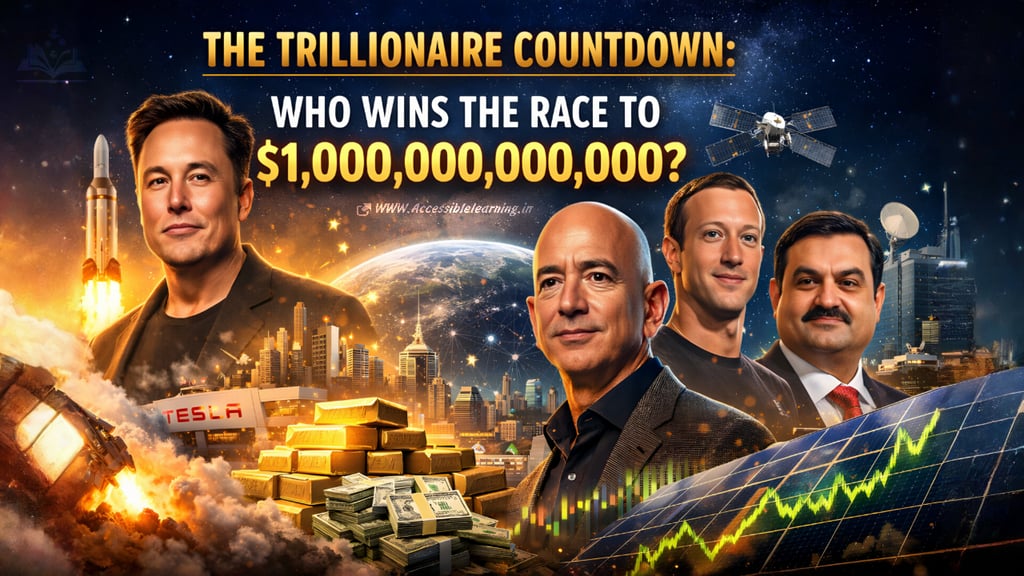
The world has seen kings, oil barons, and tech billionaires. Now we are entering a new era: the first trillionaire. No one has reached a net worth of $1 trillion yet, but many economists believe it could happen within the next 10 to 15 years.
This is not just about rich people getting richer. It is about how technology, AI, energy, and global platforms are reshaping wealth at a historic scale. Let’s break down who is leading, how trillionaire wealth is created, and what it means for the future.
What Is a Trillionaire?
A trillionaire has a net worth of $1,000,000,000,000. To understand the scale:
1 million seconds ≈ 11 days
1 billion seconds ≈ 31 years
1 trillion seconds ≈ 31,000 years
This level of wealth has never existed for a single individual in recorded history.
Top Contenders in the Trillionaire Race
Elon Musk
Elon Musk is widely seen as the closest to reaching trillionaire status. Why he leads:
Large ownership in Tesla and SpaceX
Exposure to AI, robotics, satellites, EVs, and energy storage
Equity-based compensation plans that scale with company valuation
Multiple industries growing at the same time
If Tesla, SpaceX, and AI ventures grow together, Musk’s wealth could multiply quickly.
Other Strong Candidates
Jeff Bezos
Massive Amazon stake
Investments in space and AI
Strong logistics and cloud infrastructure
Mark Zuckerberg
Controls global social media platforms
Building AI ecosystems and virtual reality tech
Jensen Huang
Nvidia chips power the global AI boom
Semiconductor dominance can create trillion-dollar companies
Larry Page and Sergey Brin
Google’s AI and cloud ecosystem continues to grow globally
Could an Indian Billionaire Reach $1 Trillion?
For readers in India, names like Mukesh Ambani and Gautam Adani come up often.
They run huge energy, telecom, and infrastructure empires. If global energy transition or digital infrastructure explodes in scale, an Indian trillionaire is possible, though currently less likely than tech founders in the US.

Industries Creating Trillionaires
The trillionaire race is driven by industries that scale globally with low marginal cost.
Artificial Intelligence
AI powers healthcare, finance, automation, design, and defense. Companies that dominate AI infrastructure could reach multi-trillion-dollar valuations.
Space Economy
Satellite internet, space manufacturing, asteroid mining, and Mars missions are becoming real industries.
Renewable Energy
Battery storage, solar grids, hydrogen fuel, and global power networks can create massive wealth.
Semiconductors
AI needs chips. Chip makers control the backbone of modern technology.
Platform Ecosystems
E-commerce, cloud services, mobile apps, and digital payments scale across billions of users.
Biotechnology
Gene editing, longevity research, and AI-driven drug discovery could create trillion-dollar healthcare giants.
Robotics & Automation
Factories, logistics, agriculture, and home robotics could transform productivity worldwide.
The Math Behind Becoming a Trillionaire
To reach $1 trillion, a founder usually needs a big stake in a massive company.
Examples:
20% of a $5 trillion company
10% of a $10 trillion company
This means trillionaires will almost always come from companies serving billions of people.
Key Factors That Will Decide the Winner
Ownership Percentage
Founders who keep large equity stakes have the best chance.
Market Expansion
Global adoption of EVs, AI, or cloud tech increases company value.
Government Policies
Regulation, antitrust laws, and taxes can slow or speed wealth growth.
Economic Cycles
A global recession could delay trillionaire status.
Innovation Speed
Breakthroughs in AI or energy could create new trillion-dollar companies quickly.
Possible Timeline
Predictions vary, but many analysts think the first trillionaire could appear between 2027 and 2035.
If AI growth accelerates, it could happen sooner.
What Happens When the First Trillionaire Appears?
Economic Effects
Positive:
Massive innovation funding
New jobs in advanced industries
Faster technological progress
Negative:
Greater wealth inequality
Increased corporate power
Market concentration
Social Effects
People will question taxation, wealth distribution, and fairness.
This could reshape public policy worldwide.
Why This Matters to Creators, Designers, and Builders
You, since you work with digital strategy and AI workflows, this trend actually shows where opportunity is moving. The next trillionaire will likely come from:
AI infrastructure platforms
Digital ecosystems
Automation tools
Climate technology
Global creator economies
This means people who understand design, AI, and strategy together will shape the next generation of companies. Even small creators can build scalable digital products that reach millions.
Could a Startup Founder Become the First Trillionaire?
Yes. Think about history:
Amazon started as an online bookstore
Nvidia started as a gaming chip company
Tesla was almost bankrupt
A founder building a global AI platform today could reach trillionaire status in 20 years.
Ethical Questions Around Trillionaires
This milestone raises serious questions:
Should one person control that much wealth?
How should taxes work?
Will trillionaires influence politics?
Can wealth be redistributed fairly?
These debates will shape the next era of capitalism.

Hidden Forces That Could Create the First Trillionaire
Most conversations focus on famous CEOs, but the real drivers are deeper.
Network Effects
When a platform grows, its value grows faster than its users. Examples:
Social networks
Payment apps
Cloud platforms
Once billions of users depend on a system, its valuation can explode.
Data Ownership
Data is becoming the most valuable asset in the world.
Companies that control large datasets in healthcare, finance, AI training, or logistics may create trillion-dollar value.
Infrastructure Control
Owning the backbone of technology matters more than owning apps. Think about:
Global chip supply chains
Internet satellites
Cloud computing servers
Electric grid networks
Infrastructure companies grow quietly but massively.
The Dark Horse Candidates Nobody Talks About
The first trillionaire might not be from Big Tech. Possible unexpected sources:
Biotech Founders
A cure for major diseases or anti-aging breakthroughs could create trillion-dollar healthcare companies.
Energy Innovators
Cheap fusion energy or breakthrough battery tech could reshape global markets overnight.
Quantum Computing Pioneers
If quantum computing becomes practical, it could disrupt finance, security, and science.
Defense Technology Entrepreneurs
Private defense tech companies are growing fast due to global tensions.
The future trillionaire may be building in a lab, not on social media.
How Inflation and Currency Value Affect the Trillionaire Race
A trillion dollars in 2050 will not equal a trillion today. Factors that speed up trillionaire status:
Inflation
Currency devaluation
Stock market bubbles
Asset price inflation
In simple terms, rising valuations make trillionaire status easier even without real economic growth.
The Psychology of Extreme Wealth
Reaching $1 trillion is not just a business strategy. It is a mindset. Common traits among ultra-rich founders:
Obsession with long-term goals
Willingness to take extreme risks
Ability to attract top talent
Strong control over company vision
They do not build for quarterly profits. They build for decades.
Governments and the Trillionaire Problem
When one person reaches $1 trillion, governments will respond. Possible policies:
Wealth taxes
Antitrust breakups
Global tax agreements
Data ownership laws
Countries may compete to attract trillionaires while also trying to regulate them. This will shape international economics.
How the Stock Market Creates Trillionaires
Trillionaire wealth is mostly stock value, not cash. Key mechanisms:
Founder Stock Grants
Large equity packages tied to company performance.
IPO Timing
Companies going public at peak hype create massive wealth jumps.
Stock Buybacks
Companies raising share prices increase founder net worth.
Market Sentiment
AI hype, tech optimism, or clean energy excitement can push valuations up quickly.
The Role of AI in Creating a Single Dominant Company
AI could create a company that dominates multiple industries at once. Imagine one company controlling:
Personal AI assistants
Business automation
Education tools
Healthcare diagnostics
Transportation systems
A founder owning a large part of such a company could reach $1 trillion faster than expected.

Why the First Trillionaire Might Not Stay One
Markets change fast. A trillionaire could lose wealth due to:
Market crashes
Regulation
Competition
Technology disruption
History shows that the richest person rarely stays the richest forever. So the first trillionaire may only hold the title briefly.
Lessons Entrepreneurs Can Learn Today
This topic is not just about billionaires. It gives real lessons for builders like you.
Build Platforms, Not Products
Products solve one problem. Platforms solve thousands.
Think Globally From Day One
Companies that reach billions of users create exponential value.
Own Your IP and Equity
Ownership matters more than salary.
Focus on Future Industries
AI, climate tech, robotics, biotech, and space will dominate the next decades.
For someone like you who works across design, tech, and strategy, the edge is in combining creativity with scalable systems.
What Happens After the First Trillionaire?
Once one person reaches $1 trillion, others will follow faster. Because:
Markets learn from success
Investors fund similar companies
Talent moves to winning sectors
Just like the first billionaire in the early 1900s, trillionaires could become common later in the century.
The Cultural Impact of Trillionaire Status
Movies, books, and media will reshape how we see wealth. Possible changes:
Luxury markets becoming ultra-exclusive
New forms of philanthropy
Private cities or space habitats funded by individuals
Billion-dollar art and cultural projects
Trillionaires could influence culture the same way kings once did.
The Biggest Question: What Kind of Trillionaire Will It Be?
There are two possibilities.
The Builder
Creates massive value, jobs, and innovation.
The Extractor
Gains wealth through monopoly power and control.
Society will judge trillionaires based on impact, not just numbers.
Signs the First Trillionaire Is Getting Close
Watch for these signals:
Companies crossing $5 trillion valuation
Massive stock-based pay packages
AI companies dominating global markets
Space industry becoming profitable
Energy grids controlled by a few corporations
When these trends align, trillionaire status becomes realistic.
The race to $1 trillion is not just about billionaires. It shows where the world economy is heading. Artificial intelligence, space technology, renewable energy, and global digital platforms are creating wealth faster than ever before. Elon Musk may be leading today, but technology moves fast. The first trillionaire might be someone we barely know yet.
What matters more is this:
The trillionaire era will redefine wealth, innovation, and power for generations.


FAQs
Q: Has anyone become a trillionaire yet?
No. As of early 2026, no individual in history has reached a net worth of $1 trillion. The richest individuals are still in the hundreds of billions.
Q: Who is currently the richest person in the world?
As of recent global rankings in 2025–2026, Elon Musk is usually listed as the richest person in the world, depending on stock market changes. His wealth comes mainly from his ownership stakes in Tesla, SpaceX, and other technology companies.
Because his net worth is tied to stock prices, it can rise or fall by tens of billions in a short time.
Q: Who are the other people closest to becoming trillionaires?
Several billionaires are often mentioned as possible future trillionaires:
Jeff Bezos – Amazon founder
Mark Zuckerberg – Meta CEO
Jensen Huang – Nvidia CEO
Larry Page & Sergey Brin – Google founders
Mukesh Ambani – Reliance Industries chairman
Their companies operate in industries that scale globally, such as AI, cloud computing, semiconductors, and energy.
Q: How close is the richest person to $1 trillion?
Even the richest individuals are still hundreds of billions away.
To reach $1 trillion, a founder usually needs a large stake in companies valued at several trillion dollars. This means massive growth in company value is still required.
Q: When could the first trillionaire appear?
Most economic projections suggest a timeframe between 2027 and 2035, depending on:
Stock market growth
AI industry expansion
Global economic conditions
Government regulation
A major tech boom could speed this up, while a recession could delay it.
Q: What industries are most likely to create the first trillionaire?
Industries with global scale and fast growth:
Artificial Intelligence
Semiconductors
Space technology
Renewable energy
Cloud computing
Robotics and automation
These sectors create companies worth trillions because they serve billions of users.
Q: Could someone from India become the first trillionaire?
It is possible, but currently less likely than US tech founders.
Indian business leaders like Mukesh Ambani or Gautam Adani run massive companies in telecom, energy, and infrastructure. If these sectors expand globally on a huge scale, an Indian trillionaire could emerge in the future.
Q: Is trillionaire wealth real money?
Not exactly. Most billionaire wealth is tied to company shares, not cash.
If stock prices drop, net worth also drops. So trillionaire status depends heavily on market valuations.
Q: Why does the trillionaire race matter?
Because it shows:
How technology creates wealth
Where the global economy is heading
How inequality may grow
Which industries dominate the future
It also influences policies on taxation, regulation, and global economics.
Q: Could a startup founder today become the first trillionaire?
Yes. Many trillion-dollar companies started small.
If a founder builds a global AI platform, an energy breakthrough, or a biotech revolution, they could reach trillionaire status within decades.
Q: Will there be more than one trillionaire?
Most likely yes. Once one person reaches $1 trillion, others usually follow as industries grow and markets expand.
This happened with billionaires in the past century.
Q: What is the biggest challenge to becoming a trillionaire?
Market crashes
Government regulation
Competition
Technology disruption
Loss of ownership stake
Maintaining large ownership while companies grow is the hardest part.
Subscribe to Frontier Intelligence
All © Copyright reserved by Accessible-Learning Hub
| Terms & Conditions
Accessible Learning Hub — Actionable clarity for high-agency minds.
Weekly breakdowns on AI breakthroughs, capital flow, and human performance systems. Zero fluff.