

The Swedish Empire: Rise, Dominance, and Fall of Northern Europe's Great Power (1611-1721)
Explore the Swedish Empire's 110-year reign as a European superpower. Discover military innovations, territorial expansion, and the dramatic fall that reshaped Baltic history.
EMPIRES/HISTORYHISTORYEUROPEAN UNION
Kim Shin
1/27/20268 min read
What Was the Swedish Empire?
The Swedish Empire (Stormaktstiden in Swedish, meaning "the Great Power Era") represents one of history's most dramatic geopolitical transformations. Between 1611 and 1721, Sweden evolved from a relatively poor, sparsely populated Scandinavian kingdom into one of Europe's most formidable military and political powers, controlling territories across the Baltic Sea and influencing the fate of continental Europe.
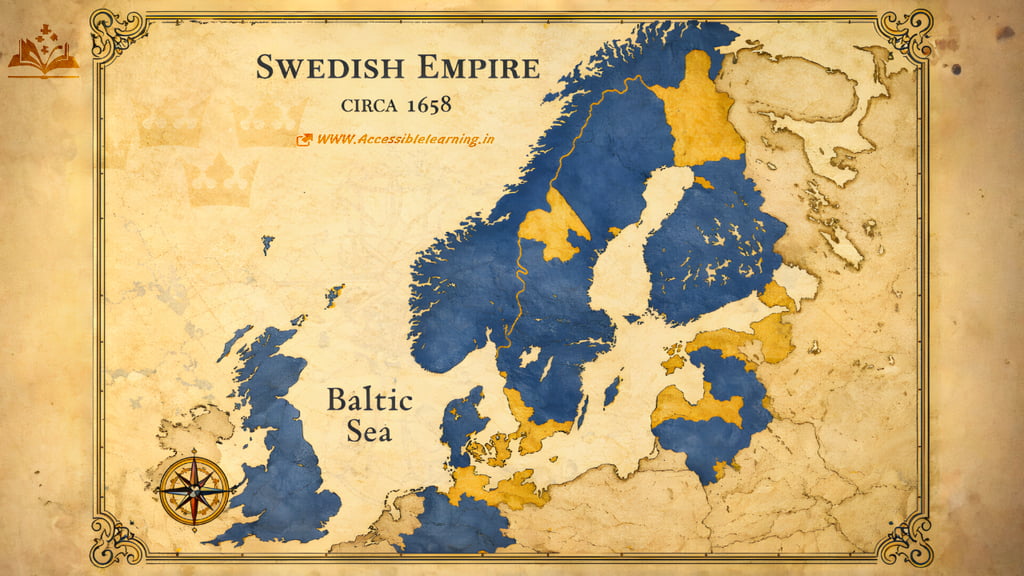
At its territorial zenith around 1658, the Swedish Empire commanded approximately 1 million square kilometers, including modern-day Sweden, Finland, Estonia, Latvia, parts of northwestern Russia, northern Germany, and portions of Poland. For perspective, this empire was ruled by a nation whose population never exceeded 2.5 million people—a remarkable feat of military efficiency and strategic positioning.
The Foundation: How Did Sweden Become an Empire?
Gustavus Adolphus: The Architect of Swedish Power
The transformation began under King Gustavus Adolphus (ruled 1611-1632), often called "The Lion of the North." He inherited a kingdom at war with Denmark, Poland, and Russia simultaneously. Rather than succumbing to these pressures, Gustavus Adolphus revolutionized Swedish military capabilities through:
Military Innovations:
Introduction of lighter, more mobile artillery that could be repositioned during battle
Development of disciplined linear infantry tactics combining pike and shot
Creation of Europe's first truly professional, well-trained standing army
Implementation of combined arms tactics coordinating infantry, cavalry, and artillery
Standardization of equipment and systematic military training
Administrative Reforms:
Reorganization of tax collection to fund military expansion
Development of efficient bureaucratic systems
Establishment of copper and iron mining as revenue sources
Creation of the Swedish East India Company (1731, though planned earlier)
The Thirty Years' War: Sweden's European Breakthrough
Sweden's intervention in the Thirty Years' War (1618-1648) marked its emergence as a continental power. Gustavus Adolphus entered the conflict in 1630, ostensibly to protect Protestant interests but strategically to secure Swedish dominance around the Baltic Sea.
Key Achievements
Decisive victories at Breitenfeld (1631) and Lützen (1632)
Control of German territories providing strategic depth and economic resources
The Peace of Westphalia (1648) granted Sweden substantial German territories, including Western Pomerania, Wismar, and the bishoprics of Bremen and Verden
Recognition as a guarantor power of the Westphalian settlement, giving Sweden legal authority in European affairs
Territorial Expansion: The Empire at Its Peak
The Baltic Sea as "Sweden's Lake"
By the mid-17th century, Sweden had effectively transformed the Baltic Sea into a Swedish-controlled waterway, a strategic achievement with profound economic and military implications.
Swedish Baltic Territories (circa 1658):
Eastern Baltic
Estonia (conquered 1561-1629)
Livonia (modern Latvia, acquired through various treaties)
Ingria (northwestern Russia, including the future site of St. Petersburg)
Karelia (southeastern Finland and northwestern Russia)
Southern Baltic
Swedish Pomerania (northeastern Germany)
Wismar (important port city)
Bremen-Verden (controlling the Weser and Elbe estuaries)
Scandinavian Acquisitions
Scania, Halland, Blekinge (southern Sweden, taken from Denmark in 1658)
Bohuslän (western coast)
Gotland (Baltic island)
Economic Foundations of Empire
Sweden's imperial ambitions were supported by:
Natural Resources
Copper from Falun (Sweden supplied two-thirds of European copper in the 17th century)
High-quality iron ore from central Sweden
Vast timber resources for shipbuilding
Control of Baltic trade routes and toll collection
Strategic Trade Control
Domination of grain exports from Poland and the eastern Baltic
Control of naval stores (tar, pitch, hemp) essential for European navies
Taxation of trade passing through Swedish-controlled ports

Military Excellence: Why Was the Swedish Army So Effective?
The Swedish military achieved a reputation that exceeded the nation's actual size through systematic innovation and professionalization.
The Swedish Military System
Organizational Structure:
The indelningsverk system (allocation system) provided soldiers with farms in exchange for military service
Professional officer corps with formal military education
Standardized regimental organization across the army
Merit-based promotion system (revolutionary for the era)
Tactical Innovations:
Reduction of pike-to-musket ratio from 2:1 to 1:2, increasing firepower
Three-rank firing lines allowing continuous volleys
Aggressive offensive doctrine emphasizing shock and momentum
Integration of light cavalry (reiters) with heavy cavalry charges
Mobile artillery that could advance with infantry
Superior Logistics:
Magazine system for supply storage
Living off the land with organized foraging
Efficient administrative support for armies in the field
Notable Military Commanders
Beyond Gustavus Adolphus, Sweden produced exceptional military leadership:
Lennart Torstenson: Artillery innovator who continued Swedish successes after Gustavus Adolphus's death
Carl Gustaf Wrangel: Commander during latter stages of Thirty Years' War
Charles X Gustav: Led aggressive campaigns against Poland and Denmark
Charles XII: Perhaps the most tactically brilliant but strategically reckless Swedish king
The Great Northern War: Beginning of the End
Charles XII and the Carolinian Absolutism
Charles XII (ruled 1697-1718) ascended the throne at age 15 and immediately faced a coalition of enemies in the Great Northern War (1700-1721). Initially, his military genius seemed to vindicate aggressive Swedish policies:
Early Victories:
Battle of Narva (1700): 8,000 Swedes defeated 37,000 Russians in a snowstorm
Victories in Poland forced the dethroning of Augustus II
Defeated Danish and Saxon forces repeatedly
The Catastrophic Russian Campaign
Charles XII's decision to invade Russia in 1708 proved disastrous:
The Campaign:
Advance into Ukraine expecting support from Cossack hetman Mazepa
Harsh winter of 1708-1709 (one of the coldest in centuries) decimated the army
Russian scorched-earth tactics denied supplies
Battle of Poltava (June 1709): Decisive Russian victory destroyed Swedish military power
Consequences:
Charles XII fled to Ottoman territory for five years
Swedish Baltic territories became vulnerable to reconquest
Russia emerged as the new dominant Baltic power under Peter the Great
Coalition of enemies (Russia, Denmark, Saxony, Prussia, Hanover) carved up Swedish territories
The Decline Accelerates
The remainder of Charles XII's reign saw:
Loss of most Baltic territories
Economic exhaustion from constant warfare
Population decline due to military casualties and disease
Charles XII's death in Norway (1718) during yet another military campaign
Treaty of Nystad (1721): Sweden ceded Estonia, Livonia, Ingria, and part of Karelia to Russia
Why Did the Swedish Empire Fall?
Structural Weaknesses
Demographic Limitations:
Population of 2.5 million governing territories with 3-4 million subjects
Unsustainable military casualties (estimated 100,000+ Swedish deaths during Great Northern War)
Inability to replace losses from limited population base
Economic Overextension:
Constant warfare drained copper and iron revenues
Decline in copper prices as new sources emerged globally
Tax burden on Swedish peasantry reached breaking point
Inability to compete with wealthier nations economically
Strategic Vulnerability:
Empire consisted of scattered territories difficult to defend
Growing power of rivals (Russia, Prussia) with larger populations
Dependence on military success for revenue (a vicious cycle)
Political Factors:
Charles XII's absolutism and refusal to compromise
Lack of diplomatic flexibility in coalition wars
Alienation of potential allies through aggressive policies
Rise of Russia
Peter the Great's Russia proved to be Sweden's nemesis:
Larger population (15-16 million vs. Sweden's 2.5 million)
Adoption and improvement of Swedish military innovations
Strategic patience and willingness to learn from defeats
Modernization programs creating a powerful state apparatus
Legacy of the Swedish Empire
Military Influence
Swedish military innovations influenced warfare for generations:
Linear tactics became standard across European armies
Professional military education systems
Combined arms doctrine
Artillery mobility concepts
Political and Cultural Impact
In Sweden:
Frihetstiden (Age of Liberty, 1719-1772) brought parliamentary supremacy and reduced royal power
Cultural flowering despite political decline
Development of Swedish identity tied to imperial past
Neutrality policy emerging from exhaustion with great power politics
In Conquered Territories:
Swedish legal and administrative systems left lasting marks in Baltic states
Lutheran church organization persisted
Swedish-speaking minorities in Finland and Estonia
Architectural heritage in cities like Riga and Tallinn
European Balance of Power:
Sweden's decline created power vacuum filled by Russia and Prussia
Shift in European geopolitics northward and eastward
Demonstration that military excellence alone couldn't sustain empire without economic foundation

Modern Perspectives on the Swedish Empire
Historical Reassessment
Contemporary historians view the Swedish Empire through several lenses:
Revisionist Interpretations:
Questioning the "Golden Age" narrative by examining costs to Swedish society
Analyzing impact on conquered populations
Examining economic exploitation and resource extraction
Comparative studies with other European empires
National Memory:
Central to Swedish national identity despite neutrality policy
Museum exhibitions and historical sites preserving imperial heritage
Ongoing debates about commemoration and historical interpretation
Baltic states' complex relationship with Swedish period (often viewed more positively than Russian or Polish rule)
Archaeological and Material Evidence
Recent archaeological work has uncovered:
Battlefield sites providing insights into 17th-century warfare
Shipwrecks like the Kronan (1676) revealing naval technology
Fortification systems across former territories
Material culture showing Swedish influence on Baltic societies
Lessons from the Swedish Empire
The Swedish Empire's rise and fall offers profound insights into the nature of power in international relations. A small, resource-constrained nation achieved remarkable success through innovation, organization, and strategic timing, demonstrating that military excellence and administrative efficiency can temporarily overcome demographic and economic limitations.
However, the empire's collapse equally demonstrates that such advantages cannot indefinitely compensate for fundamental disparities in population and wealth. Sweden's attempt to maintain great power status against larger rivals—particularly Russia—proved unsustainable, leading to catastrophic military defeat and territorial losses.
Today, as Sweden has abandoned imperial ambitions in favor of neutrality (now evolving with NATO membership considerations), the empire period remains a formative chapter in Swedish identity. The legacy of Stormaktstiden—both its achievements and its costs—continues to shape how Sweden understands its place in the world, balancing pride in historical accomplishments with recognition of the ultimate futility of small-nation imperialism.
For students of history, the Swedish Empire provides a compelling case study in military innovation, strategic overreach, and the limits of power—lessons that remain relevant in understanding international relations today.
Frequently Asked Questions
Q: How long did the Swedish Empire last?
The Swedish Empire's great power period (Stormaktstiden) lasted from approximately 1611 to 1721—110 years. The beginning is marked by Gustavus Adolphus's accession and military reforms, while the end is formalized by the Treaty of Nystad in 1721, which ceded most Baltic territories to Russia following the Great Northern War.
Q: What was the largest extent of the Swedish Empire?
At its territorial peak around 1658, following the Treaty of Roskilde with Denmark, the Swedish Empire controlled approximately 1 million square kilometers, including modern Sweden, Finland, Estonia, Latvia, parts of northwestern Russia, portions of northern Germany, and areas of present-day Poland. This made it one of the largest European states by territory, though not by population.
Q: Why was Sweden so powerful in the 17th century despite its small population?
Sweden's power derived from military innovation rather than population size. Key factors included revolutionary tactical reforms by Gustavus Adolphus, Europe's first professional standing army, superior artillery mobility, efficient tax collection and administration, strategic control of Baltic trade routes, and revenue from copper and iron mining. The Swedish military system emphasized quality, training, and tactical sophistication over numerical superiority.
Q: Who was the greatest Swedish king during the empire period?
Most historians consider Gustavus Adolphus (1611-1632) the greatest Swedish monarch. He transformed Sweden from a regional power into a European great power, revolutionized military tactics, intervened decisively in the Thirty Years' War, and established administrative systems that sustained Swedish power for generations. While Charles XII demonstrated tactical brilliance, his strategic failures led to the empire's collapse.
Q: What caused the fall of the Swedish Empire?
The Swedish Empire fell due to a combination of factors: catastrophic defeat at the Battle of Poltava (1709) against Russia, demographic limitations preventing replacement of military losses, economic exhaustion from constant warfare, the rise of Russia as a superior Baltic power, strategic overextension across scattered territories, and Charles XII's inflexible military absolutism. The Great Northern War (1700-1721) proved Sweden could not sustain an empire against larger, wealthier opponents.
Q: How did the Swedish Empire treat conquered peoples?
Swedish rule varied by region but generally maintained existing local elites and legal systems while imposing Swedish administrative oversight. In the Baltic provinces, Swedish rule brought legal reforms, reduced serfdom somewhat, and established Swedish as the administrative language alongside German. Protestant conversion efforts were pursued in Catholic areas. Compared to contemporaneous empires, Swedish rule was relatively bureaucratic and legalistic, though still extractive economically. Baltic populations often viewed Swedish rule more favorably than subsequent Russian rule.
Q: What role did religion play in the Swedish Empire?
Religion was central to Swedish imperial identity and expansion. Sweden championed Protestant (Lutheran) causes during the Thirty Years' War, with Gustavus Adolphus portrayed as the defender of Protestantism against Catholic Habsburg forces. The Swedish state church was closely tied to royal authority, and Lutheran orthodoxy was enforced in Swedish territories. Religious justifications helped legitimize territorial expansion, particularly in the Baltic region. However, pragmatic political considerations often overrode purely religious motivations.
Q: How does modern Sweden remember its imperial past?
Modern Sweden has a complex relationship with its imperial history. While the empire period remains important to national identity and is taught in schools, Sweden's modern neutrality policy and social democratic values create tension with militaristic imperial narratives. Museums like the Army Museum in Stockholm preserve this heritage, and sites like the Vasa warship attract millions of visitors. However, there's increasing scholarly attention to the costs of empire and experiences of conquered peoples, moving beyond triumphalist narratives.
Subscribe To Our Newsletter
All © Copyright reserved by Accessible-Learning Hub
| Terms & Conditions
Knowledge is power. Learn with Us. 📚

