

The Spanish Empire: How Cerro Rico's Silver Mountain Built the First Global Economy
Discover the shocking true story of Cerro Rico in Potosí, Bolivia, the mountain that produced 60% of the world's silver, fueled the Spanish Empire, shaped the first global economy, and may have inspired the modern dollar sign.
HISTORYEMPIRES/HISTORYSPANISH
Valeria González Torres
8/1/202611 min read


A Single Mountain Produced So Much Silver That It Changed the World's Economy Forever
Imagine standing in front of one mountain that supplied around 60% of the world's silver during the 16th century. Imagine that the coins dug from its depths traveled across Europe, Africa, the Americas, India, China, and even Japan, becoming the closest thing the world had ever seen to a universal currency.
Now imagine that this wealth came at such an unimaginable human cost that miners began praying to a devil underground because they believed God had abandoned the mines.
That mountain was Cerro Rico ("Rich Mountain") in Potosí, present-day Bolivia. It helped create the first truly global economy, financed Spain's empire, fueled Asian trade, and may even have influenced the symbol you see every day on prices around the world: the dollar sign ($).
Quick Facts
Location: Cerro Rico, Potosí, modern-day Bolivia
Silver discovered: 1545
Empire: Spanish Empire
Peak output: Around 60% of the world's silver during much of the 16th century
Economic impact: Powered the first large-scale global trading network connecting Europe, the Americas, Africa, and Asia
Famous coin: The Spanish Piece of Eight (8 Reales)
Possible origin of "$": The intertwined P and S mint mark from Potosí is one of several historical theories for the dollar sign's evolution
Mining system: Forced Indigenous labor through the Mita, later supplemented by enslaved Africans
Working conditions: Toxic mercury, cave-ins, dust inhalation, starvation, and exhaustion
Religious tradition: Miners still leave alcohol, cigarettes, coca leaves, and offerings for El Tío, the underground spirit believed to control the mines
What Was Cerro Rico, and Why Was It Called "The Mountain That Ate Men"?
It earned that name because it produced unimaginable wealth while consuming countless human lives.
In 1545, Indigenous miner Diego Huallpa reportedly discovered extraordinarily rich silver deposits inside a mountain towering over the Andean plateau. Spanish authorities quickly realized they had stumbled upon one of the richest mineral discoveries in recorded history.
Within decades, a remote mountain settlement exploded into one of the largest cities anywhere on Earth. By around 1600, Potosí's population may have reached 160,000 to 200,000 people, rivaling or exceeding many major European capitals.
Everything revolved around one thing.
Silver.
Not gold.
Not spices.
Not silk.
Silver became the fuel powering an empire.
Why Was So Much Silver Hidden Inside One Mountain?
Because Cerro Rico was the product of unusual geological processes over millions of years.
Ancient volcanic activity concentrated exceptionally rich silver ores beneath the mountain. Early miners barely needed advanced equipment because some veins were so pure that chunks of silver could reportedly be extracted almost directly from exposed rock.
Spanish officials realized these deposits weren't just valuable.
They were economically transformative.
Soon, roads, mills, refineries, churches, warehouses, and entire neighborhoods appeared almost overnight around the mountain.
Potosí became one of history's fastest-growing boomtowns.
How Much Silver Actually Came Out of Cerro Rico?
An astonishing amount.
Historians estimate that during much of the 1500s, around 60% of global silver production came from Spanish America, with Potosí serving as its greatest source.
Millions upon millions of silver coins flowed out every year.
Some estimates suggest the mines ultimately produced over 45,000 metric tons of silver across centuries, though exact totals remain debated because of smuggling and incomplete records.
Spain suddenly controlled the world's largest supply of precious metal.
That wealth reshaped international commerce.
Why Did One Mountain Create the First Global Economy?
Because silver became the world's favorite payment method. Before modern banking, international trade had one persistent problem.
Everyone trusted different currencies.
Spanish silver solved that.
Merchants across continents accepted Spanish coins because they contained consistent amounts of high-quality silver.
A shipment might begin in Bolivia.
It crossed the Andes.
It reached Pacific or Atlantic ports.
It sailed to Europe.
Some coins paid soldiers.
Others bought African goods.
Others crossed the Pacific aboard the famous Manila Galleons to purchase Chinese silk, porcelain, tea, and luxury goods.
One mountain effectively connected:
South America
Europe
Africa
North America
India
Southeast Asia
China
Japan
Long before globalization became a buzzword, silver had already connected the planet.


What Made the Piece of Eight the World's First Global Currency?
Because nearly everyone trusted it.
The Spanish 8 Reales, better known as the Piece of Eight, became the preferred international trade coin for centuries.
Its reputation came from the following:
Reliable silver content
Standardized weight
Consistent purity
Massive production
Merchants from London to Canton accepted these coins with little hesitation.
Even after Spain's dominance faded, the Piece of Eight remained widely circulated. In fact, it strongly influenced the early monetary systems of the United States and many other nations.
Did the Dollar Sign Really Come from Potosí?
Possibly, and it's one of history's most fascinating debates.
The mint at Potosí stamped many coins with an intertwined "P" over "S" mark, indicating the city's mint.
Some historians argue that repeated handwritten abbreviations gradually evolved into the familiar "$" symbol.
Another long-standing theory suggests the symbol evolved from the abbreviation "Ps" for pesos.
Others trace it to overlapping letters used in Spanish accounting.
No single explanation has universal agreement.
However, the connection between Spanish silver, the peso, and the modern dollar symbol is well documented enough that Potosí remains central to discussions about the symbol's history.
Even if the exact origin remains debated, the world's money icon almost certainly owes something to the silver economy Spain built.
Who Actually Dug Out All That Silver?
Mostly people who had almost no choice.
The Spanish revived and expanded an existing Inca labor draft known as the Mita.
Entire Indigenous communities had to send workers into the mines for fixed periods each year.
Many traveled hundreds of kilometers from their homes.
Conditions were horrifying.
As richer ore became harder to reach, tunnels grew deeper, narrower, and more unstable.
Workers spent endless hours underground breathing toxic dust with almost no sunlight.
When Indigenous labor proved insufficient, enslaved Africans were also brought into the mining economy, particularly for refining operations and other demanding work.
The empire's prosperity rested on forced labor.
Why Were the Mines So Deadly?
Because nearly every part of the process could kill you. The dangers included:
Mercury Poisoning
Extracting silver increasingly relied on the patio process, which mixed crushed ore with mercury.
Workers handled mercury directly.
Long-term exposure damaged the nervous system, lungs, kidneys, and brain.
Collapsing Tunnels
Wood supports frequently failed.
Entire sections could collapse without warning.
Some workers were buried alive.
Others suffocated.
Thin Air
Potosí sits over 4,000 meters (13,000 feet) above sea level.
Even walking there can be exhausting.
Mining heavy rock for long hours at that altitude pushed the human body to its limits.
Silica Dust
Constant drilling filled tunnels with microscopic dust that destroyed lungs over time.
Many miners slowly suffocated from occupational lung disease.
Exhaustion
Workers often endured extremely long shifts with poor food, little sleep, freezing temperatures, and relentless physical labor.
Death became an expected part of mining life.
Why Did Miners Worship a Devil Underground?
Because they believed the mountain belonged to him. Deep inside Cerro Rico, miners created statues of El Tío, a horned underground spirit combining Indigenous beliefs with imagery introduced during Spanish colonization.
To outsiders, El Tío resembles the Christian Devil.
To miners, the figure serves a different purpose.
He is the guardian of the underground.
They believe he controls:
Rich veins of ore
Cave-ins
Survival
Good fortune
Death
Before entering dangerous tunnels, miners traditionally leave the following:
Pure alcohol
Coca leaves
Cigarettes
Candles
Dynamite
The offerings are requests for safe passage. Remarkably, this tradition continues in parts of the mines today.

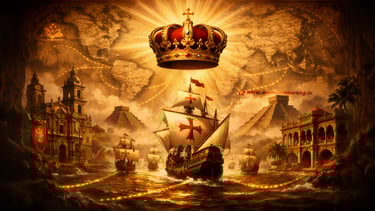
Did Spain Become Rich Because of All This Silver?
Yes, but the story has a surprising twist. Spain received extraordinary wealth.
Kings financed:
Massive armies
Naval fleets
Religious wars
Palaces
Imperial expansion
Yet flooding Europe with silver also triggered one of history's largest inflationary episodes. Prices across Europe rose dramatically during the Price Revolution of the 16th and early 17th centuries.
More money entered circulation than economies could easily absorb.
Silver made Spain powerful.
It also contributed to economic instability that later weakened the empire.
More money didn't automatically create lasting prosperity.
Why Did China Want So Much Spanish Silver?
Because China's economy increasingly demanded silver for taxes and commerce. During the Ming Dynasty, tax reforms required many payments to be made in silver.
That created enormous demand.
Spanish merchants shipped American silver across the Pacific aboard the Manila Galleons.
Chinese merchants exchanged silk, porcelain, lacquerware, and other luxury products for silver.
The result was an enormous trans-Pacific trade network unlike anything the world had previously experienced.
Potosí wasn't simply supplying Europe.
It was helping fuel Asia's economy as well.
Why Was Potosí Called "The Treasure House of the World"?
During the late 1500s and early 1600s, Potosí became one of the wealthiest cities on Earth. Spanish chroniclers often described it as a place where fortunes could be made overnight. The city featured grand churches, lavish mansions, theaters, universities, and markets stocked with luxury goods imported from Europe and Asia.
The wealth became so legendary that the Spanish expression "vale un Potosí" ("worth a Potosí") entered everyday language. Even today, the phrase means something of extraordinary value.
Ironically, the people creating that wealth rarely benefited from it.
How Did Engineers Build an Industrial City at 4,000 Meters?
Potosí was far more than a mining camp. It became one of the world's earliest large-scale industrial centers.
Spanish administrators constructed an impressive hydraulic system that included more than twenty artificial reservoirs in the surrounding mountains. Water from these reservoirs powered over one hundred ore-crushing mills, allowing miners to process silver on a scale that had never been seen before.
This network turned the high Andes into a massive industrial complex centuries before the Industrial Revolution.
Why Was Mercury Almost as Important as Silver?
Silver extraction changed dramatically after rich surface ores became scarce.
Beginning in the late 16th century, miners increasingly relied on the patio process, which used mercury to separate silver from lower-grade ores. Much of this mercury came from the Spanish-controlled mines at Huancavelica in present-day Peru.
Without this steady mercury supply, Cerro Rico's enormous silver output would have declined much earlier.
Historians sometimes describe Potosí and Huancavelica as two halves of the same economic machine: one produced silver, the other supplied the chemical needed to extract it.
Why Did Smuggling Become a Massive Business?
Not every silver bar made it into Spanish records.
Merchants, mine owners, officials, and sailors frequently smuggled silver to avoid royal taxes. Some historians estimate that illegal exports accounted for a substantial share of total production.
This hidden economy enriched private traders while reducing the Spanish Crown's tax revenue, making it difficult to calculate the mountain's true lifetime output.
How Did Pirates Benefit from Potosí's Silver?
Cerro Rico indirectly fueled the Golden Age of Piracy. Spanish treasure fleets carrying American silver became prime targets for English, Dutch, and French privateers and pirates.
Famous raiders such as Francis Drake attacked Spanish shipping, hoping to seize cargoes ultimately sourced from the mines of the Andes.
In many ways, Potosí financed both Spain's empire and the enemies trying to dismantle it.
Why Did So Many Empires Depend on One Metal?
Silver became the backbone of international commerce because it was trusted almost everywhere.
Unlike many regional currencies, silver had intrinsic value based on its weight and purity. Merchants from vastly different cultures could trade without sharing the same political system or language.
Long before international banking networks existed, silver functioned as a common economic language.

What Happened After the Silver Boom Ended?
Cerro Rico never suddenly "ran out." Instead, production gradually declined as miners exhausted the richest veins and extraction became increasingly expensive.
By the eighteenth century, other mining regions became more competitive, and Spain's dominance in global silver production weakened.
Potosí remained an important mining city, but it never again reached the extraordinary influence it held during the sixteenth and early seventeenth centuries.
Has Modern Science Changed What We Know About Cerro Rico?
Yes. Archaeologists, geologists, and economic historians continue to study the mountain using modern techniques.
Recent research has improved estimates of production levels, trade routes, labor systems, and environmental damage. Scientists have also documented how centuries of tunneling have destabilized the mountain, confirming concerns that extensive mining has permanently altered its internal structure.
The story of Cerro Rico is still evolving as new evidence emerges.
Did Cerro Rico Leave a Lasting Environmental Impact?
Absolutely.
Centuries of mining left behind contaminated soil, polluted waterways, abandoned tunnels, and widespread mercury residues.
Although environmental standards have improved compared with the colonial period, pollution from historical mining continues to affect surrounding communities.
Cerro Rico is not only an archaeological landmark but also an enduring environmental challenge.
Could the Spanish Empire Have Become a Superpower Without Potosí?
Probably not on the same scale.
While Spain already possessed military strength and overseas colonies, the immense flow of silver from Potosí gave the Crown financial resources unmatched by most European rivals.
That wealth supported imperial expansion for generations, even if much of it was ultimately spent on wars, debts, and imports rather than long-term domestic development.

Is Cerro Rico Still Being Mined Today?
Yes, although far less productively than before. After centuries of extraction, the mountain has become structurally unstable.
Large sections have collapsed.
Sinkholes have appeared near the summit.
Mining continues on a smaller scale, and concerns remain about worker safety and the mountain's long-term stability.
UNESCO has listed Potosí as a World Heritage Site, while also expressing concern over ongoing deterioration.
The mountain that once seemed inexhaustible has been physically hollowed out.
What Are the Biggest Myths About Cerro Rico?
"Everyone agrees millions died."
No. The exact death toll remains impossible to verify. Contemporary accounts and later writers have cited figures reaching into the millions over centuries, but historians debate these estimates because reliable records are incomplete. What is beyond dispute is that the mines caused an enormous loss of life through forced labor, disease, accidents, and toxic exposure.
"Spain kept all the silver."
Not even close.
Much of it flowed almost immediately into international trade, debt payments, military expenses, and Asian commerce.
"The mountain is empty."
Not entirely.
Mining continues today, although remaining ore is far less accessible than during its richest years.
Why This Matters Today
The smartphone in your pocket depends on minerals mined across multiple continents.
Electric vehicles rely on lithium, cobalt, nickel, and rare earth elements extracted through global supply chains.
Financial markets move trillions of dollars every day using currencies backed by confidence rather than precious metals.
More than 450 years ago, Cerro Rico offered an early version of that interconnected world. One resource, extracted in one place, influenced economies thousands of miles away. Wealth flowed through shipping routes, governments, banks, and merchants, while the hardest physical labor remained largely invisible to the people spending the money.
Potosí reminds us that globalization did not begin with the internet or container ships. It began when a mountain in the Andes became the engine of a worldwide economy. Its silver helped finance empires, linked Europe with Asia and the Americas, shaped international trade, and may even have left its mark on the symbol that represents money today.
The story of Cerro Rico is not just about extraordinary riches. It is also a reminder that every global economy has a source, and every source has a human story behind it.
FAQ's
Q: Where is Cerro Rico located today?
Cerro Rico overlooks the city of Potosí in modern-day Bolivia, sitting more than 4,000 meters (13,000 feet) above sea level in the Andes Mountains.
Q: Why is Cerro Rico called the "Rich Mountain"?
The Spanish named it Cerro Rico, meaning "Rich Mountain," because of its exceptionally rich silver deposits discovered in 1545.
Q: How much of the world's silver came from Potosí?
During much of the sixteenth century, historians estimate that Potosí accounted for roughly 60% of global silver production, making it the most productive silver mine of its era.
Q: Is the dollar sign ($) definitely from Potosí?
No. It remains a debated historical question. One respected theory links the symbol to the intertwined P and S used on Potosí mint marks, while others connect it to handwritten abbreviations for peso or Spanish pesos. There is no universal scholarly agreement.
Q: What was "El Tío"?
El Tío is the supernatural guardian of the mines in Bolivian mining tradition. Miners continue to leave offerings such as alcohol, coca leaves, and cigarettes in hopes of receiving protection underground.
Q: Are people still mining Cerro Rico?
Yes. Mining continues today on a much smaller scale, although concerns remain about worker safety and the mountain's structural stability after centuries of excavation.
Q: Why did China buy so much Spanish silver?
During the Ming Dynasty, silver became essential for taxation and commerce. This created enormous demand, making Spanish American silver one of the world's most sought-after commodities.
Q: Why is Cerro Rico important to world history?
Cerro Rico helped finance the Spanish Empire, accelerated global trade, connected economies across four continents, influenced international currency systems, and became one of the foundations of the first truly globalized economy. Its history also serves as a powerful reminder of the immense human and environmental costs that often accompany extraordinary wealth.
Subscribe To Our Newsletter
All © Copyright reserved by Accessible-Learning Hub
| Terms & Conditions
Knowledge is power. Learn with Us. 📚

