

The Skills Economy: Why Micro-Credentials Are Beating Degrees in 2026
The Skills Economy is transforming hiring in 2026. Discover why micro-credentials, digital badges, and skills-based hiring are gaining more value than traditional degrees, and learn which high-income skills can help you stay competitive in the modern job market.
PSYCHOLOGY & COGNITIVE SCIENCEACCESSIBLE LEARNING
Shiv Singh Rajput
6/12/20268 min read
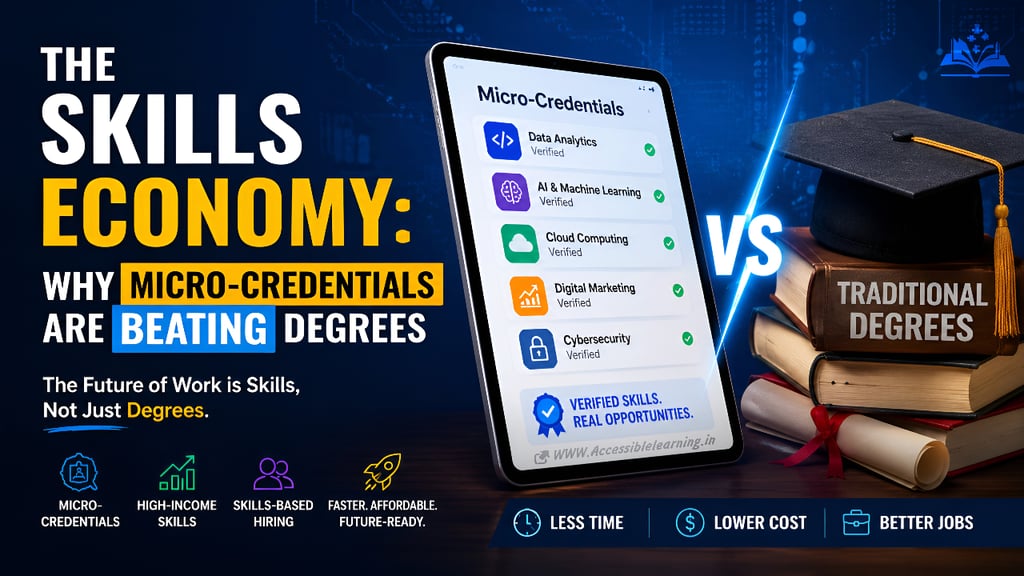
Why Employers in 2026 Care More About Your Digital Badges Than Your Degree
For decades, the formula for career success seemed simple: earn a college degree, build experience, and climb the professional ladder. But in 2026, that formula is changing faster than ever.
A growing number of employers are no longer asking where candidates went to school first. Instead, they're asking a different question:
What can you actually do right now?
This shift has fueled the rise of the Skills Economy, a labor market where practical abilities, verified competencies, and industry-recognized micro-credentials often matter more than traditional academic qualifications.
Digital badges, professional certificates, skill assessments, and specialized training programs are becoming powerful indicators of job readiness. Companies need talent that can contribute immediately, and micro-credentials provide a faster, more transparent way to validate those skills.
As technology evolves and industries transform, workers are discovering that they no longer need to spend four years and accumulate massive debt to build valuable careers. Instead, they can acquire targeted skills, earn verifiable credentials, and enter high-paying fields in a fraction of the time.
This transformation is redefining education, hiring, and career development worldwide.
What Is the Skills Economy?
The Skills Economy refers to a labor market where hiring decisions are increasingly based on demonstrated abilities rather than traditional educational backgrounds.
Instead of focusing primarily on degrees, employers evaluate candidates based on:
Technical skills
Industry certifications
Portfolio projects
Digital badges
Micro-credentials
Work samples
Practical assessments
Continuous learning achievements
In this environment, employers care less about where knowledge was acquired and more about whether a candidate can apply that knowledge effectively.
For example, a company hiring a digital marketer may prioritize certifications in:
Google Ads
Analytics
SEO
AI-powered marketing tools
Conversion optimization
over a general business degree that may not reflect current industry requirements. The result is a more dynamic workforce where skills can be acquired, updated, and verified continuously.
What Are Micro-Credentials?
Micro-credentials are short, focused educational programs designed to validate specific skills or competencies. Unlike traditional degrees, which cover broad academic subjects over several years, micro-credentials target a particular area of expertise.
Examples include:
Data Analytics Certifications
AI Prompt Engineering Credentials
Cloud Computing Certificates
Cybersecurity Training Programs
UX/UI Design Certifications
Project Management Certifications
Digital Marketing Credentials
Programming Certifications
Most micro-credentials can be completed within:
A few days
Several weeks
A few months
rather than years.
Once completed, learners often receive:
Digital badges
Verifiable certificates
Skill endorsements
Portfolio-ready projects
These credentials can be displayed on resumes, professional profiles, portfolios, and job applications.

Why Traditional Degrees Are Losing Their Absolute Authority
Degrees are not disappearing. Many professions still require formal education, especially fields such as:
Medicine
Law
Engineering
Scientific Research
However, in many technology-driven and digital industries, employers are questioning whether a degree alone adequately prepares candidates for modern workplace demands. Several factors are driving this change.
1. Technology Evolves Faster Than University Curriculums
Academic programs often take years to update course structures.
Meanwhile, industries such as:
Artificial Intelligence
Digital Marketing
Data Science
Software Development
Cloud Infrastructure
can change dramatically within months. Micro-credential providers can update training programs almost immediately to reflect industry trends and employer needs.
2. Skills Gaps Are Growing
Businesses are struggling to find workers with job-ready skills.
Many graduates possess theoretical knowledge but lack practical experience with current tools and technologies.
Micro-credentials help bridge this gap by focusing directly on workplace applications.
3. Student Debt Is a Major Concern
Higher education costs continue to rise globally. Many individuals are looking for alternative pathways that provide the following:
Faster employment
Lower financial risk
Immediate income opportunities
Micro-credentials often cost a fraction of a traditional degree while delivering highly marketable skills.
4. Employers Need Faster Hiring Solutions
Organizations can no longer afford lengthy recruitment cycles. Hiring managers increasingly rely on skill-based hiring models that focus on the following:
Proven competencies
Certifications
Portfolio evidence
Practical assessments
This approach helps reduce hiring risks and improve workforce productivity.
Why Employers Trust Digital Badges
Digital badges have become a powerful form of professional verification. Unlike traditional resumes, digital badges can provide evidence of the following:
Completed coursework
Skill mastery
Assessment results
Project completion
Ongoing professional development
Employers appreciate digital badges because they offer greater transparency. A degree may indicate broad educational achievement, but a badge can show specific expertise in the following:
Machine Learning
Search Engine Optimization
Data Visualization
Cloud Security
Automation Workflows
This level of detail helps recruiters identify candidates with the exact skills required for a role.
The Rise of Skills-Based Hiring
One of the biggest workforce trends of 2026 is skills-based hiring. Instead of filtering applicants primarily by educational credentials, employers evaluate the following:
Competencies
Certifications
Demonstrated performance
Technical proficiency
This shift is particularly evident in the following:
Technology
Marketing
Design
Sales
Customer Experience
Product Management
Data Analytics
Companies are increasingly discovering that exceptional talent can come from non-traditional educational backgrounds. As a result, skill validation is becoming more important than educational pedigree.


High-Income Skills Driving the Skills Economy
Many professionals are searching for skills that can generate significant earning potential without requiring years of formal education. Some of the most in-demand high-income skills in 2026 include:
Artificial Intelligence Skills
Growing demand exists for professionals who can:
Build AI workflows
Create automation systems
Engineer prompts
Integrate AI tools into business operations
Data Analytics
Organizations rely heavily on data-driven decision-making. Skills in:
SQL
Data Visualization
Business Intelligence
Analytics Platforms
remain highly valuable.
Digital Marketing
Businesses continuously seek experts in:
SEO
Content Marketing
Paid Advertising
Conversion Optimization
Marketing Automation
Cybersecurity
The rise in cyber threats has created strong demand for professionals skilled in:
Security Analysis
Risk Assessment
Network Protection
Compliance Management
Cloud Computing
Cloud infrastructure expertise continues to command premium salaries. Key areas include:
Cloud Architecture
DevOps
Infrastructure Automation
Platform Administration
UX/UI Design
Companies compete through user experience. Designers with expertise in:
User Research
Interface Design
Prototyping
Accessibility
remain highly sought after.
Best Platforms Offering Valuable Micro-Credentials
Several online learning platforms have become major contributors to the Skills Economy. Popular options include:
Coursera
Offers industry-recognized certificates from universities and major corporations.
Udemy
Provides practical, affordable skill-based training across thousands of topics.
LinkedIn Learning
Focuses on business, technology, and creative skills with professional integration.
Google Career Certificates
Provides job-focused training in areas such as:
IT Support
Data Analytics
Project Management
Cybersecurity
Microsoft Learn
Offers credentials focused on cloud computing, AI, and enterprise technologies.
HubSpot Academy
Well known for certifications in:
Digital Marketing
Sales
Customer Relationship Management
AWS Training
Provides cloud computing certifications that are highly respected by employers.
How to Build a Career Using Micro-Credentials
Success in the Skills Economy requires more than collecting certificates. A strategic approach includes:
Step 1: Choose a Marketable Skill
Focus on areas with strong employer demand and long-term growth potential.
Step 2: Earn Recognized Certifications
Select credentials respected by employers within your target industry.
Step 3: Build Real Projects
Practical experience remains essential. Create:
Case studies
Portfolio projects
Freelance work
Personal experiments
to demonstrate capability.
Step 4: Showcase Credentials Publicly
Display certifications and digital badges on:
Professional profiles
Personal websites
Online portfolios
Job applications
Step 5: Continue Learning
The Skills Economy rewards continuous improvement.
Professionals who regularly update their knowledge remain competitive as industries evolve.

Are Degrees Still Valuable?
Absolutely. Degrees continue to provide benefits such as:
Broad foundational knowledge
Critical thinking development
Professional networking
Academic credibility
However, the modern reality is that degrees alone are often no longer enough. Employers increasingly expect candidates to combine formal education with practical, up-to-date skills.
The strongest professionals in 2026 often possess both:
Educational credentials
Verifiable micro-credentials
This combination creates a powerful competitive advantage.
The Future of Education and Employment
The rise of the Skills Economy represents a fundamental shift in how talent is evaluated. Education is becoming more flexible, personalized, and skills-focused.
Employers are prioritizing proven capability over traditional signals of competence. Workers are gaining greater control over their career development by acquiring targeted skills exactly when needed.
As artificial intelligence, automation, and digital transformation continue reshaping industries, the demand for continuous learning will only increase.
The professionals who thrive in the coming decade will not necessarily be those with the most degrees. They will be the individuals who can demonstrate relevant skills, adapt quickly, and continuously evolve with the changing needs of the market.
The era when a single degree guaranteed lifelong career security is fading. In its place, a new model is emerging where skills, certifications, digital badges, and practical expertise carry increasing weight.
Micro-credentials are not replacing education entirely. Instead, they are redefining how people gain credibility, demonstrate competence, and access career opportunities.
For anyone looking to enter a high-growth industry, switch careers, or stay competitive in a rapidly evolving workforce, investing in verifiable skills may be one of the smartest career decisions available today.
In the Skills Economy of 2026, what you can prove often matters more than what you can claim.
FAQ's
Q: What is the Skills Economy?
The Skills Economy is a workforce model where employers prioritize proven skills, certifications, portfolios, and practical experience over traditional educational credentials alone. Hiring decisions are increasingly based on what candidates can do rather than where they studied.
Q: What are micro-credentials?
Micro-credentials are short, focused learning programs that validate specific skills or competencies. They typically result in a digital certificate or badge that demonstrates expertise in a particular subject, such as data analytics, cybersecurity, digital marketing, or artificial intelligence.
Q: Are micro-credentials better than a college degree?
Micro-credentials are not necessarily better than a degree, but they offer a faster and more affordable way to gain job-relevant skills. In many technology and digital industries, employers increasingly value practical certifications and demonstrable skills alongside or even above traditional academic qualifications.
Q: Do employers recognize micro-credentials?
Yes. Many employers recognize industry-backed certifications and digital badges from respected organizations and learning platforms. Credentials from companies such as Google, Microsoft, AWS, and other major industry leaders are often viewed as evidence of job-ready skills.
Q: Can micro-credentials help me get a high-paying job?
Micro-credentials can improve your chances of securing higher-paying roles, especially in fields such as artificial intelligence, cloud computing, cybersecurity, software development, data analytics, and digital marketing. However, practical experience and portfolio projects remain important factors in hiring decisions.
Q: Which micro-credentials are most valuable in 2026?
Some of the most sought-after micro-credentials in 2026 include certifications in:
Artificial Intelligence (AI)
Cybersecurity
Cloud Computing
Data Analytics
Project Management
Digital Marketing
UX/UI Design
Automation and Workflow Management
Q: How long does it take to earn a micro-credential?
Most micro-credentials can be completed within a few weeks to several months, depending on the complexity of the subject and the learning schedule. This makes them significantly faster than traditional degree programs.
Q: Can micro-credentials replace a university degree?
In some industries, particularly technology and digital fields, micro-credentials can help candidates compete successfully without a traditional degree. However, professions such as medicine, law, and engineering still require formal academic qualifications and licensing.
Q: What is skills-based hiring?
Skills-based hiring is a recruitment approach where employers evaluate candidates based on their abilities, certifications, portfolios, assessments, and practical experience rather than relying primarily on degrees or academic backgrounds.
Q: What is a digital badge, and why does it matter?
A digital badge is a verifiable online credential that confirms a specific skill, achievement, or certification. Employers use digital badges to quickly assess a candidate's expertise and commitment to continuous learning.
Q: What are the best platforms for earning micro-credentials?
Popular platforms include:
Coursera
LinkedIn Learning
Udemy
Google Career Certificates
Microsoft Learn
HubSpot Academy
AWS Training and Certification
These platforms offer industry-relevant training and certifications recognized by many employers.
Q: How do I choose the right micro-credential?
Choose a micro-credential based on:
Current job market demand
Career goals
Industry recognition
Potential salary growth
Practical application of the skills being taught
Focus on certifications that align with your desired career path and have strong employer recognition.
Q: Are micro-credentials worth it in 2026?
For many professionals, micro-credentials are one of the most cost-effective ways to gain in-demand skills and remain competitive in a rapidly evolving job market. They provide flexibility, affordability, and direct relevance to modern workplace needs.
Q: What industries benefit most from micro-credentials?
Micro-credentials are particularly valuable in the following:
Information Technology
Artificial Intelligence
Cybersecurity
Digital Marketing
Data Science
Cloud Computing
Project Management
Design and User Experience
These industries evolve quickly and often prioritize current skills over traditional qualifications.
Q: What is the future of micro-credentials?
The future points toward greater adoption of skills-based hiring, digital credential verification, and lifelong learning. As industries continue to evolve, micro-credentials are expected to play an increasingly important role in helping professionals demonstrate relevant expertise and stay employable.
Q: Can I earn multiple micro-credentials to advance my career?
Yes. Many professionals build a stack of complementary micro-credentials to create a stronger professional profile. For example, combining certifications in AI, data analytics, and project management can make candidates more attractive for leadership and specialized roles.
Q: Do micro-credentials help freelancers and entrepreneurs?
Absolutely. Micro-credentials can help freelancers and business owners demonstrate expertise, build credibility with clients, expand service offerings, and stay competitive in rapidly changing markets.
Q: What is the difference between a certification and a micro-credential?
A certification often validates broader professional knowledge and may require passing an exam. A micro-credential typically focuses on a specific skill or competency and is designed to be completed more quickly. Both can strengthen a professional profile when recognized by employers.
Q: How can I showcase my micro-credentials to employers?
You can display micro-credentials on the following:
Professional networking profiles
Personal websites
Digital portfolios
Resumes
Job applications
Including evidence of real-world projects alongside credentials can further strengthen your profile.
Q: Why is continuous learning important in the Skills Economy?
The Skills Economy rewards professionals who regularly update their knowledge and adapt to changing technologies. Continuous learning helps individuals stay relevant, improve career opportunities, and remain competitive in an increasingly skills-focused job market.
Subscribe to Frontier Intelligence
All © Copyright reserved by Accessible-Learning Hub
Accessible Learning Hub — Actionable clarity for high-agency minds.
Weekly breakdowns on AI breakthroughs, capital flow, and human performance systems. Zero fluff.